Family Drama (2 Samuel 13:37-14:24)

The woman of Tekoa before King David, by Caspar Luiken, 1700

Absalom fled and went to Talmai son of Ammihud, the king of Geshur. But King David mourned many days for his son.

After Absalom fled and went to Geshur, he stayed there three years. And King David longed to go to Absalom, for he was consoled concerning Amnon’s death.

Joab son of Zeruiah knew that the king’s heart longed for Absalom. So Joab sent someone to Tekoa and had a wise woman brought from there. He said to her, “Pretend you are in mourning. Dress in mourning clothes, and don’t use any cosmetic lotions. Act like a woman who has spent many days grieving for the dead. Then go to the king and speak these words to him.” And Joab put the words in her mouth.

When the woman from Tekoa went to the king, she fell with her face to the ground to pay him honor, and she said, “Help me, Your Majesty!”

The king asked her, “What is troubling you?”

She said, “I am a widow; my husband is dead. I your servant had two sons. They got into a fight with each other in the field, and no one was there to separate them. One struck the other and killed him. Now the whole clan has risen up against your servant; they say, ‘Hand over the one who struck his brother down, so that we may put him to death for the life of his brother whom he killed; then we will get rid of the heir as well.’ They would put out the only burning coal I have left, leaving my husband neither name nor descendant on the face of the earth.”

The king said to the woman, “Go home, and I will issue an order in your behalf.”

But the woman from Tekoa said to him, “Let my lord the king pardon me and my family, and let the king and his throne be without guilt.”

The king replied, “If anyone says anything to you, bring them to me, and they will not bother you again.”

She said, “Then let the king invoke the Lord his God to prevent the avenger of blood from adding to the destruction, so that my son will not be destroyed.”

“As surely as the Lord lives,” he said, “not one hair of your son’s head will fall to the ground.”

Then the woman said, “Let your servant speak a word to my lord the king.”

“Speak,” he replied.

The woman said, “Why then have you devised a thing like this against the people of God? When the king says this, does he not convict himself, for the king has not brought back his banished son? Like water spilled on the ground, which cannot be recovered, so we must die. But that is not what God desires; rather, he devises ways so that a banished person does not remain banished from him.

“And now I have come to say this to my lord the king because the people have made me afraid. Your servant thought, ‘I will speak to the king; perhaps he will grant his servant’s request. Perhaps the king will agree to deliver his servant from the hand of the man who is trying to cut off both me and my son from God’s inheritance.’

“And now your servant says, ‘May the word of my lord the king secure my inheritance, for my lord the king is like an angel of God in discerning good and evil. May the Lord your God be with you.’”

Then the king said to the woman, “Don’t keep from me the answer to what I am going to ask you.”

“Let my lord the king speak,” the woman said.

The king asked, “Isn’t the hand of Joab with you in all this?”

The woman answered, “As surely as you live, my lord the king, no one can turn to the right or to the left from anything my lord the king says. Yes, it was your servant Joab who instructed me to do this and who put all these words into the mouth of your servant. Your servant Joab did this to change the present situation. My lord has wisdom like that of an angel of God—he knows everything that happens in the land.”

The king said to Joab, “Very well, I will do it. Go, bring back the young man Absalom.”

Joab fell with his face to the ground to pay him honor, and he blessed the king. Joab said,

“Today your servant knows that he has found favor in your eyes, my lord the king, because the king has granted his servant’s request.”

Then Joab went to Geshur and brought Absalom back to Jerusalem. But the king said, “He must go to his own house; he must not see my face.” So Absalom went to his own house and did not see the face of the king. (New International Version)

By Bible Art

Absalom’s sister, Tamar, was sexually assaulted by their half-brother Amnon. As a result, Absalom brought Tamar to live in his house, because she had become a desolate woman.

When their father, King David, heard all this, he was, of course, furious; yet, he did nothing. And Absalom never talked to Amnon again; he hated Amnon because he had disgraced his sister Tamar.

For two years, Abasalom stewed on the terrible event of his sister’s assault. When the man’s bitterness came to it’s full poison, Abasalom created a ruse in order to kill Amnon. And the murderous plot was successful.

Then, Absalom fled and went to Geshur (north of Israel, in present day Syria) and stayed there three years. King David longed to go to Absalom, but he never did, nor did he do anything, either good or bad.

All of that stuff is what led up to today’s story about bringing Absalom back. When I was younger, I would read these stories of David and his sons and scratch my head as to why a guy that’s so wise to so many things seems stupid when it comes to his own family.

And then I became a father myself, with grown adult children. Now, I understand David’s actions and in-actions. I get it. When it comes to being a parent of adult kids, there is a very different perspective. It’s an outlook that’s hard to communicate and put into words.

Sometimes I wonder if it’s how God looks at us.

The nearest I can get to describing it, is that the sense of awe and wonder at that little baby being born never quite goes away.

The incredible and seemingly miraculous thing we call childbirth creates a view that this human being is so special, there is always hope they will become a little child again, that is, not literally, but in the sense of being yet again humble, right, good, and endearing – that the relational value will return.

In this sense, a parent never loses hope. And I think that is something of what King David was experiencing with his own adult children. What’s more, it seems that God has this unfailing love for us that continually longs for humanity to come back to the divine relationship.

God appears in Holy Scripture as this heavenly Father (and Mother) who is slow to judgment and long on steadfast love and covenant loyalty. The Lord is not slow in keeping promises or doing what is right. Rather, God is patiently waiting for humans to come to repentance and faith.

Admittedly, there is the sense that King David seems unreasonable, that he was unwilling to do something about his adult children’s shenanigans. Yet, there is also this sense of longing, of King David knowing the potential of his children, and holding out the hope that they will live into who they were created to be on this earth.

I definitely don’t think David always got it right. But he also didn’t always get it wrong, either. Which is pretty darned close to how every parent is doing, if we are honest about it. So, here is a blessing for parents of adult children:

May the Lord bless your adult children with the gift of the Holy Spirit. May they be filled with faith, hope, love, peace, truth, and spiritual power, so that they may be blessed and be a blessing to others.

And may God guide parents everywhere with discernment and wisdom, so that everything they do will come from the place of grace, truth, and love. Amen.

Turning the Hearts of Parents and Children (Malachi 3:16-4:6)

Then those who honored the Lord spoke with each other, and the Lord listened and heard them. The names of those who honored the Lord and respected him were written in his presence in a book to be remembered.

The Lord All-Powerful says, “They belong to me; on that day they will be my very own. As a parent shows mercy to his child who serves him, I will show mercy to my people. You will again see the difference between good and evil people, between those who serve God and those who don’t.

“There is a day coming that will burn like a hot furnace, and all the proud and evil people will be like straw. On that day they will be completely burned up so that not a root or branch will be left,” says the Lord All-Powerful. “But for you who honor me, goodness will shine on you like the sun, with healing in its rays. You will jump around, like well-fed calves. Then you will crush the wicked like ashes under your feet on the day I will do this,” says the Lord All-Powerful.

“Remember the teaching of Moses my servant, those laws and rules I gave to him on Mount Sinai for all the Israelites.

“But I will send you Elijah the prophet before that great and terrifying day of the Lord’s judging. Elijah will help parents love their children and children love their parents. Otherwise, I will come and put a curse on the land.” (New Century Version)

According to the U.S. Census Bureau, twenty-five million children in America — one out of every three — live in biological father-absent homes. The National Fatherhood Initiative reports that nine in ten American parents agree this is a “crisis.”  Consequently, there is a “father factor” in many social issues today. Children with involved fathers do better across every measure of child well-being than their peers in father-absent homes.

From a biblical perspective, the relationship between fathers and children is hugely important not only for the well-being of family and society, but for God’s people. Fathers in ancient Israel were the primary instructors of God’s covenant to their children. This responsibility was critical to ensuring success in Israel and in obeying their God. 

The fact of the matter in the prophet Malachi’s day was that, for the most part, the fathers blew it. The last verse of the Old Testament ends on a note of coming judgment. However, that’s not the end of the story because the prophet Elijah will come to turn the hearts of the fathers to their children and vice versa.

John the Baptist, Jesus said, was the Elijah to come:

From the days of John the Baptist until now, the kingdom of heaven has been subjected to violence, and violent people have been raiding it. For all the Prophets and the Law prophesied until John. And if you are willing to accept it, he is the Elijah who was to come. Whoever has ears, let them hear. (Matthew 11:12-15, NIV)

In the Christian tradition, Jesus is the fulfillment of God’s covenant promises to the people. Therefore, fathers who follow Jesus have a sacred responsibility to gently guide their kids to Christ. It’s important for Christian dads to take up the mantle of teaching children the ways of God, especially as expressed by Jesus.  

God is on a mission of restoration; and a good place to begin is with restoring relationships between fathers and children. In fact, it behooves all fathers to step back and slow down enough to consider what the nature of their family relationships are really like – taking action to instruct kids in both word and deed.

The word catechism derives from the Greek language and means “instruction.” Ever since the start of the Protestant Reformation, learning about God has often taken the form of catechetical teaching. Catechisms vary in length with a pedagogical question-and-answer format. Typically included are explanations on the Apostle’s Creed, the Ten Commandments, and the Lord’s Prayer.

Question and answer 104 of the Reformed Confession, the Heidelberg Catechism, says this:

Q. What is God’s will for you in the fifth commandment?

A. That I honor, love, and be loyal to my father and mother and all those in authority over me; that I submit myself with proper obedience to all their good teaching and discipline; and also that I be patient with their failings – for through them God chooses to rule us.

A simple observation: Children cannot obey what they have not been taught. Underpinning all submission and obedience of both divine and human authority is the basic assumption that parents will instruct their children in the way of sound theology, biblical ethics, and religious piety.

What’s more, we are all spiritual fathers and mothers to a host of children in our sphere of influence. This is a foundational way of relating to one another, and so, deliberate intention and effort needs to be placed here. Otherwise, there is religious decline with neither social nor familial cohesion.

This planet has quite enough curses upon it; we need not add to it by having constant friction and estrangement between parents and children. So, let us love one another through careful training, effective teaching, and gracious tutoring so that righteousness will shine like a cloudless dawn and rise to warm the world with the love of God.

Gracious God, thank you for the gift of children. Teach me your ways of grace so that I might pass them on to children, in the merciful name of Jesus Christ through the power of the Holy Spirit. Amen.

Proverbs 29:1-27 – Discipline Yourself

Some people refuse to bend when someone corrects them. Eventually they will break, and there will be no one to repair the damage.

When the rulers are good, the people are happy. When the rulers are evil, the people complain.

A son who loves wisdom makes his father happy. One who wastes his money on prostitutes will lose his wealth.

A nation will be strong when it has a fair and just king. A nation will be weak when it has a king who is selfish and demands gifts.

If you give false praise to others in order to get what you want, you are only setting a trap for yourself.

Evil people are defeated by their sin, but good people will sing and be happy.

Good people want to do what is right for the poor, but the wicked don’t care.

Proud people who laugh at what is right cause problems that divide whole cities, but people who are wise are able to calm those who are angry.

If someone who is wise tries to settle a problem with a fool, the fool will argue and say stupid things, and they will never agree.

If you always try to be honest, murderers will hate you, but those who do what is right will want you to be their friend.

Fools are quick to express their anger, but wise people are patient and control themselves.

If a ruler listens to lies, all his officials will be evil.

In one way the poor and those who steal from them are the same—the Lord made them both.

If a king judges the poor fairly, he will rule for a long time.

Punishment and discipline can make children wise, but children who are never corrected will bring shame to their mother.

If the wicked are ruling the nation, sin will be everywhere, but those who live right will win in the end.

Correct your children whenever they are wrong. Then you will always be proud of them. They will never make you ashamed.

If a nation is not guided by God, the people will lose self-control, but the nation that obeys God’s law will be happy.

Servants will not learn a lesson if you only talk to them. They might understand you, but they will not obey.

There is more hope for a fool than for someone who speaks without thinking.

Give your servants everything they want, and they will learn to be wasteful.

An angry person causes arguments, and someone who is quick-tempered is guilty of many sins.

Your pride can bring you down. Humility will bring you honor.

You are your own worst enemy if you take part in a crime. You will not be able to tell the truth even when people threaten you.

Fear can be a trap, but if you trust in the Lord, you will be safe.

Many people want the friendship of a ruler, but the Lord is the only one who judges people fairly.

Good people think the wicked are disgusting, and the wicked feel disgust for those who are honest. (Easy to Read Version)

I’m not much one for binary definitions of either/or. I find both/and to be a better approach to most things. So, when it comes to the nature versus nurture debate, it seems confusing to apply the either/or. Children are shaped by both their nature, DNA, and ancestral lineage – and the nurturing (or lack thereof) provided by their parents, grandparents, and significant people in their lives.

Both nature and nurture influence children so that the way of the parent tends to be the way of the child. It is extremely difficult for kids to rise above traumatic, abusive, or neglectful parenting and be virtuous. Violence, greed, and misdirected anger are vices both inherited and learned.

Even in loving homes directed by good hearts, a child can fall into bad companionship leading to bad behavior. And added to the mix, we are all profoundly touched by the fall of humanity. Our disordered loves, unhealthy habits, and dubious actions easily rub off on others, especially kids.

This is why self-discipline is so very important. It needs constant attention. There are too many obstacles and too much at stake to ignore wisdom and slide into an undisciplined life. The biblical proverbs help us to focus our attention and our efforts in healthy directions so that we might contribute to the good of our families and our society.

Reverence and trust in the Lord is the beginning of wisdom. The self-controlled and self-disciplined life leads to spiritual prosperity, emotional buoyance, and a mentality of abundance. Selfishness, and the lack of proper boundaries, quickly degenerates into foolish behavior and adversely effects the family and society.

Any garden variety fool can bluster on and cause a raucous, being insensitive and shortsighted to the consequences of their words and behavior. Foolish people scoffing and belligerently offering their unsolicited opinions helps absolutely no one. Indeed, it seems the fools around us are a dime-a-dozen.

The security and stability of both home and society depend upon wise order. Such order, applied wisely and graciously, avoids the extremes of harsh discipline and lax correction. It takes wisdom to make sound decisions in finding the sweet spot between too much and not enough.

Holding people accountable for their words and behavior, and doing it without a critical spirit, is at the heart of godly living.

A great deal of self-discipline is to force ourselves, and allow the Lord to bend our will, to exercise faithfulness in a responsible, regular, and robust way over all those whom we nurture and care for – without succumbing to ramshackle improvising, as if spontaneity were our only tool.

The wise sayings of the biblical proverbs are to be our merciful guide, keeping us on the road of life, not falling into the ditch on either side.

May it be so to the glory of G-d, and the shalom of our family homes, faith communities, and societal institutions.

Proverbs 22:1-21 – Teach and Train the Children

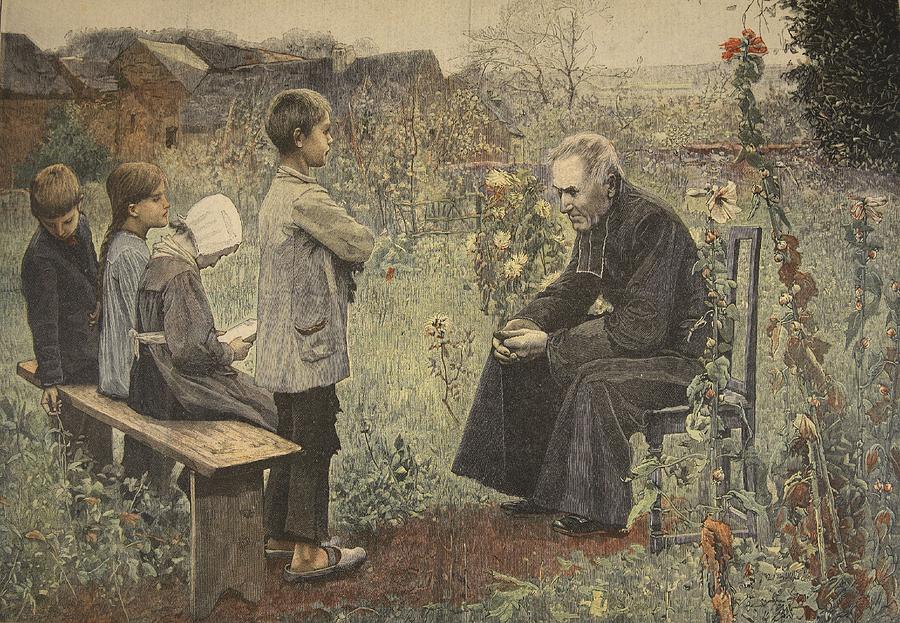
Priest teaching children the catechism by Jules-Alexis Meunier, 1898

Choose a good reputation over great riches;
    being held in high esteem is better than silver or gold.

The rich and poor have this in common:
    The Lord made them both.

A prudent person foresees danger and takes precautions.
    The simpleton goes blindly on and suffers the consequences.

True humility and fear of the Lord
    lead to riches, honor, and long life.

Corrupt people walk a thorny, treacherous road;
    whoever values life will avoid it.

Direct your children onto the right path,
    and when they are older, they will not leave it.

Just as the rich rule the poor,
    so the borrower is servant to the lender.

Those who plant injustice will harvest disaster,
    and their reign of terror will come to an end.

Blessed are those who are generous,
    because they feed the poor.

Throw out the mocker, and fighting goes, too.
    Quarrels and insults will disappear.

Whoever loves a pure heart and gracious speech
    will have the king as a friend.

The Lord preserves those with knowledge,
    but he ruins the plans of the treacherous.

The lazy person claims, “There’s a lion out there!
    If I go outside, I might be killed!”

The mouth of an immoral woman is a dangerous trap;
    those who make the Lord angry will fall into it.

A youngster’s heart is filled with foolishness,
    but physical discipline will drive it far away.

A person who gets ahead by oppressing the poor
    or by showering gifts on the rich will end in poverty.

Listen to the words of the wise;
    apply your heart to my instruction.
For it is good to keep these sayings in your heart
    and always ready on your lips.
I am teaching you today—yes, you—
    so you will trust in the Lord.
I have written thirty sayings for you,
    filled with advice and knowledge.
In this way, you may know the truth
    and take an accurate report to those who sent you. (New Living Translation)

As a pastor, I have seen my share of parents broken over their particular son’s or daughter’s lifestyle and/or behavior. In some cases, the parents have a great deal of work to do with their own shortcomings. In many other scenarios, there are godly mothers and fathers experiencing the heartache of a wayward child through no real fault of their own. 

Yet, some of them feel tremendously guilty because of a famous (or infamous) verse tucked away in our Old Testament lesson for today, to train children in the way they should go, and when they are old, they won’t depart from it.

Keep in mind, there are many different literary genres in Holy Scripture. Narratives, parables, gospel, epistles, poetry, and even apocalyptic literature all occur in the Bible. The book of Proverbs is a collection of wisdom sayings. 

A proverb is a short pity statement of experiential truth. 

In other words, a proverb expresses a general truth in which, all things considered, a particular outcome will likely occur. Proverbs were never designed to be ironclad promises of how things always are or will be. Rather, they are meant to teach wisdom, to give guidance in how to apply reality to a range of life circumstances.

So, when it comes to directing, guiding, and training children, it cannot be claimed that if a parent does a certain set of practices or disciplines that the child will always come out living a certain way. Neither people, nor Scripture, operates in that manner. 

Biblical proverbs on parenting are designed to place emphasis on the necessity of intentional training and instructing children in the ways of God. And, more than likely, all things being equal, that training in the law of God will kick-in when the child is an adult, living on their own, needing wisdom to navigate a difficult world. Yet, remember, it is not a guarantee.

Even God, as the perfect parent, had rebellious children. 

Adam and Eve disobeyed and went their own way. The ancient Israelites, God’s people, were often fickle about their commitment and obedience to the God who consistently showed them steadfast love.

Proverbs encourage us to put significant effort into developing children to be responsible people who live into their full humanity. We teach, train, exhort, live by example, and discipline our kids. We do it all because we love them and seek to be faithful in our own faith commitments.

And we live with the hope that our maternal and paternal efforts are not in vain. So, it is good for parents, teachers, and all who work with kids to have a gracious, wise, well-thought-out plan for training those children. 

As we do so, we trust God, the One who ultimately does the needed renovations of the heart, and transformation of the mind.

Lord of life, you shape us in your image, and by your gracious gift the human family is increased. Grant to all parents everywhere the blessing of teaching and training children. Fill them with wisdom and love as they care for their family, so that they and their children may know and love you. Give us all, whether parents or not, wisdom so that we might always pray intelligently, live circumspectly, and speak lovingly to all the children in our lives, through Jesus Christ our Lord. Amen.