Return to the Lord (1 Samuel 7:3-15)

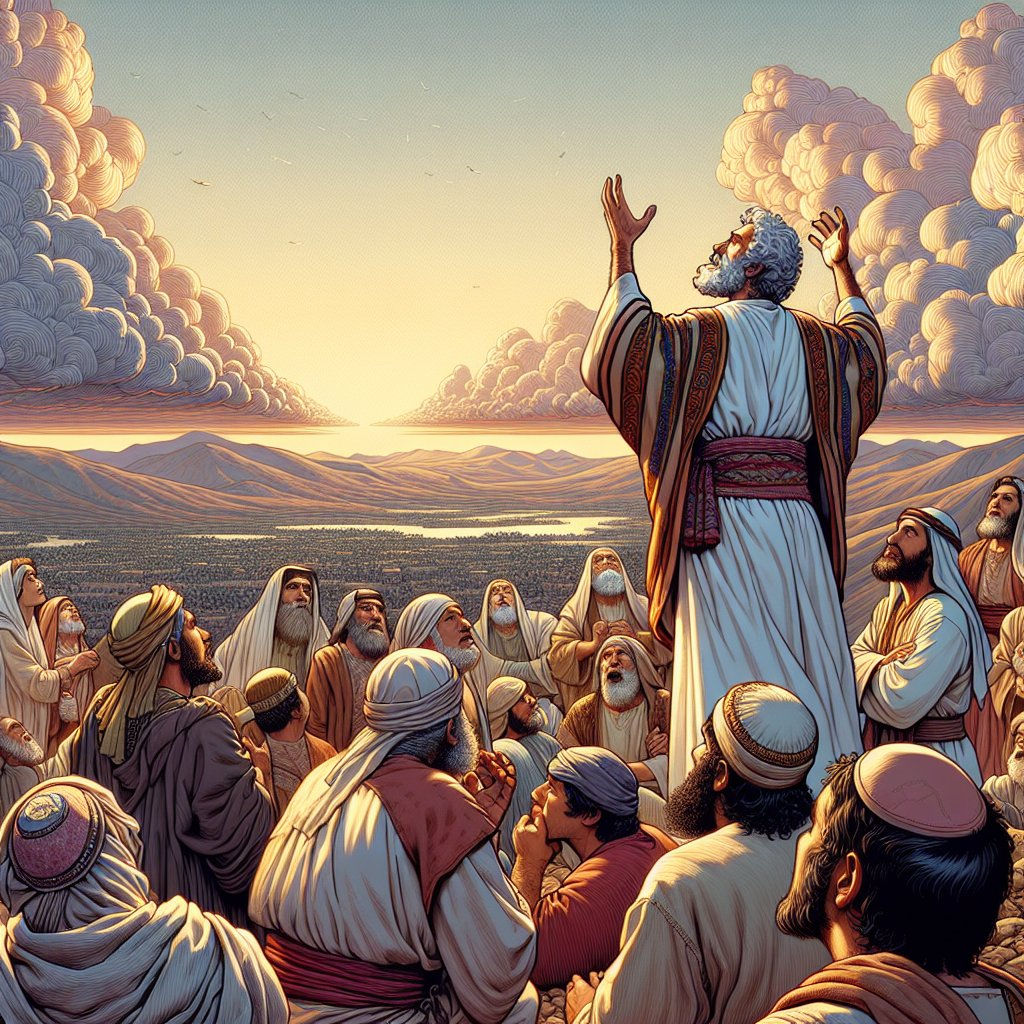
Samuel prays to the Lord on behalf of the people, by Bible Art

So Samuel said to all the Israelites, “If you are returning to the Lord with all your hearts, then rid yourselves of the foreign gods and the Ashtoreths and commit yourselves to the Lord and serve him only, and he will deliver you out of the hand of the Philistines.” So the Israelites put away their Baals and Ashtoreths, and served the Lord only.

Then Samuel said, “Assemble all Israel at Mizpah, and I will intercede with the Lord for you.” When they had assembled at Mizpah, they drew water and poured it out before the Lord. On that day they fasted and there they confessed, “We have sinned against the Lord.” Now Samuel was serving as leader of Israel at Mizpah.

When the Philistines heard that Israel had assembled at Mizpah, the rulers of the Philistines came up to attack them. When the Israelites heard of it, they were afraid, because of the Philistines. They said to Samuel, “Do not stop crying out to the Lord our God for us, that he may rescue us from the hand of the Philistines.” Then Samuel took a suckling lamb and sacrificed it as a whole burnt offering to the Lord. He cried out to the Lord on Israel’s behalf, and the Lord answered him.

While Samuel was sacrificing the burnt offering, the Philistines drew near to engage Israel in battle. But that day the Lord thundered with loud thunder against the Philistines and threw them into such a panic that they were routed before the Israelites. The men of Israel rushed out of Mizpah and pursued the Philistines, slaughtering them along the way to a point below Beth Kar.

Then Samuel took a stone and set it up between Mizpah and Shen. He named it Ebenezer, saying, “Thus far the Lord has helped us.”

So the Philistines were subdued and they stopped invading Israel’s territory. Throughout Samuel’s lifetime, the hand of the Lord was against the Philistines. The towns from Ekron to Gath that the Philistines had captured from Israel were restored to Israel, and Israel delivered the neighboring territory from the hands of the Philistines. And there was peace between Israel and the Amorites.

Samuel continued as Israel’s leader all the days of his life. (New International Version)

Faithfulness to God matters. One cannot worship the Lord by day, then have a moonlighting job with other gods.

The priest and prophet Samuel helped lead Israel to repentance, and thus, a restoration of right relationship with their God. His leadership made all the difference. Samuel was not like the previous priests of Eli and his sons; nor was he like anyone else who didn’t really know what they were doing.

Samuel performed the appropriate sacrifices correctly; interceded with God on behalf of the people; enabled them to achieve victory; and continually and carefully watched over everything. Samuel was a needed stabilizing force in Israel. He identified sin in the nation and dealt with it wisely. Samuel led them to do right.

I confess my iniquity; I am troubled by my sin.

Psalm 38:18, NIV

Godly sorrow brings repentance that leads to salvation and leaves no regret, but worldly sorrow brings death. (2 Corinthians 7:10, NIV)

Come near to God and he will come near to you. Wash your hands, you sinners, and purify your hearts, you double-minded. Grieve, mourn and wail. Change your laughter to mourning and your joy to gloom. Humble yourselves before the Lord, and he will lift you up. (James 4:8-10, NIV)

Today’s Old Testament lesson brings up important questions of acknowledging disobedience, ignorance, and guilt; and how we are to respond to it.

Whenever we say or do something that we ought not to, it’s like squeezing a big tube of toothpaste out; there’s no way you can get it back in.

I actually did that once when I was a little kid. I saw new tube of toothpaste in the bathroom and wondered what it would be like to squeeze out a big amount. So, I did. It was fun. I did it again, then again and again, until it was all gone.

Knowing that perhaps this toothpaste thing might be a problem, I made an artwork out of it. After I was done, I turned off the light, shut the door, and in my little four-year-old brain, hoped nobody would see it. But oh my, they did!

As we get older, and into adulthood, we discover that we have a capacity to do a lot worse than toothpaste escapades. When we sin, there’s no way to put everything back the way it was before. Everything has changed because of our actions (or inactions). And we cannot make it look better, or put a positive spin on it.

There needs to be repentance – a confession of sin, a coming to God, and letting grace and forgiveness have its way. This is the path to restoration in returning to God, in bringing relational connections together again.

Repentance means that we tell God what we did; and that we’re sad about it. Instead of running away, we run to God and admit our guilt. This, by no means, is easy; but it’s the only way to take care of the problem and to feel better about it. And the Lord won’t make us feel worse, but will help us, no matter what.

Everybody is sad when they are caught doing something bad. But there is a good kind of sad, and a bad kind of sad. The bad kind of sad thinks to self, “I’m so stupid; I can’t do anything right,” and punishes myself for the wrong. On the other hand, the good kind of sad helps us realize that we never want to do that thing ever again; and we look to Jesus to forgive us and be our example of what to do right.

Good leaders, like Samuel, assist us in this process with grace, sensitivity, humility, respect, and a forthright spirit.

Most merciful God, we confess that we have sinned against you in thought, word, and deed, by what we have done, and by what we have left undone. We have not loved you with our whole heart; we have not loved our neighbors as ourselves. We are truly sorry and we humbly repent. For the sake of your Son Jesus Christ, have mercy on us and forgive us; that we may delight in your will, and walk in your ways, to the glory of your Name. Amen.

Trust and Obey (Deuteronomy 32:44-47)

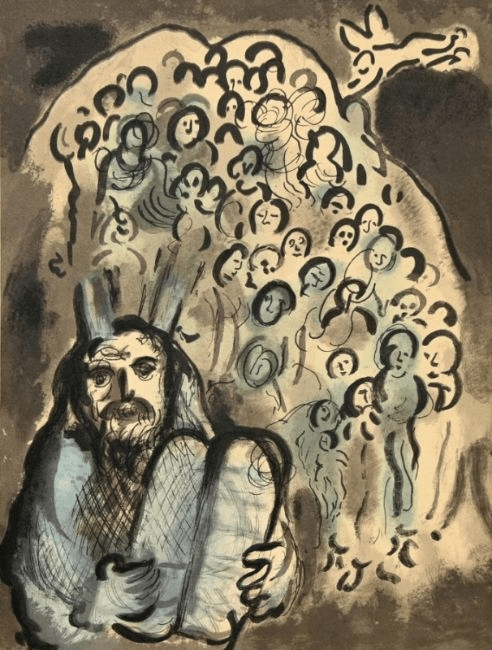
Moses and His People, by Marc Chagall, 1973

Moses and Joshua son of Nun recited this song, so that the people of Israel could hear it.

When Moses had finished giving God’s teachings to the people, he said, “Be sure to obey all these commands that I have given you today. Repeat them to your children, so that they may faithfully obey all of God’s teachings. These teachings are not empty words; they are your very life. Obey them and you will live long in that land across the Jordan that you are about to occupy.” (Good News Translation)

It seems that most people don’t like being told to do anything. There’s a lot of reasons for that. For me, it’s a trust issue. I have a very hard time obeying an authority that I don’t have much faith in.

That’s why I’m just fine submitting myself to God and obeying God’s commands and instructions – because I am firmly convinced that God knows what God is doing; and what’s more, that God has my best interests at mind and at heart.

The ancient Israelites were exhorted by Moses to obey all of God’s teachings because it would be the best way for them to live as a new nation in a new land. The Lord truly wanted what was best for the people, and so, God made sure to give them solid instructions on how to live and thrive together as a nation.

Deuteronomy is the fifth and final book of the Hebrew Torah, and of the Bible’s Pentateuch. The core of the book is a restatement of God’s Law received at Mount Sinai 40 years earlier for the generation about to enter the Promised Land.

The book of Deuteronomy emphasizes God’s love, justice, and transcendence; and stresses the covenant relationship between God and Israel. It looks forward to Israel’s life in the land being established. Foundational to their society, was maintaining God’s social and religious laws.

And those laws were in no way meant to be onerous or oppressive, but were a divine gift to the people. By obeying the Law, the divine/human relationship was secured and the people brought close to God. Foremost to the society was a humanitarianism and concern for the welfare of the poor and disadvantaged.

What’s more, Deuteronomy has a strong intellectual orientation. It urges all Israelites to study God’s laws. There is the expectation that everyone is to be smart and learn how to live wisely.

The participation of Joshua with Moses in teaching he laws was appropriate and important because Joshua was the one who would take over the leadership of Israel and bring them into the Promised Land. The leaders of the people were thoroughly committed to God’s Law – and it was through their wholehearted devotion that they could encourage others to follow them and do the same.

They were to take all of God’s words to heart. The mind, will, and emotions of individuals and families were to be captivated by the standard of God’s divine gift of the law to them. Only in this way would obedience truly become a reality. In other words, it takes complete faith and trust in order to obey.

The way to receive all the blessings of being in the land is through knowing God’s instructions and following them with wholehearted obedience. That means future generations need to be educated about the Law’s stipulations and about the necessity of obeying them with confidence.

Moses made it clear to the people that the divine laws are what life is to be oriented around. God and God’s Law cannot be separated because God’s Law is an expression of God’s very character. For the ancient Israelites, there was no other way.

Many generations later, King David received and learned these laws, understanding the relationship between the Lord and the Law:

The law of the Lord is perfect;
    it gives new strength.
The commands of the Lord are trustworthy,
    giving wisdom to those who lack it.
The laws of the Lord are right,
    and those who obey them are happy.
The commands of the Lord are just
    and give understanding to the mind. (Psalm 19:7-8, GNT)

When it comes to passing on the faith and spiritually forming others, we must have a holistic concern for both what and whom is being taught, as well as how to teach and why we do it. 

For Moses, he was open about expressing the great redemptive acts of God that brought deliverance and vindication to the people. He was convinced that there is no God but the Lord. And he wanted all Israel to know this and to never forget.

All of us, in every generation of believers, are to remember, recite, and rehearse the mighty acts of God, who secured salvation for us. We are responsible to learn, know, and keep the commands of the Lord in our hearts so that we can live into the freedom we possess as believers.

And the Lord has made it known that learning, knowing, remembering, and doing is no trifle thing; rather, this is our very life.

This is one reason why I have devoted myself to the reading, learning, teaching, and living of the Bible. It’s important stuff! And I can testify that living according to the understanding I have of God and Scripture is satisfying, as well as far superior to any other way I have ever tried to live before.

God’s Word must be personally received – no one else can do the work that I myself must do. God’s Word must be faithfully shared and communicated with our children. And God’s Word must be carefully obeyed and observed with head, heart, and hands. This is the responsibility of every believer.

Moses knew that the people could not possibly enjoy life if they deliberately chose to ignore the words given to them in love. I’m glad that, by grace, I know that, too.

Blessed Lord, who caused all Holy Scriptures to be written for our learning: Grant us so to hear them, read, mark, learn, and inwardly digest them, that we may embrace and ever hold fast the blessed hope of everlasting life, which you have given us in our Savior Jesus Christ. Amen.

Persecuted (Acts 8:1b-8)

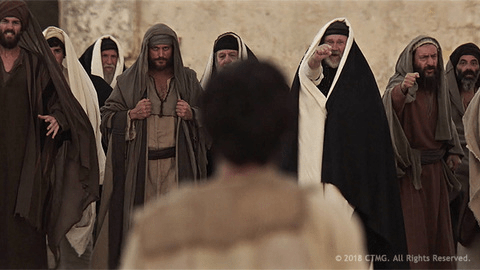
A scene from the movie, “Paul, Apostle of Christ,” in which Saul sought to wipe out Christians beginning with the stoning of Stephen

On that day a great persecution broke out against the church in Jerusalem, and all except the apostles were scattered throughout Judea and Samaria. Godly men buried Stephen and mourned deeply for him. But Saul began to destroy the church. Going from house to house, he dragged off both men and women and put them in prison.

Those who had been scattered preached the word wherever they went. Philip went down to a city in Samaria and proclaimed the Messiah there. When the crowds heard Philip and saw the signs he performed, they all paid close attention to what he said. For with shrieks, impure spirits came out of many, and many who were paralyzed or lame were healed. So there was great joy in that city. (New International Version)

Just because Christians experience the blessing of God through new life in Christ, does not mean that the rest of this earthly life will be bunnies and unicorns without any hardship.

Sometimes we forget that rabbits and horses produce manure, and we’ll have to muck out the barn. And even more than that, blessings from God are not limited to an abundance of earthly resources; blessing also comes through suffering. Jesus said:

“Great blessings belong to those who suffer persecution for doing what is right. God’s kingdom belongs to them.

“People will insult you and hurt you. They will lie and say all kinds of evil things about you because you follow me. But when they do that, know that great blessings belong to you. 

“Be happy about it. Be very glad because you have a great reward waiting for you in heaven. People did these same bad things to the prophets who lived before you.” (Matthew 5:10-12, ERV)

Saul was an up and coming Jewish Pharisee. He was intelligent, driven, and pious. Saul had the pedigree, passion, and position to go a long way and make a big splash in Judaism. And he was more than ready to do whatever it took to stamp out a heretical and dangerous sect of Jesus followers – even to the point of giving approval to the stoning of the Christian Stephen; and leading a persecution against believers like him.

Jesus not only promised abundant and eternal life to his followers, but he also promised that the cost of Christian discipleship would be persecution. Believers in Jesus Christ can expect to suffer in this life for their faithful commitment. Yet, because Christ overcame the world, we too, can accept, cope, and transcend any persecution and trouble we face in our embrace of faith. Jesus said:

“The world will make you suffer. But be brave! I have defeated the world!” (John 16:33b, GNT)

Even though the unity the believers enjoyed together in Jerusalem was disrupted and destroyed by the leadership of Saul, God bent the adverse situation toward blessing. Christians were flung all over the known world. In their going, they obeyed the words of their Lord Jesus to proclaim the message they so wholeheartedly embraced.

When Jesus came near, he spoke to them. He said, “All authority in heaven and on earth has been given to me. So wherever you go, make disciples of all nations: Baptize them in the name of the Father, and of the Son, and of the Holy Spirit. Teach them to do everything I have commanded you.

“And remember that I am always with you until the end of time.” (Matthew 28:18-20, GW)

The ancient prophesies were becoming realized. Grace, mercy, and peace were overcoming bitterness, judgment, and enmity toward one another. Even though persecution was happening, there was now a very different response to it, which will lead to a new outcome. In the last days…

The Lord will mediate between nations
    and will settle international disputes.
They will hammer their swords into plowshares
    and their spears into pruning hooks.
Nation will no longer fight against nation,
    nor train for war anymore. (Isaiah 2:4, NLT)

Suffering can be tolerated, even embraced, whenever we are aware that it can lead us to peace and joy – both personally and communally. Instead of evil taking root amongst a people, good seeds can be planted in the heart of humanity. And when those seeds are watered and nurtured, they grow to become a blessing for the world.

Finally, Jesus said, “What is God’s kingdom like? What story can I use to explain it? It is like what happens when a mustard seed is planted in the ground. It is the smallest seed in all the world. But once it is planted, it grows larger than any garden plant. It even puts out branches that are big enough for birds to nest in its shade.” (Mark 4:30-32, CEV)

Spiritual growth is built into Christianity. The faith formation and development of both individual believers and churches is important. Without it, Christians devolve into cliques of special interest groups.

But with it, Christianity becomes a blessing to the world, that is, if believers focus on producing and harvesting the spiritual fruit of love, joy, peace, patience, kindness, generosity, faithfulness, gentleness, and self-control. (Galatians 5:22-23)

Whenever and wherever believers and followers of Jesus are spiritually growing in their faith, they become like exorcists who organically purge unhealthy institutional systems of their moral corruption, selfishness, idolatry, hate, in-fighting, obsessions, bitterness, rage, competitive oppositions, conflict, and polarizing group rivalries. (Galatians 5:19-21)

Christianity is meant to bring joy and healing of both body and soul. If it doesn’t do this, then it has become just another unjust and unhealthy organization that is in need of purging its impurities; and embracing its mandate to uphold the common good of all persons through proclamation of good news and committed to a lifestyle of loving one another as Christ has loved us.

For people pay attention to that which is right, just, and good – because righteousness, justice, and goodness are in everyone’s spiritual DNA.

Almighty and gracious God of all:
Remember Christ, your Son, who is peace itself,
and who has washed away our hatred with his blood.
Because you love all men and women everywhere,
look with mercy on all who are engaged in battles of the flesh and the spirit.
Banish the violence and evil within all combatants of both body and soul
so that one day, we may all deserve to be called your sons and your daughters.
Grant this through Christ our Lord, in the enablement of the Spirit. Amen.

Mercy Is Coming (Micah 7:8-20)

“Justice Tempered with Mercy,” an oil painting by Emil Bisttram, 1936

Do not rejoice over me, my enemy,
        because when I fall, I will rise;
            if I sit in darkness, the Lord is my light.
I must bear the raging of the Lord,
    for I have sinned against him,
        until he decides my case and provides justice for me.
    He will bring me out into the light;
        I will see by means of his righteousness.
    Then my enemy will see;
        shame will cover her who said to me:
            “Where is the Lord your God?”
    My eyes will see her ruin;
        now she will become something to be trampled,
            like mud in the streets.

A day for the building of your walls!
        On that day, the boundary will be distant.
        On that day, they will come to you from Assyria and the cities of Egypt,
            from Egypt to the River,
            from sea to sea,
            and from mountain to mountain.
And the earth will become desolate because of her inhabitants,
        because of the fruit of their actions.

Shepherd your people with your staff,
        the sheep of your inheritance,
        those dwelling alone in a forest in the midst of Carmel.
    Let them graze in Bashan and Gilead, as a long time ago.

As in the days when you came out of the land of Egypt,
        I will show Israel wonderful things.

Nations will see and be ashamed of all their strength;
        they will cover their mouths;
        their ears will be deaf.

They will lick dust like the snake,
        like things that crawl on the ground.
They will come trembling from their strongholds to the Lord our God;
        they will dread and fear you!
Who is a God like you, pardoning iniquity,
        overlooking the sin of the few remaining for his inheritance?
    He doesn’t hold on to his anger forever;
        he delights in faithful love.
He will once again have compassion on us;
        he will tread down our iniquities.
You will hurl all our sins into the depths of the sea.
You will provide faithfulness to Jacob, faithful love to Abraham,
        as you swore to our ancestors a long time ago. (Common English Bible)

The prophecy of Micah was directed to the people because of the nation’s messed up social and political relations. Unrighteousness had thoroughly drenched the land. In this situation, the nation groaned; Micah responded to them and interceded for the people; God agreed with it all; and Micah concluded with a theological reminder of who God is and what God is like.

The nation of Israel was in a bad way during the eighth century B.C.E. because of their injustice toward one another. The leaders only thought of themselves, and not the people as a whole. Unfaithfulness ran so deep that not even one’s closest friends or relatives could be trusted.

To be a faithful and righteous person during that time required a resolve to wait for God’s deliverance – because there was no way any one person or group of people could fix any of it.

And this is the nature of hope – it can only be understood and realized by knowing, sensing, and feeling hopelessness in all of its despair. We do not hope for something we already possess.

The prophet Micah recognized the situation of the nation for what it was, as well as the consequences to having injustice throughout the land. Yet, he also looked forward to a time when God’s wrath will move from God’s people to the people’s enemies.

It may seem as if the Lord is either slow, not paying attention, or doesn’t care; but God’s timing is not the same as ours. Divine deliverance will come when divine deliverance will come.

The circumstances of Israel’s national sins were ripe not only for God’s judgment, but also for Micah’s prayers on behalf of the people. He called on the Lord to shepherd Israel, while at the same time, to put Israel’s enemies in their place.

And God, out of the storehouse of divine mercy, granted an assurance of pardon.

But if we confess our sins, he is faithful and just to forgive us our sins and cleanse us from everything we’ve done wrong. (1 John 1:9, CEB)

Micah affirmed the grace and mercy of God. He had the confident expectation that the Lord would cast all of Israel’s sins into the depths of the sea. Guilt, shame, and despair will not have the last word; the final word belongs to mercy.

Into a world full of cynicism and sarcasm, hopelessness and despair, it is vitally important that we have faithful and godly individuals who have a settled hope. This is what it means to be a remnant, a small minority of people who hold onto that which is just, right, and good.

We are to quietly go about our business of bringing justice, mercy, and love to this world with a quiet and confident expectation that God’s grace will overcome and overwhelm everything in its path.

Most merciful God, we confess that we have sinned against you in thought, word, and deed, by what we have done, and by what we have left undone. We have not loved you with our whole heart; we have not loved our neighbors as ourselves. We are truly sorry and we humbly repent. For the sake of your Son Jesus Christ, have mercy on us and forgive us; that we may delight in your will, and walk in your ways, to the glory of your Name. Amen.