Nonsensical Theology (Job 17:1-16)

The Nonsense #1, by Jacqueline Withers

My spirit is broken,
    my days are cut short,
    the grave awaits me.
Surely mockers surround me;
    my eyes must dwell on their hostility.

“Give me, O God, the pledge you demand.
    Who else will put up security for me?
You have closed their minds to understanding;
    therefore you will not let them triumph.
If anyone denounces their friends for reward,
    the eyes of their children will fail.

“God has made me a byword to everyone,
    a man in whose face people spit.
My eyes have grown dim with grief;
    my whole frame is but a shadow.
The upright are appalled at this;
    the innocent are aroused against the ungodly.
Nevertheless, the righteous will hold to their ways,
    and those with clean hands will grow stronger.

“But come on, all of you, try again!
    I will not find a wise man among you.
My days have passed, my plans are shattered.
    Yet the desires of my heart
turn night into day;
    in the face of the darkness light is near.
If the only home I hope for is the grave,
    if I spread out my bed in the realm of darkness,
if I say to corruption, ‘You are my father,’
    and to the worm, ‘My mother’ or ‘My sister,’
where then is my hope—
    who can see any hope for me?
Will it go down to the gates of death?
    Will we descend together into the dust?” (New International Version)

The biblical Book of Job is a troublesome story in more than one way. It not only reveals the grinding trouble of Job in losing nearly everything and everyone he had, but the story also presents some theological trouble for us.

Just when we may believe we have some understanding about how God operates in the world, the life of Job throws a theological monkey wrench into the whole thing.

Job was a righteous person, who did good in the world. He was happy and wealthy. And most people would attribute his earthly success to his spiritual piety. Yet, Job’s awful loss and suffering seem anything but a good, just, and right response from God.

Although Satan was behind all of Job’s trouble, the story makes it plain that it was God who let it all happen.

However, the Book of Job is not much concerned about God’s justice; rather, it is a story about a change in worldview. Job went from health, wealth, and happiness to sickness, poverty, and grief. It all happened quickly, one tragic event after another.

The beginning premise of the story is to question whether a privileged person in prosperity is devoted to God simply because of material and familial blessing. How would such a person look, act, and think, after having it all taken from him? Would he continue to be pious and faithful toward God, or not?

Job and his friends had the same worldview, theology, and outlook on things. But after what Job went through, a clear division opened in which the friends never budged from their views.

Yet, Job had an awakening. He saw and felt anarchy in the world. He experienced the putrid spiritual and emotional abscess of unimagined circumstances so bad that it made him wish he were never born.

Through it all, Job never lost his attachment and faithfulness to God. But he did lose his old view of the world.

Job saw firsthand that tidy theological systems of thought and belief are only that. If those systems cannot withstand the smack of worldly horror, then one needs a different system (and not a different God).

In the teeth of such misfortune, one cannot explain things in a nice neat linear fashion. In other words, bad things that happen to us don’t necessarily require repentance, condemnation, or punishment. That’s what Job’s friends believed needed to happen. But Job knew better.

A truism in life is that it’s hard to appreciate something you’ve never experienced.

You may have thoughts, opinions, and beliefs about marriage and child-rearing as an unmarried person without kids. But your world turns upside-down when those relationships become your daily reality and life. Old views become antiquated in the face of these real flesh-and-blood people.

And it’s also difficult for the privileged, the prosperous, and the well-positioned to appreciate the life of the underprivileged, the poor, and those without any power and authority in this world.

They, of course, have plenty of beliefs and opinions about how things ought to be, and what the disadvantaged among us need to do. But one cannot put themselves in their shoes, simply because the poor don’t even have shoes that the wealthy could put on.

In today’s society, it can also be difficult for the reasonably happy and optimistic among us to imagine what life is like for those whose daily reality is debilitating depression and chronic anxiety. What would happen if everything that made optimistic persons happy were completely taken away from them?

Whatever would happen, such a person’s world would never be the same again. Something would change within them. Their thoughts would be altered. There would be no going back to the status quo of things before.

Could Job, in his health and wealth, have appreciated the anguish of victims from senseless calamity? Could he have ever considered God as an enemy against him?

Maybe if one of Job’s friends had experienced terrible suffering, he himself would have responded with the established tidy worldview of telling him he needed to repent of his sin. After all, they were his friends for a reason – sharing their creed and convictions on life.

But horrible suffering opened a chasm between Job and his friends. Only Job alone knew that his disaster was undeserved – that he had done nothing against God.

Sometimes, all you and I can do in the midst of senseless and seemingly needless suffering, is to, like Job:

  • affirm our innocence and our integrity, even though no one understands
  • reaffirm our faith and commitment to God, even though what we are going through is confusing and makes no sense
  • awaken to the plight of others who go through hard things and need a friend who will truly listen and have compassion on us

Keep watch, dear Lord, with those who work, or watch, or weep this night, and give your angels charge over those who sleep. Tend the sick, Lord Christ; give rest to the weary, bless the dying, soothe the suffering, pity the afflicted, shield the joyous; and all for your love’s sake. Amen.

The Beauty of Love (Song of Songs 1:1-17)

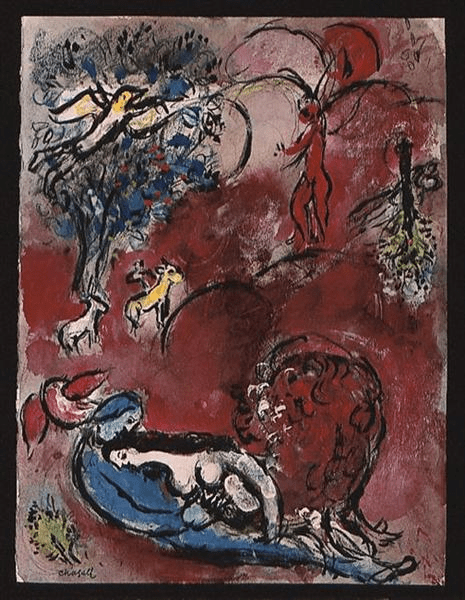
Song of Songs I, by Marc Chagall, 1960

The Song of Songs, which is for Solomon.

[Woman]

If only he would give me some of his kisses . . .

Oh, your loving is sweeter than wine!
Your fragrance is sweet;
        your very name is perfume.
        That’s why the young women love you.
Take me along with you; let’s run!

My king has brought me into his chambers, saying,
“Let’s exult and rejoice in you.
Let’s savor your loving more than wine.
        No wonder they all love you!”

Dark am I, and lovely, daughters of Jerusalem—
        like the black tents of the Kedar nomads,
        like the curtains of Solomon’s palace.
Don’t stare at me because I’m darkened
        by the sun’s gaze.
My own brothers were angry with me.
        They made me a caretaker of the vineyards—
        but I couldn’t care for my own vineyard.

Tell me, you whom I love with all my heart—
        where do you pasture your flock,
        where do you rest them at noon?—
            so I don’t wander around with the flocks of your companions.

[Man]

If you don’t know your way,
    most beautiful of women,
        then follow the tracks of the herds
            and graze your little goats
            by the tents of the shepherds.

I picture you, my dearest,
        as a mare among Pharaoh’s chariots!
Lovely are your cheeks, adorned with ear hoops;
        your neck, with beads.
Let’s make hoops of gold beaded with silver for you!

[Woman]

With my king close by,
        my perfume filled the air.
A sachet of myrrh is my love to me,
        lying all night between my breasts.
A cluster of henna flowers is my love to me
        in the desert gardens of En-gedi.

[Man]

Look at you—so beautiful, my dearest!
        Look at you—so beautiful! Your eyes are doves!

[Woman]

Look at you—so beautiful, my love!
        Yes, delightful! Yes, our bed is lush and green!
The ceilings of our chambers are cedars;
        our rafters, cypresses. (Common English Bible)

The Song of Songs is an unabashedly sensuous biblical book. It is, throughout its contents, an erotic paean to love. In eight chapters, a man and a woman pursue each other through verdant fields and lush valleys. The excitement they have, being together, is palpable.

For most of church history, the Song of Songs has been viewed as an allegory, a love poem between Christ and the Church. And in the case of Hebrew Scripture, the covenant love which exists between God and Israel, has been the predominant interpretive lens.

Seen from this perspective, the Song of Songs reflects that we ought to love the Lord with overpowering commitment, as if we were love-sick for our Beloved. Our thoughts are constantly on the object of our love – how we can please our beloved one.

And yet, there still seems to be room to read the Song in the very down-to-earth realness of physical love between two lovers. Since we are embodied people, such love ought to be celebrated, and is anything but base or to be refused. Sex is a gift from the Creator, and encouraged by God.

I think that the Song of Songs is not an either/or; it is a both/and; it’s both literal and allegorical. That’s not a weird thing. On the allegorical level, the Song is a beautiful poem describing the Divine Eros for God’s people, and the faithful’s heartfelt love for the God whose very name is Love.

Concerning a literal view, the Song celebrates the sanctity of human love, seeing within it the symbol of God’s love for us. Our very real bodies are themselves sacred, just as much as our souls.

Yet, however one chooses to look at the Song of Songs, it remains a statement of mutual admiration, of committed love and affection. It is indeed a poetic lifting of love above all else.

Indeed, if love isn’t the answer, we are not asking the right question.

Believe it or not, the Song of Songs was once viewed as an important key, capable of unlocking the entirety of Holy Scripture.

In fact, C.H. Spurgeon, the Prince of Preachers, in the nineteenth century, preached 59 sermons from this book; in Victorian England, no less. Spurgeon discerned the Song as central to the whole of the Bible. Reflecting on Song of Songs 1:7, he said:

“These words express the desire of the believer after Christ, and his longing for present communion with Him…. Tell me where Thou feeds, for wherever Thou stands as the Shepherd, there will I lie down as a sheep; for none but Thyself can supply my need. I cannot be satisfied to be apart from Thee. My soul hungers and thirsts for the refreshment of Thy presence….

“Satan tells me I am unworthy; but I always was unworthy, and yet Thou hast long loved me; and wherefore my unworthiness cannot be a bar to my having fellowship with Thee now. It is true I am weak in faith, and prone to fall, but my very feebleness is the reason why I should always be where Thou feeds Thy flock, that I may be strengthened, and preserved in safety beside the still waters.

“Why should I turn aside? There is no reason why I should, but there are a thousand reasons why I should not, for Jesus beckons me to come. If He withdraw Himself a little, it is but to make me prize His presence more. Now that I am grieved and distressed at being away from Him, He will lead me yet again to that sheltered nook where the lambs of His fold are sheltered from the burning sun.” Charles Haddon Spurgeon

The Song, in history past, once functioned as a beautiful path to deep intimacy with God. Methinks it behooves us to recover this.

The two lovers in the Song see beauty everywhere. They see it in each other, in the fields where the sheep are pastured, in the orchards where love is consummated, in the seasons, in the animals, trees, and hills. Beauty is all around them, and it is they themselves.

All things which God has created are lovely. Nothing is too small or too insignificant when the eyes of love look upon them. Beauty is designed to be noticed, celebrated, and praised. Love is meant to be expressed out loud, with flavor.

Each time love is stated, every exhalation of adoration, and all of the instances when beauty is acknowledged and affirmed, the ones who speak bind themselves more deeply to God and God’s big world. Together, they call all of it good.

Today’s Old Testament lesson is a wondrous reminder that beauty and love will have its way. Regardless of class, race, family, or societal norms, lovers will continue to seek and find one another and claim their relationship.

While the daughters may stare, and the brothers may be angry, the lovers will yet affirm the beauty of their love. And they will find contentment with each other.

You and I are no accident on this earth; we were created by a loving Creator who has an eye for beauty. And no matter how separated we may get from our divine source, God will seek us out; and if we seek the Lord, he will be found.

O God, you have prepared for those who love you such good things as surpass our understanding: Pour into our hearts such love towards you, so that we, loving you in all things and above all things, may obtain your promises, which exceed all that we can desire. Amen.

Divine Goodness, Despite Human Ingratitude (Psalm 78:23-29)

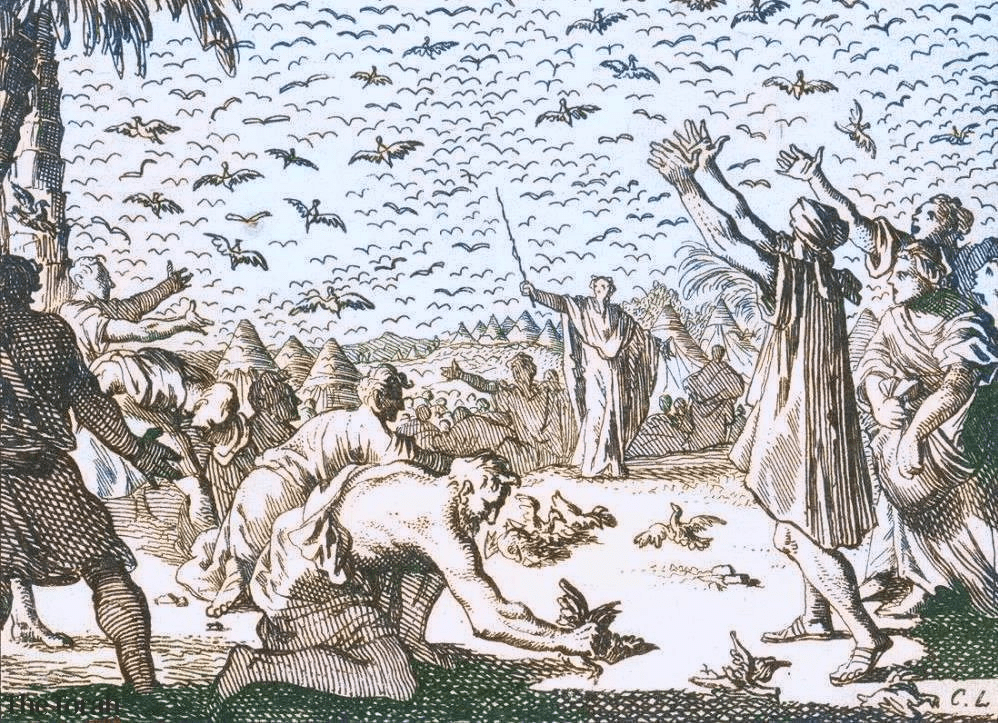
Quail in the Wilderness, by Caspar Luyken, 1698

Yet he commanded the skies above
    and opened the doors of heaven;
he rained down on them manna to eat
    and gave them the grain of heaven.
Mortals ate of the bread of angels;
    he sent them food in abundance.
He caused the east wind to blow in the heavens,
    and by his power he led out the south wind;
he rained flesh upon them like dust,
    winged birds like the sand of the seas;
he let them fall within their camp,
    all around their dwellings.
And they ate and were well filled,
    for he gave them what they craved. (New Revised Standard Version)

Today’s psalm is the second longest in the psalter (72 verses, with Psalm 119 the longest at a hefty 176 verses). Along with Psalms 105-106, Psalm 78 remembers and rehearses the history of Israel. This is a psalm which is meant for teaching and passing on important lessons.

The upshot of this psalm’s historical recollection is that the people’s ancestors were faithless; therefore, those reading the psalm now should live differently in a positive life of goodness, having observed how the past actors serve as a negative example of ingrates.

The psalmist, Asaph, viewed past events as highly informative for present circumstances. His purpose for crafting the psalm was explicit. He wanted the people:

 to put their hope in God—
        never forgetting God’s deeds,
        but keeping God’s commandments—
    and so that they won’t become like their ancestors:
    a rebellious, stubborn generation,
        a generation whose heart wasn’t set firm
        and whose spirit wasn’t faithful to God. (Psalm 78:7-8, CEB)

The verses for today’s lectionary reading have a unique place within the psalmist’s rehearsal of the past. They connect to the previous section (verses 9-22) which recounts the Lord’s angry response concerning Israel’s unbelief and rebellion.

In many ways, Psalm 78 has a consistent theme of human stubbornness, lack of faith, and wanting to do their own thing apart from God. Bucking God’s covenant code and moral law was ever-present in Israel’s history. And yet…

The Lord remained the same: Faithful and true. Furthermore, God stubbornly showed steadfast divine love and covenant loyalty to the people, despite their herky-jerky commitment and fickle faith.

Manna from heaven

Although the theme of human failure runs throughout the psalm, the dominant idea points to God’s gracious mercy, eternal faithfulness, and steadfast love. Most of all, the psalmist wanted his readers to remember the goodness and grace of God.

The people’s unbelief in no way stymied the promises of God. That’s because salvation and deliverance, faith and hope, do not originate and are not sustained by humans, but by the Lord God almighty who created heaven and earth.

Even though the people were faithless, and thus, had no trust in God’s power; nevertheless, the Lord opened the doors of heaven in order to meet the needs of people who did not deserve divine help.

The verses for today remember the story of God’s provision of manna and quail in the desert (Exodus 16). The Lord was gracious, merciful, and kind to the Israelites, despite their incessant grumbling. God responded to them because of their sheer need, and not because of any righteousness coming from them.

God not only provided food, but gave the manna in abundance, and the quail in superabundance. The contrast could not be any more glaring: Israel murmured, grumbled, complained, and demonstrated a lack of faith; God granted the Israelites a ridiculous amount of food, and evidenced steadfast faithfulness to the covenant.

The supreme goodness of God brings out, in stark relief, the incredible foolishness of Israel’s attitude. In the Exodus account, while the meat was still in their mouths, God’s anger flared because of the people’s recalcitrance.

On the surface, the divine response of judgment may appear out of sorts to the divine grace shown to Israel. Yet, the Lord cares about the holistic needs of people, and not only in giving sustenance.

God wants faithful and obedient people. The Lord desires goodness, righteousness, and justice to be the hallmark of the community.

To have your belly full and your spirit empty is an affront to God – because the Lord is good, right, and just, and does not tolerate impertinence, impudence, and impetuousness. Vice and ingratitude only makes a person an imbecile who is worthless to their fellow humanity.

Divine punishment – anywhere you find it in Holy Scripture – is meant to draw people back into relationship with God. Another way of phrasing this, is that God delivers people and grants them freedom, so that they will have no obstacles toward living a good, right, and just life.

No matter the response of God – whether it is by miraculous provision or by divine punishment – it’s always a response of grace; the Lord consistently acts from a place of compassion and commitment to doing what is best for the community.

Whereas the Israelites repeatedly cycled themselves through spirals of faith and unbelief, gratitude and grumbling, obedience and disobedience; God, however, constantly demonstrated the presence of grace and mercy, righteousness and justice, holiness and love.

The only reason the Israelites (and the entire human race, for that matter) are not wiped out is because God forgave their iniquity and did not destroy them. What’s more, the Lord didn’t even let them destroy themselves, unwittingly by their own unawareness and foolishness. (Psalm 78:36-39)

I am profoundly glad that God is the bigger person in the relationship with humanity. The Lord is continually mindful of who we are, as well as God’s own divine essence and power.

Yet he, being compassionate,
    forgave their iniquity
    and did not destroy them;
often he restrained his anger
    and did not stir up all his wrath.
He remembered that they were but flesh,
    a wind that passes and does not come again. (Psalm 78:38-39, NRSV)

As people created in the image and likeness of God, we find our highest joy and greatest fulfillment in receiving the good things from God with gratitude; and of giving goodness to others in a spirit of love – no matter what.

Gracious and almighty God: Open wide the eyes of my soul that I may see the good in all things. Grant me today a new vision of your truth. Inspire me with the spirit of joy and gladness. Make me a cup of strength to suffering souls. Amen.