Psalm 130 – Believe, Hope, and Love

I cry out to you from the depths, Lord—

my Lord, listen to my voice!
    Let your ears pay close attention to my request for mercy!
If you kept track of sins, Lord—
    my Lord, who would stand a chance?
But forgiveness is with you—
    that’s why you are honored.

I hope, Lord.
My whole being hopes,
    and I wait for God’s promise.
My whole being waits for my Lord—
    more than the night watch waits for morning;
    yes, more than the night watch waits for morning!

Israel, wait for the Lord!
    Because faithful love is with the Lord;
    because great redemption is with our God!
He is the one who will redeem Israel
    from all its sin.
(Common English Bible)

Throughout church history, the book of Psalms has been used and understood as the Church’s prayer book.  Indeed, the psalms are much more than a collection of beautiful poems, words of assurance, and songs of praise – they are designed and meant to have regular and ongoing use as prayers. And I’m not just talking about the psalms being somebody else’s prayers; they are my prayers and your prayers. 

There are times when words fail us – where we find ourselves between a rock and a hard place and want to pray. Our stress and/or anxiety is so high, we can neither think straight, nor form anything coherent with our mouths. It’s in such times that the psalms present themselves to us as the path forward. 

What’s more, psalms are meant to be spoken out loud and more than once. And I’m not talking about saying them with a quiet mumble or a flat monotone.  No! These precious prayers of Holy Scripture are meant to be declared with full voice and a large amount of flavor!  They are to repeatedly roll off our lips with all the emotional and spiritual gusto which resides within us!  Tears and yelling are both appropriate and encouraged. 

For we do not possess a mere heady faith of thoughts and ideas; we also possess a faith that is robustly heartfelt, and dwells down deep in the gut where our bowels of compassion have their abode. 

Even with a cursory reading of today’s psalm, we can easily observe there’s more going on here than beliefs of faith, hope, and love. 

The psalmist is expressive, clinging to faith with a patient longing for God to make good on divine promises. It is chocked full of emotion, a prayer coming from the depths of the gut. The whole being is involved, and rightly so, because our faith affects the entirety of a person and everyone in the community of the redeemed.

If this psalm resonates with you in any way, let your proclamation of it be with the expanse of feeling inside you. After all, as people created in the image of God, we share God’s own deep sense of love – and love is genuinely love when it is outwardly expressed with a sacred combination of words, actions, and feelings.

Waiting, watching, hoping. We as humans do a lot of that. While we anticipate God’s response, we keep up the praying. We keep reminding God to be God. We encourage others to watch and wait and hope, all the while encouraging ourselves, as well.

Whenever we are stressed, more often than not, we thrash about, like a desperate swimmer in the middle of a lake, just trying to keep his head above water. Yet, the psalm tells us to do the counterintuitive: Don’t do something. Just stay there and relax. Why, in heaven’s name, should I do nothing?

Because the Lord will act.

And that action of God will redeem, renew, refresh, and revitalize. It will be new, like the morning dawn. A fresh day, that will not be like any other day before it.

God does his best saving work in the worst and most impossible of circumstances. We need not fear the overwhelming depths of difficulty and trouble. We can trust the Lord.

Perhaps the most awful of deep holes are emotional – deep depression and/or anxiety – a lostness inside oneself because of mental disorder. In such a dark oblivion, and terrible morass, one tries to survive into another hour, not just another day. Like a watchman waiting for the night to dissipate and dawn to break, there is a longing for God.

Deliverance and rescue seem slim. Hopelessness begins to calcify the spirit. Only love can release the hardening situation; the steadfast love of God is a gentle hammer, picking away at the grief.

This is a love which never gives up.

Today’s psalm begins as a desperate cry for help. It ends with an awareness of the need to trust, hope, and wait….

Blessed Jesus, in the comfort of your love, I lay before you the memories that haunt me, the anxieties that perplex me, the despair that frightens me, and my frustration at my inability to think clearly. Help me to discover your forgiveness in my memories and know your peace in my distress. Touch me, O Lord, and fill me with your light and your hope. Amen.

*Above painting of Psalm 130 by Virginia Wieringa

Mark 6:45-52 – Facing Fear

Immediately Jesus made his disciples get into the boat and go on ahead of him to Bethsaida, while he dismissed the crowd. After leaving them, he went up on a mountainside to pray.

Later that night, the boat was in the middle of the lake, and he was alone on land. He saw the disciples straining at the oars because the wind was against them. Shortly before dawn he went out to them, walking on the lake. He was about to pass by them, but when they saw him walking on the lake, they thought he was a ghost. They cried out because they all saw him and were terrified.

Immediately he spoke to them and said, “Take courage! It is I. Don’t be afraid.” Then he climbed into the boat with them, and the wind died down. They were completely amazed, for they had not understood about the loaves; their hearts were hardened. (New International Version)

Sometimes, we are afraid – even terrified. And Christians aren’t immune to the feeling of fear and terror.

The truth of the Christian life is that it is a herky-jerky process of three-steps-forward, two-steps-backward, not always knowing with certainty everything we encounter.  

The expectation that we will have a consistent upward trajectory of spiritual development with no scary experiences is wrongheaded and misguided. Throw into the mix that our self-awareness is often skewed, and that we have difficulty assessing ourselves with any accuracy, and voila! we have a recipe for the true human condition.

Doubt, fear, failure, and stubbornness aren’t just endemic to other people – it also characterizes many Christians, as well. We will face severe storms in life. They will be harsh. We will wonder if we’ll even make it out alive, or not. And it may very well seem like Jesus is nowhere to be found. Then, when he does show up, we don’t recognize him, and it scares the bejabbers out of us.

This was the experience of Christ’s disciples, who too often reflect our own stories of faith and fear all rolled up in one person. Today’s Gospel lesson is this: Our fears and foibles do not need to define us because Jesus is Lord over the water, the weather, the wondering, the waiting, the wildness, and our own whimsical natures of seeing miracles accomplished in others, then not believing it can happen in our own lives.

So, what are we really afraid of? Failure? Fear itself? Death? Irrelevance? Loss? Change? Perhaps, everything? Yes, all of life is a risky scary business. There are no guarantees, except one: Christ is present with us, whether we are aware of it, or not.

If the worst scenario you worry about in your head would actually come to pass, it will still never change the reality that God loves you and is with you.  And it will not stop Jesus from assuring us of his presence and climbing into the boat to be with us.

We don’t have any accounts of Jesus freaking out in fear, or when other people flip out in their own fear. Jesus was a person of prayer, completely grounded in his relationship with the Father.   

Jesus made his disciples get into a boat and go out on the lake – all the while knowing what they were about to face with the weather. Even though the disciples were doing God’s will by going out on the lake, they were not spared from adversity. In fact, Jesus wanted them to experience the storm because it is through the storm that we really learn faith and to face down our fears. 

There is no shame in being afraid. We all experience it. And there is no shame in admitting we’re scared. Where shame exists, our instinct is to run away like our ancestors Adam and Eve and hide, thus hiding ourselves from the grace that could be ours.

Being out on the middle of a lake during a storm did not prevent Jesus from being present with the disciples – he just walked on the water to be with them. Even though the disciples had just seen and participated in the miracle of Jesus feeding the five thousand, they were not looking for another miracle – which is why they did not recognize Jesus and were afraid when they saw him.

Jesus never chided his disciples for their fear, or their hard hearts. He simply invited them, with the tone of grace and mercy, to not be afraid. And the Scripture is replete with continual encouragements to not be afraid because of God’s presence. Along with psalmist, we can say:

But when I am afraid,
    I will put my trust in you.
I praise God for what he has promised.
    I trust in God, so why should I be afraid?
    What can mere mortals do to me? (Psalm 56:3-4, NLT)

I sleep and wake up refreshed
    because you, Lord,
    protect me.
Ten thousand enemies attack
from every side,
    but I am not afraid. (Psalm 3:5-6, CEV)

When I called, you answered me.
You made me bold by strengthening my soul. (Psalm 138:3, GW)

Ultimately, fear has to do with disconnection. It is to feel powerless, separated from any resources, unable to do anything about what is presently staring us in the face and scaring us.

Yet, when we have an awareness and a sense of connection with Jesus, there are unlimited resources of grace to accept, cope, and transcend any and every storm we find ourselves in the middle of.

May the risen and ascended Christ, mightier than the hordes of hell, more glorious than the heavenly hosts,
be with you in all your ways. 

May the cross of the Son of God protect you by day and by night, at morning and at evening, at all times and in all places.

May Christ Jesus guard and deliver you from the snares of the devil, from the assaults of evil spirits, from the wrath of the wicked, from all base passions, and from the fear of the known and unknown. 

And may the blessing of God almighty – Father, Son, and Spirit – be upon you and remain with you always. Amen.

*Above painting of Jesus walking on water by Brian Whelan

**Above Orthodox icon of Christ walking on water

***Above painting: Christ walking on the sea, by French artist Amédée Varint (1818-1883)

1 Samuel 18:6-30 – Saul’s Deep Anxiety

When the men were returning home after David had killed the Philistine, the women came out from all the towns of Israel to meet King Saul with singing and dancing, with joyful songs and with timbrels and lyres. As they danced, they sang:

“Saul has slain his thousands,
    and David his tens of thousands.”

Saul was incredibly angry; this refrain displeased him greatly. “They have credited David with tens of thousands,” he thought, “but me with only thousands. What more can he get but the kingdom?” And from that time on Saul kept a close eye on David.

The next day an evil spirit from God came forcefully on Saul. He was prophesying in his house, while David was playing the lyre, as he usually did. Saul had a spear in his hand, and he hurled it, saying to himself, “I’ll pin David to the wall.” But David eluded him twice.

Saul was afraid of David because the Lord was with David but had departed from Saul. So, he sent David away from him and gave him command over a thousand men, and David led the troops in their campaigns. In everything he did he had great success, because the Lord was with him. When Saul saw how successful he was, he was afraid of him. But all Israel and Judah loved David because he led them in their campaigns.

Saul said to David, “Here is my older daughter Merab. I will give her to you in marriage; only serve me bravely and fight the battles of the Lord.” For Saul said to himself, “I will not raise a hand against him. Let the Philistines do that!”

But David said to Saul, “Who am I, and what is my family or my clan in Israel, that I should become the king’s son-in-law?” So, when the time came for Merab, Saul’s daughter, to be given to David, she was given in marriage to Adriel of Meholah.

Now Saul’s daughter Michal was in love with David, and when they told Saul about it, he was pleased. “I will give her to him,” he thought, “so that she may be a snare to him and so that the hand of the Philistines may be against him.” So, Saul said to David, “Now you have a second opportunity to become my son-in-law.”

Then Saul ordered his attendants: “Speak to David privately and say, ‘Look, the king likes you, and his attendants all love you; now become his son-in-law.’”

They repeated these words to David. But David said, “Do you think it is a small matter to become the king’s son-in-law? I’m only a poor man and little known.”

When Saul’s servants told him what David had said, Saul replied, “Say to David, ‘The king wants no other price for the bride than a hundred Philistine foreskins, to take revenge on his enemies.’” Saul’s plan was to have David fall by the hands of the Philistines.

When the attendants told David these things, he was pleased to become the king’s son-in-law. So, before the allotted time elapsed, David took his men with him and went out and killed two hundred Philistines and brought back their foreskins. They counted out the full number to the king so that David might become the king’s son-in-law. Then Saul gave him his daughter Michal in marriage.

When Saul realized that the Lord was with David and that his daughter Michal loved David, Saul became still more afraid of him, and he remained his enemy the rest of his days.

The Philistine commanders continued to go out to battle, and as often as they did, David met with more success than the rest of Saul’s officers, and his name became well known. (New International Version)

Anxiety can warp our thinking, cause pain in our gut, and darken our heart. Maybe that statement seems a bit harsh. After all, everyone becomes anxious, at some time or another. Anxiety is endemic to the human experience; it is something we all have in common. Whenever anxiety takes root in the life of a person, it bears the fruit of irrational fear and deep insecurity. 

King Saul was jealous of David’s success in battle. Behind Saul’s personal anxiety was the concern that David was stealing the limelight. It made Saul angry, David getting all the attention. Since Saul was the leader in charge, he continually put David in overwhelming situations where it seemed likely he would fail. But instead of failure, David was wildly successful in everything he did. 

Today’s Old Testament lesson makes it clear David’s achievements were because the Lord was with him. This made Saul even more anxious and afraid, possessing malevolent motives behind everything he did toward David. Even though it might not have looked evil on the outside, in reality, the interior life of Saul was a mess. And it made him plain stupid.

When Saul observed God was with David, it only reinforced his fear and led him down a dark path. In contrast to Saul, David had godly character, developed in the lonely place of the pasture. It led him on a lighted trail toward the will of God.

Genuine integrity is always forged in the secret place where no one is looking. If we are merely concerned for outward performance and/or perfectionism, all sorts of anxieties can develop and twist our sense of reality. Yet, if we pay attention to the inner person, and allow God to create a deep faith within, then we can stand strong, even when there are those who have ill will against us.

Search me, O God, and know my heart.  Test me and know my anxious thoughts.  See if there is any offensive way in me and lead me in the way everlasting.  Amen.

*Above painting by Chinese artist He Qi

**Above statue of King Saul at the University of North Carolina Art Museum

1 Samuel 17:1-49 – Faith in Action

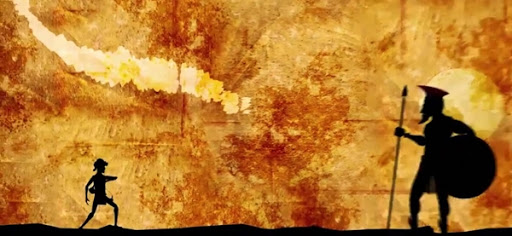
The story of David and Goliath is one of the best known stories in the entire Bible. It’s a classic example of what can be accomplished through one person who chooses to exercise faith. Puny David taking on giant Goliath has served as one of the greatest inspirations for believers through the centuries – seeing God give victory to people against dramatically overwhelming odds.

Whereas the New Testament exhorts us to live by faith, this Old Testament narrative demonstrates what can happen when a person of faith decides to put that faith into action.

Old Testament stories are framed in a way to help the reader or listener discern the differences between the characters of the story – to understand the contrasts between good and bad. So, then, the account of David and Goliath revolves around four character contrasts so that we will learn the lessons of faith God wants to teach us.

First Contrast: David and Saul

David is brave. Saul is fearful. In the ancient world, a typical tactic of warfare, when the battle lines were drawn, was to choose a champion from each side. They would fight together, just the two of them, on behalf of the entire army. It was a fight to the death, and the losing side would submit to the winning side. 

This was a way of preventing the terrible carnage of war. It also created some incredible individual champions.  A champion would be selected not only for his ability to fight, but also for his impressive stature so that there was an intimidation factor to it all.

Saul was the King of Israel. He was the logical choice for the combat since he was a head taller than all the other Israelites and a rather impressive looking soldier. But compared to Goliath, Saul looked like a midget.  The intimidation factor worked. Saul was downright afraid and not about to put himself out there to face a giant.

David is brave because he has faith in God. Saul is fearful because he is not a man of faith in God. The opposite of faith is not unbelief, but fear. As the muscle of faith grows through trusting God in the daily stresses of life, fear is better confronted and managed. The development of faith is a process, and it takes time.

Considering this story in light of Father’s Day, Dads have the daily opportunity of being a hero to their kids through faith in God. That means dealing with two great fears: being found inadequate; and, being controlled by another person or circumstance.

Those two fears were evident in Saul. He felt inadequate because he compared himself to Goliath. He felt controlled by the situation because the Philistines were picking a fight. So, he froze. There are many men who would rather do nothing than be labelled as inadequate or controlled.

David, in contrast, had plenty of practice facing down foes as a shepherd – the bear and the lion – who threatened the sheep. David was often out in the countryside all by himself, guarding the sheep, and his skills were improved in a place where no one was looking.

The way to progress our faith is to be assertive in owning our relationship with God through prayer and Bible reading (or listening on a Bible app) on a daily basis. It’s something everyone can do.

Second Contrast:  David and the Israelites

It was not only Saul who was intimidated by Goliath; the entire army of Israel was hiding behind the battle lines cringing in fear. David, however, discerned no reason to avoid this bullying blowhard. It appears he is the only person able to see Goliath as a small person in comparison to a big God. By faith, David understands Goliath is no match for God.

So, we see that one person full of faith can accomplish the impossible – whereas an army full of fear cannot accomplish a thing. 

We might tend to believe everything has to be large with a big splash to it – that only then can we accomplish big things for God. But really, if we want to achieve something for God, we need to step out in faith and do it – instead of recruiting an army of people or hiding in the group, nursing our fears and anxieties.

No one can do your personal faith work for you; you must do it. The Beaver Cleaver philosophy of life says, “Gee, Wally, if I get in trouble or in a pickle, I’ll just ignore it and hope it goes away….” But Goliath is not going anywhere. He will still be there tomorrow.

Third Contrast: David and Goliath

Goliath represents the other extreme to the fear of Saul and the Israelites. He had absolutely no fear, including any fear of God. Goliath trusted in himself, his abilities, and his stature. David, however, trusted in God alone.

The story gives a detailed description of Goliath’s weapons and physical appearance because Goliath trusted in his aptitude and the ancient technology of his day to face down the Israelites. Conversely, David was small and too young to even be considered for military service. He was too small to wear anybody’s armor. But David did not need any of that – he just needed his faith.

Humanly speaking, David appears insignificant; there is nothing about him that caused anyone to think there was something special or different about him. Goliath, however, was the Arnold Schwarzenegger of his day, ready to terminate anybody who got in his way.

It can be easy to trust in ourselves, another person, or our technology to accomplish something in the face of insurmountable odds, instead of looking to God. The battle is not ours; it is the Lord’s.

Most things in life take a great deal of bravery – especially parenthood! It takes more than copious Dad speeches (and I had a lot of speeches for my kids). Fatherly courage requires modeling for boys what they are expected to become and modeling for girls what they should expect from males.

Children need to observe men who have courage to do the right thing, even when it has personal cost. They need to see them bravely shouldering responsibilities – even when they don’t feel like it. Kids need to see men who demonstrate the courage to be vulnerable, as well as strong and self-disciplined. They need to experience fathers and men with courage to pay attention to them – even, and especially, when those men are angry or disappointed with their own choices.

Fourth Contrast:  David and Eliab

Eliab was David’s big brother. Eliab was a soldier in the army. David was just a kid. It did not matter he was a kid; David was concerned for God’s name and glory. In contrast, Eliab was concerned about his little brother being an embarrassment and superseding him.

When we choose to step out in faith and act, there will likely be opposition, even among family and fellow believers. But David did not let a little criticism stop him. Criticism and opposition will inevitably happen. David was determined to please God, not his brother. He did not wilt and was not deterred from his concern to face down Goliath.

Conclusion

If we want to be brave in the Christian life; if we desire to live a life full of faith in Christ that deals with problems; then, the story of David and Goliath will serve as an inspiration in those times we feel less than mighty for God. 

Goliath was defeated and fell because David trusted God. The issue is not how much faith we have, but in whom our faith is placed. David trusted God. Saul did not even acknowledge God. Goliath trusted in himself. Eliab was too busy quibbling about things that didn’t matter. 

What is your response?