Matthew 17:14-21 – Use Your Faith

At the foot of the mountain, a large crowd was waiting for them. A man came and knelt before Jesus and said, “Lord, have mercy on my son. He has seizures and suffers terribly. He often falls into the fire or into the water. So, I brought him to your disciples, but they couldn’t heal him.”

Jesus said, “You faithless and corrupt people! How long must I be with you? How long must I put up with you? Bring the boy here to me.” Then Jesus rebuked the demon in the boy, and it left him. From that moment the boy was well.

Afterward the disciples asked Jesus privately, “Why couldn’t we cast out that demon?”

“You don’t have enough faith,” Jesus told them. “I tell you the truth, if you had faith even as small as a mustard seed, you could say to this mountain, ‘Move from here to there,’ and it would move. Nothing would be impossible.” (New Living Translation)

As we reflect on today’s Gospel lesson, let’s keep in mind that any time we see Jesus exorcising demons, we need to resist the idea that anyone having similar symptoms today is demonic in origin. Any chronic health condition a person experiences, without seeing any healing take place, does not necessarily mean the condition is due to the person’s lack of faith.

Conversely, it is also possible to relegate such healing accounts to a different time and place. My own view of Scripture, along with personal experience, informs me that demonization is real. We may underestimate how influential and widespread demonization occurs in this modern time and place.

The nature of faith is not located in its amount or intensity but in its object. All of life requires some faith. Even sitting in a chair. When I sit, the amount or intensity of my faith isn’t the issue – the object, the chair, is the issue. If a leg on the chair breaks and I flop to the floor, its not reasonable for me to conclude that it happened because of my lack of faith.

The disciples’ inability to heal the boy.

I’m not sure what is more difficult: to be the person suffering, or to observe a loved one suffering. The father is desperate and hurting, watching his son suffer with seizures. The man is utterly discouraged because Christ’s disciples were not able to help.

So, the desperate father approached Jesus and knelt, begging him to have mercy and help his son.

Our Lord’s response, I admit, is not likely what my response would be. I would be more like, “I’m so sorry this is happening to you. This is terrible. Let’s take care of this.” Jesus did honor the father’s request and healed the boy, but not before he had some words.

Jesus was exasperated, and he let everyone know about it. Why was he so disappointed?

Because his disciples knew better. The disciples were not ignorant or unable. They had what they needed to deal with the boy and his father. Jesus already equipped them to do this kind of ministry: 

Jesus called his twelve disciples together and gave them authority to cast out evil spirits and to heal every kind of disease and illness… “Heal the sick, raise the dead, cure those with leprosy, and cast out demons. Give as freely as you have received!” (Matthew 10:1, 8, NLT)

The reason for the disciples’ inability to heal was their lack of faith.

Jesus was perturbed with his disciples because they were not utilizing faith.

Jesus is bothered when believers don’t believe.

Up until this encounter, the disciples were healing people and doing the work Jesus gave them to do. Yet now they cannot. What changed? They relied on their own power, abilities, and experience, instead of relying on the power of God to heal. 

The Gospel of Mark includes Jesus saying that this kind of demon can only be dislodged through prayer (Mark 9:14-29). In short, the disciples didn’t pray. They didn’t tap into God’s power. They didn’t use the authority Jesus gave them. Rather, the disciples rested on their own laurels.

Their lack of prayer translated into a lack of power. 

If we are unable to do the work God has called us to do, it isn’t because we lack the authority or ability. It is a lack of faith.

Effective ministry happens because of faith.

The power of faith is in the person to whom it is directed. If we trust solely in ourselves, we will fail. However, if we trust in Jesus, then even the tiniest of faith will be able to do the impossible.

The power is not in particular words, or in a certain formula – the power is in faith rightly directed toward Jesus. Most demonic manifestations are much more subtle – such as thoughts of how I am not enough, how I have no right to try and help another, and how unable I am to do the will of God.

Conclusion

Here is a simple observation of Christ’s words: We are not told that if we have faith as big as a mountain that we can move one. Instead, Jesus tells us that if we have any faith at all, even as small as a tiny seed, directed toward God and not ourselves, the sky is the limit – we will have all the ability we need to do the will of God.

So, what is that impossible thing that could be done in your life with properly directed faith? 

What miracle, healing, or resistance to a bad spirit needs to take place around us? 

Discouragement is the most common tool of the devil in keeping us from realizing genuine manifestations of faith. Jesus has already accomplished victory over sin, death, and Satan. We must, then, claim all the will of God for today.

Resist the devil and he will flee from you (James 4:7). Step out in faith and do the will of God. The first step is always one of prayer….

High and Holy One, because your mercy is everlasting and your truth endures from generation to generation, show mercy to the sick and infirmed of either body or soul. Grant them deliverance from mental, emotional, spiritual, and physical illness. Blessed Lord, keep them under your care, for only in you can we live in safety and wellbeing. Visit them with your saving health. Do not let their hope be taken away, through Jesus Christ, our Lord. Amen.


Hebrews 12:3-13 – Interpret Your Circumstances Wisely

“The Kingdom Comes” by Bangladeshi artist Nikhil Halder, 1978

Consider him who endured such opposition from sinners, so that you will not grow weary and lose heart.

In your struggle against sin, you have not yet resisted to the point of shedding your blood. And have you completely forgotten this word of encouragement that addresses you as a father addresses his son? It says,

“My son, do not make light of the Lord’s discipline,
    and do not lose heart when he rebukes you,
because the Lord disciplines the one he loves,
    and he chastens everyone he accepts as his son.”

Endure hardship as discipline; God is treating you as his children. For what children are not disciplined by their father? If you are not disciplined—and everyone undergoes discipline—then you are not legitimate, not true sons and daughters at all. Moreover, we have all had human fathers who disciplined us, and we respected them for it. How much more should we submit to the Father of spirits and live! They disciplined us for a little while as they thought best; but God disciplines us for our good, in order that we may share in his holiness. No discipline seems pleasant at the time, but painful. Later on, however, it produces a harvest of righteousness and peace for those who have been trained by it.

Therefore, strengthen your feeble arms and weak knees. “Make level paths for your feet,” so that the lame may not be disabled, but rather healed. (New International Version)

Missed expectations often result in discouragement, even depression.

If we expect God to continually bless us with unending positive circumstances, we will, sooner or later, be confused and/or frustrated when life goes sideways.

The ancient Jewish Christians, for whom today’s New Testament lesson was addressed, faced opposition. Not only did they encounter the hardship of being Jews living in a Gentile world, but they also had to experience the difficulty of being Christians in a Jewish community.

Its one thing to put up with adversity for a few days or weeks. It is quite another thing altogether to deal with hard circumstances day after day, week after week, month after month, even year after year.

Where is God in all this negativity? When are the earthly blessings going to come? What the heck is going on here? Why are my prayers bouncing off the church ceiling?

Over time, the believers began to lose their joy. They started getting discouraged. The Jewish Christians, after beginning well in their faith, gradually slid into misinterpreting their circumstances as God being mean to them. Things got so bad, they even entertained the notion of returning to Judaism and leaving Christianity behind.

Their faith was shrinking.

However, their plight was very much seen by God. In fact, God was the One orchestrating the situations, as difficult as they were.

It is not our lack of resources, the disrespect, or the difficult people around us who are the problem. The issue is our interpretation of those events and persons.

The author of Hebrews invited the struggling believers to take a different interpretation of their hardship: They were experiencing divine discipline.

We are all responsible for our own children. As parents, we discipline them (ideally) for their own good. We know it will hurt temporarily. Yet, in the long run, the discipline will work out.

In fact, we understand this with all kinds of things. Everyday, people submit themselves to getting cut open, poked, prodded, and tested by doctors, surgeons, and healthcare workers because we know there needs to be temporary pain for permanent healing to occur.

It is the rare child who grows up without any discipline and becomes a productive citizen of society. It is the exceptional person who knows nothing of medical interventions for health and healing. And so, it is extremely unlikely that a Christian will experience holiness, righteousness, and live wisely in the world apart from some gut-wrenching, heart-breaking, and mind-bending circumstances for which they neither saw coming, nor ever asked for.

So, when the divine baseball bat whacks us upside the head, how will we interpret it?

Discipline is education by correction. God is the Father, treating us as family, as children who need to learn the ways of grace. God is the Divine Coach, exhorting us to work, run the laps, put in the reps, and reach beyond what we think we can do – knowing all along what our true capabilities are.

Godliness comes through discipline, training, and plain old fashioned hard work. Unless there is the suffering which comes through trials to our faith, Christianity is only a theory.

Before I suffered, I took the wrong way,
    but now I do what you say.
You are good and you do good.
    Teach me your statutes!
The arrogant cover me with their lies,
    but I guard your precepts with all my heart.
Their hearts are unfeeling, like blubber,
    but I rejoice in your Instruction.
My suffering was good for me,
    because through it I learned your statutes. (Psalm 119:67-71, CEB)

The appropriate response to difficult and adverse circumstances is to view them as God’s gracious guidance and correction. Rightly interpreting our life events gives us renewed resolve for the Christian marathon.

Endurance and perseverance are needed. Keeping good running form, consistent spiritual exercise, and maintaining liturgical rhythms, all help us face the adversity with energy, focus, and strength.

Christianity isn’t a matter of doing more. It is a way of life – a continuous evaluation of beliefs and thinking, addressing the shadows of the heart, and listening to the compassion deep in our gut.

Don’t give up. Keep going.

Be safe. Be strong. Be smart. Be spiritual. We are all in this together.

Thanks be to you, Lord Jesus Christ, for all the benefits which you have given us; for all the pain and insults you have borne for us. O most merciful redeemer, friend and brother, may we know you more clearly, love you more dearly, and follow you more nearly day by day. Amen.

Matthew 15:21-31 – Sense the Urgency

Woman of Canaan by Sadao Watanabe, 1965

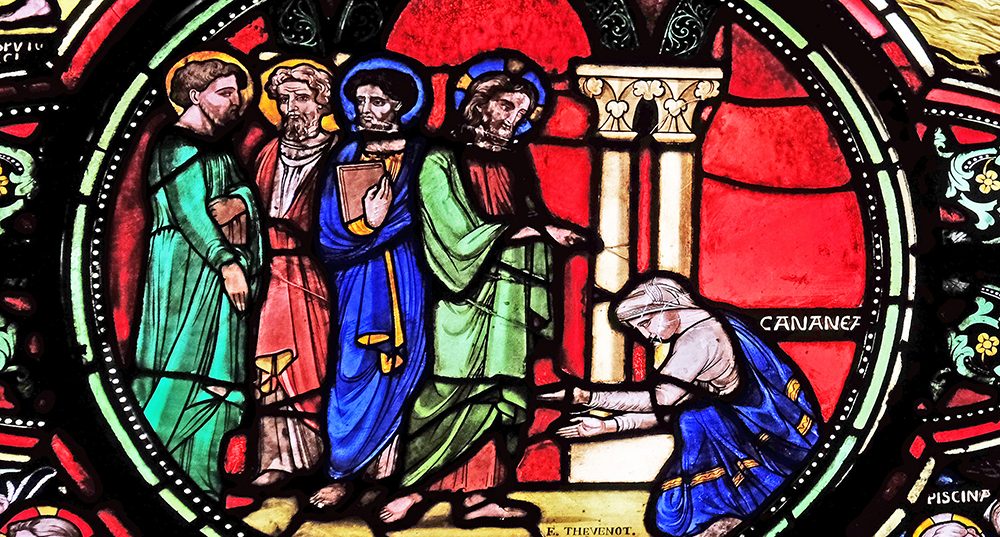
Leaving that place, Jesus withdrew to the region of Tyre and Sidon. A Canaanite woman from that vicinity came to him, crying out, “Lord, Son of David, have mercy on me! My daughter is demon-possessed and suffering terribly.”

Jesus did not answer a word. So, his disciples came to him and urged him, “Send her away, for she keeps crying out after us.”

He answered, “I was sent only to the lost sheep of Israel.”

The woman came and knelt before him. “Lord, help me!” she said.

He replied, “It is not right to take the children’s bread and toss it to the dogs.”

“Yes it is, Lord,” she said. “Even the dogs eat the crumbs that fall from their master’s table.”

Then Jesus said to her, “Woman, you have great faith! Your request is granted.” And her daughter was healed at that moment.

Jesus left there and went along the Sea of Galilee. Then he went up on a mountainside and sat down. Great crowds came to him, bringing the lame, the blind, the crippled, the mute and many others, and laid them at his feet; and he healed them. The people were amazed when they saw the mute speaking, the crippled made well, the lame walking and the blind seeing. And they praised the God of Israel. (New International Version)

Not much happens until something becomes urgent.

A doctor, a financial planner, or a preacher can tell us something until they are blue in the face, but it usually doesn’t mean much without a sense of urgency that a change must occur – that the way things are isn’t going to cut it any longer. 

We can say eating healthy is of value, yet unless there is a sense of urgency to it, it is difficult to do. Someone can proclaim that retirement savings is important, yet unless there is a sense of desperate action, it likely won’t happen. 

Christians say prayer is important, lost people matter to God, and ministry to youth is the hope of the world. Yet without a sense of urgency, there is procrastination and talking, resulting in zero change.

It’s the difference between law and gospel, or between duty and grace. The law and duty are important elements of the Christian life. The law shows us our sin and gives us direction how to live. However, law and duty can only take us so far – it cannot effect real and lasting change. Only the gospel of grace can do that. 

Law and duty alone won’t do it. And when we figure out it doesn’t work, we try and hide our struggle by keeping up the appearance of being a good Christian. Then, we boil down the rules of the Christian life to merely being nice and attending church (law). Our deep hurts and damaged emotions are handled by burying them in layers of law in order to protect ourselves from any more disappointment.

Nothing could be further from today’s Gospel lesson. We have a Gentile Canaanite woman, who is as far from God as one can get in the ancient world. She is neither concerned about appearances nor hiding to mask her pain. The woman cares about her daughter’s terrible suffering from demonization. She recognizes Jesus as the Promised One and seeks him out.

Only grace, not law-keeping, will save, deliver, or heal anyone.

Grace is bestowed to the humble who recognize the great urgency of needing Jesus – in God’s good timing, not ours. Faith is exemplified by a willingness to beg. It’s demonstrated with dogged persistence in the face of the slimmest of odds.

The Canaanite woman screams for help.

Her daughter is suffering. The region of Tyre and Sidon is demon territory – the home region of the Old Testament character, Jezebel – a place far from the covenant people of Israel’s ways. 

The woman has no leverage, no ground of appeal, and no spiritual pedigree. There is no way to approach Jesus by any other means than crying out to him with her deeply felt need. In her sense of urgency, noise and humility is all she has.

Jesus is silent.

Have you ever felt like God is silent, as though your prayers were doing nothing but bouncing off the ceiling? 

God is often silent. Yet, let’s not misinterpret this lack of response as thinking God didn’t hear, or doesn’t care, or something is wrong with me. Silence from God is just that – agonizing divine silence….

A superficial reading of the story may lead us to believe Jesus is aloof, or elitist, that maybe he isn’t interested in certain people. It seems to me, a better way of interpreting the silence is through the lens of our patience and perseverance, a sort of faith testing.

There is some mystery to this story we may never fully grasp. However, the story lets us know Jesus is not a coin machine where we can slip in a dollar and get immediate change. Jesus is a person, not a mechanism to figure out, to get what we want from him. This is not the way of grace.

The disciples want Jesus speaking to get rid of the screaming obnoxious woman.

“Holy cow, Jesus, just give her what she wants so she’ll go away!”  They wanted a healing, but it wasn’t out of a sense of compassion or grace. “After all, we’ve got important Jesus-work to do here, and we don’t need this woman upsetting the peace, rocking the boat, challenging the status quo, making waves, and ruining our sanctified party.” 

The disciples labeled the woman as loud and undeserving. Frankly, they may have been right. But they were operating out of law, not grace.

Jesus and the Canaanite woman, from Saint Germain-l’Auxerrois church in Paris, France

Sometimes the most compassionate thing we can do is not give everybody what they want, right away. 

Jesus did not come to this earth to ensure everybody gets their way and stays happy so that no one is upset. In fact, Christ did quite the opposite. Jesus sought to do his father’s will by establishing the kingdom of God on this earth – teaching values that weren’t part of the religious culture, telling the most “godly” people of the time they were a brood of vipers, and generally offending a lot of people who claimed to know God.

Jesus cared enough about the woman to not immediately give her what she wanted. She had to go hard after Jesus, to keep going after him, to exercise her faith muscle. 

Jesus doesn’t give the disciples what they want, either.

Two different petitions were given to Jesus, and his response doesn’t really address either one of those asking’s.  He just says he was sent to the lost sheep of Israel. Yet the woman responds as if she doesn’t even hear what Jesus just said.

The chosen nation of Israel was meant by God to be a missionary people. All nations on earth are blessed through Abraham, through the Jewish people. It has always been God’s design to have the Gentiles come to faith, and the way that was to happen was through Israel being a great missionary people proclaiming God and being a light to the nations. 

I tell you that Christ became a servant of the Jews to show that God has done what he promised their great ancestors. Christ also did this so that the non-Jewish people could praise God for the mercy he gives to them. The Scriptures say,

“So, I will give thanks to you among the people of other nations;
    I will sing praise to your name.” (Romans 15:8-9, ERV)

And that is exactly what happened. I am a Gentile Christian today because a small group of Jewish persons took the gospel of grace given them by Jesus and fulfilled their role as a missionary people.

The woman worships and tries Jesus again.

Jesus never said “no” to the woman. This was the basis for her asking again. She reasons much like an infatuated teenager who asks the girl of his affections, “so, what kind of chance do I have going out with you?”  The girl responds to the teenage boy, “a million to one.”  And the boy responds to her, “so, what you’re saying to me is that there’s a chance!”

Slim as the woman’s chances seem, she saw an opening where others might not. This is precisely the nature of true faith – it sees possibilities where none seem to exist.

This is raw, real, and persistent faith. If we don’t resonate with this kind of faith and persistence, there is not a sufficient level of urgency in our lives. The bald fact is: If we don’t pray, it’s because there is no desperation. We are still more fixed on law than gospel. Duty only goes so far.

Jesus still doesn’t answer the woman’s request, but gives her a metaphor about dogs, instead.

Jesus is restating what he said about the Jews: Salvation is through the Jews, not around them. We cannot ignore or get rid of the Old Testament because the gospel comes through it.

The woman still doesn’t give up but works with the metaphor.

She doesn’t argue with Jesus about being a dog; doesn’t insist she ought to be an exception; doesn’t say she has a right to be like the Jews; and doesn’t claim Jesus is being unfair or uncaring.

The woman simply accepts Christ’s words. Then, replies that even as a dog she would be allowed to receive a few crumbs from the table of the children. She might be a dog, but she’s still in the house, even if it’s under the highchair. The woman is looking for mercy as expectantly as my own dog looks at me with those sad brown eyes while I’m eating.

Jesus honors her faith.

Why? Because she humbly looked for grace. We need not write an essay to God about why our requests should be answered, as if Jesus needs convincing. We just need to seek the mercy of God.

Faith, coupled with urgency, doggedly persists. It believes Jesus will deliver. Great faith overcomes discouragement, despite the odds. It doesn’t listen to naysayers who want us to shut up and quit bothering them.  Urgent prayers are an unabashed begging before Jesus because only he can help. Begging isn’t sexy. It isn’t comfortable. But it’s needed.

So, pray. Pray like it’s the only thing that will make a difference. Pray with a sense of urgency. 

Psalm 125 – Mountain Theology

Photo by Saulo Zayas on Pexels.com

Everyone who trusts the Lord
    is like Mount Zion
    that cannot be shaken
    and will stand forever.
Just as Jerusalem is protected
    by mountains on every side,
the Lord protects his people
    by holding them in his arms
    now and forever.
He won’t let the wicked
rule his people
    or lead them to do wrong.
Let’s ask the Lord to be kind
to everyone
    who is good
    and completely obeys him.

When the Lord punishes
    the wicked,
he will punish everyone else
who lives a crooked life.
    Pray for peace in Israel! (Contemporary English Version)

Psalms 120-134 comprise a collection of short songs of ascent meant to guide Jewish pilgrims on their communal trek up to the city of Jerusalem, and ultimately to the temple mount. 

Ascending to the Light by Alex Levin

The rhythm of the pious ancient Israelites centered round particular festivals, seasons, and Sabbath. Taking the annual pilgrimage to the Holy City was an especially anticipated time of year. This yearly cycle brought both increased faith and needed spiritual stability to the people. It reminded them that, like the mountains themselves, God cannot be moved. God will always be there.

Robust understandings of God are good solid mountain theology. Mountains make up about one-fifth of the world’s landscape and 12% of the world’s population live on them. They are more than imposing and impressive statues of rock. About 80% of our planet’s fresh water originates in the mountains.

So, when the psalmist likens God to a mountain, it is a reference not only to protection and strength; it is also pointing us to the source of life. With God, every need is met and satisfied.

On a mountain, Noah settled, Moses was given the law, Jesus preached and died – and the beans from my morning coffee were grown. I have everything I need in the mountainous God of all.

The most fundamental truths about God is consistency and constancy in the divine nature. God is forever present with people. 

If God seems or feels aloof or unconcerned, it is not that the Lord is avoiding us or is distracted with other important matters of running the universe. It simply means God chooses to reveal divine character and the divine will whenever the appropriate time ensue, for our benefit.

A mountain looks like it never moves. Yet the slow but steady rains, the creeping of tectonic plates, and undiscernible changes within the earth shift mountain ranges over time. The Lord is most certainly responding to us, our movements and changes, in a way we cannot perceive with the naked eye.

Our responsibility in the entire affair is to engage in consistent rhythms of spirituality which place us in a position to receive grace when God decides to give it. If we are still, we can feel the movements of grace enveloping us with life.

Perhaps we need to become adept at being spiritual mountain goats, using our wide cloven hooves of faith to negotiate the immense crags and rocks of God. After all, we will spend an eternity getting to know God and never exhaust the exploration.

Therefore, we must not despair but anticipate meeting with God, just as the Israelites of old looked forward and upward to their annual worship at the top of the mountain. The truth is that God surrounds people, even when we do not always perceive it to be so. 

The sturdiness of God is able to handle and bear the weight of our heaviest burdens.

Throw all your anxiety onto him because he cares about you. (1 Peter 5:7, CEB)

If we will but look up, there is abiding help for the most vexing of problems.
I raise my eyes toward the mountains.
    Where will my help come from?
My help comes from the Lord,
    the maker of heaven and earth.
God won’t let your foot slip.
    Your protector won’t fall asleep on the job. (Psalm 121:1-3, CEB)

There is peace and settled rest when we call upon the God who surrounds us.

I call out to the Lord,
    and he answers me from his holy mountain.

I lie down and sleep;
    I wake again because the Lord sustains me. (Psalm 3:4-5, NIV)

It is through trust that we become mountains ourselves – strong in faith and giving life to those around us.

Ever-present God, there is no place where I can go where you are not.  Help me to so intuit your presence that it bolsters my faith and resilience for daily life in Jesus Christ.  Amen.