James 4:8-17 – Make Wise Spiritual Resolutions

Come near to God and he will come near to you. Wash your hands, you sinners, and purify your hearts, you double-minded. Grieve, mourn and wail. Change your laughter to mourning and your joy to gloom. Humble yourselves before the Lord, and he will lift you up.

Brothers and sisters do not slander one another. Anyone who speaks against a brother or sister or judges them speaks against the law and judges it. When you judge the law, you are not keeping it, but sitting in judgment on it. There is only one Lawgiver and Judge, the one who is able to save and destroy. But you—who are you to judge your neighbor?

Now listen, you who say, “Today or tomorrow we will go to this or that city, spend a year there, carry on business and make money.” Why, you do not even know what will happen tomorrow. What is your life? You are a mist that appears for a little while and then vanishes. Instead, you ought to say, “If it is the Lord’s will, we will live and do this or that.” As it is, you boast in your arrogant schemes. All such boasting is evil. If anyone, then, knows the good they ought to do and doesn’t do it, it is sin for them. (New International Version)

Resolve to Come Near to God

God is longingly looking out the window watching and waiting for us to come home (Luke 15:11-32). And when we are seen, God will run and come near to us.

We can come to God morning, noon, and night; when things are good and when they are bad. God gives generously to all without finding fault if we will but come near. (James 1:5)

When my oldest daughter was a small child, her bike was stolen. When she discovered it was gone, we sat down together in the backyard and came to God and prayed. I barely finished praying, we both looked up, and a police cruiser pulled up in the alley behind our house. The officer rolled down his window and said, “Hey, are you missing a bike?” 

We hopped in the back of the cruiser and the officer took us to a place where someone had ditched the bike. It was a tremendous lesson to both my daughter and I that when we come to God, God comes to us. I realize life doesn’t always work that way, yet we can be assured God listens, hears, and will respond.

Resolve to Wash Your Hands

We cannot approach God with blood on our hands. We need to come squarely facing our guilt and shame. God wants us to admit our guilt, confess it as such, receive forgiveness, and deal with matters of restitution, reconciliation, or making amends.

Look at what this very experience of godly sadness has produced in you: such enthusiasm, what a desire to clear yourselves of blame, such indignation, what fear, what purpose, such concern, what justice! (2 Corinthians 7:11, CEB)

Resolve to Purify Your Heart

Whereas the previous resolution was more external, this one addresses the inner person, the heart. Not only do our actions need to be cleaned up through washing our hands (repentance) our attitudes need cleansing, as well. 

Our hearts cannot be devoted to two masters. Double-minded persons need to become single-minded with pure, not mixed, motives.

“The man who tries to walk two roads will split his pants.”

African Proverb

Resolve to Grieve

God blesses those people who grieve. They will find comfort! (Matthew 5:4, CEV)

Any significant change or loss creates grief. And it is necessary to grieve. Grief is not an event but a process. Everyone’s grief is intensely personal and has its own timetable. It is not crazy, selfish, or unspiritual to grieve.  In fact, it is biblical.

The only way to get on the other side of grief is by telling your story. Sharing with each other, giving testimony to God’s grace, and expressing emotion is important. There cannot be healing apart from grief and lament.

Resolve to Mourn

Mourning is the emotional response to how terrible our fallen world is and can be, and how much we really need God.  It is to see that sin in all of its foulness and degradation is horrible and destroys everything it touches.

People who do not or cannot mourn are hard-hearted. They need deep spiritual transformation. By his wounds we are healed.

Resolve to Wail

We are actually commanded to cry – more than cry – to wail.  Whereas mourning might be more private and personal, wailing is more public.

I believe one of the greatest tragedies in today’s modern church is that Christians can become so focused on victory that they end up crying alone. Nobody should ever have to cry by themselves. Weep with those who weep. If there ever was an appropriate place for crying, it should be amongst likeminded brothers and sisters.

Resolve to Change

In the face of immense human need in this world, there must be change. We cannot turn the clock back to a more bygone idyllic era. We are here, now, together on spaceship Earth. We must come to grips with the kind of change needed to live above petty human degradation.

I once had a discussion with a young woman about heaven and hell. When we first started conversing, she expressed the desire to be in the place that had the better party going on. By the time we finished talking, she was grieving, mourning, and crying. I never knew what became of her – I even forget her name now. But once she got just a glimpse of sin’s gravity, it completely undid her.

Resolve to Be Humble

Humility is the path to intimacy with God and one another. The paradox is that through grieving, mourning, and wailing we become joyful and experience God. Through suffering there is glory. Being last makes us first.  Entering through the narrow gate brings us into the broad open space of eternal life.

Resolve to Not Slander One Another

To slander means to “speak against” or “speak down” to someone. Slander always contains false information based on bogus observations and misinterpretations. To intentionally tear-down another person either to their face or to other people is slander.

People sometimes believe they have a right to speak against another person. That really says more about the slanderer than the slandered. Slander is a spirit of retaliation and revenge. It is being self-righteous and acting as the judge.

Resolve to Not Be Judgmental

A critical and condemning spirit breaks the biblical law of love and declares itself the authority. It wrongheadedly believes it knows best for everyone.

When we put our focus on others and do not deal with our own critical spirit, we play God. That is not our job. 

Never pay back evil with more evil. Do things in such a way that everyone can see you are honorable. Do all that you can to live in peace with everyone. Dear friends, never take revenge. Leave that to the righteous anger of God. For the Scriptures say,

“I will take revenge;
    I will pay them back,”
    says the Lord.

Instead,

“If your enemies are hungry, feed them.
    If they are thirsty, give them something to drink.
In doing this, you will heap
    burning coals of shame on their heads.”

Don’t let evil conquer you but conquer evil by doing good (Romans 12:17-21, NLT)

Resolve to Have God in Your Plans

Some folks plan and map out their lives without a consideration of what God wants. They hold back on God, only giving partial effort and resources. And this can happen to any of us. We may not all have money and power, but we all have time, and how we use our time says a lot about our faith.

Jesus said we cannot serve both God and money (Matthew 6:24). In God’s economy, money is a tool to be used to meet needs and bless others. However, many persons tend to make audacious plans with money by accumulating debt and presuming they can pay it off; encouraging their kids to get high paying jobs as their highest objective; and, relying on the market economy to provide for them in the end. 

Money and making plans are good. Yet, the almighty dollar is not to be the motivating factor in our lives, and God needs to be squarely in the middle of all that we do.

So, resolve to embrace the virtue of humility – considering both others and God in making plans and decisions. For if we fail to do what we know we ought, our guilt will eventually catch up to us. Better to rely on God’s grace and make necessary changes.

Holy One, you are eternal, ever-present, and boundless in love. Yet there are times when we fail to recognize you in our daily lives. Sometimes shame clenches our hearts, and we hide our true feelings. Sometimes fear makes us small, and we miss the chance to speak from our strength. Sometimes doubt invades our hopefulness, and we degrade our own wisdom. In the daily round from sunrise to sunset, remind us again of your holy presence hovering near us and in us. Free us from shame and self-doubt. Help us to see you in the moment-by-moment possibilities to live honestly and to act courageously, through Jesus Christ our Lord. Amen.


Matthew 17:23-32 – Parable of the Two Sons

The Parable of the Two Sons by Jorge Cocco

Jesus entered the temple courts, and, while he was teaching, the chief priests and the elders of the people came to him. “By what authority are you doing these things?” they asked. “And who gave you this authority?”

Jesus replied, “I will also ask you one question. If you answer me, I will tell you by what authority I am doing these things. John’s baptism—where did it come from? Was it from heaven, or of human origin?”

They discussed it among themselves and said, “If we say, ‘From heaven,’ he will ask, ‘Then why didn’t you believe him?’ But if we say, ‘Of human origin’—we are afraid of the people, for they all hold that John was a prophet.”

So, they answered Jesus, “We don’t know.”

Then he said, “Neither will I tell you by what authority I am doing these things.

“What do you think? There was a man who had two sons. He went to the first and said, ‘Son, go and work today in the vineyard.’

“‘I will not,’ he answered, but later he changed his mind and went.

“Then the father went to the other son and said the same thing. He answered, ‘I will, sir,’ but he did not go.

“Which of the two did what his father wanted?”

“The first,” they answered.

Jesus said to them, “Truly I tell you – the tax collectors and the prostitutes are entering the kingdom of God ahead of you. For John came to you to show you the way of righteousness, and you did not believe him, but the tax collectors and the prostitutes did. And even after you saw this, you did not repent and believe him. (New International Version)

The people entering God’s kingdom may not be the ones we expect. 

That’s because God’s kingdom is an upside-down kingdom. The spiritual insiders are really on the outside, while the spiritual outsiders are the ones inheriting the kingdom.

Today’s Gospel parable is a warning to all the spiritually serious to beware, lest their energies be spent entirely in correctness, believing the right things, and making obedience to Christ of secondary importance. 

This parable also encourages moral failures with the wonderful possibilities of a changed life. 

That’s because talk is cheap. Only what one believes, one will do.

Lip service to God, without loving service, is hollow and means nothing.

The Warning: Don’t Assume

Christ’s parable warns those who arrogantly assume they have an inside track by their belief, when in reality they aren’t obeying God, at all.  It’s a bit hard for us to imagine how offensive this story was to the religious authorities of the day, so here is a restatement of the parable in a more contemporary form:

What do you think? There was once a man well-respected in the community. He had two sons. The one son grew up and also became a respectable member of the community. This son was a successful businessman, and willingly gave a lot of money to causes in his community, including new lights for the football field – which was no small cost. He only asked that appropriate and prominent recognition be given him with a plaque on each of the light poles with his name on it. 

The other son was not so successful.  He was the one in school of whom the teachers said, “Why can’t you be more like your brother?”  There was nothing spectacular about this son. In fact, he lived an alternative lifestyle and seemed to always be the talk of people behind his back. 

One day the father said to him, “Son, go and work at my place of business today. I am going away and need you to do some of the tedious paperwork I have gotten behind on so that I can get away.” “I will not,” he answered, but later felt heartsick about the way he had spoken to his father and decided to go to his place of business and do all the grunt work his father needed done.

The father also went to the other son, the well-respected one, and said the same thing about needing him to do all the thankless paperwork that was piled up. That son answered, “Yes, sir, I will. Anything you need I will do.”  However, that son did not follow through and go do the tedious work. Instead, he chose to go golfing with some people whom he was trying to coy favor with.

After telling the story, Jesus asked all the upstanding church leaders and people listening, “Which of the two sons did what his father wanted?” “The first,” they all answered.

Then, Jesus said to them, “I tell you the truth, the gay, lesbian, bisexual, transgender, and queer people are entering the kingdom of God ahead of you. For you have had heard hundreds if not thousands of sermons about grace and the true way of righteousness, and you did not believe by putting the Word of God into practice; but they did. And even after you saw how grace can transform a life from the inside-out, you yourselves did not repent and believe.

For Jesus to tell such a story was so incredibly scandalous that it could get him killed – and it did. Simply believing the right things and living as an upstanding citizen is not the way of salvation. Tax collectors and prostitutes were the most despised people in Christ’s time. It was assumed they were on the outside and could never come to God, much like some might believe it unthinkable that a Muslim terrorist could be saved by Jesus. 

The proof of genuine belief is not in talking a good line; it is in actively obeying God when no one is looking to see what a good person you are.

Those who say, “I love God” and hate their brothers or sisters are liars. After all, those who don’t love their brothers or sisters whom they have seen can hardly love God whom they have not seen! This commandment we have from him: Those who claim to love God ought to love their brother and sister also.

1 John 4:20-21, CEB

The Christian life hinges on obedience to the words and ways of Jesus. It is to be a blessing to a lost world in need of the grace and love of God.

There was once a Pastor in the 1890’s, Pastor Wright, who pronounced from his pulpit and wrote an article for his denomination’s newsletter on how people flying was both impossible and contrary to the will of God.  Pastor Wright had two sons named Orville and Wilbur. The Pastor was so sure of himself, but he was surely wrong.

The Invitation: Walk Through the Open Door

This parable is more than a warning; it is also a story that opens a door of grace and mercy for unlikely people, far from God, who have said “no” to God. It is a wonderful invitation for all us screw-ups and people with little to no faith to come to Jesus, and he will give rest.

One of my favorite Old Testament references is from the life of David. It is rather obscure and tucked away where no one notices it in Scripture. David was on the outside looking in. King Saul was trying to capture him, even though he had done nothing wrong:

David got away and escaped to the Cave of Adullam. When his brothers and others associated with his family heard where he was, they came down and joined him. Not only that, but all who were down on their luck came around—losers and vagrants and misfits of all sorts. David became their leader. There were about four hundred in all. (1 Samuel 22:1-2, MSG)

This rag-tag group of outsiders in Israel became Israel’s insiders as David eventually became king. These were the men, referred to later, as David’s mighty men, people on the cutting edge of bringing Israel into prominence. 

Jesus, Son of God, Son of Humanity, came and clearly identified himself as the Savior to the outsider when he quoted the prophet Isaiah: 

“The Spirit of the Lord is on me.
    He has chosen me to tell good news to the poor.
He sent me to tell prisoners that they are free
    and to tell the blind that they can see again.
He sent me to free those who have been treated badly
    and to announce that the time has come for the Lord to show his kindness.” (Luke 4:18-19, ERV)

In Christ, there is no lost cause and no person too far to be rescued and redeemed. And if we believe that, we will participate with God’s desire to reach the outsider.

Conclusion

Practicing the words and ways of Jesus happens when we locate ourselves within this parable. For the true outsider, this is the most wonderful news possible – that Jesus is reaching out and bringing you to himself – that changing a “no” to saying “yes,” entry to life is possible. 

Yet, maybe some of us need to locate ourselves as the insider who needs to get a clue before we miss out on the grace of God in Christ.

Take heart, for Jesus came to seek and to save that which is lost. It is time to act on what we believe – to affirm truth and right doctrine, and to embody it with obedience to God’s call on our life.

James 2:17-26 – Faith Works

Isn’t it obvious that God-talk without God-acts is outrageous nonsense?

I can already hear one of you agreeing by saying, “Sounds good. You take care of the faith department; I’ll handle the works department.”

Not so fast. You can no more show me your works apart from your faith than I can show you my faith apart from my works. Faith and works, works and faith, fit together hand in glove.

Do I hear you professing to believe in the one and only God, but then observe you complacently sitting back as if you had done something wonderful? That’s just great. Demons do that, but what good does it do them? Use your heads! Do you suppose for a minute that you can cut faith and works in two and not end up with a corpse on your hands?

Wasn’t our ancestor Abraham “made right with God by works” when he placed his son Isaac on the sacrificial altar? Isn’t it obvious that faith and works are yoked partners, that faith expresses itself in works? That the works are “works of faith”? The full meaning of “believe” in the Scripture sentence, “Abraham believed God and was set right with God,” includes his action. It’s that weave of believing and acting that got Abraham named “God’s friend.” Is it not evident that a person is made right with God not by a barren faith but by faith fruitful in works?

The same with Rahab, the Jericho harlot. Wasn’t her action in hiding God’s spies and helping them escape—that seamless unity of believing and doing—what counted with God? The very moment you separate body and spirit, you end up with a corpse. Separate faith and works and you get the same thing: a corpse. (The Message)

True faith is shown as the genuine article by how it acts and responds in real life situations. 

Christians are saved for a purpose. Christian faith is much more than mere intellectual knowledge of Jesus Christ. We are to take our knowledge of Christ’s redemptive events and put it into daily practice.

There were folks in today’s New Testament lesson who were justifying a lack of action with statements such as, “I’m not wired that way,” “That’s not my gift,” “We pay our pastor to do the ministry,” “This church is not meeting my needs,” “Let the next generation deal with change.”

Anyone in the habit of complaining without doing anything to be part of the solution needs to get an active faith. Every believer in Jesus Christ is called to ministry. All Christians are gifted by God for service. And God expects us to use those gifts to build up the Body of Christ. The church suffers when we do not all participate with the abilities God has provided.

Faith apart from action is impossible. It’s like saying I can bench press 400lbs. just because I read about it in a muscle magazine; or, that I can produce corn just because I saw a farmer in a field. 

There are no atheistic demons. The glimpses of Satan we get in the Bible lead me to think he likely has the entire Bible memorized and knows it quite well. Knowledge, however, by itself, is useless.

The Great Blondin, walking a tightrope across Niagara Falls, 1859

In the nineteenth century, a famous tightrope walker from France, Charles Blondin, once strung a cable across Niagara Falls from the American side all the way to the Canadian side. Thousands of people watched him do his theatrics across the falls.  He walked back and forth, people applauding wildly. Then to further wow the crowds, he put a blindfold on and went back and forth. He also rode a bicycle back and forth, and then pushed a wheelbarrow back and forth.

As the story goes, while pushing the wheelbarrow back and forth, he called out to the crowd on one end, inquiring whether or not they thought he could successfully push the wheelbarrow across with a human being riding in the wheelbarrow. The crowd went berserk: “Sure you can. You’re remarkable. We believe in your abilities. You are the greatest.” On and on they went, to which Blondin responded, “Then someone volunteer. You come right up here, single file, form a line, and get in the wheelbarrow to prove your trust in my ability.” A deafening silence overtook the crowd. There were no takers.

Intellectual belief is one thing. It is quite another thing to place complete trust in Jesus Christ. Knowledge without an active commitment is about as helpful as a backseat driver.

Faith is a big word in Scripture and life. It encompasses the totality of how we come to Jesus Christ and how we live for him. So, when talking about faith, it is important to distinguish between saving faith and sanctifying faith. 

If we are fuzzy on our understanding and application of these two spiritual realities of salvation and sanctification, we will sleepwalk through life as zombies living in two different worlds of the living and the dead.

“Salvation” is a term used a lot in the church. In Christianity, it means to be delivered from sin, death, and hell.  Through the death and resurrection of Jesus, a person is “saved” by knowing about the work of Christ on the cross and trusting this has taken care of the sin issue once for all. 

Through repentance and faith in Jesus, there is salvation. A person cannot earn it, accomplish it, or buy it. Salvation is a gift that comes by faith in the person and work of Jesus. It is a one-time event of trust.

“Sanctification,” on the other hand, begins when we become believers in Jesus. The word means “to become holy,” or, “to be set apart for God.” Sanctification is not a singular event; it is a lifelong process. Whereas saving faith is a gift given to us without effort, sanctification requires much effort. We work, struggle, and expend lots of energy to live the Christian life. 

“Grace is not opposed to effort; it is opposed to earning. Earning is an attitude. Effort is an action. Grace, you know, does not just have to do with forgiveness of sins alone.”

Dallas Willard

When a student receives a college scholarship, it is a one-time event, granted to the student. She now possesses it and is able to attend school without trying to earn the money to pay for it. Yet, the scholarship was given for a reason – so that the student can now focus entirely on their studies and/or sport. The work is just beginning.  More blood, sweat, and tears will take place living into that scholarship than the student could ever imagine. It won’t be easy. It will consume the student’s waking hours for the next four years.

When the Apostle James talks about faith, he is primarily referring to sanctifying faith, to believers who already professed saving faith in Jesus. They were granted a full-ride scholarship in the kingdom of God. Now the work begins. And, just as a student will surely become discouraged at points throughout their education, wondering if they ought to drop out, so the Christian will face tremendous adversity and challenge in living the Christian life.  There is a lot of spiritual training and studies to do so that faith will be strengthened for a lifetime of service.

Abraham was saved from an empty way of life and given a gift of grace to move to a better country. Abraham did nothing to earn this favor. God just chose him, period. Abraham sojourned as a pilgrim throughout the land God gave him, which mirrored his spiritual sojourning and learning to be a follower of God.

Abraham’s faith was demonstrated by what he did. The way genuine faith develops and grows is in the fiery trial of adversity and hardship.

Christianity is not a matter of continual upward triumph; it is a downright hard work of faith development as we learn to be followers of Christ. Spiritual maturity happens through sanctifying faith by means of difficult life circumstances.

Rahab, a completely different person than Abraham, was a prostitute who lived in the red light district of Jericho. Abraham is a recognized giant of faith. Rahab is an almost overlooked example of faith. All of us likely fall somewhere in between these two people – graced and called by God to live into our sanctifying faith through continual spiritual exercise.

Rahab’s faith and actions worked together. She honestly believed the city of Jericho would experience God’s judgment, and, so, she housed the visiting Israelite spies.

Maybe we need to expand our understanding of faith to include people we might typically exclude. 

No one is outside the realm of faith. So, let’s not be quick to judge those with dubious lives and backgrounds, as well as the poor and needy. If we do not know their stories, or why and how they ended up in this station in life, we may make unwarranted assumptions, and turn our backs on the needy.

We must not sanitize Rahab as someone other than who she was – and because of her faith she ended up being an ancestor of Jesus himself.

Needy people are not dumb, clueless, helpless, or ignorant; they are resourceful and resilient. They need Jesus, too. Yes, people make choices, often bad ones. Yet, nobody says to themselves, “When I grow up I want to be a prostitute or maybe a porn star and live in a red light district with a pimp who abuses me and gets high on heroin.” 

People too often back into behaviors due to a lack of positive relational connections and just trying to survive whatever crisis is going on in their lives.  The church can be a social connection for them to become grounded in something other than their past experience.

God grants faith scholarships to the rich and the poor, from every race, ethnicity, and background imaginable across the entire earth.

From the standpoint of faith, Abraham and Rahab are on the same level. Neither of them did anything to receive God’s grace. And God does not grit his teeth to show favor – the Lord genuinely loves us – and sincerely loves and likes all kinds of people.

Saving faith means life is just beginning. True salvation produces good works. Both Abraham and Rahab, along with all God’s people throughout the ages, exhibit sanctifying faith by persevering through hardship and allowing God to grow their faith.

Therefore, submit to hardship. Find solace in God and Scripture. Pray and worship like you mean it. Lean into community. Keep your eyes of faith open to what the Lord is doing around you.

Faith works. So, embrace it. Enjoy it. Live into it and with it always.

Hebrews 11:17-22 – Faith Forward

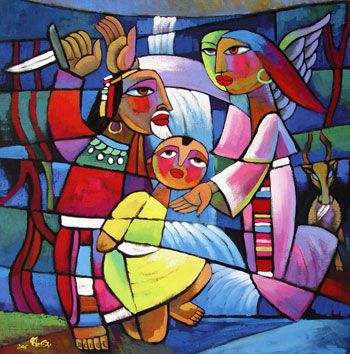
Sacrifice of Abraham by He Qi

By faith Abraham, when God tested him, offered Isaac as a sacrifice. He who had embraced the promises was about to sacrifice his one and only son, even though God had said to him, “It is through Isaac that your offspring will be reckoned.” Abraham reasoned that God could even raise the dead, and so in a manner of speaking he did receive Isaac back from death.

By faith Isaac blessed Jacob and Esau in regard to their future.

By faith Jacob, when he was dying, blessed each of Joseph’s sons, and worshiped as he leaned on the top of his staff.

By faith Joseph, when his end was near, spoke about the exodus of the Israelites from Egypt and gave instructions concerning the burial of his bones. (New International Version)

Life requires faith.

To keep going, to endure and persevere, demands sustained faith over the course of a lifetime.

Faith is confidence in what we hope for and assurance about what we do not see. (Hebrews 11:1)

The biblical character, Abraham, let faith shape his actions. He obeyed God’s call on his life and left his home country to go somewhere he knew nothing about. And he did it with no GPS and no AAA tour books.

Even thought Abraham had a good life in his home city of Ur, he left, believing there was something better ahead.

After reaching the land which God led them to, Abraham, age 100 and his wife, Sarah, age 90, became parents. It happened because of faith. The two of them believed God’s promise of a child, even though it was biologically impossible.

Abraham kept his faith over the long haul of his life. He did it by looking ahead to the eternal city. Because Abraham had looked ahead on this earth and stepped out in faith, he was able to clearly discern that all his faith eggs were not in the earthly basket.

Against all odds, Abraham was convinced God was good for his promises and knew what he was doing.

Trust in the Lord with all your heart,
And lean not on your own understanding;
In all your ways acknowledge Him,
And He shall direct your paths.

Proverbs 3:5-6, NKJV

Isaac was the miracle child, the promised son born to Abraham and Sarah in their old age. One day, God came along and gave Abraham a very strange command: Take your son, the child of the promise, and go to the mountain and sacrifice him there. (Genesis 22:1-19)

“Huh? What the @#$&*!!” we might say. But it only seems perplexing and weird to us. Abraham listened and obeyed. He simply went about the business of saddling up the donkey, chopping some wood for the sacrifice, and took his only son with him on the journey to the mountain – with no questions or talk back to God.

While you and I might try and figure out if we really heard God or not, Abraham had a history of faith with God. He knew God’s voice as well as he knew his own. Abraham was well down the road of relationship with the God he served.

Today’s New Testament lesson gives us an insight into Abraham’s thought process, a line of thinking consistent with a person who has a regular habit of talking with God. Abraham was willing to follow through with sacrificing his beloved son because he was sure that God could raise people to life. Abraham believed death would not have the last word.

Abraham did not try and figure out God’s mind. He didn’t get into a debate with God about the contradiction of ethics he was being asked to do. He just obeyed. Abraham reasoned that it didn’t matter if Isaac were killed because God could raise him from death. This, of course, is not what happened. It was all a test of faith. Abraham knew beyond a shadow of a doubt that God is the Lord who provides.

You and I rarely know why we are facing the unwanted circumstances we are enduring. We don’t always know what in the world God is thinking. Yet, like Abraham, if we have a spiritual history of walking with God and hearing the Lord’s voice, we don’t hesitate to respond. We are convinced God will provide.

Obedience for the follower of Christ is not a burden but a privilege, even when we are being tested beyond our seeming emotional ability to do it.

Grant, O God, that we may never lose our way through self-will, and so end up in the far countries of the soul. May we never abandon the struggle, but endure to the end, and so be saved. May we never drop out of the race but press forward to the goal of our high calling. May we never choose the cheap and temporary path but let go of all but you. May we never take the easy way and never forget that sweat is the price of all things, and that without the cross, there cannot be the crown.

So, keep us and strengthen us by your grace so that no disobedience, weakness, or failure may stop us from entering into the blessedness which awaits those who are faithful in all the changes and chances of life, through Jesus Christ our Lord. Amen