Lessons From a Genealogy (Ruth 4:18-22)

Now these are the descendants of Perez: Perez became the father of Hezron, Hezron of Ram, Ram of Amminadab, Amminadab of Nahshon, Nahshon of Salmon, Salmon of Boaz, Boaz of Obed, Obed of Jesse, and Jesse of David. (New Revised Standard Version)

No, I didn’t make a mistake about what the verses are for today from the Revised Common Lectionary. Yes, the Old Testament lesson is a brief genealogy. And yes, there is something to learn from this.

The Bible contains a lot of genealogies. Although they may be boring, with names we have difficulty pronouncing, every genealogy serves the same purpose that it does for your own family history.

Genealogies remind us of our connection with past generations. And this interconnectedness has influenced us in profound ways. You and I are the result of what history has produced. We are who we are, to a significant degree, because of the people who came before us.

By listing someone’s descendants in writing, it indicates an ongoing developing story which has happened, and continues to develop up to the present time, and even into the future.

One aspect about biblical genealogies that must be noted: Ancient compilers of genealogical lists did not often include every single person in the genealogy. They typically listed the more significant persons, and left out persons who barely dented history.

That’s because the biblical writer’s purpose in giving a genealogy was not necessarily to be exact and precise about each individual past actor. Rather, the writer usually has a moral and/or theological reason for providing the list.

For the writer of the Book of Ruth, the reason for this genealogy was to establish the bloodline and pedigree of King David. Perez was a son of the patriarch Judah (and Tamar). Boaz was a descendant of Judah. Boaz married Ruth, and they had a son, Obed, who was the grandfather of David.

I hope that you see the grace in every biblical genealogy. Including in our genealogy for today, we have two women, Tamar and Ruth. Both of them were unlikely candidates for producing a king. And even more unlikely to be included in greatest Christian genealogy of them all, the lineage of Jesus (Matthew 1:1-17)

The Gospel writer Matthew included in his genealogical list a note about Boaz. He was the son of Rahab. Yes, the same Rahab who was the prostitute in Jericho, and became a faithful woman included in God’s covenant community. (Matthew 1:5-6)

Ruth was a “heathen” woman from Moab, a nation which historically was hostile to Judah. Yet, through her own pious actions, Ruth became a worthy member of Judah, and listed as a great mother of the Jewish people.

The brief genealogy we have here is a part of an historical continuity in God’s covenant community. From Abraham to Judah to David to Jesus, and to the Christian Church, this both literal and spiritual heritage is brought about through a daughter-in-law of Naomi the Jew, Ruth.

None of us are truly alone. We are all connected as people. And Christians are spiritually linked to the covenant as God’s people, by faith.

Just as Abraham “believed God, and it was reckoned to him as righteousness,” so, you see, those who believe are the descendants of Abraham. And the scripture, foreseeing that God would reckon as righteous the gentiles by faith, declared the gospel beforehand to Abraham, saying, “All the gentiles shall be blessed in you.” For this reason, those who believe are blessed with Abraham who believed. (Galatians 3:6-9, NRSV)

This connection to the past, prevents us from having an over-individualistic faith in God and relationship to the Lord. We belong to the historical and worldwide communion of saints. We, both personally and communally, belong to God.

For the writer of the Book of Ruth, history is important. Genealogy is significant. God’s covenant matters. The Church’s life is bound up in the person of Christ, in King Jesus, Son of David, Son of Boaz and Ruth, Son of Abraham.

Not only do we belong to God, but we also belong to one another. We belong to ordinary people who showed extraordinary faith.

And it is through ordinary people that God works out divine purposes on this earth for the common good of all people.

We have many grandparents in the faith. We are linked to them by faith. There is a mystical spiritual connection that we enjoy with them. And that connection is shared with others of the faith, as well.

For by the grace given to me I say to everyone among you not to think of yourself more highly than you ought to think but to think with sober judgment, each according to the measure of faith that God has assigned. For as in one body we have many members and not all the members have the same function, so we, who are many, are one body in Christ, and individually we are members one of another. (Romans 12:3-5, NRSV)

Blessed Christ, you do not call us servants, but friends—companions on this mission to see love, peace, and hope made known. You do not leave us to fend for ourselves, but invite us into community with you and others. Draw us closer to you and one another, and help us to become companions and confidants in our collective journey of faith and perseverance. Amen.

Visible Signs of Invisible Realities (Hebrews 9:15-24)

For this reason Christ is the mediator of a new covenant, that those who are called may receive the promised eternal inheritance—now that he has died as a ransom to set them free from the sins committed under the first covenant.

In the case of a will, it is necessary to prove the death of the one who made it, because a will is in force only when somebody has died; it never takes effect while the one who made it is living. This is why even the first covenant was not put into effect without blood. When Moses had proclaimed every command of the law to all the people, he took the blood of calves, together with water, scarlet wool and branches of hyssop, and sprinkled the scroll and all the people. He said, “This is the blood of the covenant, which God has commanded you to keep.” In the same way, he sprinkled with the blood both the tabernacle and everything used in its ceremonies. In fact, the law requires that nearly everything be cleansed with blood, and without the shedding of blood there is no forgiveness.

It was necessary, then, for the copies of the heavenly things to be purified with these sacrifices, but the heavenly things themselves with better sacrifices than these. For Christ did not enter a sanctuary made with human hands that was only a copy of the true one; he entered heaven itself, now to appear for us in God’s presence. (Hebrews 9:15-24)

The Hebrew Christians were tired. They had faced adverse circumstances, unjust imprisonments, persecution, prejudice, confiscation of their property, and public ridicule.

Most of all, they encountered rejection from their Jewish families of origin. There was precious little support for them, outside of their group.

The suffering went on long enough that the Christians began to experience a weakening of faith. In their distress, they started considering whether to return to Judaism, and renege on their commitment to Christ.

The author of Hebrews saw the struggle and spoke up, encouraging and exhorting the believers to keep going, to exercise faith and perseverance in the face of their ongoing troubles.

The author’s overall message to the discouraged believers was that Jesus Christ is superior over everything and everyone. Christ is better than the angels, Moses, and Aaron. Jesus is the ultimate high priest who offered himself as a sacrifice, once for all.

By means of the cross, Jesus became the mediator of a new and better covenant. There is, therefore, no more need of another high priest. Christ now occupies that office permanently.

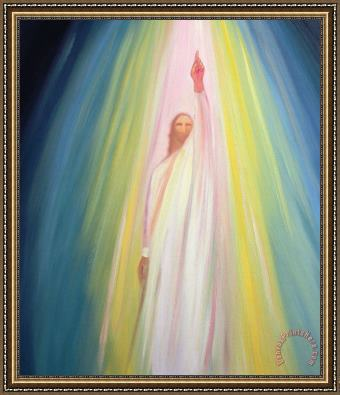
Jesus Christ Points us to God, by Elizabeth Wang

Christ’s death was efficacious for all. The sacrificial system with all of the officiating Levitical priests was the old order of things, meant to point us to Christ.

Offering sacrifices day after day, and engaging in prescribed liturgical rituals in order to access God, are no longer necessary. Perpetual anxiety exists wherever people keep wondering if they have done enough to satisfy their guilt and/or responsibility.

The answer of Christianity is yes, the work is finished; Jesus completed it, once and for all.

There is no longer anything that can distress us. Sin, death, and hell have been conquered through the death of Christ. His singular sacrifice has achieved victory over the sinful powers, and reconciliation and peace with God.

Blessed is the one
    whose sin the Lord does not count against them
    and in whose spirit is no deceit. (Psalm 32:2, NIV)

The covenant code’s sacrificial system was never designed to be a permanent way of doing things. All of the implements used in that system were symbols pointing to the real deal. They were a temporary means of leading people to Christ, who is the once for all sacrifice to end all sacrifices, the one who truly takes away our guilt and shame forever.

The picture is of Christ, as our high priest, who sprinkled us with his own blood and made us clean – not only today or for some temporary period of time – but for all time. We are not only made clean; we are made clean forever by the blood of Christ.

Cleanse me with hyssop, and I will be clean;
    wash me, and I will be whiter than snow. (Psalm 51:7, NIV)

The historical person of Jesus – his life, ministry, crucifixion, death, resurrection, ascension and glorification – was a visible image showing us the great importance of invisible realities.

The Ark of the Covenant was a visible sign of God’s invisible presence, and the need for a restoration of the divine/human connection.

The temple, the worship implements, and the whole sacrificial system was a visible sign of God’s invisible holiness, and the need for purity of heart amongst the people.

Jesus was a real person with a real body and real human needs, a visible reality which showed us the invisible God, and what God truly deems as right and good.

It is Jesus Christ, the Son of God and Son of Humanity, in whom we have redemption the forgiveness of sins. He is the image of the invisible God. (Colossians 1:14-15)

Christ is our Mediator, bridging the gap between heaven and earth.

Christ is our Savior, delivering us from our guilt and shame, our worry and anxiety, and our old enemy, death itself.

Christ is our Advocate, stepping in and acting on our behalf, and sending the Holy Spirit to be his continuing presence on this earth.

Christ is our champion, the pioneer of our salvation, securing redemption for us through his singular death.

Christ is our Intercessor, who even now lives to intercede for us, as we strive and struggle to live in humility, justice, and righteousness, as peacemakers in this world.

What this all means, from the vantage of Christianity, is that we need Jesus.

Without Christ, there is no hope. With Christ, all things are possible.

Jesus is the answer to every question, because Jesus is the center of all things. He is the fertile soil from which all of life sprouts; the first-fruit which provides life; and the continuing sustenance which saves us from a disconnected, fragmented, discouraging existence.

Along with the ancient Hebrew Christians, let us be encouraged with Christ, who is truly our everything.

Accept, O Lord, our thanks and praise for all that you have done for us. We thank you for the disappointments and failures that lead us to acknowledge our dependence on you alone.

Above all, we thank you for your Son Jesus Christ; for the truth of his Word, and the example of his life; for his steadfast obedience, by which he overcame temptation; for his dying, through which he overcame death; and for his rising to life again, in which we are raised to the life of your kingdom.

Grant us the gift of your Spirit; that we may know you and make you known; and through your Spirit, at all times and in all places, may give thanks to you in all things. Amen.

A Reason To Hope (Ruth 2:15-23)

When she got up to glean, Boaz instructed his young men, “Let her glean even among the standing sheaves, and do not reproach her. You must also pull out some handfuls for her from the bundles and leave them for her to glean, and do not rebuke her.”

So she gleaned in the field until evening. Then she beat out what she had gleaned, and it was about an ephah of barley. She picked it up and came into the town, and her mother-in-law saw how much she had gleaned. Then she took out and gave her what was left over after she herself had been satisfied. 

Her mother-in-law said to her, “Where did you glean today? And where have you worked? Blessed be the man who took notice of you.”

So she told her mother-in-law with whom she had worked, saying, “The name of the man with whom I worked today is Boaz.” 

Then Naomi said to her daughter-in-law, “Blessed be he by the Lord, whose kindness has not forsaken the living or the dead!” Naomi also said to her, “The man is a relative of ours, one of our nearest kin.”

Then Ruth the Moabite said, “He even said to me, ‘Stay close by my young men until they have finished all my harvest.’ ” 

Naomi said to Ruth, her daughter-in-law, “It is better, my daughter, that you go out with his young women, otherwise someone might bother you in another field.” 

So she stayed close to the young women of Boaz, gleaning until the end of the barley and wheat harvests, and she lived with her mother-in-law. (New Revised Standard Version)

Ruth was both a widow and a foreigner from Moab. She and her mother-in-law Naomi had no land. Widowed foreign women were likely to be poor. They were vulnerable to abuse by being out in the fields during harvest time, trying to glean whatever leftovers they could find after the harvesters came through.

The covenant code of Israel prescribed laws concerning how to treat the poor. There was even instruction on what to do in just such a situation of the landowning harvester Boaz and the poor gleaner Ruth:

“When you reap your harvest in your field and forget a sheaf in the field, you shall not go back to get it; it shall be left for the alien, the orphan, and the widow, so that the Lord your God may bless you in all your undertakings. When you beat your olive trees, do not strip what is left; it shall be for the alien, the orphan, and the widow.

“When you gather the grapes of your vineyard, do not glean what is left; it shall be for the alien, the orphan, and the widow. Remember that you were a slave in the land of Egypt; therefore I am commanding you to do this. (Deuteronomy 24:19-22, NRSV)

The law stipulated a spirit of generosity toward the poor in the land. The reason for the law is that the Israelites had been slaves in Egypt, and experienced the cruelty of abusive slavedrivers. Israel was to remember this, and ensure that no foreigners would experience what they themselves had to go through for 400 hundred years in Egypt.

Ruth gleaning, by James Tissot, c.1898

Fortunately for Ruth, Boaz was an observant Jew, concerned for the intent and spirit of God’s law. He held to the covenant law both legally and spiritually.

Boaz remembered God’s grace to Israel. He blessed Ruth, and commended her for placing herself in God’s hands.

If not for the covenant code’s opportunity for the poor to glean, Boaz would have faced a dilemma. Once he became aware Ruth and Naomi’s poverty, he surely would not have let them starve. Yet, neither would he likely have made them dependent upon himself.

It is important to preserve the dignity of people, which is why the Old Testament is filled with social and economic laws concerning the poor in Israel.

Ruth was given the chance to glean and work for the harvest. This allowed her to use the grain for making bread. Furthermore, her own labor freed herself and her mother-in-law from being dependent as beggars. All of this helped make the two of them less vulnerable to exploitation by those with little concern for God’s covenant code.

Rather than being smothered either by sheer dependency, or through being used and exploited, God’s law operated as intended, thanks to the pious concern of Boaz.

This did not go unnoticed by Naomi. She clearly saw the gracious hand of God acting through Boaz.

Regardless of who we are, whether rich or poor, old or young, we can be gracious. We can commit ourselves to working hard for one another. We can be concerned for the common good of everyone.

God’s grace turns our hearts and minds, our heads and hands, toward ensuring that all persons have what they need to grow, thrive, and flourish in this life. This is exactly what biblical justice is all about. It’s what Boaz was about.

This will include concerns about equity. A just society will involve some sort of distribution of resources. It will mean making sure that our collective values, communal priorities, and social structures uphold the inherent dignity of human life. We will protect the most vulnerable among us.

A culture attuned to grace will champion the underprivileged and not use them as political pawns to achieve personal goals. A people focused on grace will place faith in God’s presence and provision for us all.

Those with much will care for the disadvantaged, and will uphold laws that do so. Those with little will take advantage of opportunities to both receive and give, and will make their voices heard on behalf of the needy.

Since God is just toward all, so we who are created in God’s image are to also be just.

Since God is good in all that God does, we too, are to be good.

Since God is gracious, merciful, and kind to the poor, so we are to be full of grace, mercy, and kindness.

Since God is love, so we are to love, not hate.

Faith and hope are born within the heart, because there is a reason to do so. Let us all be the people who give others a reason to trust God, hope for a better tomorrow, and love, despite any unloving situations.

Soli Deo Gloria

Showing Kindness (Ruth 2:10-14)

Calling in the Gleaners, by Jules Breton, 1859

Then she fell prostrate, with her face to the ground, and said to him, “Why have I found favor in your sight, that you should take notice of me, when I am a foreigner?” But Boaz answered her, “All that you have done for your mother-in-law since the death of your husband has been fully told me, how you left your father and mother and your native land and came to a people that you did not know before. May the Lord reward you for your deeds, and may you have a full reward from the Lord, the God of Israel, under whose wings you have come for refuge!” Then she said, “May I continue to find favor in your sight, my lord, for you have comforted me and spoken kindly to your servant, even though I am not one of your servants.”

At mealtime Boaz said to her, “Come here and eat some of this bread and dip your morsel in the sour wine.” So she sat beside the reapers, and he heaped up for her some parched grain. She ate until she was satisfied, and she had some left over. (New Revised Standard Version)

Ruth and her mother-in-law Naomi were widows, living in the land of Moab. But Naomi decided to go back to Judah, to her hometown of Bethlehem. She and her husband had originally left because of a great famine.

Naomi had encouraged Ruth to remain in her own country, among her own people. But Ruth insisted on remaining and being with Naomi. But just because the two of them had each other, and they were in Naomi’s native land, it did not mean things were going to be easy or better.

The truth was that that Ruth and Naomi had next to nothing. It was common that during the harvest, the less fortunate folk would walk a ways behind the workers who were gleaning the fields, in order to pick up what was left behind.

Picking up after the workers in the field is precisely what Ruth went out to do. Naomi was too old for the work, so it was up to Ruth. The field that Ruth ended up walking, belonged to a man named Boaz.

Depending upon the owner of the land, the poor folk who came to walk the fields were treated either with kindness or contempt. Boaz was the sort of person who was attentive to God’s law, and sought to do what was right. He knew what Torah said:

“‘When you reap the harvest of your land, do not reap to the very edges of your field or gather the gleanings of your harvest. Leave them for the poor and for the foreigner residing among you. I am the Lord your God.’” (Leviticus 23:22, NIV)

Boaz had taken notice of Ruth. He approached her and told her to remain in his field and stay close to his workers. Boaz also commented to Ruth that he instructed the young men working for him to leave her alone and not bother her. He let Ruth know that she could drink from the vessels appropriated for his laborers.

This was a kindness which was overwhelming to Ruth. As a foreigner and a widow, she was not expecting anything from anyone in Judah. And yet, here is this man extending mercy to her.

One of the reasons Boaz showed kindness to Ruth is because he had heard about her commitment to Naomi, and admired her courage and spunk in coming to a land which was not her own.

Indeed, the picture we gain is that Ruth was a modest and faithful person, upright, diligent, and full of kindness. She understood who she was, where she was, and she was willing to do whatever she could for the sake of her dear mother-in-law.

Ruth had faith that Naomi would lead her well, and to a life of commitment to both God and God’s people. Ruth’s bravery and willingness to submit to Naomi is a beautiful portrayal of faith, hope, and love.

We can be inspired from such courage. For we, too, must take risks and allow ourselves to venture out into places we aren’t familiar with.

We will do well to understand that it was Ruth’s willingness to act, and her commitment to the life she chose, that helped bring about a family and an adopted community which she did not think possible.

It would be good for each of us to take the time to get a long look at our own lives. We must decide what risks we will take, and which things to avoid, and then go out in faith and perform those actions to the best of our ability, and with the grace which God grants us.

In stepping out and acting with kindness and commitment, Ruth discovered God’s care when she and Naomi were in poverty.

The blameless spend their days under the Lord’s care,
    and their inheritance will endure forever.
In times of disaster they will not wither;
    in days of famine they will enjoy plenty. (Psalm 37:18-19, NIV)

Boaz eventually found the blessing of family through his own act of kindness toward Ruth. He was well-off and had plenty, yet he used his privilege to bless others.

Command those who are rich in this present world not to be arrogant nor to put their hope in wealth, which is so uncertain, but to put their hope in God, who richly provides us with everything for our enjoyment. Command them to do good, to be rich in good deeds, and to be generous and willing to share. In this way they will lay up treasure for themselves as a firm foundation for the coming age, so that they may take hold of the life that is truly life. (1 Timothy 6:17-19, NIV)

So, whether we are poor or rich, underprivileged or privileged, we all can find ways to show kindness and live on this earth in peace and goodwill.

How, then, will you live?

O Lord, give me strength today to show kindness in all that I do. Help me to open my arms to those less fortunate and extend my hand to those who may need it, so that they may see You in my kind words and actions. Amen.