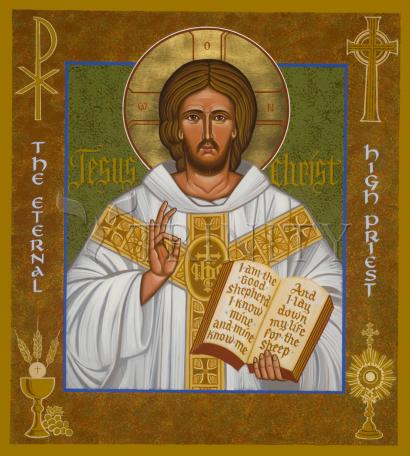
Hebrews 4:12-16 – Jesus Is Our Great High Priest

Jesus, the Eternal High Priest, by Joan Cole

For the word of God is alive and active. Sharper than any double-edged sword, it penetrates even to dividing soul and spirit, joints and marrow; it judges the thoughts and attitudes of the heart. Nothing in all creation is hidden from God’s sight. Everything is uncovered and laid bare before the eyes of him to whom we must give account.

Therefore, since we have a great high priest who has ascended into heaven, Jesus the Son of God, let us hold firmly to the faith we profess. For we do not have a high priest who is unable to empathize with our weaknesses, but we have one who has been tempted in every way, just as we are—yet he did not sin. Let us then approach God’s throne of grace with confidence, so that we may receive mercy and find grace to help us in our time of need. (New International Version)

Church Persecution and Christian Suffering

The book of Hebrews was originally a sermon preached to a group of believers who had come to Christ out of Judaism. From the book of Acts, we know there were thousands of Jewish Christians who were dispersed from Jerusalem when Stephen was martyred.  A great persecution broke out, and many believers fled west to places like Galatia, Ephesus, Greece and Rome. 

The Jewish believers were immigrants in a foreign land, looking to practice their faith without harm. Yet, their experience was anything but ideal. These followers of Christ found fellow ethnic Jews in the places where they went, yet those Jews had no use for these people that they believed were in some sort of aberrant cult.

What is more, the surrounding Gentile culture did not understand Christianity, at all, and many of those who held to pagan religions bought into rumors, such as, that Christians were cannibals who ate at what’s called the Lord’s Table.

So, here we have a situation where these displaced Christians had no respect from both Jews and Gentiles. As a result, they had a difficult time carrying out business because no one trusted them. They were essentially alone in the world. 

Losing Their Grip

Initially, they embraced their identity as Christians and held up quite well under the stress. However, over time, their resolve began to slowly erode. The followers of Jesus began to question their adverse situation. 

They began listening to their fellow Jews throw doubts on their faith. The hard life was not improving, maybe even becoming worse.  Eventually, the church came to a point where they began re-considering their whole way of life as Christians, and their faith commitment started slipping. The Christians actually considered leaving the Church and Christianity and going back to their old life in Judaism.

The Message of Hebrews

It was at this point that a vigorous believer in Jesus came to town, saw the situation of the church, and preached a spirited message to them. The preacher called them to hold tight to their commitment – to see Jesus afresh and anew as superior over all the Old Testament, as the fulfillment of all the promises of God. 

So, then, throughout the book of Hebrews we have this wonderful explanation and exposition of how to make sense of Jesus and the Old Testament, and of what Jesus really means to the church. Throughout his sermon, the preacher occasionally paused his teaching and gave the people a stiff warning about falling away from Christ. He called the church to be bold and confident in Christ, to stand up to the suffering, and to confront their temptations so that they would persevere in their commitment to Jesus Christ for the rest of their lives.

God’s Word and Work

We pick up the teaching and the exhortation in chapter four. Hebrews 4:12-16 is composed of two distinct sections that are paired together for a reason.  Verses 12-13 give us a graphic visual of the penetrating work of God’s Word, of the reality that God can get deep inside us. The next section, verses 14-16, lays out God’s response to our being under divine scrutiny – that there is grace and mercy available because of Jesus, our great high priest who is superior to every priest of the Old Testament to the point of being the last and permanent priest forever! 

These verses are bound together because we all need to struggle with the tension between God’s Word to us, and our words to God; between God’s judgment that opens our souls on a spiritual operating table, and God’s grace which jumpstarts our broken hearts. Our most fundamental need is for God’s mercy in Jesus Christ.

The Christian Life

It is important that our outer lives and our inner lives match each other. Whenever the two are out of sync, we come under the judgment of God’s Word. These early Hebrew Christians had slowly drifted from the truth so that their inner and outer lives did not line up well.

Some of them still performed the outward duties of being a Christian yet were inwardly despising their hard situation. A growing vacuum developed on their insides as they slowly started letting go of Jesus as their object of devotion. Their hearts began to harden because of their hard lives. 

On the other hand, there were other Hebrew Christians who began drifting in a different way. Inwardly, they tried to maintain their devotion and commitment to Christ. Yet these believers began compromising their outward life to match the culture around them. In both cases of hardening inwardly, and of compromising outwardly, they each shared the situation of drifting away from their original commitment to Christ.

Even today, it is a real temptation to try and avoid suffering, to grow weary of our present circumstances and look for a way to get out from under the pain and find a quick fix.  Whenever we find ourselves in such a situation, the remedy is to be reminded that we must continue to hold firmly to the faith we profess because of who Jesus is.

15th Century Orthodox icon of Christ the Great High Priest

Jesus As Permanent High Priest

Jesus is our great high priest. In the Old Testament, among the twelve tribes of the ancient Israelites, the tribe of Levi made up the class of priests. One of those Levites, always a descendent of the original Levite priest, Aaron, had the task of once a year entering a place called the Holy of Holies, which was at the center of the Temple, to offer a bloody sacrifice on behalf of the people, to atone for their sins from the previous year.

Jesus is our great and ultimate high priest. He did not enter the temporary sacrificial system to deal with sins for only a year. Jesus not only took on the role of high priest, but became the sacrifice, as well. As a result, we now have a thorough and permanent forgiveness of sins through Christ. So, the Hebrew Christian who considered going back to an old outdated system needed to be brought back to his senses and embrace again the once-for-all sacrifice of Jesus. 

As they considered Jesus, the believers needed to remember that Christ was not so far removed from them that the church could not relate to Jesus. Rather, Jesus is able to sympathize with each and every trouble, trial, and temptation we face because he faced the very same kind of sufferings. 

The only difference between Christ and his followers is that Jesus did not succumb to the trouble, but persevered and secured for us deliverance from sin, death, and hell. Jesus is the One who deserves every bit of our commitment, allegiance, and devotion. Christ is the One whom we are to worship inside and out.

Approaching God with Boldness

Let us then approach Jesus with confidence, with boldness, knowing that with him there is mercy and grace. Jesus not only suffered for us in the past; he also suffers with us now, in the present. We, as believers, are in union with Jesus. Christ is our great high priest, the One intimately involved in every nook and cranny of our lives. He knows what you and I are going through and is ready to give grace to help right now. 

Approaching Jesus has nothing to do with being good enough to do so. Coming to Jesus is about grace. Whenever we drift from Jesus and are confronted with God’s Word cutting us to the heart, the end result is not wrath or judgment; the result is mercy and grace.

Like the early Hebrew Christians, we all face situations out of our control that wear us down and cause us to become weary. In our tired state, we can be tempted to let our commitment to Christ slide in some small way. Over time, the small compromises of faith can snowball into a big slide away from God. 

Yet, Jesus is not sitting in heaven frustrated or confounded. God is not looking for a reason to punish people. It is just the opposite. Jesus, the Son of God, our great high priest, is looking for a reason to give grace and help us in our time of need. Christ is waiting for us to approach the throne of grace with confidence. Right now, Jesus is alive. He is scanning the world and the church, looking to extend mercy to those who need it. 

Asking for Help

We must avoid a spiritual hardening of heart which estranges us from approaching Jesus. Every one of us needs help. We are not God. We have weaknesses. We have confusion. We have limitations of all kinds. We need help.  And every one of us has something else: guilt and shame. At the bottom of our hearts, we feel undeserving, and so, avoid coming to Jesus. Yet, we need with family, loneliness, work, health, finances.

So, what to do? I can try to deny it all and be a superman who doesn’t need any help. I can try to drown it all with alcohol. I can be obsessive and compulsive about controlling events and/or people. I can simply succumb to discouragement. Here is what God declares: Jesus Christ became a High Priest to shatter despair with hope, to rescue that drowning person and that anxious individual.

God planned for a High Priest, a Savior, a Redeemer, and a gracious Helper. You and I are not trapped. We have Jesus. 

The book of Hebrews is all about a call to commitment – an invitation to come to Jesus.  And it is the most important invitation you will ever receive. Let us approach the throne of grace with confidence….

This is the confidence we have in approaching God: That if we ask anything according to his will, he hears us.  And if we know that he hears us – whatever we ask – we know that we have what we asked of him. Spirit of God, lead us into your will. Help us in all things. Fill our hearts and lives to overflowing with divine mercy and grace so that what comes out of our mouths and the actions we do are compassionate, kind, and good, through our great High Priest, Jesus Christ. Amen.


Psalm 22:1-15 – Responding to Trouble

My God, my God, why have you forsaken me?
    Why are you so far from helping me, from the words of my groaning?
O my God, I cry by day, but you do not answer;
    and by night but find no rest.

Yet you are holy,
    enthroned on the praises of Israel.
In you our ancestors trusted;
    they trusted, and you delivered them.
To you they cried, and were saved;
    in you they trusted, and were not put to shame.

But I am a worm, and not human;
    scorned by others, and despised by the people.
All who see me mock at me;
    they make mouths at me, they shake their heads;
“Commit your cause to the Lord; let him deliver—
    let him rescue the one in whom he delights!”

Yet it was you who took me from the womb;
    you kept me safe on my mother’s breast.
On you I was cast from my birth,
    and since my mother bore me you have been my God.
Do not be far from me,
    for trouble is near
    and there is no one to help.

Many bulls encircle me,
    strong bulls of Bashan surround me;
they open wide their mouths at me,
    like a ravening and roaring lion.

I am poured out like water,
    and all my bones are out of joint;
my heart is like wax;
    it is melted within my breast;
my mouth is dried up like a potsherd,
    and my tongue sticks to my jaws;
    you lay me in the dust of death. (New Revised Standard Version)

Christians readily recognize the beginning question of this psalm. Jesus asked it from the cross (Matthew 27:46). Today’s psalm is a heartfelt lament, an affirmation of trust, a call for help, and vow to praise.

Lament

Grieving and lamenting is neither selfish nor sinful. It is necessary. God did it. Job did it. Jesus did it. And the psalmist did it – repeatedly, I might add. So, we ought to do it. It’s biblical. Part of our hard-wiring as humanity is to lament our significant changes and losses in life.

Some folks believe it sacrilegious to challenge, complain, and/or yell at/to God. However, God is big enough to handle our contentions. There are times in life when God seems very distant and aloof, as if the Lord is not paying attention to our plight and pain.

Three of Job’s friends heard of all the trouble that had fallen on him. Each traveled from his own country—Eliphaz from Teman, Bildad from Shuhah, Zophar from Naamath—and went together to Job to keep him company and comfort him. When they first caught sight of him, they couldn’t believe what they saw—they hardly recognized him! They cried out in lament, ripped their robes, and dumped dirt on their heads as a sign of their grief. Then they sat with him on the ground. Seven days and nights they sat there without saying a word. They could see how rotten he felt, how deeply he was suffering. (Job 2:11-13, MSG)

Asking “why?” can come from a belligerent heart, or it can arise as a genuine heartfelt expression of hurt, anger, and wondering. One thing us humans need to become comfortable with is that it is okay to not be okay. Not everything needs to be fixed, even though we would like it to.

Yet, if we don’t understand what the heck is going on, and where God is in it all, pouring out a passionate cry is both legitimate and encouraged.

Affirmation of Trust

It helps when we have a track record of God working in the past. Even if that doesn’t include personal experience, we have an entire human history of God’s dealings with individuals and groups of people concerning deliverance, care, and help.

If we have been in the habit of affirming our faith in God through daily prayers and weekly worship, then trust comes more reflexively and organically.

Be merciful to me, O God,
    because I am under attack;
    my enemies persecute me all the time.
All day long my opponents attack me.
    There are so many who fight against me.
When I am afraid, O Lord Almighty,
    I put my trust in you.
I trust in God and am not afraid;
    I praise him for what he has promised.
    What can a mere human being do to me? (Psalm 56:1-4, GNT)

One of the reasons I like saying the ancient Creeds of the Church together with God’s people is that it affirms and deepens my existing faith. To know that millions of Christians throughout the past two-thousand years, as well as the believers around me today, openly confess and affirm their faith with these words, helps strengthen me for the hard times to come.

Call for Help

One of the best prayers we could ever pray is “Help!” For many people, asking for help is a humbling affair. It smacks of weakness, perhaps even neediness – as if it’s a sin to not always be strong or be dependent on another.

Scour both the Old and New Testaments of the Bible and you will not find weakness or dependence to be sin-worthy. It’s just the opposite. Delusions of independence and strength are signs of misplaced pride which believes we ought to be able to handle any situation. God wants us to ask for help when we need it.

The wicked are too proud to ask God for help. He does not fit into their plans. (Psalm 10:4, ERV)

Ask and it will be given to you; seek and you will find; knock and the door will be opened to you. (Matthew 7:7, NIV)

I will do whatever you ask for in my name, so that the Father’s glory will be shown through the Son. If you ask me for anything in my name, I will do it. (John 14:13-14, GNT)

If you need wisdom, ask our generous God, and he will give it to you. He will not rebuke you for asking. (James 1:5, NLT)

Vow to Praise

Whenever we go through difficult times and come out the other side, it is important to tell our story. The sharing of stories deepens our faith, as well as edifying others. And then, down the road, when another event upends our life, we can recall the faithfulness of God in the past.

Whom have I in heaven but you?
    And earth has nothing I desire besides you.
My flesh and my heart may fail,
    but God is the strength of my heart
    and my portion forever.

 Those who are far from you will perish;
    you destroy all who are unfaithful to you.
But as for me, it is good to be near God.
    I have made the Sovereign Lord my refuge;
    I will tell of all your deeds. (Psalm 73:25-28, NIV)

There will be pain and suffering. There will also be victory and glory. The ways in which we engage the seasons of hardship will determine the trajectory of our spiritual lives.

Times change. God is forever the same. May we tether ourselves to eternal mercy. Amen.

Hebrews 3:7-19 – Encourage One Another Daily

So, as the Holy Spirit says:

“Today, if you hear his voice,
    do not harden your hearts
as you did in the rebellion,
    during the time of testing in the wilderness,
where your ancestors tested and tried me,
    though for forty years they saw what I did.
That is why I was angry with that generation;
    I said, ‘Their hearts are always going astray,
    and they have not known my ways.’
So I declared on oath in my anger,
    ‘They shall never enter my rest.’ ”

See to it, brothers and sisters, that none of you has a sinful, unbelieving heart that turns away from the living God. But encourage one another daily, as long as it is called “Today,” so that none of you may be hardened by sin’s deceitfulness. We have come to share in Christ, if indeed we hold our original conviction firmly to the very end. As has just been said:

“Today, if you hear his voice,
    do not harden your hearts
    as you did in the rebellion.”

Who were they who heard and rebelled? Were they not all those Moses led out of Egypt? And with whom was he angry for forty years? Was it not with those who sinned, whose bodies perished in the wilderness? And to whom did God swear that they would never enter his rest if not to those who disobeyed? So, we see that they were not able to enter, because of their unbelief. (New International Version)

Although many people do their outdoor grilling with propane and propane accessories, there are still some who go with the old charcoal grill. The key to a good hot grill is in the stacking of the briquettes into a neat pile before lighting them. If this is not done, it is likely the white hot fire will never get going. At the most, the briquettes will become warm but quickly grow cold and die.

The New Testament lesson for today operates with the same principle. We are not to stoke a fire of evil with an unfaithful heart. Instead, we are to gather together with our shared value of Jesus and warmly encourage each other every day so that we don’t become insensitive and cold to God.

Just as a pile of charcoal needs all the individual briquettes together to become hot, so every Christian needs other Christians to speak into their life every day. If this dynamic does not happen, the heart will grow cold and hard. Eventually, if left unchecked, the heart falls away from the faith.

There are some churches around the world which wisely take today’s teaching to heart. They have opportunities every day for believers to gather and encourage one another. Some even provide multiple chances to meet throughout a day.

Early in the morning they come together for prayer and encouragement before going off to their jobs and busy lives. At noon there are bible studies or prayer groups during lunch. And in the evening there is vespers, or some sort of Scripture reflection along with strengthening each other in faith.

There is a reason why many places on this earth have grown hot for God with Christians being added daily. It may be wise and necessary to re-think and re-do our spiritual practices to better accommodate and reflect an obedience to these very verses in the book of Hebrews. Consider just a few ways of potentially doing this:

  • Meet virtually for 10-15 minutes at the same time every morning. Take advantage of shared technology. Read a portion of Holy Scripture and offer a reflection or encouragement. Pray for one another. You might also sing or practice some silence together.
  • Meet physically for 10-15 minutes at either sunrise or sunset every dawn or dusk with some neighbors. Offer prayers of gratitude to God and spend some minutes in worship.
  • Create space in a church building through a church ministry – or in your home with a few friends or family – to read the Daily Lectionary Scriptures or some other plan.
  • Prayer walk through your community or neighborhood with one or two others at the same time every day for a set amount of time.
  • Establish a daily worship service in the church or other gathering place at the same time each day for 30 minutes. It can be as planned or unplanned, as liturgical or free as you like. I suggest a healthy combination of planning and improvising.
  • Get together with some other like-minded believers to brainstorm ideas of what might be helpful to daily encourage each other in the faith.

Whenever we are together as believers in Jesus, it gives us the opportunity to smile and give direct eye contact, listen to each other with focused attention, validate one another’s honest strivings toward the spiritual life, offer gratitude, and acknowledge each person’s gifts, strengths, and abilities.

May you engage in practices which soften and enlarge your heart for each other and for the world, so that a hard small heart might be far from you. Be a white hot believer who burns with grace, mercy, and love for God’s people and God’s world.

Blessed Father, Son, and Spirit – the Holy Trinity whom I serve, I have been made in your image – the image of the triune God. Help me to reflect that image every day by encouraging my fellow believers and allowing them to exhort me toward love and good deeds in the faith of Jesus Christ through the power of the Holy Spirit.  Amen.

Psalm 55:1-15 – Pray as First Response

God, listen to my prayer;
    don’t avoid my request!
Pay attention! Answer me!
    I can’t sit still while complaining.
    I’m beside myself
        over the enemy’s noise,
        at the wicked person’s racket,
        because they bring disaster on me
        and harass me furiously.

My heart pounds in my chest
    because death’s terrors have reached me.
Fear and trembling have come upon me;
    I’m shaking all over.
I say to myself,
    I wish I had wings like a dove!
    I’d fly away and rest.
    I’d run so far away!
    I’d live in the desert.
    I’d hurry to my hideout,
    far from the rushing wind and storm.

Baffle them, my Lord!
    Confuse their language
    because I see violence and conflict in the city.
Day and night they make their rounds on its walls,
    and evil and misery live inside it.
Disaster lives inside it;
    oppression and fraud never leave the town square.

It’s not an enemy that is insulting me—
    I could handle that.
It’s not someone who hates me
    who is exalted over me—
    I could hide from them.
No. It’s you, my equal,
    my close companion, my good friend!
It was so pleasant when
    together we entered God’s house with the crowd.

Let death devastate my enemies;
    let them go to the grave alive
        because evil lives with them—
        even inside them! (Common English Bible)

We all likely know he modern day proverb, “The squeaky wheel gets oiled.” The saying is often used in reference to someone who is loud, even obnoxious, about what they want. 

In today’s psalm, David cannot avoid the squeaky wheel. There are people in his face and all up in his grill. The only thing we know about David’s enemies from the psalm is that they were nursing a grudge against him about something. David was hurt and betrayed.

So, David prayed. He pleaded with God to hear his prayer – to not hide from his plea for mercy. David desperately wanted the Lord to respond to his terrible plight. He couldn’t sleep. He had racing thoughts. He was hyper-vigilant. He was downright anxious. David felt the ache of people speaking against him. For whatever reason, they had an axe to grind and were determined to make David’s life difficult.

Although, like David, we sometimes feel like flying away and being at rest from the turmoil, we must deal with the insults, the false rhetoric, and half-truths of others. 

The way David confronted the problem was primarily through prayer. Whenever David prayed, it was never a quick on-the-run sort of prayer to God in the rush of dealing with all his kingly duties. Instead, David offered specific, agonizing, timely prayers, asking, even begging God to not let the violent speech and actions of his enemies prevail.

David was committed to maintaining peace, equity, and justice in the public square. In those times when injustice reared it’s ugly head, David’s first response was to pray.

Out of the range of possibilities we might do in response to slander, gossip, backbiting, threats, and general sins of the tongue against us, prayer needs to be the primary tool to face it all. Heartfelt, passionate, detailed, and pointed prayers can and must be offered to the God who hears the righteous in their grief. 

If you are in such a position of being oppressed by another, a sage way to begin addressing the situation is through praying the very same psalm that David did when he was under duress.

The biblical psalms are prayers which are meant to be prayed as our own. There is no such thing as praying them too often. It is always open season on praying the psalms for our own contemporary purposes.

The prayers are more than personal. They are public, as well. Violence, strife, iniquity, trouble, oppression, fraud, and injustice effect the entire community. Our prayers can and must include asking God to put an end to all this awful muck.

It’s one thing to have some schmuck we’ve never met make a disparaging social media comment against us, or some random persons spout baseless lies. And it’s quite another thing when it is someone close to us, a trusted friend who turns on us.

God cares about our adverse situations. Unlike fickle friends, the Lord is a faithful companion who will neither leave us nor forsake us. The New Testament affirms and encourages prayer to God in anxious times:

God cares for you, so turn all your worries over to him.

1 Peter 5:7, CEV

Jesus modeled a life of prayer in response to injustice, suffering, and belligerence.

“Into your hands I entrust my life.” (Luke 23:46, CEB)

“I don’t ask you to take my followers out of the world but keep them safe from the evil one.” (John 17:15, CEB)

May we know that loneliness is far from us. God is with us, always and forever. Amen.   

Listening God, you hear the cries of the righteous. Give ear to my plea. I cry out to you for respite from those allayed against me.  I ask for justice in my life and in the public square so that the wicked and the unrighteous do not have their way in this world, through Jesus Christ in the power of the Holy Spirit. Amen.