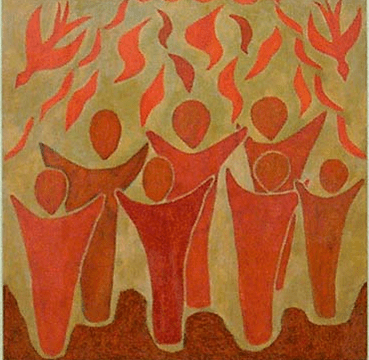
Spiritual Confidence (2 Corinthians 3:4-11)

Such confidence we have through Christ before God. Not that we are competent in ourselves to claim anything for ourselves, but our competence comes from God. He has made us competent as ministers of a new covenant—not of the letter but of the Spirit; for the letter kills, but the Spirit gives life.

Now if the ministry that brought death, which was engraved in letters on stone, came with glory, so that the Israelites could not look steadily at the face of Moses because of its glory, transitory though it was, will not the ministry of the Spirit be even more glorious? If the ministry that brought condemnation was glorious, how much more glorious is the ministry that brings righteousness! For what was glorious has no glory now in comparison with the surpassing glory. And if what was transitory came with glory, how much greater is the glory of that which lasts! (New International Version)

The Christian religious tradition holds to the great Three-in-One of God – God is indivisibly One, and at the same time, a Trinity of Father, Son, and Spirit. Christians typically have no problem expressing their prayers and devotion to the Persons of the Father and the Son, as well as connecting their ministry efforts to them. 

However, when it comes to the Spirit, this Person of the Holy Trinity is often referred to as an “it” or a “force.” Yet, the Holy Spirit is as much God and a Person as the heavenly Father and the Savior, Jesus Christ. The Spirit is the One who provides the guidance and energy for Christian ministry – and not the Law.

We very much need the Holy Spirit of God. Without the Spirit’s help, Jesus is merely looked at as one person out of thousands of individuals crucified in history; and only an example of one who was martyred for his faith. But Jesus is infinitely more than that. 

Christ is the Son of God, the Savior of the world. Through Jesus Christ’s life, death, resurrection and ascension, people can be redeemed from empty lives, saved from destructive life-patterns, and given the kind of security and purpose in life that God intended from the beginning for people to possess. 

And the Spirit of God is the One that takes these redemptive events of Jesus and applies them to our lives. Apart from the Holy Spirit, we are lost, because we are unable to see the genuine spiritual truth about the cross of Jesus Christ unless God the Holy Spirit breaks into our lives and does an intervention – showing us our denial about how we are really doing and our delusions about who we really are (1 Corinthians 2:1-16).

This, then, is the basis for spiritual confidence. And this sort of confidence does not and cannot come from obedience to the Law.

Admitting that we absolutely need the Holy Spirit of God means that the power of Christianity does not reside with me or you; power for the Christian life rests upon Jesus Christ and him crucified, with the Spirit witnessing to us of this truth. 

In other words, we are largely powerless. 

Now, I realize this is not a popular message, especially in Western society. That sounds ridiculous to a particularly can-do kind of people, like most Americans. We believe we’ve done fairly well on our own, thank you very much. A couple of cars, a house, a job, and a family. I work hard. I’ve earned my stuff and my accomplishments. 

But the thing is, any worldly success may lead us to the delusion that we have the power to do what we want – as if I am the sole captain of my soul. I did it. And I did it my way.

“Oh, sure,” many a person may reason, “we have problems just like everybody else. After all, I can’t control everything!” Yet, we are not powerless just because we have difficult circumstances and a few problem people in our lives. “God will step in a take-over where I leave off, right?” Wrong. 

It’s all wrong, because it’s based in one’s effort to obey a personal creed, the rules of the game, or even the Law and the Ten Commandments. But if we could really do it on our own, there’s no need for any of this spiritual stuff.

In truth, apart from the Holy Spirit of God, we are unable to be Christians and live the Christian life. If we think we manage our lives just fine, with a bit of help from God, then we are likely in denial. We are probably placing ourselves at the center of the world; and believe we should be able to deal with whatever comes in life. 

Whenever the consistent response to adverse situations, or the realization that we are not handling something well, is to try and fix ourselves, then we are surely living in the delusion that we hold the power to change – independently without anyone or anything helping us.

If our first reaction to adversity or problems is:

  • Searching Google for more knowledge
  • Dealing privately with personal issues
  • Expecting that willpower should be enough

Then, we are feeding the delusion that we do not really need the Holy Spirit of God; we are actually believing that we need more effort, or information, in order to find the power to overcome whatever is in my life that needs overcoming.   

Unfortunately, it typically takes a tragedy or crisis to break our delusions of power. Let me ask: How bad must we hurt before we admit that we are not managing our lives well at all, and that the real power to change resides with the Holy Spirit?

Our spiritual power and confidence resides in the cross of Jesus Christ, with the Holy Spirit testifying to us of God’s great grace. 

The Apostle Paul believed this with all his heart. Although he was a very intelligent and learned person, he did not rely on his abilities, but on God’s. 

The cross of Jesus is not just an historical event, but an ongoing reality for us to experience victory over all the brokenness of this world, and all the mess we have made of things by putting ourselves at the center of the universe. 

We need the Holy Spirit of God to intervene and apply Christ’s finished work to us. 

None of this means that the Law, or that you, are bad. Both you and the Law are good. It’s just that we, by ourselves, and the Law by itself, are inadequate to save, deliver, and overcome. For that, we need God’s Spirit, and to tap into the spiritual reality that exists.

If the Ten Commandments were introduced with glory, and we ourselves were created with glory, then how much more glory and life is there through an intimate relation with the Spirit?

O God of peace, who has taught us that in returning and rest we shall be saved, in quietness and confidence shall be our strength: By the might of your Spirit lift us, we pray, to your presence, where we may be still and know that you are God; through Jesus Christ our Lord. Amen.

The Pleasing Aroma of Worship (Exodus 30:1-10)

The Altar of Incense, by Erhard Altdorfer (1480-1561)

“Make an altar of acacia wood for burning incense. It is to be square, a cubit long and a cubit wide, and two cubits high—its horns of one piece with it. Overlay the top and all the sides and the horns with pure gold, and make a gold molding around it. Make two gold rings for the altar below the molding—two on each of the opposite sides—to hold the poles used to carry it. Make the poles of acacia wood and overlay them with gold. Put the altar in front of the curtain that shields the ark of the covenant law—before the atonement cover that is over the tablets of the covenant law—where I will meet with you.

“Aaron must burn fragrant incense on the altar every morning when he tends the lamps. He must burn incense again when he lights the lamps at twilight so incense will burn regularly before the Lord for the generations to come. Do not offer on this altar any other incense or any burnt offering or grain offering, and do not pour a drink offering on it. Once a year Aaron shall make atonement on its horns. This annual atonement must be made with the blood of the atoning sin offering for the generations to come. It is most holy to the Lord.” (New International Version)

Worship is intended to engage the whole person, including our five senses. That’s why God instructed Moses to oversee construction of an altar for burning incense. Smells and aroma matter. We associate certain smells with particular times, places, or people. Inhaling the incense signifies and reminds people that God is with us.

Included in the instructions about the altar of incense is about when and where to burn it. The incense was to be utilized just outside the great curtain that veiled the Holy of Holies – which was the place where God met with Aaron the high priest.

The people not only smelled the incense, but could also see the smoke rise – and so be reminded of the great pillar of cloud that went before the Israelites in the exodus from Egypt. The cloud was a visible manifestation and reminder of God’s presence with the people.

Experiencing the smell of the incense and the visual smoke were comforting. It was a spiritual encounter that reinforced and strengthened the faith needed to keep on living for the Lord.

At the same time, the incense smoke highlighted the Holy of Holies curtain in front of the worshiper. Although God is close and near to the people, God is also distant and unreachable.

The Lord is both immanent and transcendent – able to meet us where we are and know our intimate needs. Yet, God is also so far above us – the high and holy God – so as to see the big picture of the world. The Lord knows us and our troubles, and has the perspective and power to do something about it.

The altar of incense with its billowing smoke and sweet smelling aroma was not only pleasing to the people, but also to God. Whenever worshipers present their offerings with joy and gladness on the altar of sacrifice, then the Lord is pleased with their faithfulness.

For example, Noah built an altar to the Lord and provided burnt offerings on it. God smelled the pleasing aroma and was stirred to say:

“Never again will I curse the ground because of humans, even though every inclination of the human heart is evil from childhood. And never again will I destroy all living creatures, as I have done.”

“As long as the earth endures,
seedtime and harvest,
cold and heat,
summer and winter,
day and night
will never cease.” (Genesis 8:21-22, NIV)

Incense and pleasing aromas are not so much the point, but what the smell represents. If we miss this, then worship becomes mechanical, and a primitive way of trying to appease an angry deity. But if we see and smell with spiritual eyes and nose, then we discern and know that our senses are a doorway to connection with God.

Our offerings are acceptable and pleasing when they are offered with sincerity of heart, integrity of spirit, and faithfulness to the God who cares not only about what we do, but why we do it.

A heart inclined toward disobedience, a mind with a bad attitude, and feet that would rather be elsewhere than at the altar, are a noxious smell to God; it is odious to the Lord. But the greatest and sweetest incense is the life offered in faith and devotion to God. In the New Testament, the Apostle Paul commented on the offerings of God’s people:

I now have plenty and it is more than enough. I am full to overflowing because I received the gifts that you sent from Epaphroditus. Those gifts give off a fragrant aroma, an acceptable sacrifice that pleases God. (Philippians 4:18, CEB)

The altar of incense giving off its smell also clued-in the worshiper to the ultimate offering to come. The Apostle Paul pictured the cross of Christ as the greatest and sweetest fragrance of all:

You are God’s dear children, so try to be like him. Live a life of love. Love others just as Christ loved us. He gave himself for us—a sweet-smelling offering and sacrifice to God. (Ephesians 5:1-2, ERV)

All of the offerings in the sacrificial system were designed to be temporary, preparatory, and anticipatory – foreshadowing the day when a final sacrifice and the sweetest fragrance of all would come; a sacrifice to end all sacrifices.

Jesus Christ was the aroma so sweet, so compelling, that we can now offer our incense of faith, hope, and love to the Son of God by taking up our cross and following him.

O Lord, listen to me as I pray. Please hurry and help me! Accept my prayer like a gift of burning incense, the words I lift up like an evening sacrifice. Help me control what I say. And don’t let me say anything bad. Take away any desire to do evil. Keep me from joining the wicked in doing wrong. My Lord God, I look to you for help. I look to you for protection. Amen. (Psalm 141:1-4, 8)

Trust vs. Anxiety (Isaiah 30:15-18)

The holy Lord God of Israel
    had told all of you,
“I will keep you safe
if you turn back to me
    and calm down.
I will make you strong
    if you quietly trust me.”

Then you stubbornly said,
“No! We will safely escape
    on speedy horses.”

But those who chase you
    will be even faster.
As few as five of them,
or even one, will be enough
    to chase a thousand of you.
Finally, all that will be left
    will be a few survivors
as lonely as a flag pole
    on a barren hill.

The Lord God is waiting
to show how kind he is
    and to have pity on you.
The Lord always does right;
he blesses those who trust him. (Contemporary English Version)

God’s plan for our lives calls for times of retreat and renewal, of quiet patience and perseverance, for restraint and waiting.

Ancient Judah was experiencing one of their many periods of rebellion toward God’s commands. One of the things that happens – whether in ancient times or today – is that whenever we go off the road of God’s ways, our lives become characterized by a grand self-help program.

Those in the Judean royal court could not wait on God. They had to do something about Assyria. The Assyrian Empire was waning, and Judah wanted to take advantage of it, seeing an opportunity for some relative autonomy.

So, many of the activists in the royal court rushed to Egypt for help – not at all considering to turn toward God and wait on the Lord. God blesses those who trust and wait on divine promises and initiative. But, in their anxiety, the people of Judah would not exercise faith and patience.

As a result, the enemy would overtake them. The people’s refusal to take the quiet course would not end well for them.

On many days, as I attend to the hospitals for which I work, I visit many hurting people, including patients, their families, and teammates. In my time there, I deal with a vast array of emotional problems, spiritual struggles, and mental disorders. One of things I have discovered through this work is that people’s internal issues absolutely need to be expressed, out loud, to someone who cares and knows what to do with those expressions.

And this is not only a modern problem; the need to deal with our internal stuff has been there throughout all of human history. Every culture and society who does not attend well to personal and communal spiritual health is literally killing their bodies – because body and soul are inextricably connected in a union as one.

It continually amazes me that people who think nothing of going to a medical doctor, an emergency room, or having a surgery, would never think of getting help when their minds are mixed up, emotions are frayed, and spirits are downcast.

Stubbornly holding onto self-help to handle a spiritual crisis, refusing help from others, and ignoring God, is just as sure to kill you as believing that chest pains, shortness of breath, and inability to walk across the room will simply get better on its own.

Conversely, isolating oneself and calling it “waiting on God” and remaining passive – when the Lord has clearly told us to be active – will accomplish the same ends as the committed self-help person. Faith and action are not mutually exclusive terms. It takes some wisdom to know when to retreat, pray, and be patient; and when to take initiatives of faith, and trust God to work through action.

Rebellion gets us nowhere. It’s what puts us in the awkwardness of making bad decisions and discernments. The Lord had told the people of Judah to stay put and not rely on Egypt to help them. There were clear instructions through the prophets about what to do. But the people were too anxious, too impatient, wondering too much about whether God would show up or not.

The Spirit God gave us does not make us afraid. His Spirit is a source of power and love and self-control.

2 Timothy 1:7, ERV

No matter where we have been or what we have done, the Lord is continually waiting on us – and will consistently respond with grace and mercy to our petitions and overtures to live for God. It’s never too late to flee to God in quiet trust.

Running to God is not escaping our problems. Rather, the Lord enables us to face both our outward situations, as well as our inward thinking and feeling. It’s easy to engage in busywork and keep active when we are anxious; yet it is very difficult to sit still before God and be alone. Silence and solitude put us face to face with ourselves. And doing that is what many people would rather avoid.

“I’ll do it myself!” is the cry of many a person who is mentally, emotionally, and spiritually overwhelmed. That approach, however, is a highway to the grave. And, in fact, it is a stubborn rebellion that puts a stiff arm to God.

I’m not saying that opening-up is easy; I am stating that it is necessary to our spiritual and emotional health. It might be helpful to begin communicating with some vulnerability and authenticity to God. The following are some appropriate ways that might help:

  1. Be congruent between the outer self and inner self. Make sure your outside affect and behavior is congruent with your inside feelings and thoughts. If you are discouraged on the inside, but wear a smile and pretend to be spiritually with it, you’re not fooling God. You cannot receive grace apart from humble authenticity.
  2. Focus on feelings. You won’t get struck by lightning if you express your anger, or other emotions, to God. Be aware of how you are feeling. In fact, ask the Lord to help you understand your feelings. Share them openly as much as you can.
  3. Change questions into statements. Sometimes, when we have an attitude or a feeling, we’re afraid to say it and be open. So instead, we ask a question. Try changing questions such as “Do you love me?” into “I love you.” And, “Do you want me to do this?” to “I want to do your will.”
  4. Speak in the first person. Begin sentences with “I” instead of “you,” For example, ” I am happy that you are with me,” instead of asking, “Are you there?”
  5. Say out loud what you really want and need. It’s okay to do that. This is when it is appropriate to ask questions. The Lord’s ear is ready to listen.

Patient and confident trust in God is always a better option than anxious and nervous striving by yourself.

O God, the source of all health: So fill my heart with faith in your love, that with calm expectancy I may make room for your power to possess me, and gracefully accept your healing; through Jesus Christ our Lord. Amen.

Share Your Story (Psalm 107:1-16)

Psalm 107, by Erin Beardemphl

O give thanks to the Lord, for he is good,
    for his steadfast love endures forever.
Let the redeemed of the Lord say so,
    those he redeemed from trouble
and gathered in from the lands,
    from the east and from the west,
    from the north and from the south.

Some wandered in desert wastes,
    finding no way to an inhabited town;
hungry and thirsty,
    their soul fainted within them.
Then they cried to the Lord in their trouble,
    and he delivered them from their distress;
he led them by a straight way,
    until they reached an inhabited town.
Let them thank the Lord for his steadfast love,
    for his wonderful works to humankind.
For he satisfies the thirsty,
    and the hungry he fills with good things.

Some sat in darkness and in gloom,
    prisoners in misery and in irons,
for they had rebelled against the words of God
    and spurned the counsel of the Most High.
Their hearts were bowed down with hard labor;
    they fell down, with no one to help.
Then they cried to the Lord in their trouble,
    and he saved them from their distress;
he brought them out of darkness and gloom,
    and broke their bonds apart.
Let them thank the Lord for his steadfast love,
    for his wonderful works to humankind.
For he shatters the doors of bronze
    and cuts in two the bars of iron. (New Revised Standard Version)

Every person of faith has a story, a testimony of God’s redeeming, saving, and loving deliverance from trouble. And each one of those stories is sacred and special; no one story is better or greater than another. There’s no need, therefore, to act like you’re taking a course in comparative storytelling – as if you don’t have nearly the spiritual testimony of someone else.

The fact of the matter is that there is no trouble like your own personal trouble. Although others can relate to elements of each of our stories, no one else knows what your own experience is like. The old black spiritual is right in saying. “Nobody knows the trouble I’ve seen. Nobody knows but Jesus.”

It’s important to have others empathize with us and help normalize the experience we are going through. It’s necessary to have another validate our emotions and affirm the feelings we’re feeling. And, even after that, there’s nothing quite like a compassionate and caring Being who intimately knows everything about your trouble, how you experience it, and steps-in according to perfect divine timing, to bring uplift, hope, and salvation.

There is such a Being. God. Yahweh. The Lord. Pure Goodness. Redeemer. Savior. And most of all, Lover who is infinite Love with a capital “L.”

Why am I so confident about such a Being as this? Did I take too much methadone? Am I only an old fart who still believes in God? Or perhaps, you think, I’m a weird sort of giddy about God because of the Bible. Well, yes, and no. Scripture – especially the Psalms – just happens to put into words my actual experience and emotions.

But I don’t much care about parsing out whether I’m a deluded metaphysician or a sappy magpie or whatever other label gets affixed to me. It just doesn’t matter – because every epistemic fiber of my lower case being resonates with the upper case Being who bestows steadfast love because that Being’s character is actually made up of Love. It’s as if God is the biggest ultimate Teddy Bear, stuffed with holy love for all creation.

And, what’s more, this God seems to specialize and enjoy paying attention to the least, the lost, and the lowly among us humans. I was once in such a deep, dark, dank, black hole of spiritual nothingness that I knew I could never get out of, that is, on my own. I needed deliverance, or there wouldn’t be any hope whatsoever.

Others have experienced something akin to wandering alone out in a desert spiritual wasteland with no water, no food, no nothing but oppressive heat and loneliness. And others have had the trouble of real flesh and blood people seeking to do them harm, both physically and mentally. Yet others felt like they were bereft of options on a plantation of slavery in which all they could do was work like animals just to survive another day.

What all these persons have in common is that they cried out to the Lord, the maker of heaven and earth. And most of them didn’t just do it once; some cried out until they had no voice and were too weak to even speak anymore.

God showed up. God also showed off. Not only was there deliverance, but there was also an upgrade. For me, it was not like Tim 2.0, but Tim 1,000.0 – a filling of divine grace that goes beyond mere words. Because of God’s grace and love in my own life, it has enabled me to tap into that storehouse of mercy and pray with spiritual confidence.

When my dear wife had a spine surgery several years ago and awoke from it unable to move her legs, I prayed. I asked for mercy. I pleaded for grace. And I did it for hours at the foot of her hospital bed. I remember that I stubbornly would not accept the fact that she could not move her lower body.  And I decided to stand there and pray until I got an answer from God.

Eventually, I prayed myself asleep. My wife woke me up sometime in the early morning the next day. She told me to pull back the covers and look at her right big toe…. She could give it an ever-small twitch. We called the nurse, who was so excited that she called everyone she could get a hold of.

With a dozen hospital staff huddled around the hospital bed, my wife proceeded to give that big toe a hearty move. The staff erupted with clapping, and I am not kidding when I say that we had a party with noise and shouts in a hospital room at 4am. Nobody cared we were going nuts. I certainly did not.

My friend, God is still in the business of answering prayer, of showing up and showing off.

Through the hard times, the good times, and the confusing times, the Lord is our constant ballast for all seasons of life, whether good or bad. And I love God for that abiding presence. I can also give testimony that through all of the adverse situations my wife and I have faced, we have learned to stop, be still, and find that all we ever wanted we already have, even when everything changes.

Psalm 107 lets us know that personal testimony expressed to the community is an important aspect of strengthening everyone’s faith. Our stories are important, and they are meant to be shared. The spiritual and emotional health of us all is at stake.

Accept, O Lord, our thanks and praise for all that you have done for us. We thank you for the splendor of the whole creation, for the beauty of this world, for the wonder of life, and for the mystery of love.

We thank you for the blessing of family and friends, and for the loving care which surrounds us on very side.

We thank you for setting us at tasks which demand our best efforts, and for leading us to accomplishments which satisfy and delight us.

We thank you also for the disappointments and failures that lead us to acknowledge our dependence on you alone.

Above all, we thank you for your Son Jesus Christ; for the truth of his Word and the example of his life; for his steadfast obedience, by which he overcame temptation; for his dying, through which he overcame death; and for his rising to life again, in which we are raised to the life of your kingdom.

Grant us the gift of your Spirit; that we may know you and make you known; and through your Spirit, at all times and in all places, may give thanks to you in all things. Amen.