Whoever Believes (John 3:14-21)

Interview Between Jesus and Nicodemus, by James Tissot (1836-1902)

Just as Moses lifted up the snake in the wilderness, so the Son of Man must be lifted up,that everyone who believes may have eternal life in him.”

For God so loved the world that he gave his one and only Son, that whoever believes in him shall not perish but have eternal life. For God did not send his Son into the world to condemn the world, but to save the world through him. Whoever believes in him is not condemned, but whoever does not believe stands condemned already because they have not believed in the name of God’s one and only Son. 

This is the verdict: Light has come into the world, but people loved darkness instead of light because their deeds were evil. Everyone who does evil hates the light, and will not come into the light for fear that their deeds will be exposed. But whoever lives by the truth comes into the light, so that it may be seen plainly that what they have done has been done in the sight of God. (New International Version)

For many, the truth about God’s purposes in Christ is confusing, even troubling. It was for Nicodemus. And even though there many today who simplify the exchange between Jesus and Nicodemus with a single Bible verse of John 3:16, taking a good look at the Gospel of John puts most of us with Nicodemus.

Nicodemus, a learned Jewish scholar, a Pharisee, found Christ’s words both confusing and troubling because it required him to let go of everything he understood – to let go and become like a newborn baby, receiving and discovering the world on new and different terms. In other words, Nicodemus had to unlearn some things before he could learn truth.

There are some things that are hard to grasp, not because they are so intellectually challenging, but because those things ask a lot of us, demanding our very lives. And so, we don’t so much want to understand; it would require a radical change.

But why would anyone not want to understand the good news that God so loved the world that gave the Son so that we may believe and have eternal life? Because we would then have to contend with the ways Jesus describes himself.

Jesus likened himself to the serpent that Moses lifted up in the desert (John 3:14; Numbers 21:4-9). In that story of Moses in the Old Testament book of Numbers, God sent poisonous snakes into the Israelite camp as punishment for the people’s incessant complaining against God.

Then, when the people repented, God told Moses to make a bronze snake, put it on a pole, and lift it up, so that anyone bitten by one of the poisonous snakes could see it and live. Jesus likened himself to the story. In the same way the bronze snake was lifted on a pole, Jesus explained that so must the Son of Man be lifted up, or exalted high above the people.
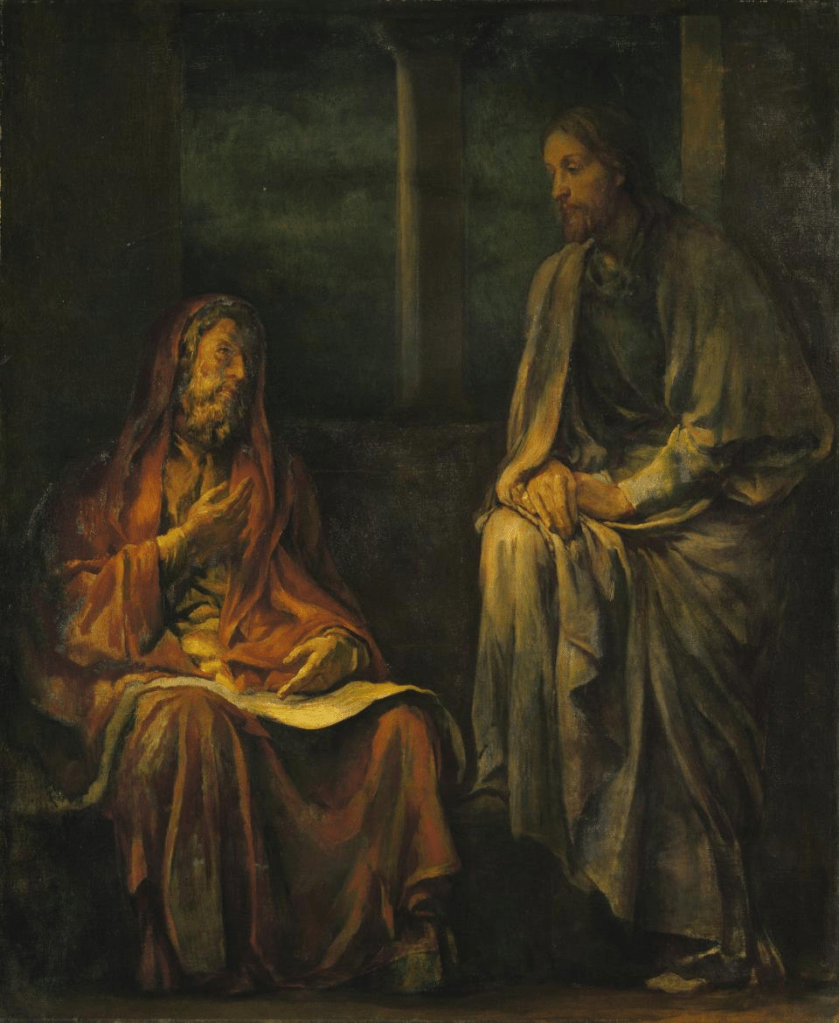
Visit of Nicodemus to Christ, by John La Farge, 1880

In the typical language of the Apostle John, using double meanings to a single concept, he meant to communicate that Jesus would be physically lifted onto the cross, above the people; and also that Jesus would be lifted up by God as the exalted One above all creation. (John 8:28; 12:32)

Just as the ancient Israelites were facing death because of their sin, and deliverance because of God’s action through Moses, so people everywhere in every age face the consequences of their sinful complaining; yet through the action of God through Christ’s crucifixion, resurrection and ascension, they can look up to the exalted and glorified Lord and receive deliverance from sin, death, and hell.

There is more to looking up at the lifted One than a mere incline of the head and eyes. In modern terms, we would refer to the sheer action of looking as an intellectual assent to faith. The Apostle John, however, means to have us believe, not simply acknowledge.

Jesus did not tell Nicodemus to simply acknowledge him as Savior, to accept him into the heart, and so, be saved. No, this was an encounter that left an intelligent man and an accomplished scholar scratching his head in bewilderment as he went back out into the darkness.

Today’s Gospel lesson is a story about how any one of us might reject the light offered to us because of the way it exposes what is dark within us. Therefore, to believe requires ultimate trust in another. It isn’t to acknowledge that Jesus was real and had an actual ministry on earth; it’s more than believing something happened in history in the ancient world of the first century.

To believe is to let our own lives be transformed by the Jesus we encounter in this story. And here is what that means:

  1. Realizing and becoming aware of the ways we are complicit in and benefit from having our loyalties elsewhere, other than Jesus. To believe demands us answering the question: Whom shall you serve?
  2. Placing our ultimate trust, allegiance, and loyalty in Jesus Christ. To believe begs the question: To whom will you commit all that you have, and all that you are?
  3. Forsaking all other competing loyalties and “gods,” including both secular and religious deities. To believe means a single-minded devotion, which asks of us all: To whom and to what will you forsake in order to embrace Jesus?
  4. Confronting inconvenient truths of our own personal values which clash with Christ’s ideals of righteousness. To believe presses us to answer the question: To whom and for what are you truly living for?
  5. Willing to die to self and to anything that would hinder knowing Jesus and him crucified, risen, ascended, and coming again. To believe forces us to ask ourselves: Am I willing to die for Jesus?

While there is nothing in this world worth killing for, there are things worth dying for. The lifting up of Jesus lets us know that the true life God has promised us is not the life that we can secure for ourselves through self-interest, caution, and theological debate.

Most merciful God,
we confess that we have sinned against you
in thought, word, and deed,
by what we have done,
and by what we have left undone.
We have not loved you with our whole heart;
we have not loved our neighbors as ourselves.
We are truly sorry and we humbly repent.
For the sake of your Son Jesus Christ,
have mercy on us and forgive us;
that we may delight in your will,
and walk in your ways,
to the glory of your Name. Amen.

Spiritual Blessings (Ephesians 1:7-14)

The Trinity, by Ukrainian artist Feodosiy Humeniuk, 1981

In him we have redemption through his blood, the forgiveness of our offenses, according to the riches of his grace that he lavished on us in all wisdom and insight.He did this when he revealed to us the mystery of his will, according to his good pleasure that he set forth in Christ, toward the administration of the fullness of the times, to head up all things in Christ—the things in heaven and the things on earth.

In Christ we too have been claimed as God’s own possession, since we were predestined according to the purpose of him who accomplishes all things according to the counsel of his will so that we, who were the first to set our hope on Christ, would be to the praise of his glory. And when you heard the word of truth (the gospel of your salvation)—when you believed in Christ—you were marked with the seal of the promised Holy Spirit, who is the down payment of our inheritance, until the redemption of God’s own possession, to the praise of his glory. (New English Translation)

The Apostle Paul wrote this letter to the Church at Ephesus. Believe it or not, the first chapter of Ephesians  comprises only two sentences in the Greek language for which he originally wrote. Ephesians 1:3-14 are one sentence, and Ephesians 1:15-23 is the other sentence. Thankfully, understandably, and mercifully, English translators have created multiple sentences for us so that we can better make sense of the text. 

It’s almost as if Paul was so excited to talk with the Ephesian believers about who they are in Jesus Christ and what they possess in him that he blurted out in writing with a flurry of enthusiasm and excited fervor without stopping to take a breath or a break.

Paul stacked word after significant word, on top of each other, in order to communicate the spiritual blessings that believers in Christ enjoy. Redemption, forgiveness, grace, wisdom, insight, predestination, faith, inheritance, and salvation are just some of the blessings given to those in union with Jesus Christ.

And, if that wasn’t enough, God has also graciously given us the Holy Spirit, the Paraclete, the one who comes alongside and helps us to live into the blessings we possess. Because God the Father predestined and elected us, God the Son redeemed us, and God the Spirit took possession of us, we are delivered from sin, death, and hell.

It’s as if we came to Christmas day expecting a package of underwear, and found instead a bunch of big boxes with some of the most lavish and expensive gifts we’ve ever seen!  This says much more about the giver than it says about us.

It was according to God’s good pleasure in Christ through the Spirit that believers in Jesus have such privileges.  Like the parent who sits back and watches the unpackaging of presents happen with great joy, so God delights and is pleased with the gifts given to us. The Lord absolutely delights in watching us unpack them and use them in this life.

These gifts, these blessings, are all lavishly provided because they are extensions of God, as if the Lord meticulously handmade each present with us in mind.

Throughout the entirety of Holy Scripture, all the stories and narratives, teachings and writings, are about God. The Lord of all creation is both the subject and object of each book of the Bible. Every good thing we have in this life is because of God’s gracious presence and power in this world.

Each positive experience we have is a direct result of God’s steadfast love toward people. All good gifts come from a good God who is delighted and pleased to give them.

Not a one of us purchased our own gifts and stuck them under the tree. God bought them all with the precious blood of Jesus and sent the Spirit to deliver them to us. 

Consider setting aside time today or tomorrow in a quiet place, and reflect on just one of the words in today’s New Testament lesson. Think about redemption or forgiveness, salvation, or grace, or any of the words which grab you.

Say the word repeatedly and meditatively, quietly and loudly, thoughtfully and with flavor. Consider what God did to bring you that gift. Contemplate the way(s) in which you have received the gift. 

Plan one way in which you might share your gift with another person. And make sure to give glory and praise to God for the grace lavishly given to you.

May your meditation lead to a deeper appreciation of what God has done for you; and may that revelation result in praise, honor, and glory to the One who accomplished so much on our behalf.

Gracious God, you have revealed and made known the way of deliverance from the power of darkness and brought me into your marvelous light. Help me to better understand all the ways you have acted on my behalf so that my life might reflect your grace and steadfast love to the world, through Jesus Christ, my Savior, in the enablement of the Holy Spirit. Amen.

Spiritual Spring Cleaning (2 Chronicles 29:1-11, 16-19)

Hezekiah became king when he was twenty-five years old and was king in Jerusalem for twenty-nine years. His mother was Abijah daughter of Zechariah. In God’s opinion he was a good king; he kept to the standards of his ancestor David.

In the first month of the first year of his reign, Hezekiah, having first repaired the doors of The Temple of God, threw them open to the public. He assembled the priests and Levites in the court on the east side and said, “Levites, listen! Consecrate yourselves and consecrate The Temple of God—give this much-defiled place a good housecleaning.

Our ancestors went wrong and lived badly before God—they discarded him, turned away from this house where we meet with God, and walked off. They boarded up the doors, turned out the lights, and canceled all the acts of worship of the God of Israel in the holy Temple. And because of that, God’s anger flared up and he turned those people into a public exhibit of disaster, a moral history lesson—look and read! This is why our ancestors were killed, and this is why our wives and sons and daughters were taken prisoner and made slaves.

“I have decided to make a covenant with the God of Israel and turn history around so that God will no longer be angry with us. Children, don’t drag your feet in this! God has chosen you to take your place before him to serve in conducting and leading worship—this is your life work; make sure you do it and do it well….”

The priests started from the inside and worked out; they emptied the place of the accumulation of defiling junk—pagan rubbish that had no business in that holy place—and the Levites hauled it off to the Kidron Valley. They began the Temple cleaning on the first day of the first month and by the eighth day they had worked their way out to the porch—eight days it took them to clean and consecrate The Temple itself, and in eight more days they had finished with the entire Temple complex.

Then they reported to Hezekiah the king, “We have cleaned up the entire Temple of God, including the Altar of Whole-Burnt-Offering and the Table of the Bread of the Presence with their furnishings. We have also cleaned up and consecrated all the vessels which King Ahaz had gotten rid of during his misrule. Take a look; we have repaired them. They’re all there in front of the Altar of God.” (The Message)

Hezekiah Destroys the Idols, by Maerten de Vos, 1585

This is the time of year when many of us begin to plan for some Spring housecleaning. And it’s definitely needed! All the rooms of the house, along with the garage, are in need of going through all the contents contained in them, as well as a good old fashioned scrubbing down and thorough cleaning.

And that is really what the Christian season of Lent is intended for on the spiritual level of things. We seek to identify any and all hindrances to living the Christian life and get rid of them; spruce up the things we keep that are helpful to us; and do the hard work of scraping off all the encrusted barnacles on our hearts.

Hezekiah was a faithful king, having come from a long line of faithless ones. In the beginning of his reign, Hezekiah’s first act of royal business was to thoroughly cleanse the Temple. And did it ever need a serious cleaning!

The evil kings who reigned before him did not treat the Temple as a sacred space devoted specifically to the prayer and worship of the one true God, Yahweh. Instead, they defiled it by introducing all sorts of unhealthy practices from other gods. As a result, the holy implements used in the Temple, as well as the structure itself, fell into terrible neglect.

Therefore, Hezekiah assembled an impressive team of people, and tasked them with getting the Temple in shape again with a complete and thorough purification that would make any German house frau proud. Hezekiah sought to restore things so that the Temple could once again be used as it ought. 

The team of Levites meticulously took their time and worked diligently to consecrate the Temple and give it a good and sacred cleaning, tossing everything unholy into the Kidron Valley – the garbage dump.

Perhaps there is no better passage of Scripture than today’s Old Testament lesson, in order to embody what the season of Lent is really all about. We are to do the holy work of carefully consecrating our hearts, so that our lives are prepared and ready for the new life of Easter. 

This task of spiritual Spring cleaning and heart purification is hard and courageous work. Just as Hezekiah had the bravery to uphold the Temple’s true purpose through cleansing it, so we are to bravely enter the shadowy places of our hearts, bring out the sin within, and toss it in the metaphorical incinerator. It’s definitely not a pretty process, but a necessary one.

One of the greatest needs that many believers have today is the courage to be vulnerable, to expose and bring into the light our besetting sins, so that they can be carried away and tossed into the dump. 

Instead of spending inordinate amounts of energy and time trying to hide our true selves, it is much better to let the example of Hezekiah clear a path forward by confronting the darkness within.

Holy God, my life is a Temple of your Holy Spirit. I invite you to come in and do the sort of cleansing work that needs to be done so that my words and actions are thoroughly consecrated to you. Help me have the courage to go to the places within that frighten me, for the sake of Jesus, my Lord. Amen.

How It’s Built Matters (1 Kings 6:1-4, 21-22)

Artist depiction of Solomon’s Temple

Four hundred and eighty years after the people of Israel left Egypt, during the fourth year of Solomon’s reign over Israel, in the second month, the month of Ziv, Solomon began work on the Temple. Inside it was 90 feet long, 30 feet wide, and 45 feet high. The entrance room was 15 feet deep and 30 feet wide, as wide as the sanctuary itself. The walls of the Temple had openings in them, narrower on the outside than on the inside….

The inside of the Temple was covered with gold, and gold chains were placed across the entrance of the inner room, which was also covered with gold. The whole interior of the Temple was covered with gold, as well as the altar in the Most Holy Place. (Good News Translation)

The first major accomplishment – and the crowning achievement – of King Solomon’s reign was building the Temple in Jerusalem. His father, King David, had it in his heart to erect a great Temple for God as both a place of worship, and a permanent place for the Ark of the Covenant to rest. However, the Lord clearly instructed David not to build the Temple, but stated that his son would do so. (1 Chronicles 28:1-21)

Solomon spared no expense for building the Temple. He ordered vast quantities of cedar wood from King Hiram of Tyre, and had huge blocks of stone quarried for the building’s foundation. In order to complete the massive project, Solomon imposed forced labor on all his subjects, drafting people for work shifts that sometimes lasted a month at a time. (1 Kings 5:1-18)

And there was the gold – lots of it! The inside of the Temple was completely covered with gold. Gold is physically and metaphorically one of the most malleable metals on the planet: one gram of gold can be beaten into a 1-square meter sheet, and gold has been used as a symbol for everything from religious devotion to great wealth and immense power.

As glorious and elaborate as the Temple was, the most important room was perhaps the greatest theological statement of all; it contained almost no furniture. Known as the Holy of Holies, it housed the two tablets of the Ten Commandments inside of the Ark of the Covenant. The unseen and almighty God of the universe doesn’t really need a house, and most certainly cannot be contained within one.

Only once a year, on the Day of Atonement (Yom Kippur) the High Priest entered the most sacred Holy of Holies and pray to God on behalf of the Israelite nation. God’s world and God’s word are holy. It was understood that the Ten Commandments are very holy words, with the name of God being the holiest word of all. The Temple – by its sheer architecture – communicated what was most important about God.

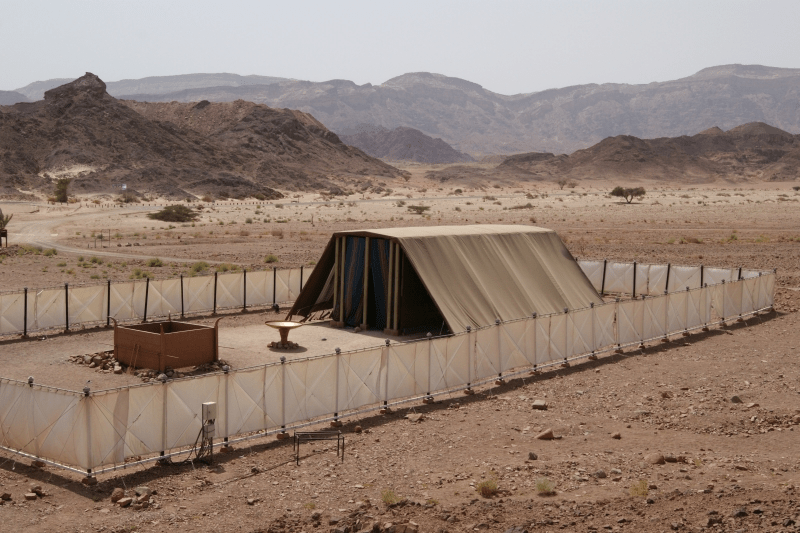
Model of the Tabernacle in Timna Valley Park, Israel

Yet, the way in which the Temple was constructed was very different from how the earlier Tabernacle was built. The Tabernacle was a sort of mobile temple for the wilderness journey. The entire community worked together in giving their possessions and services in order to make the Tabernacle a reality.

Without the contributions of the people, the project probably would not have happened at all. But the chance to help out in all the myriad ways of making things for the sanctuary, pulled everyone together in a high degree of compliance. (Exodus 36:1-6)

Indeed, the building of the Tabernacle was a consensual enterprise; the people’s faith was the wellspring of their philanthropy. Yet, in contrast, the mode by which Solomon carried out the construction of the permanent Temple was by sheer wealth, forced labor, and strong administrative business deals.

There was no community participation in the form of voluntarism in Solomon’s financing of the Temple build. To pay for the cedar and cypress wood provided by the King of Tyre and to quarry and transport the building materials, Solomon issued a massive levy. In other words, there wasn’t any free labor and no robust public spirit animating the construction.

The Tabernacle for which the people volunteered wholeheartedly never fell victim to evil. The Temple, however, eventually and certainly did – in large part due to the evil of the kings who presided over the theocracy.  

The fate of any institution is determined by how it is created in the first place. No matter what the polity and organizational structure is, it cannot long survive without popular support. Solomon’s Temple, despite all of its grandeur and gold, rested on a shaky foundation and sandy soil.

After the Temple was constructed, the sacrificial system was authorized only in Jerusalem and at the Temple. Everything was centralized under the behemoth of Solomon’s system. What’s more, practices like volunteerism and community participation were largely replaced with systems of heavy taxation and a large debt. That’s one reason the kingdom immediately split apart after Solomon’s death.

Perhaps if the selfless ethos that went into building the Tabernacle was utilized by Solomon in the building of the Temple, maybe the fate of king after king in Israel would have been quite different. For it is in the spirit of volunteerism and a concern for the public welfare that governments attentive to the common good of all persons are built. How something is built matters.

Almighty and gracious God of all, we humbly offer our gratitude for the blessing of selfless volunteers and those who participate freely in ministries of justice and service. Thank you for their tireless dedication and benevolence.

May your Spirit bless them with continual guidance as they faithfully serve others. Give them resilience, daring, and fortitude. Let joy, peace, and satisfaction be upon the good work that they do. Inspire and motivate them to persist through trying circumstances, steadfast in their dedication to aiding those around them.

Help us all to reflect the profound beauty and compassion of your divine love. Amen.