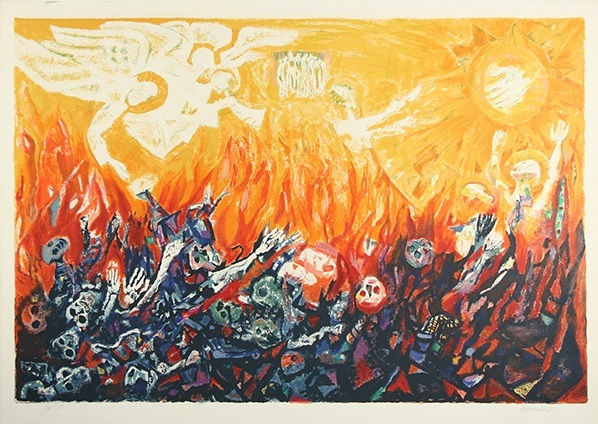
Speak To the Dry Bones (Ezekiel 37:1-14)

Valley of the Dried Bones, by Abraham Rattner (1895–1978)

The power of the Lord came over me. The Lord brought me out by his Spirit and put me down in the middle of a valley. The valley was filled with bones. He led me all around them. I saw that there were very many bones at the bottom of the valley, and they were very dry.

Then he asked me, “Son of man, can these bones live?”

I answered, “Only you know, Almighty Lord.”

Then he said to me, “Prophesy to these bones. Tell them, ‘Dry bones, listen to the Lord’s word. This is what the Almighty Lord says to these bones: I will cause breath to enter you, and you will live. I will put ligaments on you, place muscles on you, and cover you with skin. I will put breath in you, and you will live. Then you will know that I am the Lord.’ ”

So I prophesied as I was commanded. While I was prophesying, suddenly there was a rattling noise, and the bones came together, one bone ⌞attaching itself⌟ to another. As I looked, I saw that ligaments were on them, muscles were on them, and skin covered them. Yet, there was no breath in them.

Then the Lord said to me, “Prophesy to the breath! Prophesy, son of man. Tell the breath, ‘This is what the Almighty Lord says: Come from the four winds, Breath, and breathe on these people who were killed so that they will live.’ ”

So I prophesied as he commanded me, and the breath entered them. Then they came to life and stood on their feet. There were enough of them to form a very large army.

The Lord also said to me, “Son of man, all the people of Israel are like these bones. The people say, ‘Our bones are dry, and our hope has vanished. We are completely destroyed.’ So prophesy. Tell them, ‘This is what the Almighty Lord says: My people, I will open your graves and take you out of them. I will bring you to Israel. Then, my people, you will know that I am the Lord, because I will open your graves and bring you out of your graves. I will put my Spirit in you, and you will live. I will place you in your own land. Then you will know that I, the Lord, have spoken, and I have done it, declares the Lord.’ ” (God’s Word Translation)

Dry. It might be good for humor or a martini. Dry, however, doesn’t feel good when it’s a time of spiritual dryness.

Perhaps you are dry. It seems the entire world is dry. Wars, conflict, death, violence, uncertainty, unrest, and upset people everywhere is evidence that there is dryness across the earth. Many institutions, organizations, companies, and faith communities have become so withered and dry, that they have folded and died.

The hard circumstances of our world, stress in our families, and challenging personal lives may easily create anxiety, and, so, parch our souls and leave our spirits bone dry. There is, however, a God who can breathe new life into us and move us from old-worn ruts in our thinking, feeling, and behaving, to renewed ways of being in the world. 

The prophet Ezekiel’s vision is a promise and a hope of resurrection, revival, and new life. Regardless of who we are and the situations in front of us, we are all displaced people – cast out of Eden and in need of restoration. 

We, along with the ancient Israelites, are in exile and long to return to our true home with God. Along with St. Augustine we declare that our “hearts are forever restless until they find their rest in God.”

Maybe you are presently experiencing the dry bones of hopelessness and despondency. Perhaps you are in a dark night of the soul where all of life seems like one huge rut. It could be you are wondering if God is really listening, or is even there at all, because of the dry bones surrounding you.

In my work as a hospital chaplain I often encounter patients who are, ironically, bone dry from too much drinking. Their alcoholism is like a massive desert littered with thousands of dry bones. Attempting to reanimate themselves while dulling the pain of incredibly hard dry circumstances, they drink liter after liter of “spirits” to replace the dead spirit inside them. Some become so dry and dead inside their immaterial selves, that they seek to end their material lives through suicide.

But it need not be this way. We might believe we will be able to live life and pursue God better without danger or hardship – that somehow difficulty is not to be part of life. The dry bones exist, however, as an opportunity for God to give life. That’s why Alexander Solzhenitsyn’s reaction to his exile in a Soviet labor camp in Siberia was to bless it, because it was there he said:

“I discovered that the meaning of earthly existence lies not, as we have grown used to thinking, in prospering, but in the development of the soul.”

Alexander Solzhenitsyn

God not only gives life; God restores life. And this is an important truth to know and remember in the inevitable dry times of our lives. God is not only a helper; the Lord reanimates us from spiritual rigor mortis to lively resurrection through breathing on us. And this is done for a reason. Jesus came to his disciples after his resurrection and said:

God resuscitates us for a purpose, so that we might be a blessing to the world. Faith is not only a possession to keep, but a gift to give. We glorify God in loving one another and loving the world as Jesus did.  God could have resurrected the bones without Ezekiel. Instead, the Lord used Ezekiel and had him participate in the revival by speaking to the bones. 

Such a challenge to speak to the dry bones can seem overwhelming to us. What do you do when your life is upended, even shattered – when such a profound change comes to you that it is impossible for your life to be as it was? 

The questions and commands of God seemed totally absurd to Ezekiel, speaking to dead dry bones. Yet methinks we ought to operate more in the realm of the absurd than in the realm of the safe routine.

Perhaps we ought to expect our faith to be exercised and look for God to breathe new life into the dead and decaying. To believe that something, someone, or even myself can change is to have internalized this amazing story of dry bones living again. 

Our self-imposed graves cannot hold us because God is among us.

We need a genuine heaven-sent, Spirit-breathed, glorious reanimation in which God sends reviving grace and raises the dead. 

Lord of Resurrection, please be attentive to our prayers; and make what is impossible possible:

For those without hope – feeling dried up and cut off from you – open their graves and bring them back to the land of the living.

For those spiritually oppressed – held captive by sin – release them from their chains and let them go! For those who weep – lost and lifeless in a tomb of fear and shame – give them the peace of your presence, and show them what your love can do.

For those complacent – withering on the vine, and living a dull dry existence without any spiritual vigor – awaken them, O Lord! Breathe into them new life!

Pour out your Spirit, gracious God, and awaken all kinds of people to a revival of obedience, love, and courage.

May your people be so full of your Spirit that life comes rolling off our tongues and the strength of life empowers our hands for service. Amen.

Pentecost (John 15:26-27, 16:4b-15)

The Holy Spirit, by He Qi

“When the Advocate comes, whom I will send to you from the Father, the Spirit of truth who comes from the Father, he will testify on my behalf. You also are to testify because you have been with me from the beginning…

“I did not say these things to you from the beginning, because I was with you. But now I am going to him who sent me, yet none of you asks me, ‘Where are you going?’ But because I have said these things to you, sorrow has filled your hearts. Nevertheless, I tell you the truth: it is to your advantage that I go away, for if I do not go away, the Advocate will not come to you, but if I go, I will send him to you. 

“And when he comes, he will prove the world wrong about sin and righteousness and judgment: about sin, because they do not believe in me; about righteousness, because I am going to the Father, and you will see me no longer; about judgment, because the ruler of this world has been condemned.

“I still have many things to say to you, but you cannot bear them now. When the Spirit of truth comes, he will guide you into all the truth, for he will not speak on his own but will speak whatever he hears, and he will declare to you the things that are to come. He will glorify me because he will take what is mine and declare it to you. All that the Father has is mine. For this reason I said that he will take what is mine and declare it to you. (New Revised Standard Version)

Pentecost, by John August Swanson (1938-2021)

This is the Christian Day of Pentecost. It is often referred to as the birthday of the Church. Pentecost marks the time when the Holy Spirit came upon the fledgling believers in power. 

Pentecost is significant for Christians because it marks the age of the Spirit, the era of new spiritual life and power. Ten days after recognizing Christ’s Ascension, and fifty days after Christ’s resurrection from death, the Christian Year observes the Day of Pentecost (which literally means “fifty” in Greek). 

An implication of Pentecost is that it brings both change and stability, of being uprooted as well as deeply grounded. To experience Pentecost, it is necessary to invite change and to allow ourselves to be changed.

To live a truly spiritual life, full of the Holy Spirit, means that things will never be the same again. With the Spirit, there is a new form of consciousness, an emerging awareness of both self and the world, and new interests and commitments which are followed.

Change involves unlearning old thinking and ways of doing things, becoming uprooted and planted in fresh spiritual soil. The spiritual person will discover new, necessary, and expansive ways of living the faith of Jesus Christ in today’s topsy-turvy world.

Today’s Gospel lesson has Jesus talking to his disciples for the last time before his crucifixion and resurrection. He communicated to them that he was going away, and they were sad and confused about it all. So, Jesus assured them that they would not be alone – his presence would be with them in the person of the Holy Spirit.

Jesus made it plain that the One who is coming, the Paraclete, is the One who comes alongside and offers to the disciples a ministry of advocating, testifying, speaking truth, glorifying, and proving the world wrong about sin and righteousness and judgment.

The Spirit advocates for us and all creation. The Spirit hears our pain, moaning, and desperation, bringing it all to God in helpful language (Romans 8:26). The Spirit testifies about Jesus to us and about his ministry. The Spirit speaks truth to us whenever we go astray from the words and ways of Jesus; and so, will challenge us and provoke us to live into our majesty as people created in God’s image and redeemed by Christ’s death and resurrection.

If and when our Christian life and worship becomes a ho-hum hodge-podge of ritualistic or legalistic goo, where no spiritual growth or life transformation is happening – and worse, if it becomes characterized by injustice – then the Spirit will have something to say in regard to sin, righteousness, and judgment.

A lack of faith can take many forms. For many Christians, the separation between belief and practice is a form of apostasy. Signing off on a set of doctrinal beliefs means nothing unless it has feet and hands to it by going after those who are suffering, giving restitution for what we’ve taken, and putting the love of Christ where love is not found.

A confession of faith is hollow and useless without first having a confession of sin. Jesus did not say that people will know Christians by their doctrinal confessions and ancient creeds, but that others will know the Christian by the fruit of a life given to righteousness and justice. (Matthew 7:16)

The worldly ruler is the one who perpetuates systems of evil and oppression; and ignores poverty, hunger, and need. The ruler of this world is condemned by the Spirit because of meanness, brutality, violence, and abject greed and selfishness.

Anyone who turns the life-giving good world which God has made into a death-dealing world of ignorance, sloth, and power politics is under the judgment of the Spirit, on orders by Judge Jesus. Whenever the bent of the will is developed into only being concerned with personal happiness, while ignoring communal needs, the person is existing far from the teachings of Jesus to his disciples.

On this Day of Pentecost, and into this proper Pentecostal season, our call is to have a genuine spiritual life that allows the true self to make a difference in this old fallen world. The spiritual person seeks to tap into the Spirit and insist on caring for others without prejudice or favoritism; and will ground themselves in healthy spiritual dynamics of positive change and transformation as living sacrifices to God. (Romans 12:1-3)

With the reality of Pentecost, believers in Jesus, and the whole Church everywhere, has the full power of the Holy Spirit with them at all times. This means our ultimate trust is not in the power of authoritative positions, economic budgets, polished programs, personal ingenuity, or a consumer self-realization.

Our trust is in the name of the Lord who made heaven and earth, in Jesus Christ, God’s only Son, and in the strength of the Holy Spirit who is the continuing presence of Jesus. Such power is given for a purpose. So let us be responsible and conscientious in living the Christian life.

And may the blessing of the Spirit move you to know Jesus better, love the world more, and be the person you were created to be – to the glory of God. Amen.

Jesus Prays For Us (John 17:6-19)

Word of Life, by Millard Sheets

“I have made your name known to those whom you gave me from the world. They were yours, and you gave them to me, and they have kept your word. Now they know that everything you have given me is from you, for the words that you gave to me I have given to them, and they have received them and know in truth that I came from you, and they have believed that you sent me.

“I am asking on their behalf; I am not asking on behalf of the world but on behalf of those whom you gave me, because they are yours. All mine are yours, and yours are mine, and I have been glorified in them. And now I am no longer in the world, but they are in the world, and I am coming to you.

“Holy Father, protect them in your name that you have given me, so that they may be one, as we are one. While I was with them, I protected them in your name that you have given me. I guarded them, and not one of them was lost except the one destined to be lost, so that the scripture might be fulfilled. 

But now I am coming to you, and I speak these things in the world so that they may have my joy made complete in themselves. I have given them your word, and the world has hated them because they do not belong to the world, just as I do not belong to the world. 

“I am not asking you to take them out of the world, but I ask you to protect them from the evil one. They do not belong to the world, just as I do not belong to the world. Sanctify them in the truth; your word is truth. As you have sent me into the world, so I have sent them into the world. And for their sakes I sanctify myself, so that they also may be sanctified in truth. (New Revised Standard Version)

It seems to me only fitting that Jesus concluded his time with the disciples in the Upper Room before his betrayal, crucifixion, and death with prayer. It also seems to me that if you really want to know the heart of a person, listen to them pray.

The prayer of Jesus was thoroughly oriented toward the spiritual needs of his followers – even potential believers who will follow him in the future. And it was a prayer completely devoted toward honoring the heavenly Father through praying consistent with God’s will for this world.

Without the physical presence of Jesus – which would soon be gone – his followers would have to rely on prayer. And Christ was intent on instilling within his disciples the confidence and hope they needed for a solid life of prayer.

For post-resurrection Christians living in an ever-expanding world of oppression, greed, and indifference, we can be encouraged not to settle into despair or loneliness. Why? Because believers can have a solid hope and an abiding trust in the continuing presence of Jesus by means of the Holy Spirit.

God Gives

God gives. Jesus gives. Both the Father and the Son are givers. This is a major reason and motivation for prayer because God is not a reluctant giver. In the act of giving, the Father and the Son are fully on the same page; God is ready and willing to give. The Holy Trinity – Father, Son, and Spirit – are in complete unity, and act as One, in giving to us what we need.

“Those who drink of the water that I will give them will never be thirsty. The water that I will give will become in them a spring of water gushing up to eternal life.” (John 4:14, NRSV)

“Do not work for the food that perishes but for the food that endures for eternal life, which the Son of Man will give you.” (John 6:27, NRSV)

“I give them eternal life, and they will never perish. No one will snatch them out of my hand.” (John 10:28, NRSV)

We Belong

Through giving we are included. Believers and followers of Jesus – having been given the grace of faith – know that they belong to God. Christians are in union with Christ. The redemption which Jesus has secured is a million billion times stronger, and bonds us closer, than any sort of Gorilla glue. And, what’s more, once we belong, we are never forgotten, but always remembered by God.

“The Father knows me, and I know the Father. And I lay down my life for the sheep. I have other sheep that do not belong to this fold. I must bring them also, and they will listen to my voice. So there will be one flock, one shepherd.” (John 10:15-16, NRSV)

Christ the King, statue in Swiebodzin, Poland

The Name of Jesus

Because we belong, we know God’s name. The divine name stands for all that God is and all that God has done. It’s all focused in Christ. In the name of Jesus, through the person and work of Jesus Christ, we have everlasting life, spiritual power, and eternal security.

Now Jesus did many other signs in the presence of his disciples that are not written in this book. But these are written so that you may continue to believe that Jesus is the Messiah, the Son of God, and that through believing you may have life in his name. (John 20:30-31, NRSV)

We Have the Word

The Word became flesh and dwelt among us (John 1:14). Jesus has given to his disciples only those words which he first received from the Father. Those who accept the enfleshed Word and his words have been given power to become God’s children (John 1:12). Because believers belong to God, they know the truth and that truth has set them free.

It is the Christian’s mission to live into the words and ways of Jesus, to follow Christ in thought, word, and deed. The very glory of Jesus in his cross and resurrection is focused within the believing community, who is in union with Christ and belongs to God.

In his prayer, Jesus claimed an intimate oneness in the sharing of concern for people who are the objects of the Father’s gracious giving of love through the Son. All who belong to Christ belong to God, and vice versa. All the love that went into the cross was poured out upon us.

Those who believe in the name of Jesus Christ are the very glory of Jesus, and thus, the glory of God.

Sent Into the World

Because of the Father’s name—because of who the Father is and what the Father has given in love to the Son—we are set apart for truth; the words of God are truth.

Since we belong to God and bear the name of Christ, we don’t belong to the world’s systems of guilt, shame, injustice, and evil. And yet, we are separated from the world for precisely the reason of immersing ourselves in the world. In other words, Christianity is meant for the life of the world, and not as a religion that’s only concerned for itself.

To reach the world, we must be different from it. To reach the world, we need to have boots-on-the-ground in it. To reach the world, Christians are to be both far from the world, and near to the world.

As the Father sent the Son, so the Son sends us into the world – not to be like the world, but to embody the words and ways of Jesus to and for the world.

Just as the world rejected Jesus in his suffering and death, so the world, too, will reject his followers. Which means we will need to pray, a lot! And there is no better scriptural prayer to emulate than the very words of the Lord Jesus, who loved us and gave himself for us.

Holy Father, guard our hearts and minds in Jesus, as we pursue this Christian life which you gave as a gift through Christ, so that we can be united, just as the Father and the Son are one. Although we long for heaven, don’t take us out of the world until we have fulfilled our sacred mission to carry the words and ways of our Lord to the world. Make us holy, and give us everything we need for life in this present evil age; through Jesus Christ your Son, our Lord, who with you and the Holy Spirit are one God, now and forever. Amen.

Leave a Supportive Spiritual Legacy (Deuteronomy 11:18-21)

 “So commit yourselves wholeheartedly to these words of mine. Tie them to your hands and wear them on your forehead as reminders. Teach them to your children. Talk about them when you are at home and when you are on the road, when you are going to bed and when you are getting up. Write them on the doorposts of your house and on your gates, so that as long as the sky remains above the earth, you and your children may flourish in the land the Lord swore to give your ancestors.” (New Living Translation)

The biblical book of Deuteronomy is a farewell address by Moses to the Israelites.

Moses was about to die. The Israelites were about to enter the Promised Land.

So, Moses restated God’s law and called the people to remember all that God had done. He exhorted the people to communicate the law and their heritage to the next generations.

If God’s words and God’s ways are continually observed, then the people would prosper in God’s Promised Land.

The overarching call and command of Moses to the people is to love God with everything they have and everything they are.

God’s people are to have a dedicated commitment of mind, body, emotions, and spirit to the law of God. Each ability and gift, and all that makes a person a person, is to have its clear direction and orientation toward loving God through obeying God’s commands.

The love of God is meant to become a habit in the normal daily rhythms of life. How do we do that? Impress God’s commands by talking about them in every sort of context: home and family; neighborhood and workplace; morning and evening. People are even to write out God’s commands and have them in front of us all the time. 

Indeed, the entire day is an opportunity to love God by talking about God’s words. Discussing God’s words and commands doesn’t need to be forced or awkward. Yet, it is something which needs some intention and purpose to it.

Most people like talking about things which are important to them. If someone is really into classic cars, he does not have to try and force a conversation about it because it just comes out of him. Because they go to car shows, maybe own a classic car that they are continually tinkering with, and read up on car magazines, a discussion about the subject is quite natural to them.

So, the best way to live into God’s law is to spend time with God through regular Bible reading, focused and earnest prayer, conversing with others, and taking advantage of opportunities to learn and know about God. For the Christian, talking about Jesus is meant to be organic, springing from a heart which loves God and observes God’s law.

When it comes to family, an expert theologian or biblical scholar is not needed; there just needs to be a willingness and a curiosity to ask questions.

Back when raising my girls, most of our conversations at the table centered around one question I would ask. We discussed it, talked about it, and mulled it over. Sometimes it was a deep theological question. At other times, it was a practical question. My wife and I often had others share a meal with us, so I usually asked our guests to tell their God story or participate with us in the question. If they were not Christian, I would ask them what they thought about Jesus and faith, and why.

God loves it when we have conversation in the home around biblical teaching. God also loves it when we have discussions in public. Some Orthodox Jewish persons still to this day wear a “phylactery” on their foreheads – a small box with little Scripture passages inside of it – testifying to their value of the written Word.

I’m not sure that’s what Moses had in mind when he talked about binding God’s commands on the forehead and tying them as symbols on the hands. Much of the Hebrew language is metaphorical, speaking about concrete things as a way of communicating something intangible. So, I wonder if the big idea here is simply to be open about faith and love for God and the law.

Although I don’t believe we have to take today’s verses quite so literally, there is, however, something to be said for keeping Holy Scripture continually in front of us, in order to remember divine commands and promises.

It’s good to write some Bible verses and place them on your bathroom mirror, the dash of your car, in your pants pocket, or anywhere you will see them on a regular basis. It’s a practical way of remembering to observe all that God has commanded.

Physical reminders of significant spiritual events can help us keep the words of God in our lives. When the Israelites experienced God in some significant way, they built an altar. For example, when they approached the Jordan River to enter the land, God caused the water to stop flowing so that they could cross over. Here is what happen next: 

Joshua erected a monument, using the twelve stones that they had taken from the Jordan. And then he told the People of Israel, “In the days to come, when your children ask their fathers, ‘What are these stones doing here?’ tell your children this: ‘Israel crossed over this Jordan on dry ground.’

“Yes, God, your God, dried up the Jordan’s waters for you until you had crossed, just as God, your God, did at the Red Sea, which had dried up before us until we had crossed. This was so that everybody on earth would recognize how strong God’s rescuing hand is and so that you would hold God in solemn reverence always.” (Joshua 4:20-24, MSG)

Passing the spiritual baton and leaving a heritage for future generations is a sacred trust. One of the best ways for that to happen is within the home, talking about God and Scripture as a daily routine, as well as freely conversing about spirituality in public.

There are several ways churches can impress Scripture to younger generations: 

  1. Train them to lead. Adults do not have to do everything in the church. Every generation can be empowered to engage in ministries on a regular basis. Everyone needs a mentor to do anything well – which means taking others with us along the journey of ministry so they can both shadow and participate.
  2. Empathize with young people and young families. That means avoiding criticism. It’s easy for older generations to be critical about another generation’s lack of involvement; or how they live their lives. They don’t need our criticism, but our help. Empathy means that we recognize others are trying to do the best they can in a crazy world. And it’s a world quite different from the one I grew up in. This is a very competitive world, requiring more energy and drive than previous generations. Being a student today is not like being a student when I was a kid.  Being a young parent is not the same today as it once was. Today’s family structure is completely changed; what we think of as a traditional family only makes up 7% of the American population. The stance to take on this is not to criticize, but to encourage and help.
  3. Take the message of Jesus seriously.  Discussion, conversation, questions, and mutual sharing are the ways Jesus developed his followers; and it’s a way we can reach younger generations. Dialogue goes a lot further than simply telling others what they should believe and do.
  4. Adopt a young person, or a young family. If you consider yourself part of an older generation, consider taking a younger person or family under your wing, who is not related to you. Invite them to a meal, read these verses, and discuss them together. Commit to praying for them daily for a set period.
  5. Look for ways to support children, teens, and young families. Prioritizing younger generations means they don’t have to do everything our way. Rather, it means we will listen to what they need in loving God and building into their own families.
  6. Be great neighbors. Discuss, teach, empower, and develop young people – without criticism – into good neighbors who engage their local community by addressing issues with great love and lots of compassion.

There are many more ways to engage. The idea here is that we think about how to embody the teaching we have in Deuteronomy by passing on God’s love and God’s words. So, where will you start?…