The Authority of Jesus

They went to Capernaum, and when the Sabbath came, Jesus went into the synagogue and began to teach. The people were amazed at his teaching because he taught them as one who had authority, not as the teachers of the law. Just then a man in their synagogue who was possessed by an impure spirit cried out, “What do you want with us, Jesus of Nazareth? Have you come to destroy us? I know who you are—the Holy One of God!”

“Be quiet!” said Jesus sternly. “Come out of him!” The impure spirit shook the man violently and came out of him with a shriek.

The people were all so amazed that they asked each other, “What is this? A new teaching—and with authority! He even gives orders to impure spirits and they obey him.” News about him spread quickly over the whole region of Galilee. (NIV)

When I was in college, I drove a big car – an Oldsmobile Delta 88 with a 455 Rocket engine. Because I had the largest car around, I could fit a lot of people into my vehicle to drive to church on Sundays. Since I often gave rides to people I did not know very well, one Sunday I picked up two sisters who had never been to my church before.

Everything went like a typical Sunday morning, until toward the end of the pastor’s sermon one of the sisters began yelling and crying out in the service, maybe much like the account we have in our Gospel account for today. The pastor quickly brought an end to the worship service and the congregation hurriedly filed out of the building. I stayed behind because, well, I was her ride.

What happened next is an entire story for another day. I will just say that I saw some crazy stuff that did not seem readily explainable with our five human senses. And, I might add, there was a deliverance on that Sunday from whatever or whomever was influencing the young lady.

Ever since my experience on that Sunday, I continually wonder: What are our expectations when we come to a worship service?  Do we anticipate Jesus will be present via the Holy Spirit?  If so, do we believe he is there to confront demons and bring deliverance to people? Do folks even believe there is such beings as angels and demons anymore? How do we make sense of stories like this?

Perhaps there is so little deliverance from evil in our own experiences and in many faith communities because we simply have no expectation that such a thing will happen. Maybe the demons just sleep through gatherings knowing that their influence is not being threatened.

This brings me to the bread and butter of today’s message. I will give you three pre-suppositions (that is, things that we assume or take for granted) from which I work from when approaching Scripture and ministry. I will also make three observations of this story about Jesus, because ultimately the story is really all about him and not about demons. Finally, I offer three applications based on today’s Gospel lesson.

First Pre-supposition: Demons are real.  We know almost nothing about the man in the Gospel story other than he was “possessed by an evil spirit” which meant he was being influenced by a demon. I believe there is an unseen reality we cannot perceive with our physical eyes.

Second Pre-supposition:  Jesus has authority over demons.  Jesus took charge of the situation because he had the authority to do so. Throughout Mark’s Gospel, Jesus is portrayed as one who came to decisively deal with the powers of sin and death, especially as expressed through the demonic realm.

Third Pre-supposition:  Demons could be here.  I do not mean to scare anyone. I simply intend to point out that demons, or any type of evil manifestations, are not just out there somewhere in the world. Today’s story takes place in the sacred space of worship to God: the synagogue. Although it is a rather dramatic story, most demonic activity goes unaware because demons do not like to be recognized; they like the anonymity of the shadows and to operate in the dark where no one can detect them.  If we knew they were around, we would do something about it!  Just because we have dedicated spaces to the worship of God does not mean that it magically keeps evil out. God’s people must be savvy to evil demonic ways and take charge to use our authority in Christ with truth, justice, peace, faith, and the message of the gospel so that we might live wisely and shoo the devil away.

Based upon those three assumptions, the following are three observations about God and Jesus concerning the Christian life. These realities ought to evoke confidence in our lives without fear of the demonic realm…

First Observation: Jesus is directly interested in people.  Jesus came to seek and to save the lost. Christ came to directly confront evil and deliver humanity from sin, death, and hell.  Jesus showed interest, care, and love to people.  In the story, Jesus went to Capernaum to begin his ministry. Capernaum was a non-descript small village that was of no interest to anybody outside of it. Yet, Jesus sought to reach common ordinary people as well as the rich and famous because all are in need.  Furthermore, Jesus is concerned about every part of our lives, and not just the spiritual matters.

Second Observation: Jesus deals with pain and suffering.  One of the truest theological statements I could ever say to you is this: God loves you in the person of Jesus through the power and presence of the Holy Spirit.  Jesus suffered on our behalf. Christ is against everything that destroys. In fact, Jesus did not even destroy the demon, who was probably expecting that to happen. Instead, the Lord Jesus took the demon’s power away.  Jesus has taken the sting out of death.  Anything that robs life of its intended flourishing, Jesus is ready to do away with.  This can be a tricky point because God will use pain and suffering to teach us and form us into faithful people. Yet, that does not mean God is the author of pain or enjoys suffering. It just means that God’s grace will bend any circumstance, whether good or evil, to divine purposes for our benefit.

Third Observation: Jesus gives grace.  Every instance of healing, each miracle, and every event of deliverance from evil are all because Jesus loves us and cares about us, despite whether we deserve it or not.

Now let’s pull this together into some points of application…

First Application: We need the deliverance of Jesus, and not only psychological therapy.  I am a big believer in counseling and therapy for all kinds of emotional issues. It seems to me that far too many persons do not take advantage of the resources we have today in the psychological realm. What is more, I daily provide a range of counseling for individuals as both a church pastor and hospital chaplain. However, this in no way diminishes the need for spiritual deliverance or that therapy can somehow replace Jesus. If demons are real, and evil truly present, then no amount of counseling will deal decisively with Satan because only Jesus can do that.  I believe Jesus is not merely one option among a smorgasbord of people who could help us. Rather, Jesus is the Messiah who delivers us from evil, like no other can.

Second Application: Amazement is not faith.  The people in the Gospel story were amazed at Christ’s teaching and deliverance ministry. They had never seen or heard anything like it. Yet being impressed is not the same as naked trust. Spreading news of what Jesus did is not the same as putting Christ’s teaching into practice and personally experiencing divine power to deliver from sin.

Third Application: The Lord’s Table brings healing.  Christian communion is neither only a remembrance of what Jesus did on the cross, nor a magical act of bringing deliverance. Rather, the Table is a means of grace in which we partake of the elements in faith knowing Jesus is victorious over the demonic realm. What is more, the Spirit will join us to Christ and give us the confidence and hope to confront all that ails us. Liturgical rhythms of grace consistently and surely work their way into us and bring about the healing we need and want.

Conclusion

Jesus Christ has authority over everything, including the demonic realm. This makes him perfectly suited and situated to provide spiritual deliverance from evil – which is precisely how Christ encouraged us to pray. So, let us pray the prayer our Lord taught us:

Our Father which art in heaven, hallowed be thy name.

Thy kingdom come, thy will be done in earth, as it is in heaven.

Give us this day our daily bread.

And forgive us our debts, as we forgive our debtors.

And lead us not into temptation but deliver us from evil: For thine is the kingdom, and the power, and the glory, forever. Amen.

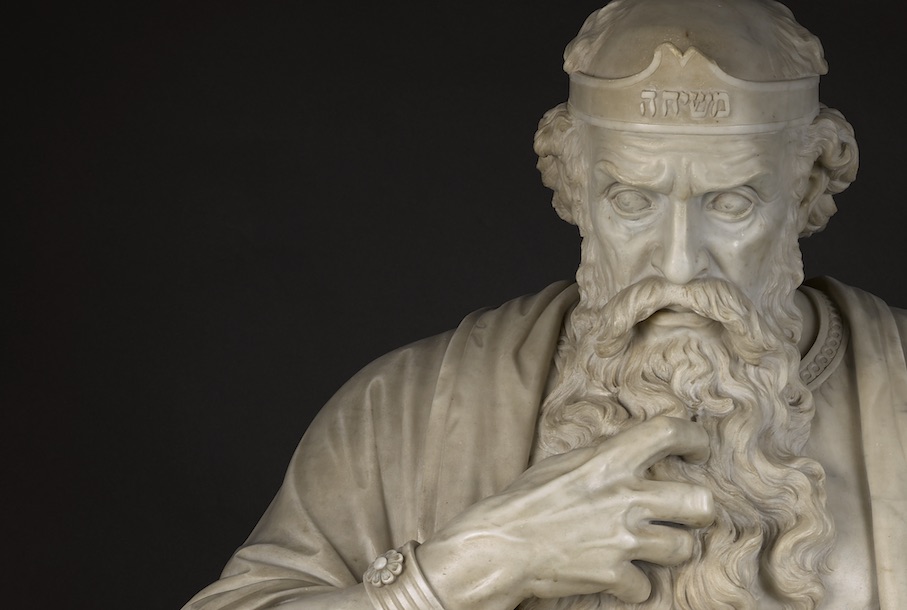
1 Samuel 15:10-31 – Rationalizing Disobedience

King Saul by William Wetmore Story (1819-1895) at the North Carolina Museum of Art

Then the word of the Lord came to Samuel: “I regret that I have made Saul king, because he has turned away from me and has not carried out my instructions.” Samuel was angry, and he cried out to the Lord all that night.

Early in the morning Samuel got up and went to meet Saul, but he was told, “Saul has gone to Carmel. There he has set up a monument in his own honor and has turned and gone on down to Gilgal.”

When Samuel reached him, Saul said, “The Lord bless you! I have carried out the Lord’s instructions.”

But Samuel said, “What then is this bleating of sheep in my ears? What is this lowing of cattle that I hear?”

Saul answered, “The soldiers brought them from the Amalekites; they spared the best of the sheep and cattle to sacrifice to the Lord your God, but we totally destroyed the rest. “Enough!” Samuel said to Saul. “Let me tell you what the Lord said to me last night.”

“Tell me,” Saul replied.

Samuel said, “Although you were once small in your own eyes, did you not become the head of the tribes of Israel? The Lord anointed you king over Israel. And he sent you on a mission, saying, ‘Go and completely destroy those wicked people, the Amalekites; wage war against them until you have wiped them out.’ Why did you not obey the Lord? Why did you pounce on the plunder and do evil in the eyes of the Lord?”

“But I did obey the Lord,” Saul said. “I went on the mission the Lord assigned me. I destroyed the Amalekites and brought back Agag their king. The soldiers took sheep and cattle from the plunder, the best of what was devoted to God, to sacrifice them to the Lord your God at Gilgal.”

But Samuel replied:

“Does the Lord delight in burnt offerings and sacrifices
    as much as in obeying the Lord?
To obey is better than sacrifice,
    and to heed is better than the fat of rams.
For rebellion is like the sin of divination,
    and arrogance like the evil of idolatry.
Because you have rejected the word of the Lord,
    he has rejected you as king.”

Then Saul said to Samuel, “I have sinned. I violated the Lord’s command and your instructions. I was afraid of the men and so I gave in to them. Now I beg you, forgive my sin and come back with me, so that I may worship the Lord.”

But Samuel said to him, “I will not go back with you. You have rejected the word of the Lord, and the Lord has rejected you as king over Israel!”

As Samuel turned to leave, Saul caught hold of the hem of his robe, and it tore. Samuel said to him, “The Lord has torn the kingdom of Israel from you today and has given it to one of your neighbors—to one better than you. He who is the Glory of Israel does not lie or change his mind; for he is not a human being, that he should change his mind.”

Saul replied, “I have sinned. But please honor me before the elders of my people and before Israel; come back with me, so that I may worship the Lord your God.” So, Samuel went back with Saul, and Saul worshiped the Lord. (NIV)

“You cannot compensate by sacrifice what you lose through disobedience.”

edwin louis cole

God had given Saul explicit instructions on how to handle a group of people called the Amalekites (the first nation to attack the Jewish people after the Exodus from Egypt, and viewed as the archetypal enemy of the Jews). Saul obeyed only some of the instructions, but not all of them. King Saul rationalized his behavior as worship. But God would have none of it. The Lord rejected Saul as king. God wants no monkey business when it comes to obedience.

Whenever I come across biblical characters like Saul, I find myself trying to distance from them. Yet, oftentimes, when I take the time to sit a bit with the Scriptures, I realize I can have some of the same propensities as their behavior. In today’s Old Testament lesson, I am like Saul whenever:

  • I say I will do something and then get busy and not do it. I sometimes rationalize my lack of follow through by explaining what good things I was doing with my time instead.
  • I justify a purchase of something I do not really need but want with the excuse that I put a lot of money in the offering plate for God.
  • I slander another person, even though it is forbidden by God, with the knucklehead notion that I am protecting and helping others from that person’s evil ways.
  • I keep quiet in the face of a bad situation when I should be speaking up. I dismiss the lack of engagement and involvement with needing to save my energy for people who want it….

I could have kept going with this little exercise, but I got too convicted to keep thinking about it anymore. So, before we get too uppity about saying we are not like Saul and would never be like him, perhaps we ought to sit with the story for a while, being mindful and aware of any unacknowledged disobedience.

Rationalization is the way of sinners.  Repentance is the path of saints.  Which road will you choose today?

Holy God, you expect obedience to clear instructions.  I am sorry for all those times I found creative ways to circumvent your teaching.  Help me not to avoid your good commands, but to own them with vigor and vitality through Jesus Christ my Lord in the power of your Holy Spirit.  Amen.

Isaiah 41:14-20 – For Such a Worm as I

Do not fear, you worm Jacob,
    you insect Israel!
I will help you, says the Lord;
    your Redeemer is the Holy One of Israel.
Now, I will make of you a threshing sledge,
    sharp, new, and having teeth;
you shall thresh the mountains and crush them,
    and you shall make the hills like chaff.
You shall winnow them and the wind shall carry them away,
    and the tempest shall scatter them.
Then you shall rejoice in the Lord;
    in the Holy One of Israel you shall glory.

When the poor and needy seek water,
    and there is none,
    and their tongue is parched with thirst,
I the Lord will answer them,
    I the God of Israel will not forsake them.
I will open rivers on the bare heights,
    and fountains in the midst of the valleys;
I will make the wilderness a pool of water,
    and the dry land springs of water.
I will put in the wilderness the cedar,
    the acacia, the myrtle, and the olive;
I will set in the desert the cypress,
    the plane and the pine together,
so that all may see and know,
    all may consider and understand,
that the hand of the Lord has done this,
    the Holy One of Israel has created it. (NRSV)

Each morning I rise and read God’s Holy Word. It is a discipline I have been doing for over forty years. In the past few years, I have begun reading more slowly and with greater contemplation – because the goal is not to check off having read some verses on a Bible reading plan. The aim is to connect meaningfully with God. The desired result is to hear the voice of the Lord, and to let the Scriptures do their incredible work in our hearts.

One of the ways I connect with Scripture, after having read the verses for the day several times, is to write it in my own words…

“My dear servant, there is no need whatsoever to worry yourself,

though others say about you,

            ‘That guy is nothing, only a wormy maggot!’

I am your holy God,

            who saves and protects you.

I’ll let you be like a big ol’ log

            covered with sharp spikes.

You will grind and crush

every mountain and hill in front of you

            until they turn to dust.

A strong wind will scatter the dust of unholy jerks

            in all directions.

Then you will celebrate

and praise me, your Lord,

            the holy God who watches your life.

When your financial budget no longer budges

and your bank accounts lie empty

            and you have no idea where to turn,

I, your Lord, and your God

will come to your rescue.

            I will not forget you.

I will make rivers of abundance flow

            on the desolate mountain peaks of your life.

I will send streams of life

to fill your empty valley of life’s tribulations.

Dry and barren places in your life

will flow with springs

            and become a lake of grace and goodness.

I will fill the parched desert areas of your needy life

            with all kinds of fruitful trees –

apple trees, olive trees, fig trees,

oak and walnut, elm and maple, fir, and pine,

like in the original garden,

all your needs will be met in and through me, your God.

Everyone will see this

            and know that I,

the holy Yahweh God whom you love and serve,

            created every bit of it.”

Whichever way we choose to view ourselves, as worm and insect, or as majestic person in the image of God, the spiritual reality continually before us is that the Lord will provide, bless, and care for us. We are the recipients of God’s gracious salvation. Although many modern hymnals do not include Isaac Watt’s, At the Cross, and if they do, the original words have been changed – it matters little. Because the action of deliverance belongs to God, and neither to you nor me. And even though we seem but lowly worms next to God, the Lord chooses to treat us with deference, accommodation, and care. Any low view of self is quickly eradicated in the face of such divine love.

Stanza 1:

Alas! and did my Savior bleed?

And did my Sov’reign die?

Would He devote that sacred head

For such a worm as I? 

Chorus:

At the cross, at the cross,

Where I first saw the light,

And the burden of my heart rolled away –

It was there by faith I received my sight,

And now I am happy all the day. 

By Isaac Watts (1674-1748) and published in 1707.

Acts 22:2-16 – You Have a Story to Tell

The Journey of the Apostle Paul by Russian artist Romanov Vladimir, 2014

When the crowd heard Paul speak to them in Aramaic, they became even quieter. Then Paul said:

I am a Jew, born and raised in the city of Tarsus in Cilicia. I was a student of Gamaliel and was taught to follow every single law of our ancestors. In fact, I was just as eager to obey God as any of you are today.

I made trouble for everyone who followed the Lord’s Way, and I even had some of them killed. I had others arrested and put in jail. I did not care if they were men or women. The high priest and all the council members can tell you that this is true. They even gave me letters to the Jewish leaders in Damascus, so that I could arrest people there and bring them to Jerusalem to be punished.

One day about noon I was getting close to Damascus, when a bright light from heaven suddenly flashed around me. I fell to the ground and heard a voice asking, “Saul, Saul, why are you so cruel to me?”

“Who are you?” I answered.

The Lord replied, “I am Jesus from Nazareth! I am the one you are so cruel to.” The men who were traveling with me saw the light but did not hear the voice.

I asked, “Lord, what do you want me to do?”

Then he told me, “Get up and go to Damascus. When you get there, you will be told what to do.” The light had been so bright that I could not see. And the other men had to lead me by the hand to Damascus.

In that city there was a man named Ananias, who faithfully obeyed the Law of Moses and was well liked by all the Jewish people living there. He came to me and said, “Saul, my friend, you can now see again!”

At once I could see. Then Ananias told me, “The God that our ancestors worshiped has chosen you to know what he wants done. He has chosen you to see the One Who Obeys God and to hear his voice. You must tell everyone what you have seen and heard. What are you waiting for? Get up! Be baptized and wash away your sins by praying to the Lord.” (CEV)

You have a story to tell. We all do. Your story is as special, powerful, and unique as anybody’s. Every person’s story is interesting, compelling, and needs to be told.

In today’s New Testament lesson, the Apostle Paul, considered the greatest follower of Christ of all time, tells his story. Paul was a Jew, an upwardly mobile mover-and-shaker within his world. He despised Christians and saw them as an aberration to the true worship of God. 

But Paul had an unexpected life-changing encounter with Jesus. It slammed him upside the head like a divine baseball bat. Whereas Paul really believed he was serving God by persecuting Christians, now he came face-to-face with the true reality that he was doing just the opposite – persecuting God!

As a result, Paul did a complete turn-around and experienced a powerful new life. He became a faithful Christian and took the good news of Jesus Christ to the known world. Paul knew something of forgiveness and never got over the grace shown to him.

This chapter of Holy Scripture is a good template for you to tell your own story. As you read Paul’s story, notice that he talked of life before being a Christian; the circumstances that happened for him to believe in Jesus Christ; and, explained what his life after becoming a Christian was all about.

A good, profitable, and healthy practice is to sit down and jot some thoughts down about your life before Christ, how you came to Christ, and what your life after becoming a Christian is like. Let your life-changing Christian event shape the story – whether it was like Paul’s, or a baptism, a church service experience, a family crisis, or whatever it was – the act of writing will help you make sense of your unique and special narrative.

Just as important, tell your story to others. There are people in your sphere of influence that need to hear what God has done in your life. They are in your life by God’s gracious design. You have a story to tell.  Let it out, my friend.

God of new life and new beginnings, I give you thanks for the person you have made me, where you have placed me, and the people you have surrounded me with. Help me learn to soak in your steadfast love and mercies each day. Let me imitate Christ’s humility and practice sacrificial love today, considering others before myself so as to bring you glory. Let me be someone who brings the fragrant aroma of Christ to those who do not yet know you. Let me not limit what you may do through me because of unbelief or fear. Thank you, Jesus, that you even promised that I may do greater works than you because your Holy Spirit lives in me. Trusting in your grace and not my abilities, I will tell my God story to all you send my way to listen. Amen.