Hebrews 6:1-12 – Don’t Give Up

Therefore, let us move beyond the elementary teachings about Christ and be taken forward to maturity, not laying again the foundation of repentance from acts that lead to death, and of faith in God, instruction about cleansing rites, the laying on of hands, the resurrection of the dead, and eternal judgment. And God permitting, we will do so.

It is impossible for those who have once been enlightened, who have tasted the heavenly gift, who have shared in the Holy Spirit, who have tasted the goodness of the word of God and the powers of the coming age and who have fallen away, to be brought back to repentance. To their loss they are crucifying the Son of God all over again and subjecting him to public disgrace. Land that drinks in the rain often falling on it and that produces a crop useful to those for whom it is farmed receives the blessing of God. But land that produces thorns and thistles is worthless and is in danger of being cursed. In the end it will be burned.

Even though we speak like this, dear friends, we are convinced of better things in your case—the things that have to do with salvation. God is not unjust; he will not forget your work and the love you have shown him as you have helped his people and continue to help them. We want each of you to show this same diligence to the very end, so that what you hope for may be fully realized. We do not want you to become lazy, but to imitate those who through faith and patience inherit what has been promised. (New International Version)

Whenever things get tough and really hard, it is inevitable that there will be people who drop out. It happens in every arena of life, including the Christian life. Sometimes life becomes so overwhelming that we feel like we’re just not making a dent in any of our issues or responsibilities. It is tempting to simply give up and leave it all behind.

Today’s New Testament lesson addresses a group of people who were considering leaving the Christian faith. Some folks had already left, causing confusion with the people still around about how to think about this and what to do going forward.

Who is the author talking about?

He’s talking about those who made a profession of Christ. Are they actual Christians? This gets at the heart of what makes a Christian a Christian. And the answer is that a Christian exhibits both faith and obedience, both trust and perseverance. Real Christians profess the name of Christ with their mouths and demonstrate faith with their actions by obeying the words and ways of Jesus.

What are they in danger of?

Apostasy is a deliberate and intentional renouncing of faith with no intention of ever going back to Christ. An apostate is a person who once professed faith, then rescinded it. This is the author’s point for crafting his message to the struggling Christians. In their hardship, they were seriously toying with the notion of leaving Christianity altogether.

Why would they ever renounce their faith?

Because of hard circumstances, spiritual overwhelm, and grinding tiredness. Adverse situations never leave us the same. They either make us bitter or better, depending upon our response to them. If Christians believe that the Christian life should be an unending journey of victory and glory in this life, disappointment will settle in rather quickly. Missed expectations are typically the manure which fertilizes the field of apostasy.

How can they be restored?

The author of Hebrews makes it clear that they cannot – not because God never gives second chances to people but because the hardness of heart in the apostate is such that they have no intention or desire to live for Jesus. In fact, they now have a hatred of Christ and show contempt for him. We are not talking about flaky or fickle people. We are talking about folks who, with their full faculties intact, put as much energy into resisting, rejecting, and renouncing Christ as they can. This isn’t a momentary lapse in judgment. Rather, it is a calculated decision to hate all that is Christian, after having once loved it.

Where does this happen?

It happens in the heart. When Jesus told his parable of the soils, he was not talking about four different kinds of Christians. The point of Christ’s parable is that there is only one kind of Christian – the other three simply demonstrated they were not the genuine article to begin with. All four professed faith but only one proved it through growth, maturity, and harvest. (Matthew 13:1–23; Mark 4:1–20; Luke 8:4–15)

According to Jesus, there is either no response, a superficial response, a temporary response, or a genuine response. The person who does God’s will is the real deal.

Some people make a dichotomy between faith and obedience, as if they are separate things. Yet, in truth, they are a package deal and cannot be separated. The following all belong together and are not to have any division between them. It is a matter of “and,” not “or.”

Faith and works.

Past and future.

Grace and merit.

Event and process.

People fall away from their faith commitments when they are unable or unwilling to hold the “and’s” together. Whenever the rocks and thorns of life hit them and stick them in ways they don’t like, it is crucial to respond in a way which doesn’t compromise staying on a path of spiritual maturity.

So, where are you on the journey of faith? How do you handle missed expectations and grave disappointments? Are you okay? What do you need? Are there ways others can help?

There are other options besides giving up. Go ahead and explore them.

Grant, O God, that I may never lose the way through self-will, and so end up in the far countries of the soul; that I may never abandon the struggle, but endure to the end; that I may never drop out of the race, but ever press forward to the goal of my calling; that I may never choose cheap and passing things, and embrace the eternal; that I may never take the easy way, and so leave the right way; that I may never forget that sweat is the price of all things, and that without the cross, there cannot be the crown.

So, keep your people and strengthen us by your grace that no disobedience and no weakness and no failure may stop us from entering into the blessedness which awaits those who are faithful in all the changes and chances of life down even to the gates of death, through Jesus Christ our Lord. Amen

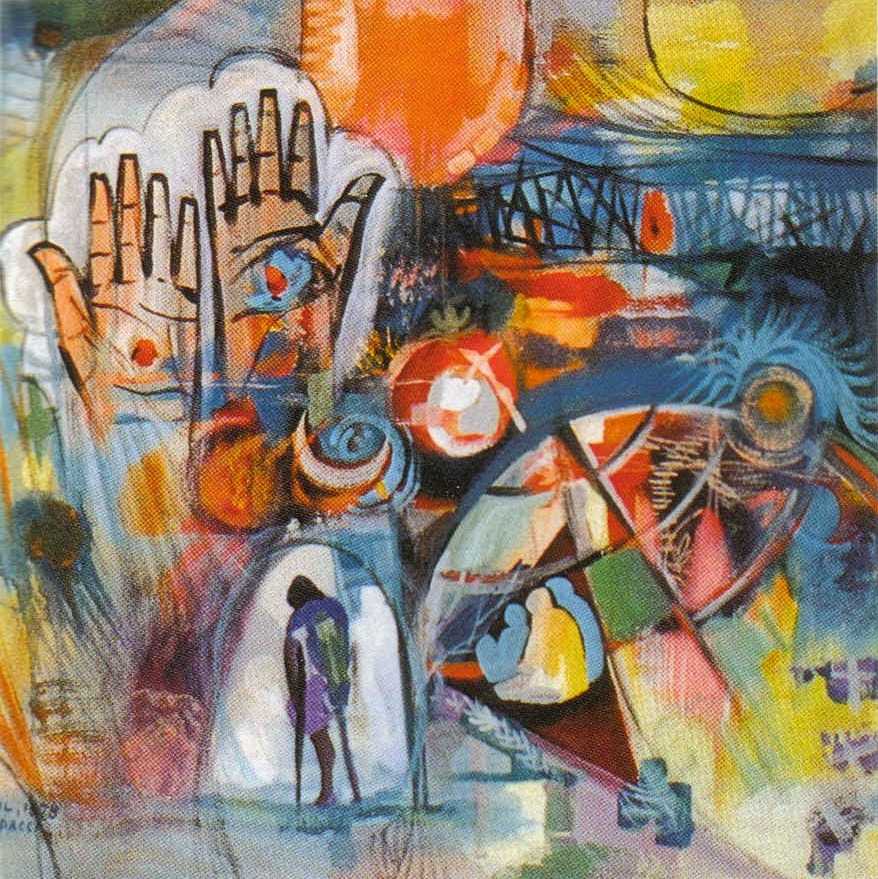
Hebrews 12:3-13 – Interpret Your Circumstances Wisely

“The Kingdom Comes” by Bangladeshi artist Nikhil Halder, 1978

Consider him who endured such opposition from sinners, so that you will not grow weary and lose heart.

In your struggle against sin, you have not yet resisted to the point of shedding your blood. And have you completely forgotten this word of encouragement that addresses you as a father addresses his son? It says,

“My son, do not make light of the Lord’s discipline,
    and do not lose heart when he rebukes you,
because the Lord disciplines the one he loves,
    and he chastens everyone he accepts as his son.”

Endure hardship as discipline; God is treating you as his children. For what children are not disciplined by their father? If you are not disciplined—and everyone undergoes discipline—then you are not legitimate, not true sons and daughters at all. Moreover, we have all had human fathers who disciplined us, and we respected them for it. How much more should we submit to the Father of spirits and live! They disciplined us for a little while as they thought best; but God disciplines us for our good, in order that we may share in his holiness. No discipline seems pleasant at the time, but painful. Later on, however, it produces a harvest of righteousness and peace for those who have been trained by it.

Therefore, strengthen your feeble arms and weak knees. “Make level paths for your feet,” so that the lame may not be disabled, but rather healed. (New International Version)

Missed expectations often result in discouragement, even depression.

If we expect God to continually bless us with unending positive circumstances, we will, sooner or later, be confused and/or frustrated when life goes sideways.

The ancient Jewish Christians, for whom today’s New Testament lesson was addressed, faced opposition. Not only did they encounter the hardship of being Jews living in a Gentile world, but they also had to experience the difficulty of being Christians in a Jewish community.

Its one thing to put up with adversity for a few days or weeks. It is quite another thing altogether to deal with hard circumstances day after day, week after week, month after month, even year after year.

Where is God in all this negativity? When are the earthly blessings going to come? What the heck is going on here? Why are my prayers bouncing off the church ceiling?

Over time, the believers began to lose their joy. They started getting discouraged. The Jewish Christians, after beginning well in their faith, gradually slid into misinterpreting their circumstances as God being mean to them. Things got so bad, they even entertained the notion of returning to Judaism and leaving Christianity behind.

Their faith was shrinking.

However, their plight was very much seen by God. In fact, God was the One orchestrating the situations, as difficult as they were.

It is not our lack of resources, the disrespect, or the difficult people around us who are the problem. The issue is our interpretation of those events and persons.

The author of Hebrews invited the struggling believers to take a different interpretation of their hardship: They were experiencing divine discipline.

We are all responsible for our own children. As parents, we discipline them (ideally) for their own good. We know it will hurt temporarily. Yet, in the long run, the discipline will work out.

In fact, we understand this with all kinds of things. Everyday, people submit themselves to getting cut open, poked, prodded, and tested by doctors, surgeons, and healthcare workers because we know there needs to be temporary pain for permanent healing to occur.

It is the rare child who grows up without any discipline and becomes a productive citizen of society. It is the exceptional person who knows nothing of medical interventions for health and healing. And so, it is extremely unlikely that a Christian will experience holiness, righteousness, and live wisely in the world apart from some gut-wrenching, heart-breaking, and mind-bending circumstances for which they neither saw coming, nor ever asked for.

So, when the divine baseball bat whacks us upside the head, how will we interpret it?

Discipline is education by correction. God is the Father, treating us as family, as children who need to learn the ways of grace. God is the Divine Coach, exhorting us to work, run the laps, put in the reps, and reach beyond what we think we can do – knowing all along what our true capabilities are.

Godliness comes through discipline, training, and plain old fashioned hard work. Unless there is the suffering which comes through trials to our faith, Christianity is only a theory.

Before I suffered, I took the wrong way,
    but now I do what you say.
You are good and you do good.
    Teach me your statutes!
The arrogant cover me with their lies,
    but I guard your precepts with all my heart.
Their hearts are unfeeling, like blubber,
    but I rejoice in your Instruction.
My suffering was good for me,
    because through it I learned your statutes. (Psalm 119:67-71, CEB)

The appropriate response to difficult and adverse circumstances is to view them as God’s gracious guidance and correction. Rightly interpreting our life events gives us renewed resolve for the Christian marathon.

Endurance and perseverance are needed. Keeping good running form, consistent spiritual exercise, and maintaining liturgical rhythms, all help us face the adversity with energy, focus, and strength.

Christianity isn’t a matter of doing more. It is a way of life – a continuous evaluation of beliefs and thinking, addressing the shadows of the heart, and listening to the compassion deep in our gut.

Don’t give up. Keep going.

Be safe. Be strong. Be smart. Be spiritual. We are all in this together.

Thanks be to you, Lord Jesus Christ, for all the benefits which you have given us; for all the pain and insults you have borne for us. O most merciful redeemer, friend and brother, may we know you more clearly, love you more dearly, and follow you more nearly day by day. Amen.

Mark 6:45-52 – Facing Fear

Immediately Jesus made his disciples get into the boat and go on ahead of him to Bethsaida, while he dismissed the crowd. After leaving them, he went up on a mountainside to pray.

Later that night, the boat was in the middle of the lake, and he was alone on land. He saw the disciples straining at the oars because the wind was against them. Shortly before dawn he went out to them, walking on the lake. He was about to pass by them, but when they saw him walking on the lake, they thought he was a ghost. They cried out because they all saw him and were terrified.

Immediately he spoke to them and said, “Take courage! It is I. Don’t be afraid.” Then he climbed into the boat with them, and the wind died down. They were completely amazed, for they had not understood about the loaves; their hearts were hardened. (New International Version)

Sometimes, we are afraid – even terrified. And Christians aren’t immune to the feeling of fear and terror.

The truth of the Christian life is that it is a herky-jerky process of three-steps-forward, two-steps-backward, not always knowing with certainty everything we encounter.  

The expectation that we will have a consistent upward trajectory of spiritual development with no scary experiences is wrongheaded and misguided. Throw into the mix that our self-awareness is often skewed, and that we have difficulty assessing ourselves with any accuracy, and voila! we have a recipe for the true human condition.

Doubt, fear, failure, and stubbornness aren’t just endemic to other people – it also characterizes many Christians, as well. We will face severe storms in life. They will be harsh. We will wonder if we’ll even make it out alive, or not. And it may very well seem like Jesus is nowhere to be found. Then, when he does show up, we don’t recognize him, and it scares the bejabbers out of us.

This was the experience of Christ’s disciples, who too often reflect our own stories of faith and fear all rolled up in one person. Today’s Gospel lesson is this: Our fears and foibles do not need to define us because Jesus is Lord over the water, the weather, the wondering, the waiting, the wildness, and our own whimsical natures of seeing miracles accomplished in others, then not believing it can happen in our own lives.

So, what are we really afraid of? Failure? Fear itself? Death? Irrelevance? Loss? Change? Perhaps, everything? Yes, all of life is a risky scary business. There are no guarantees, except one: Christ is present with us, whether we are aware of it, or not.

If the worst scenario you worry about in your head would actually come to pass, it will still never change the reality that God loves you and is with you.  And it will not stop Jesus from assuring us of his presence and climbing into the boat to be with us.

We don’t have any accounts of Jesus freaking out in fear, or when other people flip out in their own fear. Jesus was a person of prayer, completely grounded in his relationship with the Father.   

Jesus made his disciples get into a boat and go out on the lake – all the while knowing what they were about to face with the weather. Even though the disciples were doing God’s will by going out on the lake, they were not spared from adversity. In fact, Jesus wanted them to experience the storm because it is through the storm that we really learn faith and to face down our fears. 

There is no shame in being afraid. We all experience it. And there is no shame in admitting we’re scared. Where shame exists, our instinct is to run away like our ancestors Adam and Eve and hide, thus hiding ourselves from the grace that could be ours.

Being out on the middle of a lake during a storm did not prevent Jesus from being present with the disciples – he just walked on the water to be with them. Even though the disciples had just seen and participated in the miracle of Jesus feeding the five thousand, they were not looking for another miracle – which is why they did not recognize Jesus and were afraid when they saw him.

Jesus never chided his disciples for their fear, or their hard hearts. He simply invited them, with the tone of grace and mercy, to not be afraid. And the Scripture is replete with continual encouragements to not be afraid because of God’s presence. Along with psalmist, we can say:

But when I am afraid,
    I will put my trust in you.
I praise God for what he has promised.
    I trust in God, so why should I be afraid?
    What can mere mortals do to me? (Psalm 56:3-4, NLT)

I sleep and wake up refreshed
    because you, Lord,
    protect me.
Ten thousand enemies attack
from every side,
    but I am not afraid. (Psalm 3:5-6, CEV)

When I called, you answered me.
You made me bold by strengthening my soul. (Psalm 138:3, GW)

Ultimately, fear has to do with disconnection. It is to feel powerless, separated from any resources, unable to do anything about what is presently staring us in the face and scaring us.

Yet, when we have an awareness and a sense of connection with Jesus, there are unlimited resources of grace to accept, cope, and transcend any and every storm we find ourselves in the middle of.

May the risen and ascended Christ, mightier than the hordes of hell, more glorious than the heavenly hosts,
be with you in all your ways. 

May the cross of the Son of God protect you by day and by night, at morning and at evening, at all times and in all places.

May Christ Jesus guard and deliver you from the snares of the devil, from the assaults of evil spirits, from the wrath of the wicked, from all base passions, and from the fear of the known and unknown. 

And may the blessing of God almighty – Father, Son, and Spirit – be upon you and remain with you always. Amen.

*Above painting of Jesus walking on water by Brian Whelan

**Above Orthodox icon of Christ walking on water

***Above painting: Christ walking on the sea, by French artist Amédée Varint (1818-1883)

Deuteronomy 11:1-17 – Knowing Our Boundaries

Love the Lord your God and follow his instruction, his regulations, his case laws, and his commandments always. And know right now what your children haven’t known or yet witnessed:

  • The Lord your God’s discipline, his power, his mighty hand and outstretched arm.
  • The signs and the acts that he performed in the heart of Egyptian territory, against Egypt’s King Pharaoh and all his land.
  • What God did to the Egyptian army, to its horses and chariots—how he made the water of the Reed Sea flow over their heads when they chased after you, but the Lord destroyed them, and that’s how things stand right now.
  • What the Lord did for you in the desert, until you arrived at this place.
  • And what he did to Dathan and Abiram, the descendants of Eliab the Reubenite, when the ground opened its mouth and swallowed them, their families, their tents, and every living thing they possessed in the presence of all Israel.

Your own eyes witnessed each of these powerful acts the Lord performed. So, keep every part of the commandment that I am giving you today so that you stay strong to enter and take possession of the land that you are crossing over to possess, and so that you might prolong your life on the fertile land that the Lord swore to your ancestors to give to them and their descendants—a land full of milk and honey.

The land you are about to enter and possess is not like the land of Egypt, where you came from, where you sowed your seed and irrigated it by hand like a vegetable garden. No, the land you are entering to possess is a land of hills and valleys, where your drinking water will be rain from heaven. It’s a land that the Lord cares for: The Lord’s eyes are on it constantly from the first of the year until the very end of the year.

Now, if you completely obey God’s commandments that I am giving you right now, by loving the Lord your God and by serving him with all your heart and all your being, then he will provide rain for your land at the right time—early rain and late rain—so you can stock up your grain, wine, and oil. He will also make your fields lush for your livestock, and you will eat and be satisfied. But watch yourselves! Otherwise, your heart might be led astray so you stray away, serving other gods and worshipping them. Then the Lord’s anger would burn against you. He will close the sky up tight. There won’t be any rain, and the ground won’t yield any of its crops. You will quickly disappear off the wonderful land the Lord is giving to you. (Common English Bible)

“Boundaries define us. They define what is me and what is not me. A boundary shows me where I end and someone else begins, leading me to a sense of ownership. Knowing what I am to own and take responsibility for gives me freedom. Taking responsibility for my life opens up many different options. Boundaries help us keep the good in and the bad out.”

Henry Cloud

God has boundaries. The Lord doesn’t just flit about doing whatever seems alright for the moment. No, God is firmly secure as the divine Being. God has a deliberate will and way. The Creator God is not okay with created humanity having no boundaries. Since we are people created in God’s image, we are to reflect that image in all things, including having the established boundary of taking charge of our own spiritual lives and obeying the Lord in all things.

God has opened the way of redemption for wayward people. It came first in the incredible event of the exodus from Egypt, then in the culmination of our freedom through the cross and resurrection of Jesus Christ. 

Therefore, God expects us to live into this opportunity without blaming divine action or inaction for our problems, as if fault lies outside of us. Just because God stands up to people and does not cave into their demands and their whining does not make the Lord mean or unjust – it simply means God doesn’t need the props or accolades of people. God is secure enough to not be dependent on humans.

Divine expectations are quite clear on where the boundary lines fall: Love. Yes, indeed, it comes down to love. Love the Lord your God and always hold tightly to the law with its statutes, rules, and commandments. There is no fudge factor to that statement, scratching our heads wondering what we ought to be doing. If we obey God, we will discover life as it ought to be lived – free from all the machinations of the world’s brokenness and insecurity – and yet securely confined within godly boundaries. 

God can exhort people to be strong and take the land. That’s because the Lord made it possible for them to do so by acting in history. Therefore, God expects us to respond in obedience to the boundary lines established so that we will flourish and grow as people in a new land.

There is a big divine pasture for us to enjoy and thrive within. Yes, there is a fence around it, marking the boundary of where we can go. It is there for our benefit and protection, and not to simply keep us in line. Longing for the green grass on the other side of the fence is to be unaware of the vast beauty and foliage all around us.

For we already have everything we need – if we possess the awareness and the gratitude to see it.

Great God Almighty, I choose today to obey you in all things out of the grace given to me because of Jesus Christ.  I want to please you in all I say and do, so that you will be seen as the glorious and exalted king of the universe.  Help me to live up to my standing in Christ in the power of the Spirit as I step into your world with the keys of the kingdom.  Amen.