The Evil Within (Mark 7:1-8, 14-15, 21-23)

Now when the Pharisees and some of the scribes who had come from Jerusalem gathered around him, they noticed that some of his disciples were eating with defiled hands, that is, without washing them. (For the Pharisees, and all the Jews, do not eat unless they wash their hands, thus observing the tradition of the elders, and they do not eat anything from the market unless they wash, and there are also many other traditions that they observe: the washing of cups and pots and bronze kettles and beds.)So the Pharisees and the scribes asked him, “Why do your disciples not walk according to the tradition of the elders but eat with defiled hands?” He said to them, “Isaiah prophesied rightly about you hypocrites, as it is written,

‘This people honors me with their lips,
    but their hearts are far from me;
in vain do they worship me,
    teaching human precepts as doctrines.’

“You abandon the commandment of God and hold to human tradition…”

Then he called the crowd again and said to them, “Listen to me, all of you, and understand: there is nothing outside a person that by going in can defile, but the things that come out are what defile…”

For it is from within, from the human heart, that evil intentions come: sexual immorality, theft, murder, adultery, avarice, wickedness, deceit, debauchery, envy, slander, pride, folly. All these evil things come from within, and they defile a person.” (New Revised Standard Version)

There are many people who believe that evil resides out there, but not in here.

“Out there” is usually in places where people don’t live like me, think like me, and act like me. Rarely does anyone, when asked where evil is, points to their own heart.

The religious establishment of Christ’s day saw evil as something which existed “out there” where the sinners are; but not “in here” where I am.

Jesus had something to say on that subject. The exchange between the religious leaders and Christ began with a query toward Jesus about Jewish traditions and interpretations of the Mosaic law.

The leaders observed that Christ’s disciples were not holding to traditional purity practices. They were not washing their hands in a certain way prior to eating. This was less of a criticism on the followers of Jesus, and much more an indictment on Jesus as their rabbi.

It was believed that there are customs which properly trained disciples ought to know and follow. And Christ’s followers were not, it was assumed, trained well.

The religious establishment understood the words and ways of Jesus as an affront to the teaching of the elders, and of proper scriptural and legal interpretation.

Jesus, however, made a distinction between traditions of the elders and God’s commands. The former are human precepts, whereas the latter are to be obeyed. In no way did Christ demean Mosaic law, or any commandments of God.

Instead, Jesus rejected how particular interpretations – along with practices which arose from those interpretations – end up obscuring the spirit and intent of the law. In other words, purity does not come from hand washing, because neither purity nor impurity originates from the hands.

Christ reached back into the prophecy of Isaiah to show that there is a contrast between what the mouth utters and what is within the heart. The incongruence between the words spoken and the heart’s true state puts the issue of where impurity and evil really come from: The heart, not the mouth.

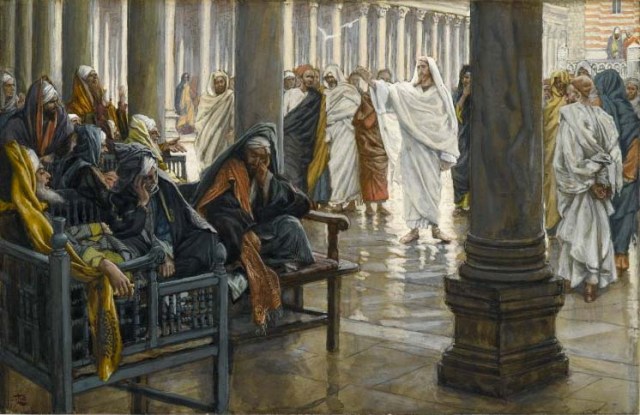
Jesus and the Pharisees, by French painter James Tissot (1836-1902)

Evil intentions originate within. Evil actions are animated by the heart. Evil attitudes are born in the heart. The human heart is the place which needs attention because, for ancient people, this is where a person’s rational will is located. It is where moral pollution dwells, deep within.

Let’s keep in mind that, in the verbal kerfuffle between Christ and the religious leaders, there is no evidence that Jesus disregarded Jewish dietary laws. He instead took the religious establishment to task on elevating outward human traditions, while simultaneously ignoring the inward human heart.

Food and hand-washing are not the chief concern, when it comes to purity and impurity. At issue is the source of defilement, that is, where the pollution is sourced. Jesus insisted that it’s more about who you are, and what is in your heart, than it is about the food you eat or avoid.

In truth, the problem of defilement is important. And keeping the Mosaic law is significant. Yet, Jesus was looking at these issues from a different angle. He affirmed the law’s purpose in restraining evil and avoiding impurity, along with the religious leaders. However, Christ disagreed with them on how the law is practically observed and obeyed.

Jesus did not come up with something new or strange in talking about evil emanating from the heart. Judaism is a religion of the heart, just as much as Christianity or any other religion.

The heart is devious above all else;
    it is perverse—
    who can understand it?
I the Lord test the mind
    and search the heart,
to give to all according to their ways,
    according to the fruit of their doings. (Jeremiah 17:9-10, NRSV)

So, what’s up with the conflict between Jesus and the religious leaders? Over time, many located evil outside, out there, with evildoers and law-breakers, with those disobedient to the law. Christ came along and reaffirmed where the problem originates, scripturally.

One isn’t defiled by improper handling of ritual; one is defiled because being unaware of, or not acknowledging, the dark shadows which reside within every human heart.

Therefore, the discussion of evil and impurity is useless, if we only talk about influences from outside. Deal, instead, with the influences from within.

The heart is not all bad; there’s a lot of good there. But there are spaces within the heart which are camouflaged in darkness. Those places need attention, before we launch into evil which exists elsewhere.

Everyone must come to the point of understanding that they are capable of both great good and great evil. A Pharisee is not all good. And a lawbreaker is not all bad. Until we can see the commonality between ourselves and those we separate ourselves from, we will continually miss the heart of true religion.

Whether a Jew, Christian, Muslim, or any other religious tradition, we must deal with our own collective house, and our own personal heart. Hate speech toward another group has no warrant from Jesus. Injustice has no place in Christianity or anywhere else.

Furthermore, not a one of us can rationalize any unjust words and/or inactions. If that happens, a terrible blindness has occurred in which someone or some group of people refuse to see their own culpability in evil, and project it outward onto another person or group.

If we keep the light of the gospel in our own hearts, then it is much less likely that we will demean or attack others, either verbally, physically, or both.

Using a self-constructed and janky flashlight to shine on another’s heart does nothing but keep the attention off of our own heart. That sort of dubious searching of splinters helps no one, especially ourselves, who already have nasty logs in our own eyes.

Evil is deeper than mere selfishness, bigger than a personal error in judgment, and greater than some individual bad decisions. That’s because there is also a collective heart in every organization, institution, corporation, and faith community. Injustice and unrighteousness resides in those hearts, as well. This makes all of us – personally and communally – both victims of evil, as well as perpetrators of wickedness.

This is why grace and mercy are the real answers to the evil in this world’s systems, and in the human heart. Jesus is trying to pave the way toward a solution of the problem of evil.

Let’s give him an honest look and hearing.

Most merciful God, we confess that we have sinned against you in thought, word, and deed, by what we have done, and by what we have left undone. We have not loved you with our whole heart; we have not loved our neighbors as ourselves. We are truly sorry and we humbly repent. For the sake of your Son Jesus Christ, have mercy on us and forgive us; that we may delight in your will, and walk in your ways, to the glory of your Name. Amen.

Fight, Flight, Freeze, or Faith (Psalm 11)

I have taken refuge in the Lord.
    So how can you say to me,
    “Flee to the hills like a bird
        because the wicked
        have already bent their bows;
        they’ve already strung their arrows;
        they are ready to secretly shoot
        those whose heart is right”?
When the very bottom of things falls out,
    what can a righteous person possibly accomplish?

But the Lord is in his holy temple.
    The Lord! His throne is in heaven.
His eyes see—
    his vision examines all of humanity.
The Lord examines
    both the righteous and the wicked;
    his very being hates anyone who loves violence.
God will rain fiery coals and sulfur on the wicked;
    their cups will be filled
    with nothing but a scorching hot wind
    because the Lord is righteous!
    He loves righteous deeds.
    Those whose heart is right will see God’s face. (Common English Bible)

We all know what it feels like to take the brunt of someone’s poison verbal darts. It’s scary and stressful. What do you do? In a state of fear, shock, or panic, we will likely either fight, flight, freeze, or faith.

Fight

If you have ever received a nasty email based on half-truths and accusations; stood dumbfounded as someone hurled misinformation and criticism at you; and/or experienced the victimization that comes from slanderous and gossiping tongues, then the psalmist knows exactly how you feel. 

Cobbling together a hasty email response, full of anger and vitriol, only sucks us into the person’s evil ways. Metaphorically punching someone in the face for their slap to your face is how the demonic realm handles offenses. Fighting back with an equal or greater force is diametrically opposed to the way of Jesus in loving our enemies and praying for those who persecute us.

Flight

Then, there is the response of taking flight from the nastiness. Indeed, it sometimes seems as if good people are always getting swallowed whole by unjust words and behaviors directed squarely at them. 

And it doesn’t help when the downers among us stroll along and give us their unhelpful fatalism about how there is nothing we can do and how nothing will ever change.

Freeze

Some folks are just plain dumbfounded that another person can be so mean or controlling, so they freeze, unable to speak or do anything. They end up suffering in silence, without their victimization having a voice.

Faith

To be the target of evil speech or malevolent actions is, at the least, unsettling, and, at worst, can bring years of struggle, depression, and inability to serve. Yet, there is someone who sees it all, and that someone will address the wrong. 

We have an option beyond fighting back in anger, fleeing altogether in fear, or freezing in our tracks. We can trust God. We can have faith.

God Sees

The Lord sits aloft, overseeing all, and knows everything humanity does and says. God always does right and wants justice done. Everyone who shares a divine sense of what is right and just will see God’s face. God will act because the Lord abhors and despises those who are cruel and enjoy violence.

It’s not a good idea to get on God’s bad side. The way to flare God’s anger is by possessing an acerbic tongue; relishing in verbal violence; and, having no remorse about any of it. Because God loves people, God hates evil. 

The righteous can take solace in the truth that God really does see the harm done and is in a position to do something about it. Like the psalmist, we seek the Lord. The Lord fights our battles.

Not Okay

Whenever we are harassed and the ungodly give us a hard time, the psalmist isn’t offering some nice religious platitudes such as, “Just let go and let God,” “Everything works for the good of those who love God,” or “It’s okay, you’ll be in heaven someday.”

In another context, maybe those statements are helpful. But being in the teeth of the wicked, all is not okay. As much as some folks try to sanitize an evil situation with rainbows and butterflies, the evil is real, and it’s there.

The truth is that everything is not okay. And it’s okay to not feel okay. The earth is filled with violence, malevolence, oppression, injustice, and systemic evil. The psalmist knows this, all too well.

Humble yourselves under God’s power so that he may raise you up in the last day. Throw all your anxiety onto him because he cares about you.

1 Peter 5:6-7, CEB

God Acts

Today’s psalm is reminding and reassuring us that the Lord is aware of what’s going on and will most certainly do something about it. God will act to punish the wicked and deliver the Lord’s people.

There may not be peace this present moment, yet it will not always be this way. We shall behold the face of the Lord.

The Lord is a righteous judge. Justice is the foundation of God’s throne. God sees the entire spectrum of humanity and can make a right assessment of people’s thoughts, intents, words, and actions.

We, however, cannot. Therefore, it is most necessary for us to put our trust in a Divine Being who cares about right and wrong and has the power to act with justice.

Whenever we are hemmed-in through the schemes of diabolical persons and are powerless, there is always the choice to trust in the Lord. The outcome of every life on earth rests in the hands of God. And it will be a just and right rendering.

Trust in the Lord and do good. Seek peace and pursue it. We might struggle mightily on both the inside and outside – our hard circumstance might not change immediately – yet God is the One who will vindicate the just person when the time is right.

You are not alone. The Lord is with you always.

God of justice, look at the state of your servant and act on my behalf. Do not let evil prevail. Thwart the ungodly so that they can no longer do any harm. Amen.

Confronting the Evil in Front of Us (Mark 6:14-29)

St. John the Baptist rebuking Herod, by Giovanni Fattori (1825-1908)

King Herod heard of it, for Jesus’s name had become known. Some were saying, “John the baptizer has been raised from the dead, and for this reason these powers are at work in him.” But others said, “It is Elijah.” And others said, “It is a prophet, like one of the prophets of old.” But when Herod heard of it, he said, “John, whom I beheaded, has been raised.”

For Herod himself had sent men who arrested John, bound him, and put him in prison on account of Herodias, his brother Philip’s wife, because Herod had married her. For John had been telling Herod, “It is not lawful for you to have your brother’s wife.” 

And Herodias had a grudge against him and wanted to kill him. But she could not, for Herod feared John, knowing that he was a righteous and holy man, and he protected him. When he heard him, he was greatly perplexed, and yet he liked to listen to him. 

But an opportunity came when Herod on his birthday gave a banquet for his courtiers and officers and for the leaders of Galilee. When his daughter Herodias came in and danced, she pleased Herod and his guests, and the king said to the girl, “Ask me for whatever you wish, and I will give it.” And he swore to her, “Whatever you ask me, I will give you, even half of my kingdom.” 

She went out and said to her mother, “What should I ask for?” She replied, “The head of John the baptizer.” Immediately she rushed back to the king and requested, “I want you to give me at once the head of John the Baptist on a platter.” The king was deeply grieved, yet out of regard for his oaths and for the guests, he did not want to refuse her. 

Immediately the king sent a soldier of the guard with orders to bring John’s head. He went and beheaded him in the prison, brought his head on a platter, and gave it to the girl. Then the girl gave it to her mother. When his disciples heard about it, they came and took his body and laid it in a tomb. (New Revised Standard Version)

Feast of Herod with the Beheading of St John the Baptist, in the Museo del Prado, Madrid, Spain

The earthly life and mission of Jesus was connected to the social and political affairs of Judea and the Roman Empire. In truth, Christ’s impact is never only ethereal; rather, it smacks against every system and organization in this world.

John the Baptist’s death was closely connected to Christ’s mission and ministry; and it was also a result of the social and political forces John was subjected to. This would explain why Herod thought of Jesus as a resurrected John, after killing him. Both the messages of John and Jesus were met with resistance by the powers that be.

Marriages in the ancient world, especially among governmental officials, were primarily political affairs, and not love arrangements. The more authority and power a person had, the greater the political implications and impact there was. And marriage was one way of consolidating more power.

Herod’s marriage to Herodias may have been politically expedient, but was ethically repugnant, and John let him know about it. Herod was both a Jew and a Roman official, with his actual allegiance being to himself.

Herodias considered John as politically repugnant and found it unethically expedient to silence him once and for all when she had the opportunity. John the Baptist discovered first-hand that hell hath no fury like a woman’s scorn. Herodias hated him and waited for an opportune time to be rid of him once and for all.

But not only did Herodias orchestrate John’s demise, she did it in a way that sought to humiliate him. To die in battle at the hand of an enemy soldier was an honorable death; but to be executed because of a woman’s handiwork was a mark of shame.

Anyone who lives for God and speaks truth to power will nearly always suffer deep consequences. Hence, this is why a great many prophets ended up dead, often by tortuous methods – including Jesus and nearly all his original disciples.

Unfortunately, there are individuals in this world who are incapable of doing good.

Whenever such persons talk a good line, or do a good deed, it’s always in the service of a larger evil agenda. They often end up in positions of authority, simply because they have no scruples and will lie to you with a straight face.

And they will do anything to not only hold on to their power, but to acquire more so that they can be in control of everything around them. Of course, the people around such a person are miserable. They typically feel powerless to change the situation.

So, if there’s going to be transformation, there will need to be a prophet – someone like John the Baptist – who has the courage to speak truth to power and remind the world that God is the sovereign of the universe.

The Gospel writer Mark presents Herodias as a person with influence and power who only cares about her own interests. She had no scruples in using her daughter for malevolent purposes.

Whereas the young daughter of the synagogue ruler Jairus was (earlier in Mark’s account) raised to life by Jesus, in today’s story the young daughter of Herodias became the vehicle of a grisly murder. And, of all things, it’s this girl who brought the severed head of John the Baptist on a platter to her mother.

We are meant to see the impact and consequence when those in power have self-centered objectives and dark hearts. This is in direct contrast to both Jesus Christ and John the Baptist, both of whom gave their lives for that which is right, just, and good.

God’s mercy and redemption will eventually overwhelm all of creation. The cross and resurrection of Christ have won the victory over evil. Yet, until Christ returns, the dark forces of this old world know their time is short; and they are doing everything they can to throw a monkey wrench into the benevolent machine of grace, before the demonic forces themselves are thrown into the pit forever.

Christian mission and ministry was never designed to be easy nor pain-free. But it is meant to bring hope, love, redemption, peace, and satisfaction to all who believe.

Christ has connected himself to us. Let’s keep that gracious connection going by doing what is right and living a good and just life, and confronting the evil in front of us – to the glory of God. Amen.

Victory Over the Power of Evil (Luke 4:31-37)

He went down to Capernaum, a village in Galilee. He was teaching the people on the Sabbath. They were surprised and impressed—his teaching was so forthright, so confident, so authoritative, not the quibbling and quoting they were used to.

In the meeting place that day there was a man demonically disturbed. He screamed, “Stop! What business do you have here with us, Jesus? Nazarene! I know what you’re up to. You’re the Holy One of God and you’ve come to destroy us!”

Jesus shut him up: “Quiet! Get out of him!” The demonic spirit threw the man down in front of them all and left. The demon didn’t hurt him.

That knocked the wind out of everyone and got them whispering and wondering, “What’s going on here? Someone whose words make things happen? Someone who orders demonic spirits to get out and they go?” Jesus was the talk of the town. (The Message)

During his earthly life and ministry, Jesus was a Deliverer and a Liberator; he came to save people from their guilt and shame, and to free the world from the clutches of evil.

And so, it was inevitable that Jesus would come into conflict with the forces of darkness.

In today’s story, Jesus had a confrontation with an unclean spirit, that is, a demon who is an ally of the devil. The particular demon was not only speaking for himself, but also for his fellow band of wicked spirits.

Christ’s ministry put him in direct opposition to the hosts of Satan. The nub of the issue for the demon was whether Jesus had come for their immediate destruction. Jesus, however, wasn’t in the habit of answering questions from demons.

So, Christ rebuked the demon, told him to get out of the person he was influencing. And that is exactly what happened. The writer, Luke, pointed out that this demonstrated Christ’s authority, that it even includes the power to command unclean spirits, and out they go.

And that is how the liberating and saving ministry of Jesus began.

In the Gospel of Luke, this account of Jesus being confronted by a demon happens just after Christ’s 40 days of being tempted in the desert, even by Satan himself. So, the entire demonic realm was alert to beginning ministry of Christ. They went after Jesus right away, perhaps trying to trip him up before he could get any ministerial momentum.

Jesus was teaching on the Sabbath in the town of Capernaum. We ought not to be surprised that a demonized man was among those observing the Sabbath. The wise believer will be savvy to this reality.

Furthermore, we aren’t told who the man was or of any symptoms he may have had. Apparently, he presented himself as a normal Jewish villager. So, we ought not to think that anyone being demonized will necessarily demonstrate madness or illness of some sort.

The demon was perhaps more aware of who Jesus was than anyone else there on that Sabbath Day in Capernaum. He acknowledged Christ’s power and mission. Jesus indeed came to destroy the power and influence of evil in the world.

You believe that there is one God. Good! Even the demons believe that—and shudder.

James 2:19, NIV

Since Jesus Christ is the rightful authority over all, that means Satan and his wicked spirits are not; and they must submit to that true and real power.

Truth and doctrine are not only about objective facts and right belief. Even though our thinking is important and critical, there is more to it than that: Orthodoxy (right belief) requires orthopraxy (right actions).

A right truth that is only described is not the whole truth. In reality, a false witness and a liar may state the truth, but not entirely, withholding important information; thus, impairing any sort of right action from taking place.

Gaslighting relatives, oppressive bosses, and tyrannical rulers who tell some truth, and even support some good things, are still gaslighting and oppressing others with their narcissistic brand of leadership.

Truly, believers in and followers of Jesus can sometimes be duped into supporting evil leaders who use all sorts of unjust tactics, just because that leader tells the part of truth I want upheld.

Jesus saves; he is Savior of the world – but that is only part of the truth. We must also ask: What has Christ come to save us from? Not just our mistakes, mess-ups, and sins. Christ came to deliver us from the very power of evil that supports injustice and unrighteous behavior to begin with.

If we merely view Jesus as our personal Savior from hell after we die, then we will likely focus almost exclusively on heaven. But if we see all the freedom we need from unhealthy behaviors and unjust ways, then we view Christ as so much more than a fire insurance policy.

We need a more expansive understanding of Christ’s cross. Yes, Jesus died for our sins. Yet, he also died to conquer evil; Christ made it possible for us to become liberated from the shackles of systemic sin and structural evil, as well as personal guilt. In other words, Christ came to topple all evil, and not just human foibles.

And this was why the dark powers of Satan, and his demons, were so afraid of Jesus. They knew their time was short. There is yet another power that has a hold on us today – and that is the reality that many people no longer believe in demons and devils and dark forces.

Since we are a technically advanced people with great understanding of medical science, we now know all sorts of things which cause physical and mental illness. Ancient people did not know about human hormones and chemicals, and the impact of genetic codes on our health. They had no idea about bacteria and viruses, microbes and hygiene.

Therefore, we can jettison all this mumbo-jumbo about demons, right?… Not so much.

Even with all of our modern (and postmodern) explanations for the body and brain, we are still finding ourselves having to contend with the mystery of evil, and the malevolent suffering it causes us.

We modern folk can certainly provide a lot of insight into the cause and effect of particular symptoms a person has according to their biology. And yet, that doesn’t take away the presence of malevolent forces on this earth.

Even with all of our understanding, evil still resides within organizations, institutions, and even faith communities. The meanness and malevolence, the injustice and the ingratitude, and the profound violence (both verbal and physical) which one human being can exact on another is still here – and some would argue that it’s worse than ever.

Knowing something isn’t the same as doing it. If that were true, then education ought to deliver us from evil. Even some intelligent and objective people, who are fluent in facts and figures, still use their calculations for evil.

No matter our creeds or convictions, whether we are religious or not, all of us seem to have a collective sense that this old world of ours is profoundly broken.

All the research dollars in the world has not produced a solution to fix evil. And even if we could completely understand evil, that isn’t the same as ridding ourselves of it.

What’s more, those who put all their trust in changing things through modern means (which means without God) have been some of the worst offenders of producing wars, political tyranny, and gross injustice.

To put all of this perhaps more succinctly in the form of question: We know and understand a lot in combating disease, disaster, and death; but does all of that insight do away with the evil of it? Are things less tragic now?

I argue that is has not. Evil is still evil. Chronic pain, homelessness, poverty, injustice, and health inequities are still wreaking their evil on people.

I believe that evil really does exist, even if it has different language today than it did in the ancient world.

There is real opposition, conflict, and confrontation from evil today. The victory Christ has achieved over the forces of evil has a 2,000 year track record of helping people experience renewed lives, even when their bodies are wasting away.

In the end, the victory of Jesus Christ shall become evident to all the world. Overcoming evil doesn’t come from us, but from God. We can and we must deal with evil in this world. But we are not the Savior or the Liberator.

We need faith in the Son of God who loved us and gave himself for us. Amen.