1 Samuel 17:55-18:5 – True Friendship

As Saul watched David go out to fight the Philistine, he asked Abner, the commander of his army, “Abner, whose son is this young man?”

“I really don’t know,” Abner declared.

“Well, find out who he is!” the king told him.

As soon as David returned from killing Goliath, Abner brought him to Saul with the Philistine’s head still in his hand. “Tell me about your father, young man,” Saul said.

And David replied, “His name is Jesse, and we live in Bethlehem.”

After David had finished talking with Saul, he met Jonathan, the king’s son. There was an immediate bond between them, for Jonathan loved David. From that day on Saul kept David with him and wouldn’t let him return home. And Jonathan made a solemn pact with David because he loved him as he loved himself. Jonathan sealed the pact by taking off his robe and giving it to David, together with his tunic, sword, bow, and belt.

Whatever Saul asked David to do, David did it successfully. So, Saul made him a commander over the men of war, an appointment that was welcomed by the people and Saul’s officers alike. (New Living Translation)

“One of the most beautiful qualities of true friendship is to understand and to be understood.”

Seneca (5 B.C.E.-65 C.E)

We may have numerous acquaintances; social media friends; friends we do activities with; family friends and cousin friends; and even some good close friends. However, there are few, maybe only one or two people, who are so close as to be your best friend and a kindred spirit.

That person is the one whom you know always has your back; is the first person you call in the middle of the night in an emergency; and is the confidant you can say anything to, and they won’t freak out about it. They will always shoot straight with you and are your biggest encourager and fan. There is nothing they would not do for you.

I hope you have such a friend because they are rare gems. Such relationships typically begin by hitting it off well together. Usually, some event or particular place brings two people to a point of discovering they have such commonality of thinking and a commitment to living a certain way that their hearts are immediately drawn to each other. This is exactly what happened to Jonathan and David.

Before Jonathan and David’s friendship emerged, Jonathan (King Saul’s son) took it upon himself to step up and step out in single-handedly taking on the Philistine army. Jonathan faced them with only his armor-bearer behind him, climbed a cliff to other side where the Philistines were, and attacked all by himself. One guy deliberately went against an entire army. 

While six-hundred Israelite soldiers were hiding, too afraid to face the enemy, Jonathan took it upon himself to act. It was not a rash action but a decision of faith:

Jonathan said to his young armor-bearer, “Come on, let’s go over to the fort of these uncircumcised men. Maybe the Lord will act on our behalf. After all, nothing can stop the Lord from saving, whether there are many soldiers or few.” (1 Samuel 14:6, CEB) 

Jonathan passionately believed the Lord was with him and would achieve the victory. Indeed, God sent a panic throughout the Philistine camp when Jonathan acted. The result was a complete rout.

David had his own act of faith with the Philistine giant, Goliath. While everyone in the Israelite camp was fearful of the larger than life enemy, David saw him through the eyes of faith, and stepped up to challenge someone twice his size. 

It just so happens, that on that day, Jonathan had a front row seat to the entire event. It was immediately after David killed Goliath that Jonathan knew this was a guy with remarkably similar sensibilities. David possessed Jonathan’s same passion for God; same zealous faith that takes enormous risk; same heart for God’s people and God’s name. They clicked – and became kindred spirits, as if knowing the one of them was to know the other.

It was true friendship at its absolute best. Jonathan had David’s back. There was nothing he would not do for him, and vice versa. So, he made a covenant with David. And it turned out to be a lasting commitment neither of them ever regretted. 

Jonathan did not make the covenant with David just to buddy-up with the new popular person. No, Jonathan is a timeless example of one who was humbly unselfish. He gave up his robe and his weapons to David. This was a magnanimous gesture. Jonathan believed David was the next true king, so he gave his kingly objects to him.

As the king’s son, Jonathan stood in line to be the next king. In fact, everything we know about Jonathan informs us he would likely be a darn good king. Yet, Jonathan recognized David was a more worthy candidate than himself. So, he gave up his right to the throne and handed over his symbols of potential kingship.

Jonathan delighted in David’s success. He joyfully watched David become a great warrior and successful leader. Jonathan was always the first one to give David a pat on the back and do whatever was needed in supporting him. 

Jonathan didn’t mind that David upped him on the battlefield and commanded ever larger numbers of soldiers.  Jonathan could have pulled rank on David as the king’s son – but he never did, because he honestly believed his friend was the real king.

“If Christ Jesus dwells in a person as his friend and noble leader, that person can endure all things, for Christ helps and strengthens us and never abandons us. He is a true friend.”

St. Teresa of Ávila

In the New Testament, we see a person with the same spirit and devotion as Jonathan. John the Baptist was out in the wilderness being a literal wild man. And he gained quite a following. All kinds of people went out into the desert to be baptized by John and to be his disciples. Yet, John recognized that he himself was not the true king. Concerning Jesus, John said:

“This is the one I told you would come! He is greater than I am because he was alive before I was born.” (John 1:15, CEV)

“I am not the Messiah…. I am the voice of one calling in the wilderness, ‘Make straight the way for the Lord.’” (John 1:20, 23, NIV)

“Though his ministry follows mine, I’m not even worthy to be his slave and untie the straps of his sandal.” (John 1:27, NLT)

“I have seen and testified that this one is God’s Son.” (John 1:34, CEB)

John never became jealous, envious, or concerned that his cousin Jesus was greater than himself. In fact, he celebrated it:

“I am so happy that he is here. He must become more and more important, and I must become less important.” (John 3:29-30, ERV)      

John was focused on God. He therefore was able to respond rightly and humbly to Jesus, the true king. 

Jonathan was focused on God, and so was able to respond rightly and humbly to David, the true king.

Jesus is both king and friend. Jesus can be your kindred spirit, the one who always has your back. You can call, and he will be there. And we can delightfully watch Christ increase while we decrease. His success is our success. 

Divine friendship is possible. God’s people can enjoy incredible unity because Jesus has gone before us – he has won the victory over sin, death, and hell on our behalf. By faith we step out and act with the knowledge God is with us.

Jesus said, “No longer do I call you servants, for a servant does not know what his master is doing; but I have called you friends, for all things that I heard from My Father I have made known to you.” (John 15:15, NKJV)

**Above wood sculpture of Jonathan and David by Olen Bryant (1927-2017)

2 Corinthians 4:13-5:1 – Do Not Lose Heart

It is written: “I believed; therefore, I have spoken.” Since we have that same spirit of faith, we also believe and therefore speak, because we know that the one who raised the Lord Jesus from the dead will also raise us with Jesus and present us with you to himself. All this is for your benefit, so that the grace that is reaching more and more people may cause thanksgiving to overflow to the glory of God.

Therefore, we do not lose heart. Though outwardly we are wasting away, yet inwardly we are being renewed day by day. For our light and momentary troubles are achieving for us an eternal glory that far outweighs them all. So, we fix our eyes not on what is seen, but on what is unseen, since what is seen is temporary, but what is unseen is eternal.

For we know that if the earthly tent we live in is destroyed, we have a building from God, an eternal house in heaven, not built by human hands. (New International Version)

We all face seasons and circumstances that stretch our faith and press the limits of what we can handle.

We have no promise from Scripture we will avoid trouble. 

Instead, Jesus promises his followers there will be adversity and stressful predicaments. 

The pressures of life can sometimes be so overwhelming, we might lapse into losing heart, either by chiding ourselves for the adversity and wishing things were different, or blaming others for our troubles, and believing that if they would just get their act together, all would be well with my soul. 

The ancient Corinthian Church had a bevy of relational issues and problems. Some they created themselves. Some came from other people. Other issues arose simply by living in a fallen world, surrounded by the effects of ever-present sinful crud. 

Yet, no matter the source or nature of the problem, the Corinthians needed a point of focus to direct their troubled hearts. They needed to be reminded of the grace they possessed in Jesus Christ.

Faith is a gift given by God. It is planted in the heart of the believer so that, over time, it will nurture, grow, and bear spiritual fruit. Out of that belief arises speaking words of hope and love that embrace the work of God in the life of the believer. The Apostle Paul said elsewhere to the Roman Church: 

If you openly declare that Jesus is Lord and believe in your heart that God raised him from the dead, you will be saved. For it is by believing in your heart that you are made right with God, and it is by openly declaring your faith that you are saved. (Romans 10:9-10, NLT)

Christ’s resurrection from death is both a spiritual and a physical reality. If we believe this truth in our hearts, we will be raised both spiritually and physically. Faith in Christ gives shape to the hope that, although we might be experiencing the effects of mortality and the fall of humanity, we are, at the same time, being spiritually renewed day by day. 

The very same afflictions causing our bodies to degenerate and challenging our spirits, are the same means to achieving a glorious, resurrected existence. There cannot be the glory of spiritual and bodily resurrection without a shameful death. Jesus absorbed the shame of the world’s violent ways onto himself so that we might be raised with him. 

However, this does not mean we will never experience difficulty in this present life. In fact, daily spiritual renewal can and does happen through adverse circumstances. There must be suffering before glory, both for Jesus and for us. Deliverance from sin, death, and hell is not an inoculation from trouble. Because it is the troubles of this life which teach us to trust in God, as well as weaning us from everything we previously trusted to deal with those troubles.

“Don’t let your hearts be troubled. Trust in God, and trust in me.”

Jesus (John 14:1, NIV)

So, we need to fix our gaze firmly on the unseen reality of faith and hope. All we see with our physical eyes is temporary. All that is unseen is eternal, especially and namely, God. Therefore, it is imperative we traffic in building heavenly treasure, learning to deal with the intangible and unseen dimensions of life.

We are to allow the physical to serve as a sign and seal of the spiritual realities they represent.

For example, Christians come to the Lord’s Table so that the tangible elements of bread and cup will bolster and fortify our faith with the grace that points to the intangible. The Table is to accomplish for us a spiritual renewal of lifting us up by God’s Spirit and joining us with Jesus. This union with Christ can never be taken away from us, even in death, because we have an eternal building from God which makes this present life look like a camping trip.

When I think of a person who is outwardly wasting away, yet inwardly being renewed, I think of Joni Eareckson Tada. She has been a paraplegic for fifty years, after an accident as a teenager in which she dove into shallow water and broke her neck. Afterwards, lying in a hospital for months unable to move, she had completely lost heart to the point of being suicidal. 

Joni could not even kill herself since she could not physically move. Finally, in her darkest moment, she cried to God with what she says was the most significant prayer she ever prayed: “Lord, if I can’t die, show me how to live.” And God did. Joni’s faith is as strong and robust as anyone’s, despite her infirmity and handicaps. She has learned to embrace her troubles as the means of growing her faith.

The path to accept, cope, and transcend our troubles and afflictions begins with acknowledging them. They only have power over us for ill if we ignore them or put up a false front to hide them. The Apostle Paul was open with the Corinthians about his life: 

We do not want you to be unaware, brothers and sisters, of the affliction we experienced in Asia; for we were so utterly, unbearably crushed that we despaired of life itself. Indeed, we felt that we had received the sentence of death so that we would rely not on ourselves but on God who raises the dead. (2 Corinthians 1:8-9, NRSV) 

Paul faced whippings, beatings, stoning, shipwreck, hunger, poverty, danger, and trouble, not to mention the stress of caring for fledgling churches. Through it all, Paul was transparent, and named his troubles so he could apply the poultice of God’s grace to his afflictions. 

It is our brokenness – not having it all together – which shows the grace of God to others.

Paul consistently described his life and ministry in apparent paradoxes: strength in weakness; glory through shame; life through death; riches through poverty. 

Although we experience the fallen nature of the world, God bends each situation toward divine purposes so that what seems to be our downfall becomes the means to our spiritual renewal.

Therefore, we do not lose heart. 

Holy Scripture encourages us not to give up because of hardship, since those very same troubles are the divine implements used to form us into solid followers of Jesus.

We need some stress. Just like a violin needing its strings adjusted to the right pressure, God will tune us with the right amount of stress we need to produce beautiful melodious music. God is the musician, and we are the instrument, not the other way around. 

We are to interpret our stress as God tuning us for good purposes. The pressure we experience becomes the means of glorious music in daily spiritual renewal for the life of the world.

Believers are being renewed daily into a valuable work of God. The stress and trouble we experience is very real and sometimes quite hard. Yet, we have the hope God will bend each circumstance for good purposes so that, even though we seem to be wasting away on the outside, on the inside those experiences are renewing us. 

When this present life is over, it is not the end; it is just the beginning.

God Almighty, you reign supreme, including over our stress and pressure in this present life. You have brought us in safety to this day. So, preserve us according to your mighty power, so that we might not fall into sin, nor be overcome by adversity. In all the situations of life, whether good or bad, direct us to the fulfilling of your purposes through Jesus Christ our Lord. Amen.

Numbers 6:22-27 – A Blessing

The Lord spoke to Moses: Tell Aaron and his sons: You will bless the Israelites as follows. Say to them:

The Lord bless you and protect you.
The Lord make his face shine on you and be gracious to you.
The Lord lift his face to you and grant you peace.

They will place my name on the Israelites, and I will bless them. (Common English Bible)

Life operates by blessing, not cursing.

The world cannot stand up under the curse. The new earth will endure forever with a blessing.

People wither without a blessing. They die when cursed. Not necessarily in body. Most definitely in spirit.

Something must be said about the word “blessing.” It gets used and misused a lot, especially by Christians.

As with most words in the Old Testament, “blessing” is a relational word. It means to have God’s stamp of approval on your life. It’s meant to convey that the Lord’s presence is with us. To be blessed by God is a multi-dimensional experience – receiving promises, enjoying peace, having right relationships with both God and other people, and knowing divine comfort and security.

A blessing isn’t simply having money and/or family and a good job. One could have none of those and still be blessed by God. And being blessed is not getting everything you want. Some people continually get what they want and are cursed, not blessed.

Blessing is tied not to human activity but divine initiative. We can’t finagle a blessing out of God. Plenty of folks try to do that, and, like Jacob, they might get away with it in their family – but it will not work with God. The grace of blessing is freely bestowed by a benevolent and merciful Lord.

Everything comes down to God. The Lord is not stingy but generous – not subject to the whimsy of human cajoling but deeply influenced by the unending unity, harmony, and love within the divine godhead.

In other words, divine blessing is a gift – not something earned or cleverly received through trickery or manipulation.

Blessing one another is also a gift. In fact, God clearly communicated to Moses and Aaron how they were to bless the people with powerful words.

I believe we all intuitively know that words and language have the power of life and of death, of blessing and cursing. And withholding words of blessing and keeping silent is to withhold goodness and love from another. Speaking words of blessing and backing up those words with an active commitment, is vital to humanity’s spiritual and emotional health.

Fathers and mothers everywhere across the world stand in a unique and special position as those who have the power of bestowing a blessing on their children – a blessing of being with them, approving of them, affirming their gifts and abilities, envisioning for them a special future of how God can use them. Those words of blessing have the power to help children navigate the world with assurance and confidence. Armed with blessing, they can filter-out the choices in front of them and walk in the way of God.

Notice in the New Testament Gospels how the God the Father blessed the Son:

And when Jesus had been baptized, just as he came up from the water, suddenly the heavens were opened to him and he saw the Spirit of God descending like a dove and alighting on him. And a voice from heaven said, “This is my Son, the Beloved, with whom I am well pleased.” (Matthew 3:16-17, NRSV)

God provided a constant presence and an active commitment through the Spirit; God spoke words of approval and affirmation; God the Father had a special future for Jesus the Son, which helped Jesus to repel the words of Satan. Since Jesus needed and received a blessing from his Father, how much more do we? 

Jesus passed the blessing to his disciples with a promise of presence and commitment:

Jesus came near and spoke to them, “I’ve received all authority in heaven and on earth. Therefore, go and make disciples of all nations, baptizing them in the name of the Father and of the Son and of the Holy Spirit, teaching them to obey everything that I’ve commanded you. Look, I myself will be with you every day until the end of this present age.” (Matthew 28:18-20, CEB)

Jesus informed the disciples his presence would be with them; communicated an active commitment to give them authority to do the job of disciple-making; pictured for them a special future of reaching the nations; affirmed and approved them. “The Great Commission” is really a statement of God’s blessing.

One reality needs to be recognized and affirmed with all confidence: You and I already possess God’s blessing; there is no need to try and earn it. The words of blessing state what is, in fact, already true.

We have the privilege and the ability to reverse the world’s curse and turn it into blessing. Those blessed with money can be a blessing by giving it away. Those blessed by growing up in a loving family can provide love to others who are unloved and need a special blessing. Those blessed with wisdom can mentor and instruct those who need wisdom. Those blessed with the mercy of God can be merciful to others. Those blessed with a wonderful relationship with God can pray people into the kingdom of God.

Parents, it is never too late to bless your children, even if they are adults. Children, it is never too late to bless your parents and your siblings, even if they are prickly and hard. To not bless is to curse. Bless through words that build up, and do not tear down. Use those words to picture a special future of what God can do. Follow through with those words by demonstrating an active commitment to embodying blessing.

I leave you with a blessing:

May God answer you when you are in distress; may the name of Jesus protect you. 

May the Lord send help when you need it and give you support when you cry out to him. 

May the God of heaven remember your good deeds done in faith and accept you just as you are. 

May the Lord give you the desire of your heart and make all your plans succeed.

When the Almighty goes out of the way to answer your prayers, then I will be the first to shout with joy!

I know the Lord is God. There is a special future for you beyond what you can even ask or think. And I will be there on the sidelines, encouraging you all the way.

Some people trust in the political process, others trust in the strength of the economy; but we trust in the name of the Lord our God. 

May God answer when you call.

May God bless you with an everlasting love. 

May you know Christ, and him crucified, risen, and coming again. 

May God’s presence and power be with you now and forever.  Amen.

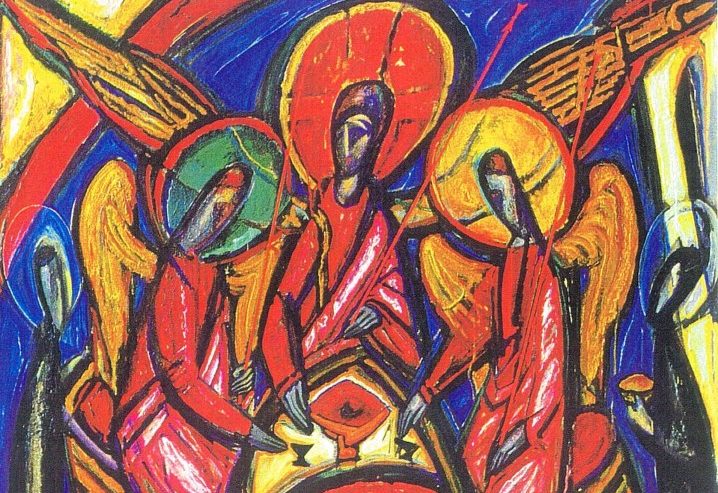
*Above painting of the Trinity by Alek Rapaport, 1994

Deuteronomy 34:1-7 – Take the Long View

Then Moses climbed Mount Nebo from the plains of Moab to the top of Pisgah, across from Jericho. There the Lord showed him the whole land—from Gilead to Dan, all of Naphtali, the territory of Ephraim and Manasseh, all the land of Judah as far as the Mediterranean Sea, the Negev and the whole region from the Valley of Jericho, the City of Palms, as far as Zoar. Then the Lord said to him, “This is the land I promised on oath to Abraham, Isaac and Jacob when I said, ‘I will give it to your descendants.’ I have let you see it with your eyes, but you will not cross over into it.”

And Moses the servant of the Lord died there in Moab, as the Lord had said. He buried him in Moab, in the valley opposite Beth Peor, but to this day no one knows where his grave is. Moses was a hundred and twenty years old when he died, yet his eyes were not weak, nor his strength gone. (New International Version)

A signpost stands at a fork in the road.

Pointing in one direction, the sign says “Victory.”

Pointing in another direction, the sign says, “Fulfillment.”

We must pick a direction.

Which one will we choose?

If we choose the path to Victory,

the goal is to win!

We will experience the thrill of competition,

as we rush toward the finish line.

Crowds gather to cheer for us!

And then it’s over.

And everyone goes home.

If we choose the path to Fulfillment,

The journey will be long.

There will be times in which we must watch our step.

There will be times we can stop to enjoy the view.

We keep going.

We keep going.

Crowds gather to join us on the journey.

And when our lives are over,

those who joined us on the path to Fulfillment,

will keep going without us and

inspire others to join them, too.

–Simon Sinek

Fulfillment

It wasn’t all about Moses. The dream and vision of entering the Promised Land didn’t die with Moses. He was just one character, albeit an especially important character, along generations of Israelites who anticipated the fulfillment of God’s promises to the people.

In Christianity, the victory has already been won. In Christ, every good promise of God is and will be fulfilled. Therefore, we can choose fulfillment. We can live into Christ’s victory over sin, death, and hell by choosing to be fulfilled in our Christian lives and our Christian service.

Fulfillment of our godly dreams, good vision, and compassionate ministry requires looking beyond the short term. Long term sustainable thriving in Christian mission and flourishing as a Christian community requires an eternal perspective.

Change

To have the end in mind, a future far ahead of us, demands systemic change. This alternative system will be inspirational, not fear-based. Rather than afraid of what might happen, a long term view is for the next generation – not the next budget crisis due to the next building need.

Maybe because I have been a pastor for so long and know my tenure in each place is only temporary, I know that my vision needs to look further down the road than my own time with a group of people. And a vision of any faith community needs to outlast our own mortal existence. If such a perspective and vision appear as if it will take the energy and will you do not have, then there is no shame in saying so and planning for a good death.

Resilience

The church is resilient. It has lasted two millennia. She has weathered a lot of challenge and adversity.

Metaphors matter. The word pictures we use are important. I choose not to view the church as the first bite of the apple, which I believe is the best bite. Instead, I see the church as a fine cigar. It’s the last puff of a cigar which to me is the best of all. Christ’s Church is far from its last puff. Rather, I’m saying that the best is yet to come.

Perseverance

Your best years are not in the past; they are in the future. And that is exactly what the author of the New Testament book of Hebrews wanted his readers to see. Yes, it is difficult in the present. You might be tired and weary, feeling as if you cannot keep going with this whole church thing. Maybe you’ve even dropped out altogether. So, according to Hebrews, this is what we do:

You must encourage one another each day. And you must keep on while there is still a time that can be called “today.” If you don’t, then sin may fool some of you and make you stubborn. (Hebrews 3:13, CEV)

Since we have a great high priest who has ascended into heaven, Jesus the Son of God, let us hold firmly to the faith we profess. For we do not have a high priest who is unable to empathize with our weaknesses, but we have one who has been tempted in every way, just as we are—yet he did not sin. Let us then approach God’s throne of grace with confidence, so that we may receive mercy and find grace to help us in our time of need. (Hebrews 4:14-16, NIV)

Let us draw near to God with a sincere heart and with full assurance of faith…. Let us hold unswervingly to the hope we profess…. And let us consider how we may spur one another on toward love and good deeds…. So do not throw away your confidence; it will be richly rewarded. You need to persevere so that when you have done the will of God, you will receive what he has promised. (Hebrews 10:22-24, 35-36, NIV)

So then, with endurance, let’s run the race that is laid out in front of us, since we have such a great cloud of witnesses surrounding us. Let’s throw off any extra baggage, get rid of the sin that trips us up,and fix our eyes on Jesus, faith’s pioneer and perfecter. He endured the cross, ignoring the shame, for the sake of the joy that was laid out in front of him, and sat down at the right side of God’s throne. Think about the one who endured such opposition from sinners so that you won’t be discouraged, and you won’t give up. (Hebrews 12:1-3, CEB)

So, through Jesus we should never stop offering our sacrifice to God. That sacrifice is our praise, coming from lips that speak his name. And don’t forget to do good and to share what you have with others, because sacrifices like these are very pleasing to God. (Hebrews 13:15-16, ERV)

Community

If we are united in a common cause; choose to collaborate with others; then, even if there is no clear end in sight; we will be on a road of contributing to something bigger than ourselves; something with value that will last well beyond our own lifetimes.

We can anticipate fulfillment.

This is a hard road. It requires counting the cost of discipleship. More important than our doing, is our way of being together, how we are with one another.

For, in the end, relationships bring fulfillment because relationships are the only things we will take with us.