

Now the Israelites went out to fight against the Philistines. The Israelites camped at Ebenezer, and the Philistines at Aphek. The Philistines deployed their forces to meet Israel, and as the battle spread, Israel was defeated by the Philistines, who killed about four thousand of them on the battlefield. When the soldiers returned to camp, the elders of Israel asked, “Why did the Lord bring defeat on us today before the Philistines? Let us bring the ark of the Lord’s covenant from Shiloh, so that he may go with us and save us from the hand of our enemies.”
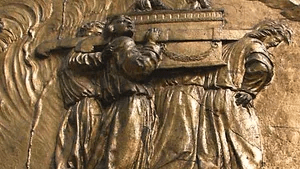
So the people sent men to Shiloh, and they brought back the ark of the covenant of the Lord Almighty, who is enthroned between the cherubim. And Eli’s two sons, Hophni and Phinehas, were there with the ark of the covenant of God.
When the ark of the Lord’s covenant came into the camp, all Israel raised such a great shout that the ground shook. Hearing the uproar, the Philistines asked, “What’s all this shouting in the Hebrew camp?”
When they learned that the ark of the Lord had come into the camp, the Philistines were afraid. “A god has come into the camp,” they said. “Oh no! Nothing like this has happened before. We’re doomed! Who will deliver us from the hand of these mighty gods? They are the gods who struck the Egyptians with all kinds of plagues in the wilderness. Be strong, Philistines! Be men, or you will be subject to the Hebrews, as they have been to you. Be men, and fight!”
So the Philistines fought, and the Israelites were defeated and every man fled to his tent. The slaughter was very great; Israel lost thirty thousand foot soldiers. The ark of God was captured, and Eli’s two sons, Hophni and Phinehas, died.
That same day a Benjamite ran from the battle line and went to Shiloh with his clothes torn and dust on his head. When he arrived, there was Eli sitting on his chair by the side of the road, watching, because his heart feared for the ark of God. When the man entered the town and told what had happened, the whole town sent up a cry.
Eli heard the outcry and asked, “What is the meaning of this uproar?”
The man hurried over to Eli,who was ninety-eight years old and whose eyes had failed so that he could not see. He told Eli, “I have just come from the battle line; I fled from it this very day.”
Eli asked, “What happened, my son?”
The man who brought the news replied, “Israel fled before the Philistines, and the army has suffered heavy losses. Also your two sons, Hophni and Phinehas, are dead, and the ark of God has been captured.”
When he mentioned the ark of God, Eli fell backward off his chair by the side of the gate. His neck was broken and he died, for he was an old man, and he was heavy. He had led Israel forty years.
His daughter-in-law, the wife of Phinehas, was pregnant and near the time of delivery. When she heard the news that the ark of God had been captured and that her father-in-law and her husband were dead, she went into labor and gave birth, but was overcome by her labor pains. As she was dying, the women attending her said, “Don’t despair; you have given birth to a son.” But she did not respond or pay any attention.
She named the boy Ichabod, saying, “The Glory has departed from Israel”—because of the capture of the ark of God and the deaths of her father-in-law and her husband. She said, “The Glory has departed from Israel, for the ark of God has been captured.” (New International Version)
It was a really bad day. Yet, it wasn’t a day disconnected from other days. This particular day had been coming for quite some time.
The Philistines and the Israelites were continually going at each other. They had been enemies for a long time. But the Philistines were only the surface problem. The real issue had been building ever since Eli and his sons Hophni and Phineas were the priests in Israel.
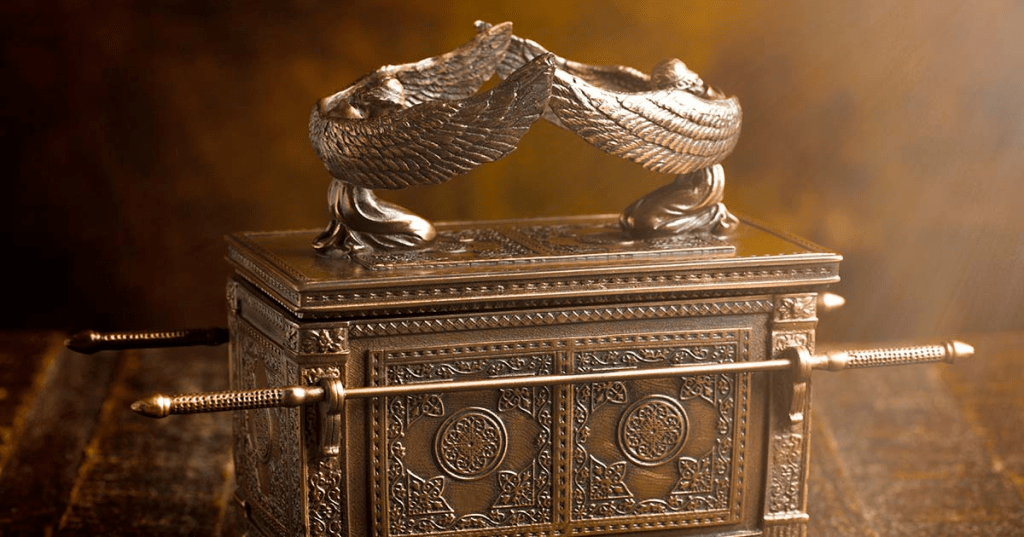
They were tasked with the sacred responsibility of caring for the Tabernacle – the tent which housed the Ark of the Covenant – and attending to the people’s worship and sacrifices. But they had been terribly irresponsible in their work. As biblical readers, we are meant to feel the building tension of inevitable divine intervention of judgment against the injustice that was happening.
In one of the many military battles which took place against the Philistines, the Israelites suffered loss. So, someone had the bright idea of perhaps getting God involved. No one perceived, however, the involvement the Lord was planning. God was ready to deal with the wickedness in Israel.
The Ark of the Covenant was brought from Shiloh to the front lines. This, of course, meant that the persons who handled sacred objects, Hophni and Phineas, would have to be the ones who bring it. We sense as readers that in spite of the Ark’s symbolism of God’s presence with the Israelites, this move isn’t going to end well for Israel.
The story is leading us to an important point: Faithfulness to the invisible God is much more important and powerful than a visible sacred object. The Ark of the Covenant is a symbol of what is right and just; it is not a supernatural talisman to ward off a bad and stressful situation.
Many in Israel were faithful to the Lord. Israel’s leaders, however, were not. In an age old story that has kept repeating itself up to the present time, the people keep supporting a bad government which does not serve the common good of all persons; it only serves itself.
What is interesting here is that God neither fights against the Philistines, nor the Israelites. The Lord simply didn’t show up. God was absent and did not help Israel. The divine intervention turned out to be no intervention at all.
The entire Ark of the Covenant plan completely backfired. The Philistines, understanding the brevity of the situation, were emboldened to fight like never before – thus bringing devastation on the battlefield to Israel. The narrator takes note to let us know the impact this has on the old priest Eli, his two sons, and the rest of that family.
Superstition will get us nowhere – especially when we are looking for solutions to problems we created for ourselves by ignoring righteousness and justice. The hard work of doing what is right cannot be substituted with magic.
There is big difference between believing in God and becoming superstitious and wanting easy solutions to complex problems. God is not, cannot, and will not be contained in a box – even if it’s the Ark of the Covenant.
Eternal God, in whose perfect kingdom no sword is drawn but the sword of righteousness, no strength known but the strength of love: So mightily spread abroad your Spirit, that all people may be gathered under the banner of the Prince of Peace, as children of one Father; to whom be dominion and glory, now and forever. Amen.



 Rev. Tim Ehrhardt