

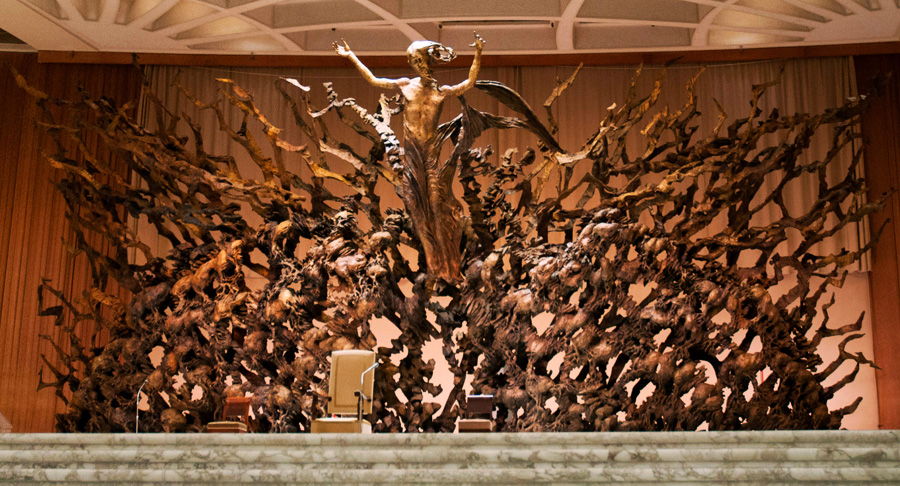
Acts 4:1-4 – The Message of Resurrection

La Resurrezione by Italian sculptor Pericle Fazzini (1913-1987)

The priests and the captain of the temple guard and the Sadducees came up to Peter and John while they were speaking to the people.They were greatly disturbed because the apostles were teaching the people, proclaiming in Jesus the resurrection of the dead. They seized Peter and John and, because it was evening, they put them in jail until the next day. But many who heard the message believed; so, the number of men who believed grew to about five thousand. (NIV)

There’s nothing quite like upsetting the status quo. And that’s exactly what the apostles Peter and John were doing. Creating trouble, causing a stink, disturbing the peace, and making waves. At least, that’s how the ruling authorities saw the upstart Christians’ activity.

At the heart of the disturbance was the authorities’ deep concern of potential social disorder. After all, the Roman Empire with all its great strength was firmly ensconced in Judea. It was already hard enough trying to maintain Jewish customs and religious practices. Now, these rabblerousers come along with their unorthodox teaching and threaten the very social fabric of Jewish life. No! Get them out of here!

So, off to jail Peter and John went. That’s how the politics of fear typically works. Being afraid of change leads to removing the object of fear. Stuff the apostles in the gulag. Shut and lock the door. Maybe if they are out of sight they will be out of mind to the people.

The rulers were too late. So many people heard the message of Christ’s resurrection that the number of believers in Jesus swelled into the thousands. Well, now, everyone’s really in a pickle! Except the church. Each time the Christians get squelched and silenced, more of them show up. Oh, my, goodness. They’re multiplying like roaches!

It doesn’t help the ruling authorities that these religious bugs continue to interpret their own whippings and jailtime as a positive thing – enjoying the solidarity of suffering with their Lord. Ugh. What’s a decent Sadducee to do?

Turns out nothing can stop resurrection. It cannot be chained, bound, or imprisoned. Once life gets into the hearts of people, there’s no getting it out. The message just takes over and consumes the whole person. Then it spreads to another, like some infectious disease.

Before you know it, the entire social order is off kilter. What a bunch of weirdos. Following a dead guy who they say isn’t dead. Walked right out of the grave, they say. Sheesh. Pull yourselves together. So many unhinged delusional people believing in resurrection!

“Here’s to the crazy ones. The misfits. The rebels. The troublemakers. The round pegs in the square holes. The ones who see things differently. They’re not fond of rules. And they have no respect for the status quo. You can quote them, disagree with them, glorify or vilify them. About the only thing you can’t do is ignore them. Because they change things. They push the human race forward. And while some may see them as the crazy ones, we see genius. Because the people who are crazy enough to think they can change the world, are the ones who do.”

Rob Siltanen

It’s easy for some Christians to be hard on non-Christians, just as it was easy for the ancient Jewish rulers to be hard on others leaving their fold. Sometimes we followers of Jesus forget whence we have come. We can get so upset and worked up in fear. Could be our underwear is too tight. More likely, we take the prideful stance of believing our status quo is best for everyone. So, there’s no listening, paying attention, or teachable spirits.

Peter, John, and the other apostles just went about proclaiming good news with joy. And the gospel spread. Jesus became known first to thousands, then tens of thousands, hundreds of thousands, and millions. Today, according to the Pew Research Center, there are 2.5 billion Christians in the world. That’s a lot of people. Christianity has had two thousand years to create their own status quo, some of it good, some of it not so much.

Yet, at the heart of it all, is the resurrection of Jesus Christ from death. It’s a message that still speaks to billions. And it’s a message Christians need to come back to whenever they are fearful of others challenging their hegemony.

All the hopes and expectations of Christians everywhere are realized not in maintaining some Constantinian sort of Christendom but in the resurrection of Jesus Christ the dead. The former does a lot of handwringing over social and cultural issues. The latter has a lot of joy, celebration, and renewal which works itself out in both personal and systemic redemption.

Because the good news of Easter can hardly be contained in a single day’s celebration, it’s message of new life in Christ is like a bright sun of inexhaustible grace to people everywhere – still warming the earth all these centuries later.

The Apostle Peter went on to pen a letter to struggling Christians facing hard circumstances in a world not yet dominated by Christianity, reminding them of the heart of Christian faith:

Praise be to the God and Father of our Lord Jesus Christ! In his great mercy he has given us new birth into a living hope through the resurrection of Jesus Christ from the dead, and into an inheritance that can never perish, spoil or fade. This inheritance is kept in heaven for you, who through faith are shielded by God’s power until the coming of the salvation that is ready to be revealed in the last time. In all this you greatly rejoice, though now for a little while you may have had to suffer grief in all kinds of trials. These have come so that the proven genuineness of your faith—of greater worth than gold, which perishes even though refined by fire—may result in praise, glory and honor when Jesus Christ is revealed. Though you have not seen him, you love him; and even though you do not see him now, you believe in him and are filled with an inexpressible and glorious joy, for you are receiving the result of your faith, the salvation of your souls.

1 Peter 1:3-9, NIV

May we come back repeatedly to Christianity’s message so that our faith is strengthened, the church is edified, and the world is blessed. Amen.

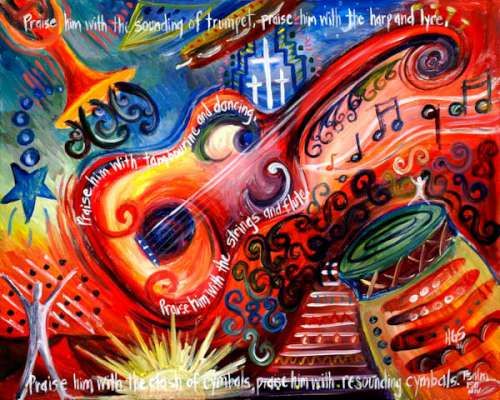
Psalm 150 – Praising God

Psalm 150 by Hope G. Smith

Shout praises to the Lord!
    Praise God in his temple.
    Praise him in heaven,
    his mighty fortress.
Praise our God!
    His deeds are wonderful,
    too marvelous to describe.

Praise God with trumpets
    and all kinds of harps.
Praise him with tambourines
    and dancing,
    with stringed instruments
    and woodwinds.
Praise God with cymbals,
    with clashing cymbals.
Let every living creature
praise the Lord.
    Shout praises to the Lord! (CEV)

There is a time for quiet reflection and contemplation, and there is a time for jubilant shouts of praise. The biblical psalms mirror the full range of human emotion. Having moved through the ups and downs of doubt, curiosity, anger, lament, and trust, it is appropriate that the psalter ends with lots of joyful noise.

I grew up in a generation where children were expected to be quiet in church. Not surprisingly, as a child, I found the church worship service on Sunday to be the most boring hour of my week. After a Saturday of morning cartoons, sugary cereal, All-Star Wrestling, and playing outside in the dirt with my brother, Sunday morning was typically a big letdown.

All I have to say about that, and about cranky old women shushing kids in church, is that the adults somehow forgot to read Psalm 150. Maybe if us big people were better about encouraging our little people to dance in the aisles, blow a kazoo as loud as they can, and freely give a shout to the Lord, then perhaps there would be a lot fewer defections from church worship services.

“Praise is the rehearsal of our eternal song. By grace we learn to sing, and in glory we continue to sing. What will some of you do when you get to heaven, if you go on grumbling all the way? Do not hope to get to heaven in that style. But now begin to bless the name of the Lord.”

Charles Haddon Spurgeon

But don’t think I’m advocating going all out noise, all the time. Just as it is neither necessary nor appropriate to always shout everything you say, and skip everywhere you go, so the worship of God needs to encompass the broad scope of the human condition. Silence, meditation, and stillness have their important place. In a desire to make church fun, some Christians have created imbalanced experiences of only victory in Jesus.

One of the reasons I follow the Christian Year with its liturgical movements is that it holds and maintains the balance of worship and the theological tension of both crucifixion and resurrection. We need healthy rhythms of sorrow and joy, stillness and movement, quietness and shouting.

The Church is currently in the Christian season of Eastertide. It is a focused time of celebration – which is why we have biblical sections in this time of year like Psalm 150. This is the appropriate time to lift loud praise to God for the risen Christ and celebrate salvation and new life in Jesus.

I’m not really a numbers kind of guy, yet its easy to notice the word “praise” occurs 10 times in a psalm of just 6 verses. And 7 musical instruments are mentioned. Methinks we’re supposed to not miss something here.

“Through Jesus, therefore, let us continually offer to God a sacrifice of praise—the fruit of lips that openly profess his name.”

hebrews 13:15, NIv

Praise is to happen in heaven and earth, in all creation, out in the world as well as inside the walls of the church building. It is to be done with voice, dance, drums, horns, woodwinds, and stringed instruments. Because God has done wonderful and marvelous acts throughout the earth, people are to respond with profuse gratitude expressed with lots of emotion.

Just so you know, that means sourpuss Christians who wrongheadedly believe human feelings ought to be stuffed and suppressed, need some remedial theological education about who God is and exactly what he expects from people. Somebody, please dispense the laxative of Psalm 150 to loosen their spiritual constipation!

God gave us our breath, and we are to use it for praise. If we see the entire book of Psalms as a life, then it is fitting the final psalm ends with sanguine praise. Indeed, when a person is at end of life, do they have reason to praise? A life of walking with God through thick and thin will inevitably end with recounting the ways in which the Lord has shown up and delivered. They want musical praise filling their last days and minutes.

That is exactly what Duke Ellington did in the twilight of his life. On January 19, 1968, Ellington performed a concert of sacred music at St. John the Divine cathedral in New York City. Among the original songs he performed and later recorded was his musical interpretation of Psalm 150. He called it “Praise God and Dance.”

Duke Ellington said that this praise music, and the two other albums of sacred music he recorded, were “the most important thing I have ever done.” When Ellington performed “Praise God and Dance” at the ancient Church of Santa Maria del Mar in Barcelona, Spain, the congregation spontaneously burst into the aisles with dancing and singing.

The whole person is to be involved in praise – mind, body, emotions, and spirit – because God is Lord of all of us, not just the spiritual dimension.

Make a joyful noise to the Lord, all the earth; break forth into joyous song and sing praises. Sing praises to the Lord with the lyre, with the lyre and the sound of melody. With trumpets and the sound of the horn make a joyful noise before the King, the Lord. (Psalm 98:4-6, NRSV)

I will bless you every day. I will praise your name forever and always. The Lord is great and so worthy of praise! God’s greatness can’t be grasped. (Psalm 145:2-3, CEB)

Praise the Lord! My whole being, praise the Lord. I will praise the Lord all my life; I will sing praises to my God as long as I live. (Psalm 146:1-2, NCV)

Shout praises to the Lord! Our God is kind, and it is right and good to sing praises to him. (Psalm 147:1, CEV)

Amen.

Children of God, Loved by God

By Unknown artist

See what great love the Father has lavished on us, that we should be called children of God! And that is what we are! The reason the world does not know us is that it did not know him. Dear friends, now we are children of God, and what we will be has not yet been made known. But we know that when Christ appears, we shall be like him, for we shall see him as he is. All who have this hope in him purify themselves, just as he is pure.

Everyone who sins breaks the law; in fact, sin is lawlessness. But you know that he appeared so that he might take away our sins. And in him is no sin. No one who lives in him keeps on sinning. No one who continues to sin has either seen him or known him.

Dear children, do not let anyone lead you astray. The one who does what is right is righteous, just as he is righteous. (1 John 3:1-7, NIV)

True children of God, Christians, are loved by God – that is their status and identity. This cannot be changed any more than a tiger can change his stripes.

True children of God live, remain, abide, and continue in their identity as Christians. They know who they are and how they are to live.

Who We Are

When Jesus was on this earth, he was misunderstood by a lot of people. Christians must learn to expect the same. True children loved by God will neither fit in with the world nor seek the world’s affirmation and accolades. The practical difference between Christianity and the world is that Christians locate their primary identity, allegiance, and purpose in Christ, whereas the world finds their identity elsewhere.

Being loved by God brings assurance, peace, security, and hope. These qualities cannot be manufactured by us because they are results of being loved. The world cannot give us these characteristics. This does not mean that Christians always have it all together. We are continually in a process of discovering our identity and growing more and more into that uniqueness. The reason Jesus lived his life without needing the world’s recognition is that he was firmly and securely assured of the Father’s love and care for him. 

Christians continue to learn what it means to be loved by God in Christ. This love helps fortify our faith so that we will not find our identities in worldly roles, however intrinsically good those roles might be. For example, a parent with the primary identity as mother or father will view salvation as coming through the family. Or a person with the primary identity as teacher will see deliverance coming through education. 

When Christians have their primary identity as children of God, loved by God, then they see deliverance from guilt, shame, darkness, and oppression as coming through Jesus. When the church, living and serving together, secure in their identity as children of God, loved by God, then she can withstand any adulterous flirtations from the world to woo them away from Jesus.

We are children of God. We are not children of the world’s institutions, systems, organizations, ethos, mores, and values. Everyone who has hope in Christ is pure and holy. When we locate our primary identity in being loved by God, we avoid defiling ourselves with the world’s grime. We take regular spiritual baths which cleanse us from the world’s crud. We keep reminding ourselves and each other of our true status as God’s children. We do not allow any other identity to topple or replace our wonderful reality of being loved by God.

How we view ourselves will determine how we live our lives.

How We Are to Live

True children of God abide by the law because they abide in Christ. Jesus said all the law could be summed up in two commands: Love God. Love neighbor. Breaking the law means:

  • Hating instead of loving.
  • Working to undermine someone instead of seeking their best interests.
  • Excluding others instead of including others.
  • Dividing and opposing instead of unifying and cooperating. 

No one abiding in Christ continues the same trajectory they had before knowing Christ. Jesus came to take care of the sin issue once for all through the cross. Therefore, Christians, loved by God, cannot be lawbreakers if they are abiding; the two cannot co-exist with each other.

So, our primary task as Christians is to abide in Jesus and remain firmly in our identity as children of God, loved by God. We are to love by remaining in God’s love and allowing love to shape all our thoughts, words, and actions. We will continue to be steadfast in that love. We will not be led astray. We will abide in Christ.

Identity and life work together. For example, I am currently a citizen of the state of Wisconsin. I not only geographically live in Wisconsin, but I am to abide in the state as a responsible person. Being a Wisconsinite is different from the rest of the world. Wisconsinites are readily identifiable by their sports and their food.

Lambeau Field, home of the Green Bay Packers

Diehard Green Bay Packer fans forsake any identification as Lions, Bears, or the god-forsaken pagan Vikings. They like their prep and collegiate sports, flock to curling clubs, get married in bowling alleys, and observe time through the various hunting seasons. Citizens of Wisconsin like their food and drink. Nothing compares to the Friday night fish fry, cheese curds, venison, mustard – all washed down with either a Spotted Cow, Leinenkugel’s, or a trip to the bubbler.

We are to become more and more like Christ. Our identity as loved by God means we will seek to live in Christ by living a life of love. The people of Wisconsin have a general reputation of being polite and helpful, not rude and unhelpful. All their citizens should live into this identity and behavior. And as Christians whose primary identity is in being children of God, loved by God, we should abide in Christ through love and obedience. 

“I am the true vine, and my Father is the gardener. He cuts off every branch in me that bears no fruit, while every branch that does bear fruit, he prunes so that it will be even more fruitful. You are already clean because of the word I have spoken to you. Remain in me, as I also remain in you. No branch can bear fruit by itself; it must remain in the vine. Neither can you bear fruit unless you remain in me.

I am the vine; you are the branches. If you remain in me and I in you, you will bear much fruit; apart from me you can do nothing. If you do not remain in me, you are like a branch that is thrown away and withers; such branches are picked up, thrown into the fire and burned. If you remain in me and my words remain in you, ask whatever you wish, and it will be done for you. This is to my Father’s glory, that you bear much fruit, showing yourselves to be my disciples.

As the Father has loved me, so have I loved you. Now remain in my love. If you keep my commands, you will remain in my love, just as I have kept my Father’s commands and remain in his love. I have told you this so that my joy may be in you and that your joy may be complete. My command is this: Love each other as I have loved you. Greater love has no one than this: to lay down one’s life for one’s friends. You are my friends if you do what I command. I no longer call you servants because a servant does not know his master’s business. Instead, I have called you friends, for everything that I learned from my Father I have made known to you. You did not choose me, but I chose you and appointed you so that you might go and bear fruit—fruit that will last—and so that whatever you ask in my name the Father will give you. This is my command: Love each other.” (John 15:1-17, NIV)

Conclusion

A true Christian is a child of God, not the world. Our behavior flows from who we are. If our primary identity is securely in being a loved child of God, then what comes out of us will be loving words and actions, even to those in the world who might not believe or understand.

When we think about our world, it can be a sad place, devoid of love. People from different cultures and backgrounds often do not get along with each other. Political parties have difficulty finding common ground. Some Christians cannot seem to get along with other Christians. In the world, differences often divide us. Can people different from each other get along? 

The early church did. And they did it without all the stuff we have – sanctuaries, church buildings, programs. Those early believers did it through the message of the cross using the basic tool of love. Not every Christian will serve on the foreign mission field or serve in a professional ministry position. However, every Christian can be loving.

True children of God are loved by God. They are characterized by the Christian practices of hospitably loving the immigrant and stranger, loving their enemies, forgiving those who have sinned against them, and obeying God’s commands. These practices stem the tide of evil and hate in the world and usher in the love of God in Christ.

Mark 12:18-27 – Go Ahead, Ask Jesus Anything

Photo by Pixabay on Pexels.com

Then the Sadducees, who say there is no resurrection, came to him with a question. “Teacher,” they said, “Moses wrote for us that if a man’s brother dies and leaves a wife but no children, the man must marry the widow and raise up offspring for his brother. Now there were seven brothers. The first one married and died without leaving any children. The second one married the widow, but he also died, leaving no child. It was the same with the third. In fact, none of the seven left any children. Last of all, the woman died too. At the resurrection, whose wife will she be, since the seven were married to her?”

Jesus replied, “Are you not in error because you do not know the Scriptures or the power of God? When the dead rise, they will neither marry nor be given in marriage; they will be like the angels in heaven. Now about the dead rising—have you not read in the Book of Moses, in the account of the burning bush, how God said to him, ‘I am the God of Abraham, the God of Isaac, and the God of Jacob’? He is not the God of the dead, but of the living. You are sorely mistaken!” (NIV)

Okay, let’s dive in with some observational lessons from today’s Gospel reading:

  • Don’t be a dip-wad and try to trip-up Jesus with philosophically ethereal questions.
  • If you want to be rebuked by Jesus for being ignorant, mistaken, and wrong, just try and control how a conversation with him ought to go.
  • Abraham, Isaac, Jacob, and Jesus are all alive – Sadducees, not so much.
  • Jesus will take the time and attention to listen and give feedback – maybe the kind you weren’t looking for.
  • What we get hung up on, Jesus doesn’t – and what Jesus sticks on, we act like Teflon about.

Do you want to keep going….?

To deny resurrection is to deny Jesus. Christ died. He’s now alive. Hence, there is a resurrection. More than that, because Christ lives, others live. This is the Christian’s hope. 

I fully understand plenty of people don’t believe in resurrection. That’s fine. I would simply point such a person no further than their own mind and heart. “Search your feelings,” as the Jedi would say, “What do they tell you?”  The evidence you need, you already have.

And this was the penultimate lesson of Jesus to the inquisitive Sadducees. They already had the answer to their question for Jesus. It was right under their noses the entire time. They just didn’t see it.

You already have everything you need for life and godliness in this present evil age.

One of the great sages of the last century, Dorothy from The Wizard of Oz, wisely said:

“If I ever go looking for my heart’s desire again, I won’t look any further than my own backyard.  Because if it isn’t there, I never really lost it to begin with.”

Resurrection has always been there because God has always been around – even when we don’t see, perceive, or acknowledge the divine.

It probably wouldn’t be a good idea to procrastinate the inevitable end of life scenario that awaits us all. Anytime is the right time to do a bit of personal funeral planning. Yet, if we mire it all with the esoteric hypothetical questions about what would happen in the most far-fetched of scenarios, methinks God is big and smart enough to see through our puny charade.

Better to ponder what is truly within your own soul, and how Jesus might already be present within and around all things, without us even knowing it. 

A good place to start in peering within is to give a straightforward honest reading of the New Testament Gospels and discover what resonates deeply with you about the person and work of Jesus.

Feel free to question him about anything you want; just brace yourself for what kind of answer you might receive.