Pillow Thoughts (Psalm 132:1-12)

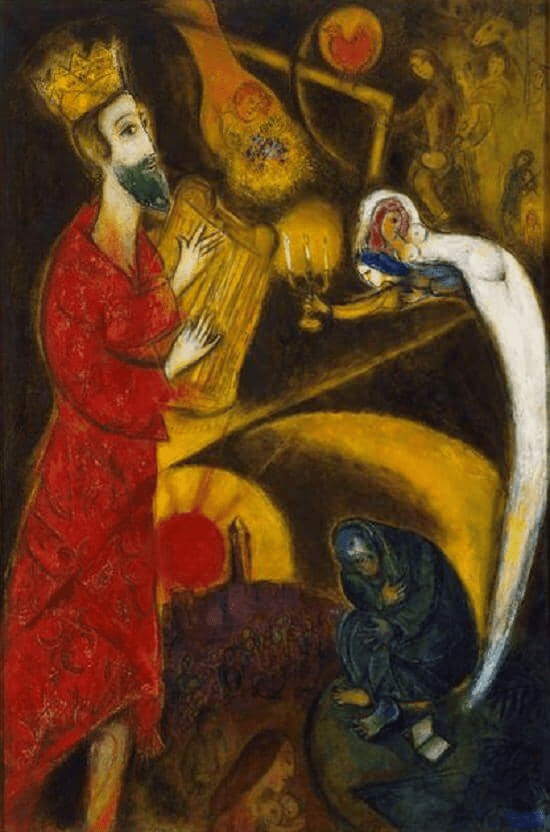
King David, by Marc Chagall, 1962

O Lord, remember in David’s favor
    all the hardships he endured;
how he swore to the Lord
    and vowed to the Mighty One of Jacob,
“I will not enter my house
    or get into my bed;
I will not give sleep to my eyes
    or slumber to my eyelids,
until I find a place for the Lord,
    a dwelling place for the Mighty One of Jacob.”

We heard of it in Ephrathah;
    we found it in the fields of Jaar.
“Let us go to his dwelling place;
    let us worship at his footstool.”

Rise up, O Lord, and go to your resting place,
    you and the ark of your might.
Let your priests be clothed with righteousness,
    and let your faithful shout for joy.
For your servant David’s sake
    do not turn away the face of your anointed one.

The Lord swore to David a sure oath
    from which he will not turn back:
“One of the sons of your body
    I will set on your throne.
If your sons keep my covenant
    and my decrees that I shall teach them,
their sons also, forevermore,
    shall sit on your throne.” (New Revised Standard Version)

King David took great pains in providing for the house of the Lord; and was very concerned about the worship of Yahweh. He went well out of his way to ensure that a temple would be built for his God.

David made as many preparations as he possibly could before his death, so that his son Solomon could follow through and build the temple. The editor of the Book of Chronicles commented on this:

David gave orders to gather together the aliens who were residing in the land of Israel, and he set stonecutters to prepare dressed stones for building the house of God. David also provided great stores of iron for nails for the doors of the gates and for clamps, as well as bronze in quantities beyond weighing, and cedar logs without number—for the Sidonians and Tyrians brought great quantities of cedar to David. 

For David said, “My son Solomon is young and inexperienced, and the house that is to be built for the Lord must be exceedingly magnificent, famous and glorified throughout all lands; I will therefore make preparation for it.” So David provided materials in great quantity before his death. (1 Chronicles 22:2-5, NRSV)

The king did all of this because God came to David and let him know that he would not be the one to build the temple; that job would fall to his son Solomon. (2 Samuel 7:4-13)

David’s final instruction to Solomon and the people had to do with the construction of a house for the Lord his God:

“Now set your mind and heart to seek the Lord your God. Go and build the sanctuary of the Lord God so that the ark of the covenant of the Lord and the holy vessels of God may be brought into the house built for the name of the Lord.” (1 Chronicles 22:19, NRSV)

The worship of God, for David, was to be the central feature of the Jewish people. All Israel and Judah were to encourage one another in worship at God’s house, the Lord’s Temple, in Jerusalem.

The priests of God wore special clothing, and handled the holy implements and the Ark of the Covenant of God. Yet, they were to be also clothed with righteousness, making sure that their outward ceremonial rituals reflected an inner moral purity and holiness before God.

David was bound and determined to not only worship the Lord himself, but to see that the entire nation of Israel had the opportunity to worship together in a central place.

Maybe a question arises for you about why David was so driven to construct a house for God. What is it that motivated King David to spend so much of his planning and energy on making sure that a temple would be constructed for the Lord?

Now when the king was settled in his house and the Lord had given him rest from all his enemies around him, the king said to the prophet Nathan, “See now, I am living in a house of cedar, but the ark of God stays in a tent.” Nathan said to the king, “Go, do all that you have in mind, for the Lord is with you.” (2 Samuel 7:1-3, NRSV)

A lot of events had transpired for David to be in the position of king, with peace all around him. The Lord had been with David, and brought him through the sort of adversities most of us will never know.

Once King David was at the pinnacle of peace and success, his thought were not about how to hold onto power, or to get more of it. He would lay his head on his pillow at night and wonder how he could give back to God for being so faithful.

And considering all that God had accomplished for him and for Israel, it seemed a travesty that he was luxuriating in a fine house, while the Ark of the Covenant – the objective presence of God among the people – was sitting in an old tent. So, David became determined to change that situation, because he could.

I wonder if when you and I are at a place in our lives where we feel safe and secure, prosperous and happy, our thoughts and dreams turn toward how we might give back to God in a worshipful way which will honor the Lord, as well as bless all the people of God.

I am curious what sort of things occupy your mind at night while your head is on your pillow, when you are feeling good about how your life is going.

Many, if not most, people will think about themselves, and what to do with what they have gained and/or accomplished. But what about you?

How will you respond to God’s grace, goodness, deliverance, and protection in your own life? What sort of ideas arise in your mind? What is in your heart to do for God and God’s people?

What are your pillow thoughts at night?

Presence itself is a great gift. The presence of God is incredibly gracious, good, and miraculous. And human presence, with each individual stamped with the image and likeness of God upon them, is also a wonderful gift from the Creator. And very much needed.

David enjoyed the presence of God, and longed for all the people to experience that divine presence. Although the Lord needed no temple to live in, David had in mind to provide one.

I imagine that King David understood that each person is a luminous icon of presence, reflecting God’s image, and needing the presence of God and others in order to have a nation who worships God as commanded in the Mosaic law.

Through communal worship at a designated site in Jerusalem, the Israelites could enjoy the beauty of God’s presence together, as well as the encouragement of one another.

Wherever there is presence and the acknowledgement of God and each other, there is freedom to offer affection, understanding, and respect.

It seems to me that these were the sort of thoughts that ran through King David’s mind, which made him determined to build a house for the Lord his God.

So, what will you do with your thoughts and your life?

Almighty God of all hope, of our thoughts and dreams: In humility, we give you thanks for all of creation; and for everything you give us. We praise you for forgiving us of our guilt and shame, even before we ask. You raise us from our broken state and make us whole. You give us the peace we yearn for.

Blessed God, fill us, your people, with your divine Spirit. Be our light in the darkness. Envelop us with your presence. Orient our hearts toward your justice; and help us always praise you. Let us ever be mindful of your power and grace in the world. Let us live as one with you in grace and in truth. Amen.

A Thunderous Beauty (Psalm 68:24-35)

Your solemn processions are seen, O God,
    the processions of my God, my King, into the sanctuary—
the singers in front, the musicians last,
    between them young women playing tambourines:
“Bless God in the great congregation,
    the Lord, O you who are of Israel’s fountain!”
There is Benjamin, the least of them, in the lead,
    the princes of Judah in a body,
    the princes of Zebulun, the princes of Naphtali.

Summon your might, O God;
    show your strength, O God, as you have done for us before.
Because of your temple at Jerusalem,
    kings bear gifts to you.
Rebuke the wild animals that live among the reeds,
    the herd of bulls with the calves of the peoples.
Trample under foot those who lust after tribute;
    scatter the peoples who delight in war.
Let bronze be brought from Egypt;
    let Cush hasten to stretch out its hands to God.

Sing to God, O kingdoms of the earth;
    sing praises to the Lord,
O rider in the heavens, the ancient heavens;
    listen, he sends out his voice, his mighty voice.
Ascribe power to God,
    whose majesty is over Israel
    and whose power is in the skies.
Awesome is God in his sanctuary,
    the God of Israel;
    he gives power and strength to his people.

Blessed be God! (New Revised Standard Version)

From psalm to psalm, the entire biblical psalter is consistent in praising God. Foremost among the praise is celebrating God’s inherent character, and for how that divine character acts with power and grace in the world.

Since God is an infinitely immense Being, our human language cannot begin to adequately contain or describe such incredible divinity. Yet, words are what the psalms have for trying to communicate the attributes of such an awesome God.

That’s why the use of metaphors is significant. Whenever we can picture something we are familiar with, then imaginatively place God alongside it, it helps give us at least a rudimentary idea and feeling of who God is, what God is all about.

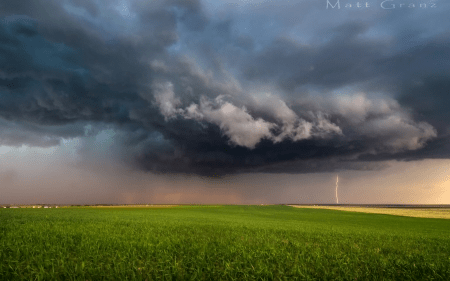
To gain a glimpse of God’s majesty and sovereignty over the universe, the psalmist invites us to see with our spiritual eyes that God riding the sky; and to hear with our spiritual ears the thunderous shout that roars and reverberates throughout the cosmos.

Along with our eyes and ears, we are invited to respond by using our power of words and speech to proclaim God’s power. And, I must say, that power is well beyond our ability to describe.

With all of the powerful forces in this world, they are but a mere puff of breath to the God who reigns supreme over all powers, both in heaven and on earth. God’s power is a thunderous beauty. God’s splendor and strength rise larger than thunderheads.

Having grown up in Midwest America, I’ve seen my share of large thunderheads (massive cumulus clouds which form just before a storm), thunderstorms replete with bright lightning and noise so awesome it shakes the farmhouse, and tornados with such force that they rip the roof off a barn as if it were a Lego building.

The appropriate response to such a great God is to make music for the One who strides the ancient skies in a heavenly chariot; and yet stoops to listen and care about puny humans.

The reasonable response to such a breathtaking God is to listen to the divine voice thundering in the world, and submit to the sound which seems like it might split the heavens open.

To gain a mere glimpse of God’s strength and power will inevitably result in a response of giving up our all to the Lord of the universe – everything we have, and all that we are.

To know, even a tiny smidgeon, of such a God will bring our own loud shouts of proclaiming God’s goodness, grace, and generosity to anyone who will listen to us.

To glimpse what the psalmist sees will consume us with awe, as we intuitively connect with the glory which is constantly streaming from heaven.

What’s more, God shares divine strength with people. God doesn’t have to do that. The Lord has no obligation to do so. Yet, it happens, despite our fickle praise and inconsistent devotion.

So, let’s give our highest praise to the God of the psalms. Let’s imbibe of God’s thunderous presence among us.

I guarantee that it will make us happier than a gopher in soft dirt; or a butcher’s dog; or a unicorn eating cake on a rainbow.

Eternal Trinity – blessed Father, Son, and Spirit – the awesome God whom I serve: The more I enter you, the more I discover, and the more I discover, the more I seek you. A massive thunderhead is but a small cloud next to you, the Godhead, the incredible Three-in-One.

Through you, almighty Lord, I shall come to know myself and my world. And that knowledge is a mighty love for humanity which spans longer and higher than the universe itself. May the love, unity, harmony, community, goodness, and power which is always present within yourself, mighty God, be present with me, your servant.

For just a molecule of You is enough to power me for eternity. Praise the Lord! Amen.

There Is No God? (Psalm 53)

Nietzsche, by Norwegian artist Edvard Munch (1863-1944)

Fools say in their hearts, “There is no God.”
    They are corrupt; they commit abominable acts;
    there is no one who does good.

God looks down from heaven on humankind
    to see if there are any who are wise,
    who seek after God.

They have all fallen away; they are all alike perverse;
    there is no one who does good,
    no, not one.

Have they no knowledge, those evildoers,
    who eat up my people as they eat bread
    and do not call upon God?

There they shall be in great terror,
    in terror such as has not been.
For God will scatter the bones of the ungodly;
    they will be put to shame, for God has rejected them.

O that deliverance for Israel would come from Zion!
    When God restores the fortunes of his people,
    Jacob will rejoice; Israel will be glad. (New Revised Standard Version)

In 1888, the German philosopher Friedrich Nietzsche published his book, “The Antichrist.” Nietzsche used the phrase, “God is dead,” to express his idea that the Enlightenment, with its thorough rejection of all things subjective and intuitive, and the embrace of everything objective and observable, had eliminated the possibility of God’s existence.

Nietzsche simply named what a modern progressive society had become: We “enlightened” people have drained and divested ourselves of all divine mystery. Nietzsche wrote:

“God is dead. God remains dead. And we have killed him. How shall we comfort ourselves, the murderers of all murderers? What was holiest and mightiest of all that the world has yet owned has bled to death under our knives: Who will wipe this blood off us? What water is there for us to clean ourselves? What festivals of atonement, what sacred games shall we have to invent? Is not the greatness of this deed too great for us? Must we ourselves not become gods simply to appear worthy of it?”

Friedrich Nietzsche, The Antichrist

This was the nineteenth century equivalent of making the psalmist’s observation that there is a philosophy extant which states, “There is no God.” God is gone; humanity has replaced God with themselves.

Unlike Nietzsche, however, the psalmist takes the perspective of God, not humans. The Lord looks about for someone wise, someone who truly takes notice to see with spiritual eyes, hear with spiritual ears, discern a spiritual touch, smell the aroma of God, and taste that the Lord is good – rather than relying solely on the five basic human senses.

So, where is God? In the grave? No, he has risen, just as he said.

Just because there appears to be a profound absence of good in this world, does not necessarily mean that good is not here – or that God has somehow gone away, and perhaps never existed at all.

Any common fool can make bold proclamations whenever they embrace an epistemology all to themselves.

From God’s perspective, anyone can use their five physical senses. To only use them, and completely ignore other ways of knowing, is well, plain stupidity.

So then, where is God? Not hanging out with fools, drinking cheap dandelion wine, and smoking nasty inexpensive cigars. Rather, the Lord is in the company of the righteous; God is with wise persons who discern the divine presence.

Things are not always as they seem. Violence and oppression in the world does not warrant the interpretation that God is on vacation, doesn’t care, or simply doesn’t exist, at all. We are invited to see beyond or through the world’s crud to a Divine Being who is there, reachable, and very much cares about the state of humanity.

All of our human posturing and preening to appear that we have it all together is nothing more than a poorly produced television reality show to God. So, if the Lord chooses to change the channel, that does not translate that God is not viewing the screen.

Only a fool believes no one is watching.

If we ignore God, perhaps we should not be surprised or upset when divine Skittles from heaven don’t come raining down on us to enjoy.

Instead, we have the opportunity and the privilege of paying attention to the spiritual life.

There are divine resources available if we will but acknowledge, receive, and use them. Though they are abundant and free, we still have to ask for them with the humility that comes from realizing we are not the center of the universe.

Nietzsche is not exactly a person that many Christians would typically acknowledge, let alone refer to, and, for good reason. And yet, Nietzsche understood that when God is removed from societal norms, it leaves us with a nihilist worldview (the belief that nothing has any inherent importance, and that life lacks purpose and meaning).

I believe that Christianity, and/or a focus on the spiritual life, is a powerful and needed antidote to the despair of meaninglessness which is all around us.

If God is truly the ground of moral reality, and gives real shape to human purpose, then we have an effective way to center ourselves. Yet, if God is ignored to the point of being “dead” then there is nothing substantial for humanity to orient their lives around.

Try as we might to create, as Nietzsche did, an Übermensch(superman) in the form of the radically independent and strong person to fill the enormous spiritual void of God’s death, it is merely a façade covering our weakness and our foolishness as creatures.

I suggest we consider the psalmist as a reliable source of knowledge – that God is a force for justice and for good in the world – and that we explore what this means for us in our respective lives, families, communities, as well as in our public discourse and personal philosophy.

Is God gone? No, not really. It’s just that we humans tend to give God the stiff arm.

Almighty God, you called your church to be one, holy, universal and missional people. By your grace you have given us new life in Jesus Christ, and by your Spirit you have called us to proclaim his name throughout the nations. Awaken in us such a love for you and your world that we may boldly proclaim Jesus Christ by word and deed. May all people everywhere come to know you, and Christ’s power to save. Amen.

Prepare the Way (Mark 1:1-8)

The beginning of the good news about Jesus the Messiah, the Son of God,as it is written in Isaiah the prophet:

“I will send my messenger ahead of you,
    who will prepare your way”—
“a voice of one calling in the wilderness,
‘Prepare the way for the Lord,
    make straight paths for him.’”

And so John the Baptist appeared in the wilderness, preaching a baptism of repentance for the forgiveness of sins. The whole Judean countryside and all the people of Jerusalem went out to him. Confessing their sins, they were baptized by him in the Jordan River. John wore clothing made of camel’s hair, with a leather belt around his waist, and he ate locusts and wild honey. And this was his message:

“After me comes the one more powerful than I, the straps of whose sandals I am not worthy to stoop down and untie. I baptize you with water, but he will baptize you with the Holy Spirit.” (New International Version)

The beginning of Mark’s Gospel lets us know what the entire account is all about: The good news of Jesus Christ, the Son of God. And, from the get-go, Mark embeds this beginning in a much older beginning, from the prophet Isaiah. None of this stuff was made up; it’s been there all along, for those with the spiritual eyes to see it.

It could be that it seems you aren’t seeing anything happen in your life that’s good right now. You know you’re now into this Christian Advent season, but not feeling at all as if it’s a time of good news – because all you have been hearing is bad news stacked on top of bad news. Devastation and despair, destruction and depression, are not only with those experiencing the harrowing circumstances of war or disease, but perhaps with you, as well.

Just because you can always point to someone else, or some other people group around the world, that has it worse than you, doesn’t mean that your own situation is necessarily good. The worst sort of grief is the grief that you yourself are experiencing. It’s likely that you may have your own unique brand of hopelessness, and might feel guilty for not being more happy or grateful in this time of year.

We all need good news – not just the ones with daily terrible and traumatic encounters. Maybe we could all tap into our collective humanity and realize our spiritual connection with everyone else in this topsy-turvy world. If we share bad news together, then it seems to me that we can also share the good news with one another, as well.

And there is always good news, if we have the spiritual ears to hear it: God is here. God knows. God cares. God loves. God is the Victor. Specifically, for Mark and for Christians everywhere, the incarnation, life, death, resurrection, and ascension of Jesus the Messiah is the dynamic proclamation of deliverance from all the guilt, shame, anxiety, and devastation that happens around us and even to us.

The consistent witness of the New Testament Gospels is nothing less than the Evangelists saying to us, “Look! God is here in the person of Jesus.”

Christ did not come to this earth in order to bring us some nice distractions from the crap we are enduring; but instead turns toward the crud and faces it down with divine power.

John the Baptist, by Anikitos Giannoudes

We possess good news of great joy for all the nations. And there is, I believe, no better messenger to let us know this than John the Baptist – a quirky man whose clothes look like they don’t fit right (or are even fit for a person to wear) and whose daily lunch makes all the girls squeal.

If a guy like John – on the margins of society – can help point us to good news, then we, too, have an important place in this world of making a difference with our own social eccentricities, spiritual foibles, mental disorders, and funny looks.

It appears obvious that John only cared about one thing: making sure everyone knew who the true and ultimate Messenger was, because this Messenger Messiah had the true message of good news that the whole world desperately needs.

The good news of God brings hope to those who find themselves in dire straits, on the peripheries of our world, and of wondering if things will ever get better, or not. God’s good news of grace announces God’s presence in all of our wonderings, in every place, and with each situation we find ourselves in.

God’s love goes wherever we are. Jesus is our Immanuel, God with us. In the person of Christ, we discover that God is for us; and if everyone else is against us, the Lord’s divine presence is enough for us. Thanks be to God!