The Severe Mercy of the Easy Yoke (Matthew 11:16-19, 25-30)

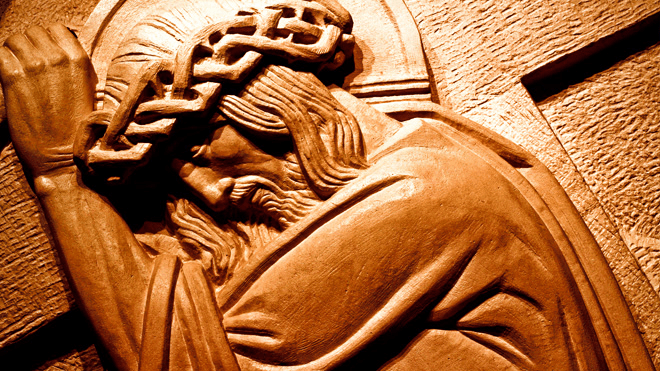
The Burden of Christ, a sculpture of Jesus Christ, in the Oratoire Saint-Joseph, Montreal, Quebec, Canada

“But to what will I compare this generation? It is like children sitting in the marketplaces and calling to one another,

‘We played the flute for you, and you did not dance;
    we wailed, and you did not mourn.’

“For John came neither eating nor drinking, and they say, ‘He has a demon’; the Son of Man came eating and drinking, and they say, ‘Look, a glutton and a drunkard, a friend of tax collectors and sinners!’ Yet wisdom is vindicated by her deeds….”

At that time Jesus said, “I thank you, Father, Lord of heaven and earth, because you have hidden these things from the wise and the intelligent and have revealed them to infants; yes, Father, for such was your gracious will.All things have been handed over to me by my Father, and no one knows the Son except the Father, and no one knows the Father except the Son and anyone to whom the Son chooses to reveal him.

“Come to me, all you who are weary and are carrying heavy burdens, and I will give you rest. Take my yoke upon you, and learn from me, for I am gentle and humble in heart, and you will find rest for your souls. For my yoke is easy, and my burden is light.” (New Revised Standard Version Updated Edition)

Exchanging one yoke for another is really a rather radical act. It is akin to dying to self, so that there can be new life in Christ.

In our anxiety-laden society, filled with multiple fears, worries, and frustrations, we are being invited by Jesus to lay it all down. In other words, every one of us must unequivocably die to self.

Perhaps this might best be illustrated by expressing my own struggle with the pharisaical yoke and the Jesus yoke:

A year-and-a-half ago, I abruptly had to leave my job as a hospital chaplain due to deteriorating health. I am now retired, not because I chose retirement, but because retirement chose me.

So, for the past eighteen months, I have struggled with this reality of no longer being a Chaplain. As hard as I thought and pondered, I’ve gained no understanding as to why I am no longer serving patients, their families, and hospital staff.

What’s more, I have no insight as to why – during my tenure as Chaplain – I experienced an awful time with a gaslighting boss for three of those years. This boss continually made nonsensical decisions, and defied any understanding, even though I sought it out. (I might add that it is super-creepy that the current U.S. President is so eerily like the former boss, as if I’m still under the abuse!).

If I was a good Chaplain doing good work (which I believe I was) then why was I treated so oppressively? Why did my employer turn a blind-eye to it all? Why would God almighty sideline me in such a loathsome health situation. Why must I keep experiencing the awful effects of incompetent political leadership? Why all of the nonsense? It is a terrible yoke for me to carry.

Likely, none of this has to do with me needing to understand any of it. It could be that it is more akin to Abraham being told to sacrifice the son of the promise, Isaac.

It was a completely nonsensical command from God. It defied any sort of understanding on Abraham’s part. And yet he quietly obeyed, with the text of Genesis 22 telling us nothing about any talk-back nor questioning from Abraham. Only obedience. It appears that Abraham was able to exchange yokes, from the oppressive one to the easy one.

In telling Abraham to sacrifice his son, the real death taking place was Abraham’s, not Isaac’s. Abraham was to die to anything that may compete or be likened to some sort of idolatry before God. For even the very good things, like families and jobs, can become idolatrous to us.

I don’t know about your situation, but maybe for me the point is that I must allow the old life to die, and to let a new life grow out of it. Maybe it’s time for a change of yokes. After all, one cannot have a new resurrected life without first experiencing a crucifying death to the old life.

Death is an integral part of life. To exchange yokes is to experience a death. I’ve wanted badly to return to chaplaincy in the hospital. But I am being commanded to sacrifice it on the altar of God. I am being told to die to myself, so that I may live a new life to God.

Any sort of mere earthly hope must die within us, that an unselfish and godly hope may arise anew. And that happens when we deliberately switch-out one yoke for another.

Chaplain Tim, in a way, is dead. I now accept that which is already true of me. It is a death to self. And I am now patiently awaiting my resurrection.

I do not understand this weird liminal space I’m inhabiting; and I need not understand it. I’m deprived of the object of my former job. And so, I let go of it. I will cling no longer to the old life.

What I seem to be currently experiencing is a severe mercy – the mercy from God to not make Christianity wholly understandable, nor boil it down to pharisaical laws of which I can clearly either follow, or not.

Instead, I allow following Christ and taking up his easy yoke to maintain it’s true mystery and grace. If I have died with Christ, I shall also live with him.

Only in hopelessness can we entertain hope. God loves me enough to let me feel the awful severity of Divine nonsense, so that I may experience the real nature of Christ.

I suppose, then, that I am really dead to having to understand everything, and am instead alive to hope. And hope will not disappoint me.

Through dreams and visions, O God, you broaden the horizon and hope of your people, so that they may discover the meaning of your covenant, even in the midst of trial and exile. Increase the number of those who believe in your word so that all people may joyfully respond to your call and share in your promises. Amen.

Living Without Answers (Job 41:12-34)

“I will not keep silent concerning its limbs
    or its mighty strength or its splendid frame.
Who can strip off its outer garment?
    Who can penetrate its double coat of mail?
Who can open the doors of its face?
    There is terror all around its teeth.
Its back is made of shields in rows,
    shut up closely as with a seal.
One is so near to another
    that no air can come between them.
They are joined one to another;
    they clasp each other and cannot be separated.
Its sneezes flash forth light,
    and its eyes are like the eyelids of the dawn.
From its mouth go flaming torches;
    sparks of fire leap out.
Out of its nostrils comes smoke,
    as from a boiling pot and burning rushes.
Its breath kindles coals,
    and a flame comes out of its mouth.
In its neck abides strength,
    and terror dances before it.
The folds of its flesh cling together;
    it is firmly cast and immovable.
Its heart is as hard as stone,
    as hard as the lower millstone.
When it raises itself up the gods are afraid;
    at the crashing they are beside themselves.
Though the sword reaches it, it does not avail,
    nor does the spear, the dart, or the javelin.
It counts iron as straw
    and bronze as rotten wood.
The arrow cannot make it flee;
    slingstones, for it, are turned to chaff.
Clubs are counted as chaff;
    it laughs at the rattle of javelins.
Its underparts are like sharp potsherds;
    it spreads itself like a threshing sledge on the mire.
It makes the deep boil like a pot;
    it makes the sea like a pot of ointment.
It leaves a shining wake behind it;
    one would think the deep to be white-haired.
On earth it has no equal,
    a creature without fear.
It surveys everything that is lofty;
    it is king over all that are proud.” (New Revised Standard Version)

In a long anticipated response, God finally spoke to Job with his companions present. And it was nothing like anyone expected.

Today’s Old Testament lesson continues God’s questioning of Job, and talking of the great Leviathan – a large and uncontrollable creature.

Trying to figure out exactly what Leviathan is or was (e.g. a dragon, a dinosaur, or some dang demon) is not the point of having this chapter in Holy Scripture.

We can become obsessed with having our questions answered, everything neatly categorized and understood, every problem and mystery solved to our satisfaction.

If the Book of Job teaches us anything, it is that there are questions for which there are no answers this side of heaven. There are problems which we humans cannot logically and scientifically solve.

Ironically, we discover the presence of God through God’s absence; and hear the voice of God through God’s silence.

Any encounter we may have with God will typically shatter any preconceived notions about divinity. Any experience with God shall prevent us from packaging up an answer with some nice pretty paper and bows, as if we were enjoying a delightful Christmas at home.

Facing God is much more like coming face to face with who you really are, and what motivations and intentions are really in your heart. It’s more like Halloween than Christmas. It’s staring at a scary monstrous Leviathan, and not a bright jolly Santa Claus.

Coming to grips with our fears and anxieties, struggles and weaknesses, mortality and vulnerability, is the real sort of encounter people have with God. It’s not so much that God is scary; it’s we who are scary.

It’s scary what people will sometimes do in order to try and get answers to their questions. And it is equally scary what we will do to avoid the questions asked of us.

We don’t like hearing there are some things which are unanswerable. Yet, the mystery of God is real, which means that we are never going to know about everything we want to understand.

And we also don’t like being questioned. But what can you do, whenever you cannot move, and God begins peppering you with his own questions?

We would like to justify and vindicate ourselves – even rationalize our words and actions, if that’s what it takes. Yet, it is God alone who has the power to absolve and exonerate, to bring justice while in the teeth of injustice.

Furthermore, such justification comes in God’s own timing, not ours. Again, this is one of those realities which is far above us, for which we have only a very limited perspective on.

As we move ever closer to the end of the Book of Job, Job’s quest for answers and vindication hasn’t come, at least yet. We, along with Job, must handover the entire affair thoroughly to God in complete trust – without insisting that God say or do what I want God to say or do.

Living by faith is the only real option we have. All other options leave us in an existential angst, sliding toward nihilism.

Anyone who believes they can govern the world better than God, better brace themselves for some serious questioning.

There is not a person on this earth, including myself, that I would trust to run it for ten minutes. Because within ten seconds the world would be burning.

I don’t want that world.

I want a world with God – because I wholeheartedly believe that grace is the real and true operative force on this earth.

The grace of God allows us to see the divine without having to have our puny questions answered. Grace reassures us that we are not lost, that God sees and knows what is happening, and will do something about it.

So therefore, I can rest assured that everything is held in the sinewy strong arms of God. And no person, no monster, no Leviathan, is outside of God’s ability to effect justice and righteousness in the world.

It may take some time to realize complete and total justice, but God has given me enough faith to rest in mystery, and to live with uncertainty.

May it be so, to the glory of God.

Creator of the world, we pray

That you, with steadfast love, would keep

Your watch around us while we sleep.

From evil dreams defend our sight,

From fears and terrors of the night;

Tread underfoot our deadly foe

That we no sinful thought may know.

O Father, we ask your will to be done

Through Jesus Christ, your only Son;

And Holy Spirit, by whose breath

Our souls are raised to life from death. Amen.

There Is No God? (Psalm 53)

Nietzsche, by Norwegian artist Edvard Munch (1863-1944)

Fools say in their hearts, “There is no God.”
    They are corrupt; they commit abominable acts;
    there is no one who does good.

God looks down from heaven on humankind
    to see if there are any who are wise,
    who seek after God.

They have all fallen away; they are all alike perverse;
    there is no one who does good,
    no, not one.

Have they no knowledge, those evildoers,
    who eat up my people as they eat bread
    and do not call upon God?

There they shall be in great terror,
    in terror such as has not been.
For God will scatter the bones of the ungodly;
    they will be put to shame, for God has rejected them.

O that deliverance for Israel would come from Zion!
    When God restores the fortunes of his people,
    Jacob will rejoice; Israel will be glad. (New Revised Standard Version)

In 1888, the German philosopher Friedrich Nietzsche published his book, “The Antichrist.” Nietzsche used the phrase, “God is dead,” to express his idea that the Enlightenment, with its thorough rejection of all things subjective and intuitive, and the embrace of everything objective and observable, had eliminated the possibility of God’s existence.

Nietzsche simply named what a modern progressive society had become: We “enlightened” people have drained and divested ourselves of all divine mystery. Nietzsche wrote:

“God is dead. God remains dead. And we have killed him. How shall we comfort ourselves, the murderers of all murderers? What was holiest and mightiest of all that the world has yet owned has bled to death under our knives: Who will wipe this blood off us? What water is there for us to clean ourselves? What festivals of atonement, what sacred games shall we have to invent? Is not the greatness of this deed too great for us? Must we ourselves not become gods simply to appear worthy of it?”

Friedrich Nietzsche, The Antichrist

This was the nineteenth century equivalent of making the psalmist’s observation that there is a philosophy extant which states, “There is no God.” God is gone; humanity has replaced God with themselves.

Unlike Nietzsche, however, the psalmist takes the perspective of God, not humans. The Lord looks about for someone wise, someone who truly takes notice to see with spiritual eyes, hear with spiritual ears, discern a spiritual touch, smell the aroma of God, and taste that the Lord is good – rather than relying solely on the five basic human senses.

So, where is God? In the grave? No, he has risen, just as he said.

Just because there appears to be a profound absence of good in this world, does not necessarily mean that good is not here – or that God has somehow gone away, and perhaps never existed at all.

Any common fool can make bold proclamations whenever they embrace an epistemology all to themselves.

From God’s perspective, anyone can use their five physical senses. To only use them, and completely ignore other ways of knowing, is well, plain stupidity.

So then, where is God? Not hanging out with fools, drinking cheap dandelion wine, and smoking nasty inexpensive cigars. Rather, the Lord is in the company of the righteous; God is with wise persons who discern the divine presence.

Things are not always as they seem. Violence and oppression in the world does not warrant the interpretation that God is on vacation, doesn’t care, or simply doesn’t exist, at all. We are invited to see beyond or through the world’s crud to a Divine Being who is there, reachable, and very much cares about the state of humanity.

All of our human posturing and preening to appear that we have it all together is nothing more than a poorly produced television reality show to God. So, if the Lord chooses to change the channel, that does not translate that God is not viewing the screen.

Only a fool believes no one is watching.

If we ignore God, perhaps we should not be surprised or upset when divine Skittles from heaven don’t come raining down on us to enjoy.

Instead, we have the opportunity and the privilege of paying attention to the spiritual life.

There are divine resources available if we will but acknowledge, receive, and use them. Though they are abundant and free, we still have to ask for them with the humility that comes from realizing we are not the center of the universe.

Nietzsche is not exactly a person that many Christians would typically acknowledge, let alone refer to, and, for good reason. And yet, Nietzsche understood that when God is removed from societal norms, it leaves us with a nihilist worldview (the belief that nothing has any inherent importance, and that life lacks purpose and meaning).

I believe that Christianity, and/or a focus on the spiritual life, is a powerful and needed antidote to the despair of meaninglessness which is all around us.

If God is truly the ground of moral reality, and gives real shape to human purpose, then we have an effective way to center ourselves. Yet, if God is ignored to the point of being “dead” then there is nothing substantial for humanity to orient their lives around.

Try as we might to create, as Nietzsche did, an Übermensch(superman) in the form of the radically independent and strong person to fill the enormous spiritual void of God’s death, it is merely a façade covering our weakness and our foolishness as creatures.

I suggest we consider the psalmist as a reliable source of knowledge – that God is a force for justice and for good in the world – and that we explore what this means for us in our respective lives, families, communities, as well as in our public discourse and personal philosophy.

Is God gone? No, not really. It’s just that we humans tend to give God the stiff arm.

Almighty God, you called your church to be one, holy, universal and missional people. By your grace you have given us new life in Jesus Christ, and by your Spirit you have called us to proclaim his name throughout the nations. Awaken in us such a love for you and your world that we may boldly proclaim Jesus Christ by word and deed. May all people everywhere come to know you, and Christ’s power to save. Amen.

Rebuilding (Ezra 6:1-16)

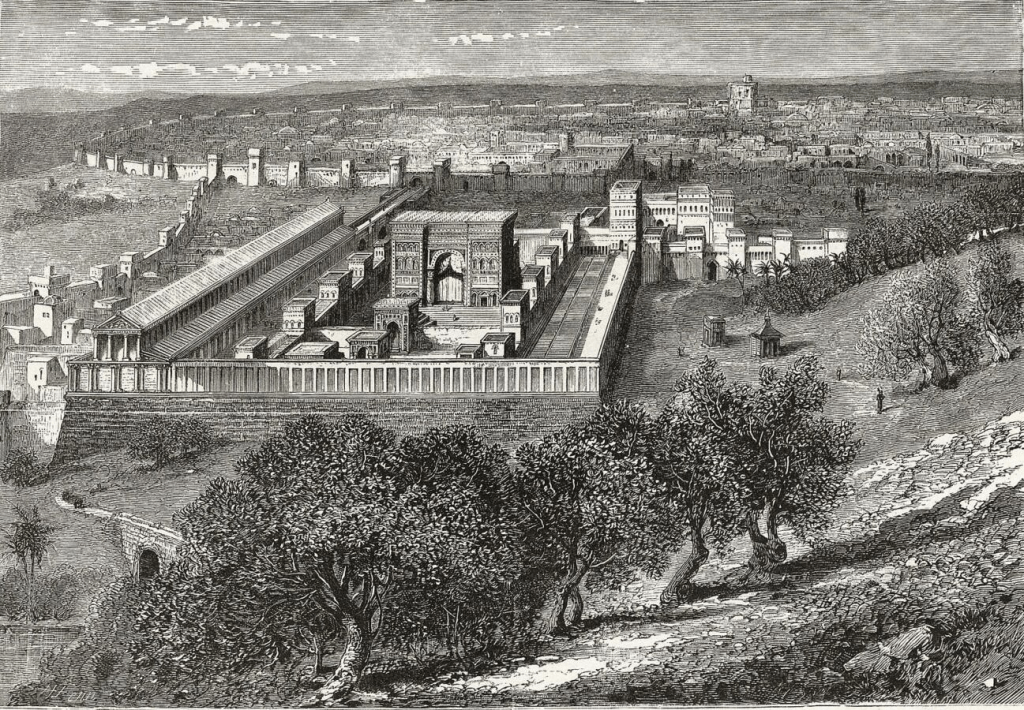
Rebuilding of the Temple, by Gustave Doré, 1866

Then King Darius made a decree, and they searched the archives where the documents were stored in Babylon. But a scroll was found in Ecbatana, the capital of the province of Media, on which was written the following:

A memorandum— In the first year of his rule, King Cyrus made a decree: Concerning God’s house in Jerusalem: Let the house at the place where they offered sacrifices be rebuilt and let its foundations be retained. Its height will be ninety feet and its width ninety feet, with three layers of dressed stones and one layer of timber. The cost will be paid from the royal treasury. In addition, the gold and silver equipment from God’s house, which Nebuchadnezzar took out of the temple in Jerusalem and brought to Babylon, is to be restored, that is, brought back to Jerusalem and put in their proper place in God’s house.

Now you, Tattenai, governor of the province Beyond the River, Shethar-bozenai, and you, their colleagues, the officials in the province Beyond the River, keep away! Leave the work on this house of God alone. Let the governor of the Jews and the elders of the Jews rebuild this house of God on its original site.

I also issue a decree about what you should do to help these elders of the Jews as they rebuild this house of God: The total cost is to be paid to these people, and without delay, from the royal revenue that is made up of the tribute of the province Beyond the River. And whatever is needed—young bulls, rams, or sheep for entirely burned offerings to the God of heaven, wheat, salt, wine, or oil, as requested by the priests in Jerusalem—let that be given to them day by day without fail so that they may offer pleasing sacrifices to the God of heaven and pray for the lives of the king and his sons.

I also decree that if anyone disobeys this edict, a beam is to be pulled out of the house of the guilty party, and the guilty party will then be impaled upon it. The house will be turned into a trash heap.

May the God who has established his name there overthrow any king or people who try to change this order or to destroy God’s house in Jerusalem. I, Darius, have decreed it; let it be done with all diligence.

Then Tattenai, the governor of the province Beyond the River, Shethar-bozenai, and their colleagues carried out the order of King Darius with all diligence. So the elders of the Jews built and prospered because of the prophesying of the prophet Haggai and Zechariah, Iddo’s son. They finished building by the command of Israel’s God and of Cyrus, Darius, and King Artaxerxes of Persia. This house was completed on the third day of the month of Adar, in the sixth year of the rule of King Darius.

Then the Israelites, the priests and the Levites, and the rest of the returned exiles joyfully celebrated the dedication of this house of God. (Common English Bible)

Throughout the time period of the Babylonian exile, the Jews waited impatiently for the day that Babylonian or Persian kings would allow them to return to their land and rebuild the Temple. When Cyrus was appointed king, their efforts were finally rewarded. Cyrus ordered that they be allowed to return to Israel and rebuild the Temple. He even promised to provide supplies for the project.

Under Persian rule, each subject people was allowed to live by its ancestral laws, which were enforced by the imperial government. Violations of the laws of the group to which one belonged constituted an offense against the state precisely because they led to instability. The maintenance of order in Judea, for example, would ensure the security of traveling to and from Egypt, and therefore the king required, in his own interest, that Jewish law be observed.

But down the road, when rebuilding efforts were questioned by the Persian governor of Judea, Tattenai, he and his associates wrote to King Darius about the legitimacy of the work. A search of the Persian records verified the Jewish claim and authority to rebuild the Temple.

What’s more, King Darius strongly affirmed support of restoration, including the use of tax revenues to help with funding the work. It was important enough for Darius to communicate that severe punishment would happen if anyone hindered rebuilding of the Temple.

The Temple was thus completed (in 516 B.C.E.) and it happened over a long period of time, under consistently adverse circumstances. The success of such a huge endeavor came through a combination of two different Persian kings who authorized the work and supported it fully; the prophets Haggai and Zechariah who encouraged it and provided spiritual support; and the Jewish leaders and workers who did the actual reconstruction and supported the effort with their blood, sweat, and tears.

In other words, a lot of stars in the universe needed to align for the Temple to actually be rebuilt. And it happened. Celebration of God’s sovereignty and divine help was then in order.

Awe and wonder are the basis of any good spirituality. Experiences that defy our imagination stick with us and bolster our faith for future mysteries and conundrums. I’m sure the Jews involved in rebuilding the Temple seriously wondered if it ever would materialize. Yet, it did.

While moments of awe come upon us, and cannot really be planned, there are yet some ways in which we can attune ourselves to experience awe in the everyday, such as:

  • Reading Holy Scripture, or inspiring biographies and novels
  • Attending church worship services and special events
  • Walking out in creation and spending time outside
  • Listening to music and going to live music performances
  • Visiting museums and community events
  • Engaging in spiritual disciplines and practicing them with others

We all go through times of rebuilding and needing to restore something which has been damaged or devastated. In your efforts, may you see the wonder of God’s movements in your life today, as you work and labor for a better tomorrow. Amen.