Psalm 113 – Shout Praises

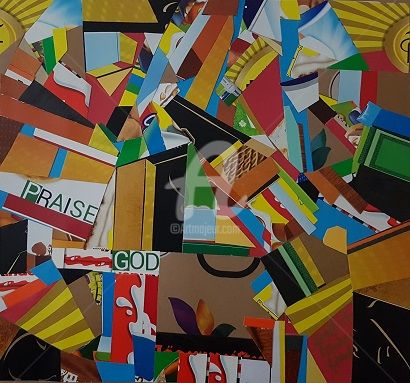
“From Sunrise to Sunset Praise God” by Muha Rukab

Shout praises to the Lord!
Everyone who serves him,
    come and praise his name.

Let the name of the Lord
    be praised now and forever.
From dawn until sunset
    the name of the Lord
    deserves to be praised.
The Lord is far above
    all of the nations;
    he is more glorious
    than the heavens.

No one can compare
    with the Lord our God.
His throne is high above,
    and he looks down to see
    the heavens and the earth.
God lifts the poor and needy
    from dust and ashes,
    and he lets them take part
    in ruling his people.
When a wife has no children,
    he blesses her with some,
and she is happy.
    Shout praises to the Lord! (Contemporary English Version)

When my firstborn daughter was an infant, I was a busy seminarian as well as working a job. I had very little discretionary time on my hands. Yet, I could stand over the crib of my beautiful little bundle of a girl for long stretches of time without ever thinking about all my responsibilities. Whenever she awoke I spoke to her in that kind of baby talk that only a doting father can do. 

I imagine God looks at us in much the same way, as well as speaking and acting toward us in ways we can understand. Just as parents (hopefully) communicate on a level their kids can understand, so G-d condescends and stoops to our level in order to help us. 

The Lord is seated on high, looking down on the heavens and the earth. G-d looks at us with lovingkindness and seeks our best interests. The Lord notices the poor and acts justly on their behalf. G-d observes the needy and lifts them from their want to a place where they can thrive. The divine condescension of God is a beautiful thing because without it we would be like a helpless baby.

G-d, while being unknowable and unreachable in so many ways, has nevertheless communicated with humanity in a way people can understand and to which they can respond. The Lord has accommodated, or made allowance for, our language and general level of understanding.

The Lord, sovereign and high above us all, has chosen to stoop and coo over us here on earth. G-d’s love affectionately delights in us. The psalmist’s portrayal of G-d is not of some aloof Being who is bothered with humanity’s pestering. Rather, G-d sees, notices, and cares. We don’t need to do some sort of spiritual back flips to gain G-d’s attention. We already have it.

This psalm of praise to G-d celebrates how the Sovereign of the universe notices and acts. We are meant to remember the great deeds of G-d – both those things done in history, and the things done for us, personally. 

“Despite our earnest efforts, we couldn’t climb all the way up to God. So what did God do? In an amazing act of condescension, God climbed down to us and became one with us.”

Will Willimon

In Christianity, the concept of divine condescension and accommodation is given its supreme form in the person and work of Jesus Christ. By becoming human, Jesus accommodates himself to the human condition. Through his life, teaching, and ministry, Christ speaks as G-d, communicating sufficiently and effectively to humanity.

The redemptive events of Christ – his incarnation, holy life, death, resurrection, ascension, and glorification – are divine acts of grace, mercy, and love to all humanity. Praise and thanksgiving are the appropriate responses to such events done on our behalf.

This is one reason why the spiritual practice of journaling is such a good personal discipline because we then have a record of the ways in which G-d has acted on our behalf. When we look back and remember, we can praise the Lord all over again for lifting us from the ash heap. And this will fortify our spiritual mettle for the times when we need encouragement.

Keeping a gratitude journal and writing each day about at least one way the Lord has acted on your behalf, can bring encouragement, transformation, and joy to your life. I suggest you write for your own eyes only. This is between you and G-d. Therefore, you need not be concerned for correct spelling and grammar. It doesn’t even need to be legible, as long as you can read your own writing!

“Praise is the rehearsal of our eternal song. By grace we learn to sing, and in glory we continue to sing. What will some of you do when you get to heaven, if you go on grumbling all the way? Do not hope to get to heaven in that style. But now begin to bless the name of the Lord.”

Charles Spurgeon

What’s more, shouting our praises is not only appropriate but encouraged – even commanded. Shouting is both cathartic and fun. It builds emotional resilience and spiritual strength. Coupled with writing, shouting our praises has the effect of bringing spiritual growth and maturity to our lives.

We, of course, want to avoid shouting at others. Yet, we can take advantage of shouting while driving alone, out in the woods by ourselves, or even into a pillow. This isn’t weird. Shouting goes appropriately with praise and celebration.

In fact, it would be weird if there were no shouting. Try telling a sports fan watching their favorite team that they aren’t supposed to shout. Or just see what happens when a woman longing for children becomes pregnant for the first time.

Emotional expressions are expected whenever G-d shows up and accomplishes great deeds for us. To not do so is a sign of having spiders in your heart and garlic in your soul. It’s not right.

What are you thankful for today? Is there something in this day for which to praise the Lord, whether big or small? Will you give yourself permission to shout?

Accept, O Lord, our thanks and praise for all you have done for us. We thank you for the splendor of the whole creation, the beauty of this world, the wonder of life, and the mystery of love. We thank you for the blessing of family and friends, and the loving care which surrounds us on every side. We thank you for setting us at tasks which demand our best efforts and leading us to accomplishments which satisfy and delight us. We thank you also for those disappointments and failures that lead us to acknowledge our dependence on your mercy and grace.

Above all, we thank you for your Son, our Lord, Jesus Christ, the truth of his Word, the example of his life; his steadfast obedience, by which he overcame temptation; his dying, through which he overcame death; and his rising to life again, in which we are raised to new life. Grant us the gift of your Spirit so that we may know Christ and make him known; and through him, at all times and in all places, we may give thanks to you in and for all things. Amen.


Philippians 2:5-11 – Palm Sunday

In your relationships with one another, have the same mindset as Christ Jesus:

Who, being in very nature God,
    did not consider equality with God something to be used to his own advantage;
rather, he made himself nothing
    by taking the very nature of a servant,
    being made in human likeness.
And being found in appearance as a man,
    he humbled himself
    by becoming obedient to death—
        even death on a cross!

Therefore, God exalted him to the highest place
    and gave him the name that is above every name,
that at the name of Jesus every knee should bow,
    in heaven and on earth and under the earth,
and every tongue acknowledge that Jesus Christ is Lord,
    to the glory of God the Father. (NIV)

I often take the posture of kneeling or prostrating when I pray. I do this, not because I think my prayers are more effective that way, but because this embodies my petitions with a recognition of Christ’s lordship over my life. Also, for me, there is no experience quite like using the kneelers on church pews and bowing together in a common experience of recognizing the lordship of Jesus Christ.

I sometimes ponder a question as I am on my knees: What kind of people would we be if we looked like these verses in Philippians?  The Apostle Paul said to the church in Philippi that their “attitude” should be the same as that of Christ Jesus. Their mindset, the way they think about everything, ought to be just like the mind of Christ. If we want to know how to think well and live well, how to relate to others in a good way, then we ought to thoroughly adopt the mind and the attitude of Jesus.  

How we should think and live comes from God. Within the life of the triune God exists three persons: Father, Son, and Spirit. Within this great three-in-one God exists perfect love, absolute holiness, united harmony, and constant respect. The Holy Scriptures tell us that just as God is holy, we are to be holy. Just as God is love, so we are to love one another. Just as God is harmonious, we are to live in harmony with one another. And just as God is supremely exemplified in the person of Jesus as a humble servant, so we are to practice humility and service in all our relations.

None of this is optional for the Christian. There is no place in the believer’s life for pride, posturing, and power-broking. There is to be humility, taking the posture of lowliness, and using any kind of influence for the benefit and encouragement of others – just like Jesus did while on this earth.

In a world pre-occupied with power and control, safety and security, influence and throwing its weight around, there is Jesus. He did just the opposite of engaging in upward mobility; he practiced downward mobility, and in doing so Christ descended into greatness as Lord and Savior.

Jesus did not consider equality with God as something to be grasped. The pre-incarnate Christ did not sit in heaven as the second person of the Trinity and hold onto his lofty position with tight fists – he did not grasp it tightly. When Jesus came to this earth, there was a humble willingness to open his hands and relinquish his rights and privileges as God. Christ made himself nothing, taking the very nature of a servant. Jesus gladly, not reluctantly, emptied himself for us. Jesus became one of us.

The television series, Undercover Boss, is a reality show in which high-level corporate executives leave the comfort of their offices and secretly take low-level jobs within their companies to find out how things are really working and what their employees are honestly thinking about their jobs and what is happening. In the process of this undercover mission, they learn of the perceptions about their companies, the spirit of their work forces and — maybe — something about themselves as well.

None of the executives cease to be executives. They just make a willing decision to take the lowest level job in their own company to hopefully benefit the employees and the entire corporation. The best episodes are when the most generous executives go above and beyond helping the employees around them at the end of the show. 

Jesus descended to earth. He never ceased to be God. Yet, Christ willingly put his kingly robe in the closet and donned Dickies and work boots. He came among us and purposely limited himself to identify with us fully – and secured for us the greatest generosity imaginable – an answer to the problem of guilt and shame through forgiveness of sins.

Jesus became a servant. He completely tied himself to us. Jesus did not come to this earth seeking to be served, but sought to serve and give his life as a ransom for many. Christ kept going lower and lower to the point of descending to the greatest humiliation of all – death on a cross. Jesus endured the ultimate shame of the ancient world by dying a terrible death. The King of the universe was killed by vicious humanity so that he might redeem and save those very same people from their terrible plight of bondage to evil.

We are to be humble people, embracing a lowly status of slaves to God and to one another. The ancient Philippian church had a real problem with pride which is why Paul talked about emulating the mind and attitude of Christ in his humiliation. The following are exhortations Paul gave to the Philippians, which were to reflect the practice of humility in relationships:

  • Whatever happens, conduct yourselves in a manner worthy of the gospel of Christ (1:27). 
  • Do nothing out of selfish ambition or vain conceit, but in humility consider others better than yourselves (2:3). 
  • Continue to work out your salvation with fear and trembling (2:12). 
  • Do everything without complaining or arguing (2:14). 
  • Join with others in following my example and take note of those who live according to the pattern we gave you (3:17). 
  • Do not be anxious about anything, but in everything, by prayer and petition, with thanksgiving, present your requests to God (4:6). 

Because of Christ’s humble obedience to the Father, he was exalted from the lowest place to the highest place.  King Jesus is on the throne, above everyone and everything. Because of his descent to this earth, Christ has ascended in glory and honor. We can now see God in a new way, through Jesus. And when we do, it causes us to kneel in prayer and profess that Jesus Christ is Lord.

In the ancient world, this was subversive language. If Jesus is Lord, Caesar is not, and ultimate allegiance does not belong to the Roman Empire. If Jesus is Lord, the local gods are not. And in our day, it is no different. Historical characters and religious deities may come and go, but the issue of ultimate allegiance still pertains to us. If Jesus is Lord, no politician or celebrity is owed lordship status. Pride and arrogance are to be put down at every turn in favor of humble service and loving actions.

If we are to follow Jesus Christ truly and really, we will practice downward mobility and embrace humility. Bowing, kneeling, and prostrating will become second nature to us as we give our unflagging allegiance to Jesus. We will accept our creaturehood and God as Creator. We will live in the reality that Jesus is Sovereign over all creation. 

As we enter the Christian Holy Week, let us acknowledge and know the humiliation and exaltation of Christ….

Just watch my servant blossom!
    Exalted, tall, head and shoulders above the crowd!
But he didn’t begin that way.
    At first everyone was appalled.
He didn’t even look human—
    a ruined face, disfigured past recognition.
Nations all over the world will be in awe, taken aback,
    kings shocked into silence when they see him.
For what was unheard of they’ll see with their own eyes,
    what was unthinkable they’ll have right before them.

Who believes what we’ve heard and seen?
    Who would have thought God’s saving power would look like this?

The servant grew up before God—a scrawny seedling,
    a scrubby plant in a parched field.
There was nothing attractive about him,
    nothing to cause us to take a second look.
He was looked down on and passed over,
    a man who suffered, who knew pain firsthand.
One look at him and people turned away.
    We looked down on him, thought he was scum.
But the fact is, it was our pains he carried—
    our disfigurements, all the things wrong with us.
We thought he brought it on himself,
    that God was punishing him for his own failures.
But it was our sins that did that to him,
    that ripped and tore and crushed him—our sins!
He took the punishment, and that made us whole.
    Through his bruises we get healed.
We’re all like sheep who’ve wandered off and gotten lost.
    We’ve all done our own thing, gone our own way.
And God has piled all our sins, everything we’ve done wrong,
    on him, on him.

He was beaten, he was tortured,
    but he didn’t say a word.
Like a lamb taken to be slaughtered
    and like a sheep being sheared,
    he took it all in silence.
Justice miscarried, and he was led off—
    and did anyone really know what was happening?
He died without a thought for his own welfare,
    beaten bloody for the sins of my people.
They buried him with the wicked,
    threw him in a grave with a rich man,
Even though he’d never hurt a soul
    or said one word that wasn’t true.

Still, it’s what God had in mind all along,
    to crush him with pain.
The plan was that he gives himself as an offering for sin
    so that he’d see life come from it—life, life, and more life.
    And God’s plan will deeply prosper through him.

Out of that terrible travail of soul,
    he’ll see that it’s worth it and be glad he did it.
Through what he experienced, my righteous one, my servant,
    will make many “righteous ones,”
    as he himself carries the burden of their sins.
Therefore I’ll reward him extravagantly—
    the best of everything, the highest honors—
Because he looked death in the face and didn’t flinch,
    because he embraced the company of the lowest.
He took on his own shoulders the sin of the many,
    he took up the cause of all the black sheep. (Isaiah 52:13-53:12, MSG)

John 1:1-18 – God in the Flesh

Welcome, friends! The astounding love of God is seen most clearly in the face of Jesus Christ. Click the videos below and let us enjoy worshiping our incarnate Lord…

John 1:1-18
O Word of God Incarnate by Jeff Pardo
He Came Down by the Gaither Vocal Band, 1999

May your hearts be filled with grace through the incarnation of Christ.

May your minds be filled with truth through the knowledge of Jesus.

May your soul be filled with love through love incarnate, the Lord Jesus Christ our Savior. Amen.

God in the Flesh

The Word Became Flesh by Guatemalan painter Hyatt Moore

In the biggest cities of the world, like Mexico City, and Manilla, there are huge garbage dumps that cover several square miles. On top of these heaps of waste there live thousands of families who have made this their home. Each day they send their kids out to forage for scraps so they can have something to eat and survive.  Few others tread where these families are.  Yet, there are believers who make the journey and try to bring the gospel of grace and mercy to such a place.

As incredible and sad a situation that this is, it is incomparable to the journey from heaven to earth that Jesus made. Christ came to the sin-soaked dump of this world, to us who were living on a heap of garbage and entered our lives to save us from our wretched condition. Eugene Peterson’s paraphrase of the Bible, The Message, frames the Gospel of John 1:14 this way:

The Word became flesh and blood and moved into the neighborhood. We saw the glory with our own eyes, the one-of-a-kind glory, like Father, like Son, generous inside and out, true from start to finish.

Jesus did not merely appear to be human; he is human. The Christ of God, enjoying unhindered fellowship within the Godhead of Father, Son, and Spirit, became like us and lived with all the same things we face from day to day.  He “tabernacled” with us, using the imagery of God’s presence with the ancient Israelites (Exodus 25-31, 35-40). Jesus is our Immanuel, God with us.

We must remember that the Apostle John and the other gospel writers were evangelists; they wrote so that people might believe in Jesus and come to see what God has done through joining them in this broken world. Another John, John the Baptist, had a sole purpose in life to be a witness of Jesus to others, to testify to the truth that Christ came to rescue us from our terrible condition.

The Apostle John saw Jesus interact with families in the dump. He knew what was happening, that God was coming to save the people. The way to reach people, who are so concerned for scurrying about their business and trying to survive apart from God, is through the incarnation – in testifying to what God has done in Christ and being sent as little incarnations entering people’s lives. 

In this way, believers are like the moon, not producing light ourselves, but in the middle of darkness, reflecting the light of the sun so that the earth may know that Jesus is coming. The mystery of the incarnation is that Jesus became human and descended to live among us.

Any birth is an incredible miracle. I was present at the births of all three of my daughters, and one of my grandsons. There is nothing quite like it. Life coming into the world for the very first time is an unparalleled mystery with an unmatched sense of majesty. Although childbirth involves pain, agony, and mess, it is all quickly forgotten amidst the joy of this little baby becoming alive to all that is around them.

What a crazy contradiction of a virgin having a child gestate in her womb and then giving birth! That is something more than a miracle. It is Divine accommodation or condescension in which God does the unimaginable and unthinkable in not only coming to earth but entering as a vulnerable human baby. The great and mighty Sovereign of the universe got down on all fours and descended far beneath such loftiness. God got off the throne and sat on the garbage heap with us.

God is so far above and beyond us that to be revealed and communicate to us, the Holy Trinity conspired to enter the earth by means of a baby. God came to us. The sixteenth century Reformer, John Calvin, framed the incarnation of Christ in these terms:

“God lisps with us as nurses are wont to do with little children. Such modes of expression… accommodate the knowledge of the divine to our feebleness. In doing so, God must, of course, stoop far below his proper height… Because our weakness cannot reach his height, any description which we receive of God must be lowered to our capacity to be intelligible… God voluntarily lowers himself not as he really is but as we conceive of him.”

Indeed, God coos at us and babbles baby-talk not because that is his language but so that we can understand. What is more, God became flesh and blood for us, so we can climb up into his lap or lean into him, just as John did with Jesus. (John 13:23-25)

The incarnation of Christ means God loves us so deeply and completely that Jesus became one of us to bring that love with skin on, in ways that truly communicate empathy, compassion, kindness, and goodness to people. This is grace, that God first conformed to us before we are conformed to Christ. God went to the greatest lengths possible to reach us, save us, and bring us into the life of the Trinity.

Jesus climbed into our skin to assure us that God understands and cares. Jesus also gets into our hearts and invites us to know God. Even though Christ said a lot of things that can be difficult to understand, the love of coming alongside another person communicates well in any language and culture. Jesus, full of both grace and truth, bent over backwards to speak and act in ways that say, “I love you.”

God got down and dirty with us. The Lord jumped into the fray of broken humanity. God connected Jesus to an umbilical cord, covered him in the muck of fetal afterbirth, and caused him to cry alongside the sorrows of humanity. None of this was illusion or appearance. It was real, just like us. The author of the New Testament book of Hebrews said this:

Since the children are made of flesh and blood, it is logical that the Savior took on flesh and blood to rescue them by his death. By embracing death, taking it into himself, he destroyed the Devil’s hold on death and freed all who cower through life, scared to death of death.

It is obvious, of course, that he did not go to all this trouble for angels. It was for people like us, children of Abraham. That is why he had to enter every detail of human life. Then, when he came before God as high priest to get rid of the people’s sins, he would have already experienced it all himself—all the pain, all the testing—and would be able to help where help was needed. (Hebrews 2:14-18, MSG)

God’s grace stretches out on the wide horizontal beam of the Cross with compassionate arms for the world. God’s truth goes down deep with the vertical beam of the cross to give stability for the world. The truth of Jesus Christ, the One who reveals God, is strong enough to support the wide beam of grace which stretches round the earth to bring deliverance from the garbage dump of sin, death, and hell.

May we rejoice and be glad in this reality, and may it move us to be used of God to save those on the sin heap of this world.