Questions Without Answers (Job 38:1-7, 38-41)

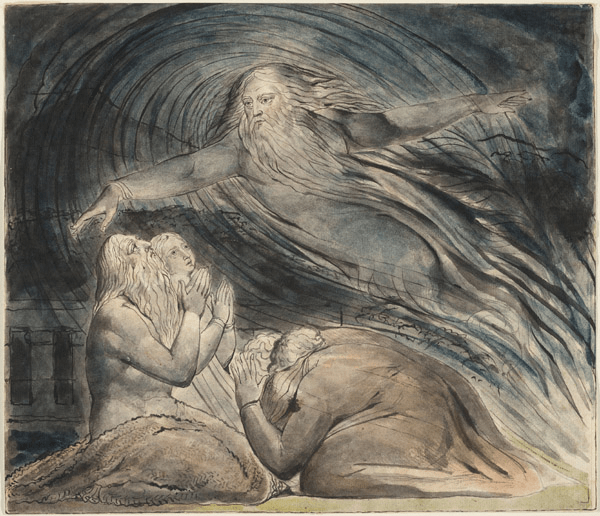
God Answers Job Out of the Whirlwind, by William Blake, 1805

Then the Lord answered Job out of the whirlwind:

“Who is this that darkens counsel by words without knowledge?
Gird up your loins like a man;
    I will question you, and you shall declare to me.

“Where were you when I laid the foundation of the earth?
    Tell me, if you have understanding.
Who determined its measurements—surely you know!
    Or who stretched the line upon it?
On what were its bases sunk,
    or who laid its cornerstone
when the morning stars sang together
    and all the heavenly beings shouted for joy?…

“Can you lift up your voice to the clouds,
    so that a flood of waters may cover you?
Can you send forth lightnings, so that they may go
    and say to you, ‘Here we are’?
Who has put wisdom in the inward parts
    or given understanding to the mind?
Who has the wisdom to number the clouds?
    Or who can tilt the waterskins of the heavens
when the dust runs into a mass
    and the clods cling together?

“Can you hunt the prey for the lion
    or satisfy the appetite of the young lions,
when they crouch in their dens
    or lie in wait in their covert?
Who provides for the raven its prey,
    when its young ones cry to God
    and wander about for lack of food? (New Revised Standard Version)

The Book of Job is rather long. After the initial two chapters which set the scene for Job’s awful suffering, we then get an extended and agonizing thirty-five chapters of speeches between Job and his companions. It’s a lot of words which generally go nowhere.

So, by the time we get to this point in chapter 38 of Job, we may likely say, “Finally, God speaks!” Indeed, this is the moment Job has anticipated.

Perhaps we are looking for something in Job’s story which may help us in our own story of suffering. Like Job, maybe we’re looking for vindication of our situation, a restoration to some semblance of life before the grief, or to have our reputation upheld.

But that is not what we get from God. For the next nearly four chapters, God only speaks in questions, and does not answer a single one of them.

If it’s answers to questions we’re searching for, it is unlikely you will get them, at least on this side of heaven. You are more likely to get even more questions than you started with. And then, imagine being questioned by God, and having no answers for God whatsoever.

Yet, that is the point. We humans know jack squat – absolutely nothing, in comparison to an omnipresent and omniscient God.

If it’s God’s voice you really want to hear, you may not know what you’re actually asking for. That was certainly true for Job and his friends. God’s questions are really rather rhetorical; there is no way any of us could really answer them with any sort of knowledge or understanding. It would be a bit like a parent asking their toddler to describe his own birth and how it happened.

God’s unanswerable questions revolve mostly around the workings of the universe. God is the Creator, and none of us were around when it all came into existence. So, of course, we have no answers.

Yet, with all of the questions, we quickly get the impression that humans have very little control over much of anything. And I think that perhaps God wants us to be aware of that reality.

It seems to me that with every question of God, we are led to believe that God is God, and is really big; and that we are not God, and are pretty dang small.

I don’t think any of this is meant to make us feel irrelevant or disposable. Rather, it gives us some needed perspective, that is, that our perspective on world issues, events, and problems is very narrow. But God sees the whole big picture and has a stellar full perspective of all things and all people.

The God in the Book of Job is no vending machine deity, in which we can pick-and-choose what we like and don’t like. There is no grand certainty that if we press the right buttons in prayer that we get what we want.

Therefore, God is not some automaton who predictably rewards the righteous, and punishes the wicked (according to our definitions of those terms). Yet this is the God that Job’s friends believed in – which is why they reflexively interpreted Job’s situation as Job himself being a sinful man.

Even Job believed in this sort of God, at least to some degree. Up to the point of his terrible trouble, he was good and righteous, and received due reward for his faithfulness. The divine system was serving Job well.

But then the system seems to have broken down. Job interpreted God as not doing the expected divine job of operating within the predictable divine structure.

Believers in every generation and era must come to grips with the reality that – although personal virtue and devotion are important – one’s piety does not necessarily lead to personal health nor wealth.

In other words, good guys don’t always win in this life, because having faith typically means we will actually suffer, rather than not.

This is, to me, good news. Why? Because it means, conversely, that persons victimized by violence, poverty, and loss are not necessarily to blame for their troubles. Frankly, there are times when bad things happen to us that are not our fault, and we don’t see any good reason for it happening.

Whenever God is silent, we might start to think that God is also absent. We may begin to entertain nihilist thoughts that nothing matters, that everything in this universe is just random chaos.

Yet, God’s response with all the questions lets us know that there is a solid structural foundation to this universe that we aren’t always aware of. In other words, there is meaning, purpose, and order to it all. We are not forgotten. God sees and remembers us.

I do believe there is a reason for everything. However, I do not believe that we are always privy to know what that purpose may be. Which means that oftentimes, like Job, we don’t have any answers to our existential questions of human tragedy and trouble. This line of thinking isn’t meant to be a cop out; it’s meant to help us accept that we are human.

Sometimes all we can do is affirm what we know to be true, and accept the limits of our own human understanding of things such as:

  • God is God. I am not.
  • God created the world. I didn’t.
  • God established order in the universe. I sometimes see order, and oftentimes see what looks like random chaos.
  • God is Love all the time. I love, but not always.
  • God is with us, even though I may not always sense or feel that divine presence.

Maybe what is most important is that we humans keep up our dialogue with God – our questions, musings, emotions, and expressions of faith and devotion. Because it is in the relationship that we discover the key to the universe.

O God, by whom the meek are guided in judgment, and light rises up in darkness: Grant us, in all our doubts and uncertainties, the grace to ask what you would have us to do, so that the Spirit of wisdom may save us from all false choices, and that in your light we may see light, and in your straight path may not stumble. Amen.

Hold Onto Faith (Job 26:1-14)

Job, by Gonzalo Carrasco (1860-1936)

Then Job replied:

“How you have helped the powerless!
    How you have saved the arm that is feeble!
What advice you have offered to one without wisdom!
    And what great insight you have displayed!
Who has helped you utter these words?
    And whose spirit spoke from your mouth?

“The dead are in deep anguish,
    those beneath the waters and all that live in them.
The realm of the dead is naked before God;
    Destruction lies uncovered.
He spreads out the northern skies over empty space;
    he suspends the earth over nothing.
He wraps up the waters in his clouds,
    yet the clouds do not burst under their weight.
He covers the face of the full moon,
    spreading his clouds over it.
He marks out the horizon on the face of the waters
    for a boundary between light and darkness.
The pillars of the heavens quake,
    aghast at his rebuke.
By his power he churned up the sea;
    by his wisdom he cut Rahab to pieces.
By his breath the skies became fair;
    his hand pierced the gliding serpent.
And these are but the outer fringe of his works;
    how faint the whisper we hear of him!
    Who then can understand the thunder of his power?” (New International Version)

Sarcasm is a form of criticism. Criticism is a form of anger. Job was angry at his “friends.” Namely, because they had proved themselves to be not very good companions.

Job needed comfort and consolation, not hellfire sermons about his being sinful. Because, in fact, he had not sinned. His intense pain and suffering were not a punishment from God, as the prologue to the story of Job makes clear. (Job 1:1-22)

But neither Job nor his friends knew what was going on behind the scenes in the cosmic court of heaven.

Job only knew he was getting a lot of undeserved tragedy. And Job’s friends only knew that he was suffering terribly.

Job didn’t know how to interpret his situation. Job’s friends misinterpreted his situation as condemnation from the Lord.

Thus, Job became exasperated and angry. Job’s friends became the ignoramuses of ancient history.

Job was certainly no ignoramus. He knew what it meant to be right with God – which was why he was so doggone confused and confounded as to why he felt abandoned by God. Job knew his suffering wasn’t a result of unfaithfulness.

The biblical character Job came face to face with the reality that good people suffer, too.

The friends of Job kept reiterating how unworthy and sinful people are; and that Job must be especially sinful to be experiencing such trouble. And, of course, Job found this line of reasoning asinine.

The majesty of God, as Job understood it, is much greater and higher than his supposed friends could ever imagine. The dead know this better than anyone. Job himself was nearly dead, and so, he seems to see some things more clearly from his perspective of abject suffering.

Job’s observations of creation are profound reflections of God’s greatness and sovereignty in the world. His faith rested firmly with God alone, as Creator and Sustainer of the universe. So, he looked beyond the water and the clouds to heaven above.

Even in the realms we humans cannot see, God has authority and power over angelic beings. We cannot fathom the breadth and depth and extent of God’s reach and knowledge of all things. Indeed, humanity only observes a mere fraction of God’s rule and reign. And we barely know anything in comparison to God’s wisdom and knowledge.

In other words, our incredible God is so mighty and wondrous that it is incomprehensible to us.

Oh, the depth of the riches of the wisdom and knowledge of God!
    How unsearchable his judgments,
    and his paths beyond tracing out! (Romans 11:33, NIV)

God is big, to the point that only the fringes of God’s robe can fit inside the temple:

I saw the Lord, high and exalted, seated on a throne; and the train of his robe filled the temple. (Isaiah 6:1, NIV)

Although Job was flummoxed as to why God was silent and allowed suffering to happen, Job nevertheless had a majestic view of God which remained intact.

And, what’s more, Job seems to have gained an even more expansive view of God through his awful experience of suffering in both body and soul. In other words, Job got to know God better, and not for worse, because of his terrible situation.

Satan certainly meant to upend Job and cause him to renounce his faith; but God meant it all, ironically, for good.

Even though Job’s words about God appear similar to the words of his friends, they come from a very different place.

It’s one thing to talk of God’s majesty, sovereignty, and power when everything is going okay for you in your life. But it is an altogether different thing whenever your life has unraveled and distress is what you eat for breakfast.

To affirm God’s inherent power and goodness, smack in the middle of grinding hardship and ill health – and truly mean it – is the genuine article of faith.

Authentic faith is resilient and gains strength when tested and tried. Bogus faith crumbles like burnt toast when it is put through the fire.

True faith is always connected to hope and love. False faith evaporates and becomes nihilistic and hateful in the face of hellish circumstances.

Real faith perseveres through suffering, knowing that God is good, no matter what. Skin deep faith is herky-jerky, vacillating between confidence and doubt.

The only way for faith to be shown as real or fake is in the crucible of suffering. How we handle the adverse situations of life demonstrates where our faith is truly placed.

Satan’s statement to God was that Job’s faith would be shown to be a mere façade because God had blessed him with health, wealth, and family.

Satan was wrong. God was right. However, we may wonder about what Job thought of all this, once the suffering subsided.

I don’t know about Job. I can only speak for myself. I won’t list the long litany of trials and tribulations I have personally encountered in my life, and those I am facing presently. Yet, I will say that each of my experiences have taught me something important about God; and those hard experiences have changed and strengthened my faith in ways I could not have imagined.

Although I would never want to go through all of the past adversity again, I would not change a thing in my life. Because each of my experiences were formative in making me the person I am today – full of robust faith in God and confident in the Lord, no matter the circumstances.

Strengthen us, O Lord, by your grace, so that through your mighty power we may overcome all spiritual enemies, and with pure hearts serve you; through Jesus Christ our Lord, who lives and reigns with you and the Holy Spirit, one God, for ever and ever. Amen.

Feeling the Pain (Job 23:1-9, 16-17)

Then Job answered:

“Today also my complaint is bitter;
    his hand is heavy despite my groaning.
Oh, that I knew where I might find him,
    that I might come even to his dwelling!
I would lay my case before him
    and fill my mouth with arguments.
I would learn what he would answer me
    and understand what he would say to me.
Would he contend with me in the greatness of his power?
    No, but he would give heed to me.
There the upright could reason with him,
    and I should be acquitted forever by my judge.

“If I go forward, he is not there;
    or backward, I cannot perceive him;
on the left he hides, and I cannot behold him;
    I turn to the right, but I cannot see him….

God has made my heart faint;
    the Almighty has terrified me.
If only I could vanish in darkness,
    and thick darkness would cover my face. (New Revised Standard Version)

Here is Job, sitting on an ash heap, of all things, and feeling like an ash. His children are gone, all killed by tragic circumstances. His wealth is no more. And now he is lamenting, because he can do nothing else; he has painful nasty sores covering his body that won’t let him do anything.

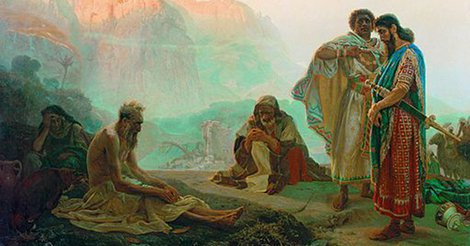
Job and his friends, by Ilya Repin (1844-1930)

And if that isn’t enough, Job’s “friends” come and end up giving him unhelpful speeches about how all this suffering is really his fault. They reasoned (wrongly) that there must be loads of sin in Job’s life for him to be going through such horror. God is punishing him, they insist.

Job’s companions had initially started out well. For seven days they sat with him in silence (Job 2:13). But then, after a week had passed, they just couldn’t take it anymore. They had the compulsion to speak. And when they opened their mouths, it was merely a bunch of ignorant gobbledygook.  

The friends, the companions, were themselves having an existential theological crisis. Their worldview was being challenged and threatened. So, rather than be open-minded and consider that their views may need to be altered, the friends acted like enemies, accusing Job of sin.

At issue was their clear and clean theology of believing that good guys are blessed with wealth, health, and happiness; and bad guys are cursed with poverty, illness, and misery – like Job.

They could not imagine or entertain the thought that God would let a good person suffer like Job was suffering. Therefore, Job must be bad, and they tried to find that hidden sin within him  to which he must repent of.

Yet, in truth, not all suffering – even terrible grinding suffering – is the result of personal sin or bad decision-making. Sometimes, good people suffer horribly, too.

Times may change, but people throughout the ages don’t. Today, we still think along the same lines as the companions of Job. There is far too much blaming of victims for their victimization; and way too many flippant beliefs which say to others in a terrible situation things like, “You reap what you sow.”

Job, through all of the loss, tragedy, and then suffering from his friends, held onto his integrity. Even though Job knew his situation was undeserved, he did not curse God, nor his friends.

Job made the incredible claim that suffering is not always the result of one’s personal sin – something he himself might not have said before his tragic experiences.

But just because Job did not curse, does not mean he was nice and okay with what unfolded in his life. He wished he was never born. He felt like death would be preferable to living. He contended with God, and longed for justice. His ultimate wish was that God would just speak and say something, anything.

Job was hurting so terribly, that he had bitter words of despair for God. He could make absolutely no sense of what was happening. He could not understand why he was the brunt of so much suffering. It felt like God was attacking him, and he said so.

The silence and absence of God were palpable for Job. He longed to speak with God. And his greatest lament – out of all the reasons to lament – was the horrible feeling of being alone without God’s presence and consolation.

It is interesting that we have no mention in the story about Job’s friends speaking directly to God, or praying to God, or addressing God in any way.

They certainly felt free to tell Job who God is, and how God operates in the world. But there was never any intercession for their friend, and no words of crying out to God on behalf of Job. There was only words of rebuke and chastisement, words of hurt that were as painful as the physical sores on his body

The phrase I hear most often from people speaking to the person in grief and pain is, “You just need to be strong.” And a close second is, “Everything happens for a reason.” The latter phrase is simply unhelpful, and the former phrase is actually hurtful.

It is not a sin to be weak. Just in case you read that sentence too quickly, I will say it again: It. Is. Not. A. Sin. To. Be. Weak!

We understand that when someone breaks a bone, they’ll be limited with weakness for a while. And we make helpful accommodations to that effect. But when someone’s heart is broken, and their life emotionally shredded, we expect them to be strong for everyone else around them.

It may be true that everything happens for a reason, yet most of the time, none of us knows the reason why we’re going through what we’re going through. And we probably won’t, this side of heaven.

If we try to have explanations for everything, then we join the company of Job’s companions who had to try and understand what was happening. And their conclusions were very wrong.

However, there is nothing wrong with weeping with those who weep; and expressing pain, grief, and even anger – both for the one who laments, and those who lament with them.

Pain cannot be relieved unless it is acknowledged, affirmed, and addressed by both the one who suffers and the community who surrounds them.

Where there is lament, there are loud words and expressions of grief. When lament is said to God, then God can hold that person, and rock them in the arms of mercy.

But silence is agonizing. We need friends who will listen and grieve with us. It is vital to have companions who voice to God what we cannot voice in our weakness. All of us, together, must hold onto God, and trust that the Lord hears, and will answer.

As Jesus cried out on the cross, I cry out to you in pain, O God my Creator. Do not forsake me. Grant me relief from this suffering and preserve me in peace; through Jesus Christ my Savior, in the power of the Holy Spirit. Amen.

A Very Heavy Burden (Job 20:1-29)

Woman carrying a burden, by Eugène Jules Joseph Laermans, 1916

Then Zophar the Naamathite replied:

“My troubled thoughts prompt me to answer
    because I am greatly disturbed.
I hear a rebuke that dishonors me,
    and my understanding inspires me to reply.

“Surely you know how it has been from of old,
    ever since mankind was placed on the earth,
that the mirth of the wicked is brief,
    the joy of the godless lasts but a moment.
Though the pride of the godless person reaches to the heavens
    and his head touches the clouds,
he will perish forever, like his own dung;
    those who have seen him will say, ‘Where is he?’
Like a dream he flies away, no more to be found,
    banished like a vision of the night.
The eye that saw him will not see him again;
    his place will look on him no more.
His children must make amends to the poor;
    his own hands must give back his wealth.
The youthful vigor that fills his bones
    will lie with him in the dust.

“Though evil is sweet in his mouth
    and he hides it under his tongue,
though he cannot bear to let it go
    and lets it linger in his mouth,
yet his food will turn sour in his stomach;
    it will become the venom of serpents within him.
He will spit out the riches he swallowed;
    God will make his stomach vomit them up.
He will suck the poison of serpents;
    the fangs of an adder will kill him.
He will not enjoy the streams,
    the rivers flowing with honey and cream.
What he toiled for he must give back uneaten;
    he will not enjoy the profit from his trading.
For he has oppressed the poor and left them destitute;
    he has seized houses he did not build.

“Surely he will have no respite from his craving;
    he cannot save himself by his treasure.
Nothing is left for him to devour;
    his prosperity will not endure.
In the midst of his plenty, distress will overtake him;
    the full force of misery will come upon him.
When he has filled his belly,
    God will vent his burning anger against him
    and rain down his blows on him.
Though he flees from an iron weapon,
    a bronze-tipped arrow pierces him.
He pulls it out of his back,
    the gleaming point out of his liver.
Terrors will come over him;
    total darkness lies in wait for his treasures.
A fire unfanned will consume him
    and devour what is left in his tent.
The heavens will expose his guilt;
    the earth will rise up against him.
A flood will carry off his house,
    rushing waters on the day of God’s wrath.
Such is the fate God allots the wicked,
    the heritage appointed for them by God.” (New International Version)

Well, there you have it. Proof positive that God is merciful. The fact that the Lord kept his mouth shut after hearing all of Zophar’s supposed insight is amazing.

Illustration of Job and his friends from the Kiev Psalter, 1397

Zophar talked as if he had the inside scoop on the righteous and the wicked, and could tell the difference with ease. He is, however, another “friend” of Job who either could not or would not entertain the possibility that Job could be innocent and undeserving of such terrible suffering.

In addition, Zophar took the further step of accusing Job of being an enemy of God, and a secret sinner who was finally exposed and found out.

I have been in the position of being accused of sinful things that I did not do; and of being victimized by others who assume I must be a sinner because of a particular set of life circumstances. In some ways, it’s worse than the situation itself.

So, not only did Job experience the loss of family, property, and health; he also experienced gross misinterpretations of that experience from the very people who ought to have consoled and helped him through it.

Zophar sounds like one of those guys who always has to win an argument, always has to have an answer for everything, always talks himself into believing the things he says, and always has to have the last word.

I don’t need a “friend” like Zophar. I’ll take a friend like Jesus, who said things like this:

Now there were some present at that time who told Jesus about the Galileans whose blood Pilate had mixed with their sacrifices. Jesus answered, “Do you think that these Galileans were worse sinners than all the other Galileans because they suffered this way? I tell you, no! But unless you repent, you too will all perish. Or those eighteen who died when the tower in Siloam fell on them—do you think they were more guilty than all the others living in Jerusalem? I tell you, no! But unless you repent, you too will all perish.” (Luke 13:1-5, NIV)

Christ put the onus on repentance where it needed to be – not on the ones who suffered and died, but on the ones who offered their bogus interpretations of the suffering.

I am confident that Jesus would have had little tolerance for Zophar, and would not have treated Job in the way he was treated by his so-called friends.

Jesus extends an invitation to those who are experiencing such heavy burdens that they seem like crushing loads. That is certainly where Job was. His spiritual and emotional wounds were just as great as his painful physical situation.

Job needed help, and not people who would add to his already inconceivable burden.

Jesus said, “Come to me, all you who are weary and burdened, and I will give you rest. Take my yoke upon you and learn from me, for I am gentle and humble in heart, and you will find rest for your souls. For my yoke is easy and my burden is light.” (Matthew 11:28-30, NIV)

Jesus! what a Friend for sinners! (verse 3)

By J. Wilbur Chapman, 1910

Jesus! what a Help in sorrow!
While the billows o’er me roll,
even when my heart is breaking,
He, my Comfort, helps my soul.
Hallelujah! what a Savior!
Hallelujah! what a Friend!
Saving, helping, keeping, loving;
He is with me to the end.

Amen.