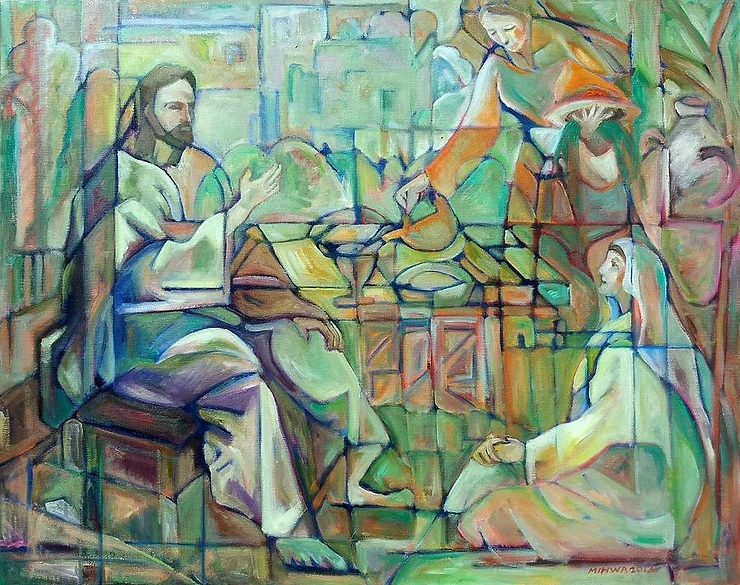
Keep Hold of Wisdom (Proverbs 4:10-27)

Hear, my child, and accept my words,
    that the years of your life may be many.
I have taught you the way of wisdom;
    I have led you in the paths of uprightness.
When you walk, your step will not be hampered,
    and if you run, you will not stumble.
Keep hold of instruction; do not let go;
    guard her, for she is your life.
Do not enter the path of the wicked,
    and do not walk in the way of evildoers.
Avoid it; do not go on it;
    turn away from it and pass on.
For they cannot sleep unless they have done wrong;
    they are robbed of sleep unless they have made someone stumble.
For they eat the bread of wickedness
    and drink the wine of violence.
But the path of the righteous is like the light of dawn,
    which shines brighter and brighter until full day.
The way of the wicked is like deep darkness;
    they do not know what they stumble over.
My child, be attentive to my words;
    incline your ear to my sayings.
Do not let them escape from your sight;
    keep them within your heart.
For they are life to those who find them
    and healing to all their flesh.
Keep your heart with all vigilance,
    for from it flow the springs of life.
Put away from you crooked speech,
    and put devious talk far from you.
Let your eyes look directly forward
    and your gaze be straight before you.
Keep straight the path of your feet,
    and all your ways will be sure.
Do not swerve to the right or to the left;
    turn your foot away from evil. (New Revised Standard Version)

Life is not a sprint; it is a marathon. Only those who persevere, and have patience over the course of their lives, will know what wisdom is, and how to live a good life.

We never get to a point in life in which we can simply rest on our laurels and slide effortlessly into end of life, and beyond to eternal life. The wisdom of endurance and humility is needed all the time, because decision-making is continually required.

The Book of Proverbs brings up some constant themes for us to keep in mind with our choices in life: There is always a choice of contrasting ways between wisdom and foolishness. That choice typically involves either a quick solution, or waiting for a good outcome.

In some ways, wisdom is the teacher who keeps giving us remedial instruction. The sage advice of the biblical proverbs continues to remind us of the connection between righteousness, justice, and the good life. Over and over we are instructed to remember the consequences to foolish decisions.

Four times in today’s lesson is the repeated exhortation to “keep:” keep hold of instruction; keep it close to your heart; keep your heart; and keep straight the path of your feet. This has the idea of valuing and treasuring the wise sayings given. To have a hold of the heart is to have hold of the life. For we do what we love.

But store up for yourselves treasures in heaven, where moths and vermin do not destroy, and where thieves do not break in and steal. For where your treasure is, there your heart will be also. (Matthew 6:20-21, NIV)

The orientation of one’s heart happens from the bottom up, through the formation of habits of desire. Learning to love God takes practice. Walking in the way of wisdom takes time.

The best way to avoid the path of evil, and not throw in your lot with the wicked, is to love righteousness, goodness, and justice. Our love for what is right, good, and just shall win out in the competing voices around us and within us. Peer pressure is no pressure at all, whenever our love is oriented toward wisdom.

You will see evil for the sheer foolishness it is, and will steer clear of it, at all costs. Love brings meaning and connection to life. Love, in the path of wisdom, clarifies one’s own spiritual sense, that there is a moral order to this universe; such a person is determined to not violate that good order.

To reach anyone, the heart must be moved to right thinking and right action. Fear of punishment is a poor means of swaying any person. A parent who threatens a child is being foolish. But a parent who gives wise instruction, along with why it’s important, with a heavy dose of love, is building a relationship which will strengthen the child’s resolve to live justly.

Rules without relationship leads to rebellion. However, the time and attention given to a loving relationship with a child helps them understand the rules, so that they have no intention of stoking a rebellious spirit.

When parents, teachers, faith leaders, mentors, and even corporate bosses aptly communicate a real love and concern, with humility and gentleness, then they are learning the way of wisdom. And this sort of leadership is needed medicine to a sick soul. It makes life good; and work, family, and church a blessing, not a burden.

Do not be anxious about anything, but in everything by prayer and supplication with thanksgiving let your requests be made known to God. And the peace of God, which surpasses all understanding, will guard your hearts and your minds in Christ Jesus. (Philippians 4:6-7, NRSV)

The wise person guards their heart and protects it as the precious possession that it is. They keep to a right and good path of life. Wisdom is their food and drink, their eyes and ears, their thoughts and intentions.

Wise persons refuse to let bitterness and grudge-bearing enter their hearts. Instead, they pay attention to what wisdom teaches them:

Teach us to realize the brevity of life, so that we may grow in wisdom.

Psalm 90:12, NLT

I have hidden your word in my heart, that I might not sin against you. (Psalm 119:11, NIV)

Since, then, you have been raised with Christ, set your hearts on things above, where Christ is, seated at the right hand of God. (Colossians 3:1, NIV)

In a sense, we are all curators of our own hearts. That is, we decide what goes into it, and what goes out. We choose what others will experience of us, and what they won’t. Through curating our hearts, we display what is truly valuable and important to us.

It’s up to you and me to decide whether we will keep on the sure, yet narrow, road of wisdom. Or whether we will take an exit onto another road that leads to the graveyard of souls.

Choose wisely, my friends. Choose wisely.

All-wise and good God: I will trust You for generous wisdom straight paths, and a peaceful heart. I praise you for being a great decision-making God. For it is Your right choices which make all the difference. And I will trust You to order my steps according to the way of justice and righteousness. Amen.

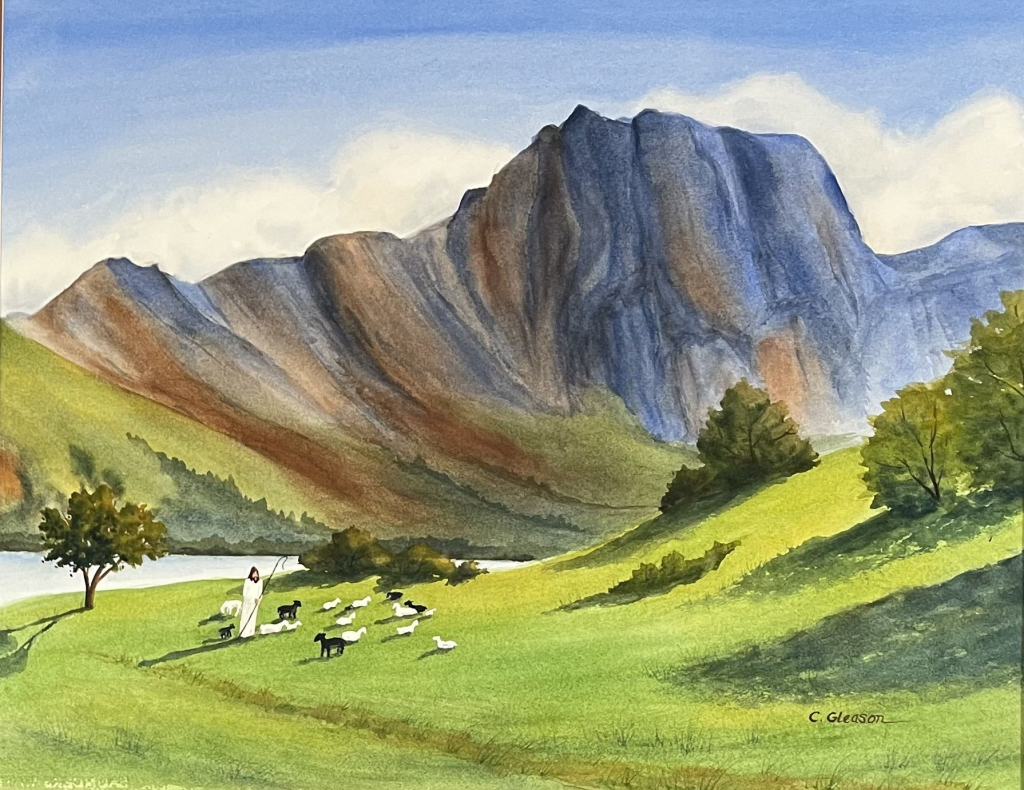
The Lord Is My Shepherd (Psalm 23)

Psalm 23, by Cliff Gleason

The Lord is my shepherd;
    I have all that I need.
He lets me rest in green meadows;
    he leads me beside peaceful streams.
    He renews my strength.
He guides me along right paths,
    bringing honor to his name.
Even when I walk
    through the darkest valley,
I will not be afraid,
    for you are close beside me.
Your rod and your staff
    protect and comfort me.
You prepare a feast for me
    in the presence of my enemies.
You honor me by anointing my head with oil.
    My cup overflows with blessings.
Surely your goodness and unfailing love will pursue me
    all the days of my life,
and I will live in the house of the Lord
    forever. (New Living Translation)

This is one of the best known places in the Bible – even for people who are not religious. And that is for good reason. The psalm is timeless in it’s relating to us in our human condition. It taps into our human need for a compassionate presence, secure protection, and abundant provision. I believe that, most of all, Psalm 23 effectively goes to our inner selves and reminds us of our greatest need: God.

My underlying conviction concerning this wonderful psalm is that the reason we adore it so much is because we humans have an innate primal desire for God. Whether we are consciously religious or not, our deepest longing is for connection with the Divine.

Much of humanity, it seems to me, have repressed this desire. Many people bury this longing underneath multiple layers of other interests and competing desires. Others experience the primal desire for God as a yearning for wholeness, completion, or fulfillment.

Yet, regardless of how particular individuals or groups may frame it, humanity’s basic need is to love and be loved – to move ever closer to the source of love. This inner craving is the essence of the human spirit, and it is captured well in a biblical psalm which pictures a person who settled into the God who is Love.

“Our hearts are forever restless until we rest in God.”

St. Augustine

With Psalm 23, our human longing is spelled out in a mere 50 or so words – we can imagine not only being transported, but also being actually transformed into an enjoyable divine/human relationship, set within an idyllic landscape of settled peace, safety, and strength.

Serenity for our anxious racing thoughts becomes a real hope, for there is a shepherd who protects the human flock and ensures that they have everything they need.

It is understandable that the relationship between God and humans is likened to that of a shepherd and sheep. In reality, sheep need a shepherd. They require someone to look out for them and provide for them. Sheep, in my opinion, are not stupid and clueless; they are skittish animals who only function well if they are non-anxious and at peace.

The presence of a caring shepherd makes all the difference. And, more than that, the shepherd does a myriad of needed things for the sheep that they are not able to do themselves, such as protecting them from wolves, finding adequate pasture to feed upon, and relieving them of the intestinal gas from eating all that grass which would literally kill them without the shepherd’s intervention.

Whereas human shepherds may or may not be faithful in their duties and extend genuine care to the flock, God is always present and loving. Moving to the rich pasture of the New Testament, Jesus is described as the Good Shepherd who will care for and preserve the sheep in every way needed. (John 10:1-21)

Psalm 23, by Cliff Gleason

Indeed, with Jesus as the consummate shepherd, people want for nothing and have everything they need. No wolf can snatch them out of his hand, and the mundane tasks of washing their feet is lovingly done for them. With Jesus, the deep yearning of the inner person becomes satisfied; the soul is restored.

Even the implements of a rod and a staff are used for good, and not for ill. An unfaithful shepherd will likely beat the sheep and berate them, only concerned for fleecing them to sell their wool on the market. But Jesus uses the rod to guide and direct in the way we ought to go, for our benefit and well-being. And the staff – the shepherd’s crook – is benevolently used to rein in the strays who don’t realize how in danger they’re in.

Truly, discipline and encouragement are not mutually exclusive concepts; they instead go together as two forms of loving leadership and care. Only those who take the time and effort to correct another are the ones who really care enough to do so.

In the shepherd’s presence, we can exist with a sense of security, even though there is danger all around us. Our longing for peace, and to be secure within oneself, is not a pipe dream, but a real possibility. To be provided for by God in the face of hard circumstances strengthens faith, awakens hope, and fosters love. It becomes an overflowing feast of the soul.

And this goodness is not fleeting. It can be a continuous present reality. Since God is good, all the time, and there is never a time when God is not good, we are continually and actively pursued and shepherded by goodness and not by harm, all the days of our lives.

The threat of death – and even death itself – cannot thwart the avenues of righteousness from being available to us. We can walk the true path toward inner peace and fulfillment, of genuine connection with God and others, without moral or spiritual harm.

There are good and right paths of life. Those avenues are guarded by a gracious God; they will never be destroyed or damaged. If the psalm is correct, and if my core convictions are right, then there is no longer any reasonable or justified basis for fear.

A good care-taking Shepherd is protecting the flock, and providing the sheep with everything they need. We can live a morally strong, ethically sound, and eminently happy life, without being constantly afraid.

Blessed and Good Shepherd of all, by laying down your life for the flock, you reveal your love for all. Lead us from the place of death to the place of abundant life, so that guided by your care for us, we may rightly offer our lives in love for you and our neighbors. Amen.

One Thing (Psalm 27)

And We Shall Dwell in the House of the Lord, by Dale Terbush

The Lord is my light and my salvation—
    whom shall I fear?
The Lord is the stronghold of my life—
    of whom shall I be afraid?

When the wicked advance against me
    to devour me,
it is my enemies and my foes
    who will stumble and fall.
Though an army besiege me,
    my heart will not fear;
though war break out against me,
    even then I will be confident.

One thing I ask from the Lord,
    this only do I seek:
that I may dwell in the house of the Lord
    all the days of my life,
to gaze on the beauty of the Lord
    and to seek him in his temple.
For in the day of trouble
    he will keep me safe in his dwelling;
he will hide me in the shelter of his sacred tent
    and set me high upon a rock.

Then my head will be exalted
    above the enemies who surround me;
at his sacred tent I will sacrifice with shouts of joy;
    I will sing and make music to the Lord.

Hear my voice when I call, Lord;
    be merciful to me and answer me.
My heart says of you, “Seek his face!”
    Your face, Lord, I will seek.
Do not hide your face from me,
    do not turn your servant away in anger;
    you have been my helper.
Do not reject me or forsake me,
    God my Savior.
Though my father and mother forsake me,
    the Lord will receive me.
Teach me your way, Lord;
    lead me in a straight path
    because of my oppressors.
Do not turn me over to the desire of my foes,
    for false witnesses rise up against me,
    spouting malicious accusations.

I remain confident of this:
    I will see the goodness of the Lord
    in the land of the living.
Wait for the Lord;
    be strong and take heart
    and wait for the Lord. (New International Version)

Just recently, I was reflecting on my vocational life with a friend. I realized that, for the majority of my adult life, I have worked at least two jobs at once. On top of that, for several years, I was also going to school. Even now that I have gotten older and (finally) pared my work life down to just one job, I still work in two different places, complete with different offices and staff.

For us Americans, this is like a badge of honor – that we can demonstrate what hard workers we are. Yet, there is also something quite unhealthy about all this work that leaves room for little else in life. Typically, our relationships suffer. And the relationship which suffers the most is with God.

The psalmist had a singular desire – one thing – that he wanted above all else.

It’s the same thing that the Apostle Paul wanted more than anything else in the world (Philippians 31-14); and the one thing Jesus said to the rich young ruler that he lacked (Mark 10:17-31). It’s the thing that Mary pursued, and the thing Martha neglected (Luke 10:38-42). The blind man discovered the one thing in his healing encounter with Jesus (John 9:1-34).

Perhaps we, especially in the United States, need a miraculous healing, not only from our compulsions toward work, but also from our collective spiritual attention-deficit-disorder. We need to be able to focus on the one thing that is needed above all other things – without any sort of multitasking.

Rather than adding another thing to our calendar, and just trying to work harder, let’s step back and reconnect with what is most important to us. What is your highest priority in life? That question isn’t only for me as an American; it’s for all of us everywhere.

It’s instructive that the one thing the psalmist doesn’t ask for is revenge, or judgment, or, at the least, some comeuppance and protection. Instead, he simply asks this: To dwell in the house of the Lord. That is, the psalmist, David, wants more than anything else to live fully in God’s presence – because when that happens, everything else falls into place.

The inherent nature of God is goodness and beauty. So, to be with God is to be surrounding by what is lovely and good. To be in God’s presence is to relax and know real security.

In this state, we are then able to get our bearings and remember the good deeds of deliverance the Lord has done in the past; the mighty acts of power God will show in the future; and are blanketed in the present with the reality that the world doesn’t cease spinning on it’s axis because I have only one job, or take a break, or turn off my cellphone for a day. I can do it without fear or anxiety because God is with me.

With renewed focus, I can center my schedule, my calendar, my plans, and all my decisions around the surety that God is with me; and that I can enjoy the Lord forever. After all, this is what the Christian season of Advent teaches us – that Jesus, our Immanuel, is God with us, come in the flesh for us and for our salvation. That is the one thing we need to know today.

Ever-present and ever-loving God, we plant the seeds that one day will grow. We water seeds already planted, knowing that they hold future promise. We cannot do everything; and so help us have a sense of liberation in realizing this, so that we are enabled to do one thing very well; to take joy in being part of the process; to see that taking some steps, and then rest, is enough. We see in part, yet you, O Lord, see all things in their entirety. We are open to being, not just doing, no matter that circumstances, through Jesus Christ our Lord. Amen.