When I came to you, brothers and sisters, I did not come proclaiming the testimony of God to you with superior speech or wisdom. For I decided to know nothing among you except Jesus Christ and him crucified. And I came to you in weakness and in fear and in much trembling. My speech and my proclamation were made not with persuasive words of wisdom but with a demonstration of the Spirit and of power, so that your faith might rest not on human wisdom but on the power of God. (New Revised Standard Version)
When it comes to proclaiming the gospel – the good news of Christ’s person and work – both the message and the messenger are important.
The Apostle Paul was dialed in and focused on the Cross of Jesus Christ. Although he could have used various methods of persuasion, he was determined to set aside all other means of proclamation, and declare Christ’s Cross as the message and method itself.
This means that Paul also deliberately faded himself into the background, in order to have the Cross of Christ in the foreground. He emphasized his own weakness, his fear and trembling, in order to highlight the strength and majesty of God.
Paul wanted the messenger to point to the message – which meant that all of his speaking allowed God’s Spirit and power to show itself through him, rather than in spite of him.
The Corinthians came to believe the message not because of a big showy demonstration of Paul’s strength, intellect, and wisdom. Instead, they embraced Christian belief because of spiritual power and effort.
If it is spiritual wisdom and power centered in the message of Christ’s Cross which saves us, then it is also more than good enough to sanctify us, as well, and be the core from which all of the Christian life emanates from.
The Apostle understood that he is God’s agent, God’s ambassador, but that God alone is the One who saves humanity and delivers them from sin, death, and hell.
Christ Carrying the Cross, by Martin Schongauer, c. 1480 C.E.
Paul’s argument doesn’t have anything to do with making sure that the word “cross” is said in every sermon and conversation, or that Christians have only one thing to talk about.
Instead, the Apostle wanted the Corinthian Church to distance themselves from their typical of use of worldly philosophical wisdom, in favor of a distinctly spiritual wisdom which demands a certain kind of ministry:
The cross of Jesus Christ is to be the central event in which all of Christian life and ministry revolves around. In other words, the shape of Christianity is cruciform.
And since the cruciform nature of Christianity is our reality, our wisdom is to be received and flow from the Cross of Christ. To do less is to rely upon a different power other than the distinctive spiritual power of Christ’s death.
It isn’t any one of us which breaks through to another’s spirit; the power of God compels a person to listen, receive the message, and be given faith to believe, grow, and spiritually mature.
When the good news of Christ’s person and work takes root and develops within us, then what comes out of us is spiritual power, and not our own homespun worldly human wisdom.
“Wisdom” is the ability to take a body of knowledge and apply it to concrete situations in life.
So, when it comes to spiritual wisdom, Christians mature in the grace and knowledge of the Lord Jesus; then, they learn to take this important body of knowledge and apply it to all of the various circumstances and situations they are faced with every day.
This isn’t to say that worldly wisdom has no merit or significance, or that it is misguided. Rather, it means that this sort of wisdom doesn’t have the ability, the strength, or the power to move and change us, or others, toward deliverance and new life. We need the wisdom of the Spirit for that. And Paul insisted that this wisdom comes from the Cross of Christ.
The crucifixion of Christ is the wise guide for all of the Apostle Paul’s theology, message, and ministry. That singular event was like a massive meteor hitting the ocean of humanity, with a powerful tsunami of spiritual power and grace still making waves up to this very day.
Indeed, the Cross of Christ impacts all of creation, the entire universe. The person and work of Jesus Christ has cosmic implications for the salvation and deliverance of everything from the grip of evil.
On the practical daily level of things, none of this is about trying to do or be better, to somehow work harder at being a Christian or doing Christian mission and ministry. The fact of the matter is that we can only give to others what we have received from God. This means that:
The Holy Scriptures are to be received with reverence and fear, as a message given for us to learn and know so well that it becomes as familiar to you as the backdoor of your house.
The Christian life is about dying to self, taking up one’s cross and following Christ. If we desire the power of the resurrection, then this will first require embracing and allowing the powerful suffering of the cross to do its work.
Faithfulness is at the heart of living. Our task is to show up, pay attention, and speak the truth in love, and let God use this to accomplish the Divine holy will. Being married to outcomes and consequences will likely lead to reliance upon worldly wisdom, and eventually disappointment.
The Cross of Christ is what everything and everyone hinges upon. The world does not revolve around you nor me. So, let’s get in sync with the Spirit of God and rely upon the cruciform power provided for us by means of Christ’s death.
O God, who for our redemption gave your only-begotten Son to the death of the cross, and by his glorious resurrection delivered us from the power of our enemy: Grant us so to die daily to sin, that we may evermore live with him in the joy of his resurrection; who lives and reigns now and forever. Amen.
He went down to Capernaum, a village in Galilee. He was teaching the people on the Sabbath. They were surprised and impressed—his teaching was so forthright, so confident, so authoritative, not the quibbling and quoting they were used to.
In the meeting place that day there was a man demonically disturbed. He screamed, “Stop! What business do you have here with us, Jesus? Nazarene! I know what you’re up to. You’re the Holy One of God and you’ve come to destroy us!”
Jesus shut him up: “Quiet! Get out of him!” The demonic spirit threw the man down in front of them all and left. The demon didn’t hurt him.
That knocked the wind out of everyone and got them whispering and wondering, “What’s going on here? Someone whose words make things happen? Someone who orders demonic spirits to get out and they go?” Jesus was the talk of the town. (The Message)
During his earthly life and ministry, Jesus was a Deliverer and a Liberator; he came to save people from their guilt and shame, and to free the world from the clutches of evil.
And so, it was inevitable that Jesus would come into conflict with the forces of darkness.
In today’s story, Jesus had a confrontation with an unclean spirit, that is, a demon who is an ally of the devil. The particular demon was not only speaking for himself, but also for his fellow band of wicked spirits.
Christ’s ministry put him in direct opposition to the hosts of Satan. The nub of the issue for the demon was whether Jesus had come for their immediate destruction. Jesus, however, wasn’t in the habit of answering questions from demons.
So, Christ rebuked the demon, told him to get out of the person he was influencing. And that is exactly what happened. The writer, Luke, pointed out that this demonstrated Christ’s authority, that it even includes the power to command unclean spirits, and out they go.
And that is how the liberating and saving ministry of Jesus began.
In the Gospel of Luke, this account of Jesus being confronted by a demon happens just after Christ’s 40 days of being tempted in the desert, even by Satan himself. So, the entire demonic realm was alert to beginning ministry of Christ. They went after Jesus right away, perhaps trying to trip him up before he could get any ministerial momentum.
Jesus was teaching on the Sabbath in the town of Capernaum. We ought not to be surprised that a demonized man was among those observing the Sabbath. The wise believer will be savvy to this reality.
Furthermore, we aren’t told who the man was or of any symptoms he may have had. Apparently, he presented himself as a normal Jewish villager. So, we ought not to think that anyone being demonized will necessarily demonstrate madness or illness of some sort.
The demon was perhaps more aware of who Jesus was than anyone else there on that Sabbath Day in Capernaum. He acknowledged Christ’s power and mission. Jesus indeed came to destroy the power and influence of evil in the world.
You believe that there is one God. Good! Even the demons believe that—and shudder.
James 2:19, NIV
Since Jesus Christ is the rightful authority over all, that means Satan and his wicked spirits are not; and they must submit to that true and real power.
Truth and doctrine are not only about objective facts and right belief. Even though our thinking is important and critical, there is more to it than that: Orthodoxy (right belief) requires orthopraxy (right actions).
A right truth that is only described is not the whole truth. In reality, a false witness and a liar may state the truth, but not entirely, withholding important information; thus, impairing any sort of right action from taking place.
Gaslighting relatives, oppressive bosses, and tyrannical rulers who tell some truth, and even support some good things, are still gaslighting and oppressing others with their narcissistic brand of leadership.
Truly, believers in and followers of Jesus can sometimes be duped into supporting evil leaders who use all sorts of unjust tactics, just because that leader tells the part of truth I want upheld.
Jesus saves; he is Savior of the world – but that is only part of the truth. We must also ask: What has Christ come to save us from? Not just our mistakes, mess-ups, and sins. Christ came to deliver us from the very power of evil that supports injustice and unrighteous behavior to begin with.
If we merely view Jesus as our personal Savior from hell after we die, then we will likely focus almost exclusively on heaven. But if we see all the freedom we need from unhealthy behaviors and unjust ways, then we view Christ as so much more than a fire insurance policy.
We need a more expansive understanding of Christ’s cross. Yes, Jesus died for our sins. Yet, he also died to conquer evil; Christ made it possible for us to become liberated from the shackles of systemic sin and structural evil, as well as personal guilt. In other words, Christ came to topple all evil, and not just human foibles.
And this was why the dark powers of Satan, and his demons, were so afraid of Jesus. They knew their time was short. There is yet another power that has a hold on us today – and that is the reality that many people no longer believe in demons and devils and dark forces.
Since we are a technically advanced people with great understanding of medical science, we now know all sorts of things which cause physical and mental illness. Ancient people did not know about human hormones and chemicals, and the impact of genetic codes on our health. They had no idea about bacteria and viruses, microbes and hygiene.
Therefore, we can jettison all this mumbo-jumbo about demons, right?… Not so much.
Even with all of our modern (and postmodern) explanations for the body and brain, we are still finding ourselves having to contend with the mystery of evil, and the malevolent suffering it causes us.
We modern folk can certainly provide a lot of insight into the cause and effect of particular symptoms a person has according to their biology. And yet, that doesn’t take away the presence of malevolent forces on this earth.
Even with all of our understanding, evil still resides within organizations, institutions, and even faith communities. The meanness and malevolence, the injustice and the ingratitude, and the profound violence (both verbal and physical) which one human being can exact on another is still here – and some would argue that it’s worse than ever.
Knowing something isn’t the same as doing it. If that were true, then education ought to deliver us from evil. Even some intelligent and objective people, who are fluent in facts and figures, still use their calculations for evil.
No matter our creeds or convictions, whether we are religious or not, all of us seem to have a collective sense that this old world of ours is profoundly broken.
All the research dollars in the world has not produced a solution to fix evil. And even if we could completely understand evil, that isn’t the same as ridding ourselves of it.
What’s more, those who put all their trust in changing things through modern means (which means without God) have been some of the worst offenders of producing wars, political tyranny, and gross injustice.
To put all of this perhaps more succinctly in the form of question: We know and understand a lot in combating disease, disaster, and death; but does all of that insight do away with the evil of it? Are things less tragic now?
I argue that is has not. Evil is still evil. Chronic pain, homelessness, poverty, injustice, and health inequities are still wreaking their evil on people.
I believe that evil really does exist, even if it has different language today than it did in the ancient world.
There is real opposition, conflict, and confrontation from evil today. The victory Christ has achieved over the forces of evil has a 2,000 year track record of helping people experience renewed lives, even when their bodies are wasting away.
In the end, the victory of Jesus Christ shall become evident to all the world. Overcoming evil doesn’t come from us, but from God. We can and we must deal with evil in this world. But we are not the Savior or the Liberator.
We need faith in the Son of God who loved us and gave himself for us. Amen.
As the Father has loved me, so I have loved you; abide in my love. If you keep my commandments, you will abide in my love, just as I have kept my Father’s commandments and abide in his love. I have said these things to you so that my joy may be in you and that your joy may be complete.
“This is my commandment, that you love one another as I have loved you. No one has greater love than this, to lay down one’s life for one’s friends. You are my friends if you do what I command. I do not call you servants any longer, because the servant does not know what the master is doing, but I have called you friends, because I have made known to you everything that I have heard from my Father. You did not choose me, but I chose you. And I appointed you to go and bear fruit, fruit that will last, so that the Father will give you whatever you ask him in my name. I am giving you these commands so that you may love one another. (New Revised Standard Version)
We Need Love
The world, in truth, spins on the axis of love. Without love, there is no beauty. Apart from love, we would all be living in a dystopian world of mere survival. But with love, there is life, hope, purpose, and meaning; there is fulfillment, satisfaction, and security. With love, our most basic needs as people are met.
So, love is a word that must be intentionally pursued and valued; because we cannot live without it.
The very word “love” gets used in various and different ways in our world. Jesus used the word in a sacrificial sense – that love willingly gives up one’s life for the benefit of another.
Love is large. It involves the whole person – body, mind, emotions, and spirit. Love in today’s Gospel lesson is used by Jesus as an action. And it’s even more than that. Christ defined love in the Upper Room to his disciples as a willingness to die – not necessarily for a spouse or a child – but for a friend, a fellow follower of Jesus.
It seems that for most Christians, giving up one’s life for another is not at the forefront of our idea of loving another. Yet, to love our neighbor as ourselves does involve the willingness to die so that another may live. To know precisely what this is like, we need look no further than the love which exists within God.
God is Love
Love is seen above all in the love of God the Father shown forth in God the Son. Because God so loves the people of this world, the Father sent the Son, Jesus, to give his life for us. And Jesus, embodying the very love of God, willingly gave himself on our behalf. It hearkens us to Christ’s earlier words about this:
“For God so loved the world that he gave his only Son, so that everyone who believes in him may not perish but may have eternal life.”
Jesus (John 3:16, NRSV)
Just as the Father loved the Son, and the Son loved us, so we are to love others with the same sort of sacrificial love which was graciously shown to us. The Apostle John made this plain in his first epistle:
God’s love was revealed among us in this way: God sent his only Son into the world so that we might live through him. In this is love, not that we loved God but that he loved us and sent his Son to be the atoning sacrifice for our sins. Beloved, since God loved us so much, we also ought to love one another. (1 John 4:9-11, NRSV)
Therefore, it is our privilege and responsibility to abide in this divine love and let it fill us to the full, so that God’s love moves powerfully in us and through us, for the life of the world.
Remain in Love
Love is the end result of an abiding relationship and close connection between Christ and his followers. We are to remain in the love of Christ, just as Christ remains in the love of God. Jesus asks nothing of us that he has not already modeled for us in his sacrificial service to the world. Living in union with Christ, loving Jesus, and keeping God’s commands are all a single package, bound up together in a mutual relationship.
We don’t need to wonder what God wants for us and from us: Love. The commands of Jesus are not general; they are focused and specific. Christ commands that we love one another. Our continuing work on this earth is to keep on loving people as Christ has loved us and gave himself for us.
No Greater Love
There is no greater love than that shown in the giving of one’s life for one’s friends. The power of God’s love is focused in Christ. It is confirmed in Christ’s resurrection from death. And it flows from Christ giving his life on the cross for us.
Yes, Christians are servants who are committed to serving others with sacrificial love. Yet, the disciples and all those who follow Christ are much more than servants; they are considered primarily as friends of Jesus.
Through the cross and resurrection of Christ, believers have discovered the divine power of love. There is no greater love than this. And it is this sort of love that binds Christians together as united in their mission to love as Jesus loved them.
We have been called, chosen, and appointed by Jesus to embody love’s mission and purpose. What’s more, we are equipped for the active work of love.
Whatever You Ask in Love
The very name of Jesus is love itself. So, whatever you ask, “in my name,” said Jesus, “the Father will give you.”
Because Christians are united to Christ, they are to remain in and abide with Christ. This relational connection opens up the power of prayer. And the content of those prayers – if we are truly in Christ – will always come from a place of love, be directed to love, and go to great lengths to accomplish love.
Prayer is an activity which is grounded in the abiding relationship of Father, Son, Spirit, and the Christian community. Love directs our prayers. And prayers are directed toward the action of love.
A confidence in the power of prayer is an abiding trust in the power of Love. With love animating our prayers and infusing our service, we are bold to ask God for what is right, just, and good in this world. Indeed, we pray that we will give love to each other with the love we have received from God.
Love and Joy
Being called and appointed by God to love is a privilege and a joy. There isn’t any begrudging service when love is involved. Perhaps one of the greatest prayers we can pray is to pray that our hearts be filled with love. If you don’t feel love for others, then pray for it. And be assured that you will receive it.
Love and joy go together like mashed potatoes and gravy, peanut butter and jelly, grits and honey. We know we are loving others if our joy is complete in doing so.
Jesus came to this earth so that we might experience an overflowing life of abundant love and joy. Christ longs for his joy to be in us, and for us to abide in his love. Our joy comes from knowing that we have been loved by God – chosen, called, and sent out into the world with love and for the purpose of love.
And it is this divine love that has the power to renew and transform everything – even the most troubling and stubborn of people and problems that you are presently facing. Indeed, if love is not the answer, then you are not asking the right question.
Creator God, by the mercies of your son, our Lord, Jesus, compel us to turn our hearts to his way of Love, so that we might follow Christ together as your faithful people. Dear Jesus, guide us in your way. Amen.
Today’s Gospel lesson encompasses the full two chapters of events surrounding the arrest, torture, crucifixion, and death of Christ. Jesus died not only for white European heritage persons (like me) but for people of all races and ethnicities everywhere. And so, it is good and appropriate that the following comes from the First Nations Version: An Indigenous Translation of the New Testament.
Every English translation of the Bible is accomplished by people translating from their own cultural perspectives and understandings. This particular translation comes through the cultural lens of American Indigenous peoples. And, in my view, this is a much needed addition to the many versions of the Bible now in print.
We have so many various translations, because we deem Holy Scripture important enough to be translated for all of the various peoples who exist – with all of their particular societal assumptions, and angles on spirituality.
So, please read this slowly, out loud if you can, and let the redemptive events of Jesus be seen in a way that will help your own understanding of Christ and his loving sacrifice for the whole world. This is Good Friday…
When he finished sending up his prayers, he and the ones who walked the road with him walked across the Valley of Darkness (Kidron) and entered a garden with many olive trees.
Speaks Well Of (Judas), the betrayer, knew about this place because Creator Sets Free (Jesus) would often go there with his followers. The betrayer came into the garden, and with him came a band of lodge soldiers sent from the scroll keepers, head holy men, and Separated Ones (Pharisees), representing the elders of the Grand Council. The air was filled with the smell of burning torches as they entered the garden carrying clubs and long knives.
Creator Sets Free (Jesus) knew all this would happen, yet he turned to the soldiers and asked, “Who have you come for?”
With one voice they answered back, “Creator Sets Free (Jesus) from Seed Planter Village (Nazareth)!”
The betrayer, Speaks Well Of (Judas), was standing there with the lodge soldiers when Creator Sets Free (Jesus) answered, “I am he!”
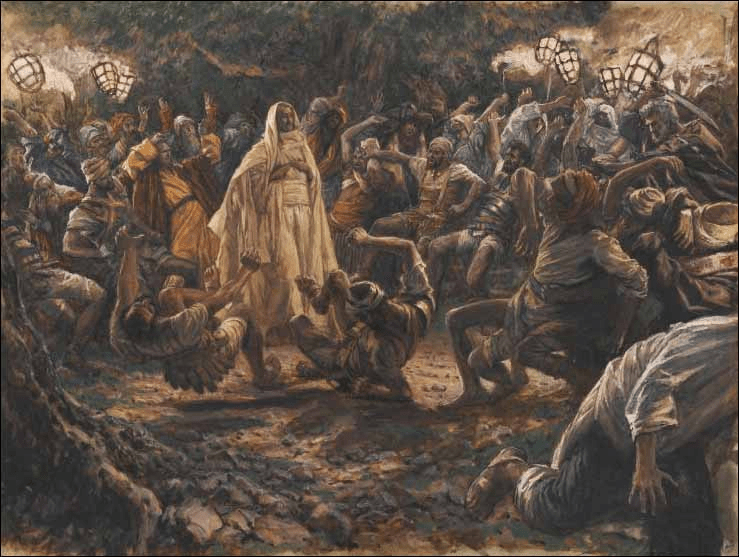
The Guards Falling Backwards, by James J. Tissot (1836-1902)
At the sound of his voice they all moved back and fell to the ground.
He asked them again, “Who have you come for?”
They answered, “Creator Sets Free (Jesus) from Seed Planter Village (Nazareth).”
“I told you already, I am the one you are looking for,” he said, “Let these other men go.”
He said this to fulfill his promise, “None of the ones you gave to me have been lost.”
Right then, Stands on the Rock (Peter) drew his long knife from its sheath and cut off the right ear of the servant of the chief holy man. The servant’s name was Chieftain (Malchus).
Creator Sets Free (Jesus) turned to Stands on the Rock (Peter) and cried out, “Enough of this! Put your long knife back into its sheath. Shall I not drink the cup of suffering my Father has asked of me?”
The lodge soldiers, along with their head soldier and the Grand Council representatives, the took hold of Creator Sets Free (Jesus), tied him securely with cowhide strips, and took him first to Walks Humbly (Annas), one of the high holy men. He was the father of the wife of Hollow in the Rock (Caiaphas), the chief holy man who had advised the Grand Council by saying, “It will be better if one man dies for all the people.”
Stands on the Rock (Peter) and one other follower had been watching from a distance. Since this follower was known by the chief holy man, he entered the courtyard of the house. But Stands on the Rock (Peter) stood outside the gate. This follower spoke to the gatekeeper, a young woman, who then let Stands on the Rock (Peter) in.
The Denial of St. Peter, by Gerard Seghers, c.1620
She said to him, “Are you not one of his followers?”
“No!” he told her, “I am not.”
The night was growing cold, so some of the men, along with the solider guards from the lodge, built a fire in the courtyard to keep warm. Stands on the Rock (Peter) stood there with them, trying to stay warm.
Back inside, the chief holy man began to question Creator Sets Free (Jesus) about his followers and his teachings. Creator Sets Free (Jesus) said to him, “I have spoken openly to all, in the gathering houses and the sacred lodge. I said nothing in secret. Why ask me? Ask the ones who heard me. They will know.”
One of the head soldiers struck him in the face and said, “Is that how you answer a chief holy man?”
Creator Sets Free (Jesus) answered him back, “If I have spoken wrongly, tell what I said wrong. If I spoke what is true, then by what right do you strike me?”
Walks Humbly (Annas) decided to send Creator Sets Free (Jesus) to Hollow in the Rock (Caiaphas), the chief holy man. So they took him, still bound by ropes, to Hollow in the Rock (Caiaphas).
Outside in the courtyard, Stands on the Rock (Peter) was still warming himself by the fire. The other asked him, “You are not one of his followers, are you?”
“No!” Stands on the Rock (Peter) denied. “I am not!”
One of the servants of the chief holy man, a relative of the man whose ear had been cut off, looked at him, and said, “Yes, you are! I saw you in the garden with him!”
Stands on the Rock (Peter) shook his head in denial – and right then a rooster began to crow.
Creator Sets Free (Jesus) was taken from the house of Hollow in the Rock (Caiaphas) to the lodge of the governor of the People of Iron (Romans). The tribal leaders stayed outside, for they did not want to become ceremonially unclean by going inside. It was early in the morning, and many of them had not yet eaten the ceremonial meal of Passover.
Spear of the Great Waters (Pilate) came outside to meet them.
They took Creator Sets Free (Jesus) and stood him before Spear of the Great Waters (Pilate). He took a good long look at him, then turned back to the crowd.
“What has this man done wrong?” he asked them.
“If he were not a criminal, would we have brought him to you?” they answered.
“Take him away!” Spear of the Great Waters (Pilate) said to them. “Use your own law to decide what to do.”
“Our tribal law will not permit us to put him to death,” they answered.
This proved that Creator Sets Free (Jesus) was right when he told them how he would die – by being nailed to a tree-pole – the cross.
Christ Before Pilate, by Duccio di Buoninsegna, 1310
Spear of the Great Waters (Pilate) went back into his lodge and had Creator Sets Free (Jesus) brought to him, so he could question him in private.
Once inside, he said to him, “Are you the chief of the tribes of Wrestles with Creator (Israel)?
“Is this your question,” Creator Sets Free (Jesus) asked, “or are you listening to others?”
“I am not from your tribes,” Spear of the Great Waters (Pilate) answered. “It is your own people and their head holy men who have turned you over to me. What have you done?”
“My way of ruling is a good road. It is not in the ways of this world. If it were, my followers would have fought to keep me from being captured.”
“So, then, you are a chief,” he said back to him.
“It is you who have said it,” Creator Sets Free (Jesus) answered. “I was born for this and have come into the world for this purpose – to tell about the truth. The ones who belong to the truth will listen to my voice.”
Spear of the Great Waters (Pilate) shook his head and said, “What is truth?”
Then Spear of the Great Waters went outside to the tribal leaders and said to them, “I find no guilt in this man. By your own tradition we set free one criminal during your Passover Festival. Do you want me to release Creator Sets Free (Jesus), your chief?”
“No! Not him,” the crowd roared back. “Release Son of His Father (Barabbas)!”
Son of His Father (Barabbas) was a troublemaker who had caused an uprising.
Spear of the Great Waters (Pilate) turned Creator Sets Free (Jesus) over to his soldiers to have him beaten. The soldiers twisted together a headdress from a thorn bush, pressed the thorns into his head, and wrapped a purple chief blanket around him. They bowed down before him, making a big show of it, and kept mocking him, saying, “Honor! Honor to the Great Chief of the tribes of Wrestles with Creator (Israel).”
Christ Mocked by Soldiers, by Georges Rouault (1871-1958)
They took turns hitting him on his face until he was bruised and bloodied.
Spear of the Great Waters (Pilate) stood before the crowd again and said, “I bring to you the one in whom I have found no guilt.”
Creator Sets Free (Jesus) was brought forward, blood flowing down his bruised face. He was wearing the headdress of thorns and the purple chief blanket that was wrapped around him.
“Behold the man!” Spear of the Great Waters (Pilate) said to them, “Take a good long look at him!”
The crowd stared at him in stunned silence.
But then the head holy men and the lodge guards began to shout, “Death! Death on the cross!”
“Then take him and kill him yourselves,” Spear of the Great Waters (Pilate) said to them. “I find no guilt in him!”
They answered him back, “Our law tells us he must die, for he has represented himself as the Son of the Great Spirit.”
When Spear of the Great Waters (Pilate) heard this, his fear grew stronger, so he took Creator Sets Free (Jesus) back inside his lodge.
“Who are you, and where are you from?” he questioned him.
Creator Sets Free (Jesus) stood there and remained silent.
“Speak to me! Do you not know I have the power of life and death over you? I can have you killed or set you free,” he warned him. “Have you nothing to say?”
“The only power you have is what has been given you from above,” he answered. “The ones who turned you over to me carry the greater guilt.”
Spear of the Great Waters (Pilate) tried harder to have Creator Sets Free (Jesus) released, but the people would not have it.
They stood their ground, saying, “If you release a man who says he is a chief, you are not honoring the ruler of your people, for anyone who claims to be a chief challenges his power.”
When Spear of the Great Waters (Pilate) heard this, he took Creator Sets Free (Jesus) and went to the Stone of Deciding, called Gabbatha in the tribal language, and sat down. It was now midday on the Day of Preparation for the Passover Festival.
He brought Creator Sets Free (Jesus) before the people and said, “Here is your chief.”
“Take him away! Take him away!” the crowd shouted with one voice. “Nail him to the cross!”
“Would you have me nail your chief to the cross?” he asked them.
This time the head holy men answered back, “We have no other chief than the Ruler of the People Iron (Caesar).”
Spear of the Great Waters (Pilate) then turned Creator Sets Free (Jesus) over to the soldiers to have him put to death on a tree-pole – the cross – so they took him away.
The cross was an instrument of torture and terror used by the People of Iron (Romans) to strike fear into the hearts of any who dared to rise up against their empire. The victim’s hands and feet would be pierced with large iron nails, fastening them to the cross. The victims would hang there, sometimes for days, until they were dead. This was one of the most cruel and painful ways to die ever devised by human beings.
The soldiers placed a wooden crossbeam on his back and forced him to carry it to the place where he would be executed.
Creator Sets Free (Jesus) carried the crossbeam to the Place of the Skull, which is called Golgotha in the tribal language. There they nailed his hands and feet to the cross, along with the two others, and placed his cross between the two of them.
Spear of the Great Waters (Pilate) fastened a sign to the top of the cross where they attached the crossbeam with these words written on it:
CREATOR SETS FREE
FROM SEED PLANTERS VILLAGE
CHIEF OF THE TRIBES
OF WRESTLES WITH CREATOR
This was near Village of Peace (Jerusalem). So that many of the Tribal Members could read it, the sign was written in Aramaic, their tribal language, but also in Latin and Greek, the languages of the People of Iron (Romans).
The chief head holy men and the tribal leaders said to Spear of the Great Waters (Pilate), “Do not write ‘chief of the tribes.’ Instead write, ‘He said he is chief.’”
But he answered, “What I have written will stand.”
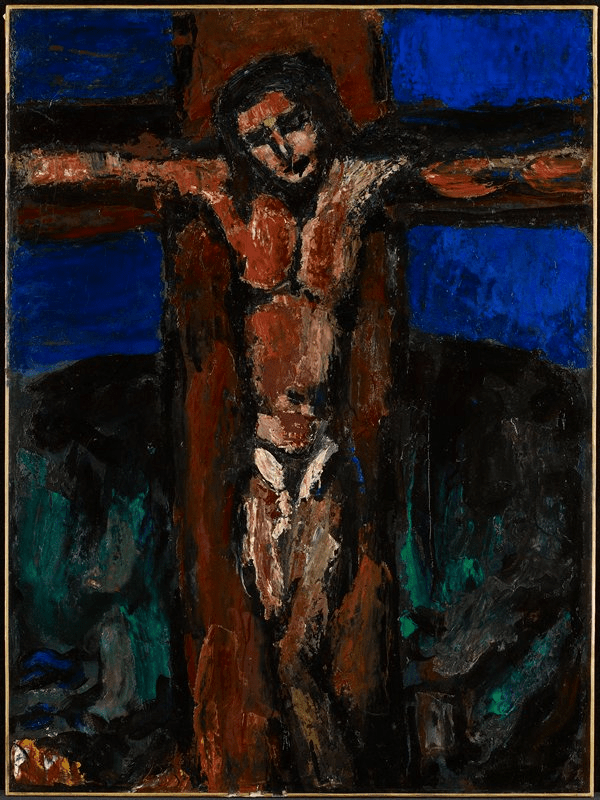
The Crucifixion, by Georges Rouault
The soldiers stripped his clothes from him when they nailed his hands and feet to the cross. They tore one of his garments in to four pieces, one for each guard. His long outer garment was woven together into one piece, so they said, “Let us not tear this, we can draw straws for it.”
This gave full meaning to the Sacred Teachings that said, “They divided my clothes between them and gambled for my garment.” This is what the soldiers did as they kept watch over Creator Sets Free (Jesus).
Standing near the cross was Bitter Tears (Mary), the mother of Creator Sets Free (Jesus), who had come to see him, along with her sister. Two other women also came with her, Brooding Tears (Mary) the wife of Trader (Clopas), and Strong Tears (Mary) from Creator’s High Lodge (Magdala). He Shows Goodwill (John), the much loved follower of Creator Sets Free (Jesus), was also there with them.
When Creator Sets Free (Jesus) looked down and saw them, he said to his mother, “Honored woman, look to your son.” The he said to his follower, “Look to your mother.”
From that time the follower took Bitter Tears (Mary) into his family and cared for her.
Creator Sets Free (Jesus), knowing he had done all the ancient Sacred Teachings had foretold, said, “I thirst.”
There was a vessel of sour and bitter wine standing nearby. One of the soldiers dipped a cloth in it to soak up some wine. He wrapped the cloth around the tip of a hyssop branch and held it up to the mouth of Creator Sets Free (Jesus).
He then tasted the bitter wine, turned his head to the sky and cried out loud, “It is done!”
He then lowered his head to his chest and, with his last breath, gave up his spirit.
Creator Sets Free (Jesus) was dead.
Soon the sun would set and a special Day of Resting would begin when no work could be done. It was time to prepare for this day, so the Tribal members asked Spear of the Great Waters (Pilate) to have the legs of the men on the crosses broken, which would make them die sooner. Then they could take the bodies down and prepare them for burial.
The soldiers came and broke the legs of the two men on each side of Creator Sets Free (Jesus). When they came to him, they saw he was already dead. Instead of breaking his legs, one of the soldiers took a spear and pierced his side. Blood and water flowed out from the wound.
The one who saw these things with his own eyes is telling the truth about this – so that all will believe. This was foretold in the ancient Sacred Teachings that say, “Not one of his bones was broken,” (Psalm 34:20) and, “They will look upon the one they have pierced.” (Zechariah 12:10)
Christ being lifted by Joseph of Arimathea and Nicodemus, by Antonio Canova (1757–1822)
He Gets More (Joseph) from High Mountain (Arimathea), a man with many possessions, was a follower of Creator Sets Free (Jesus), but in secret, because he feared the tribal leaders. Since it would soon be sunset, when the Day of Resting would begin, he went to Spear of the Great Waters (Pilate) and asked permission to remove the body of Creator Sets Free (Jesus) from the cross.
Spear of the Great Waters (Pilate) released the body to him. So he and another man, Conquers the People (Nicodemus), who had come to Creator Sets Free (Jesus) in secret at night, took his body away to prepare it ceremonially for burial. Conquers the People (Nicodemus) had brought a mixture of myrrh and oils weighing about seventy-five pounds. Together they ceremonially wrapped his body for burial in the traditional way, using strips of cloth and herbal spices and oils.
So because it was the Day of Preparation for the Passover Festival, and the day of resting was about to begin, they laid the body of Creator Sets Free (Jesus) in a nearby burial cave that had never been used and then returned to their homes.











 Rev. Tim Ehrhardt