Work and Family (Psalm 127)

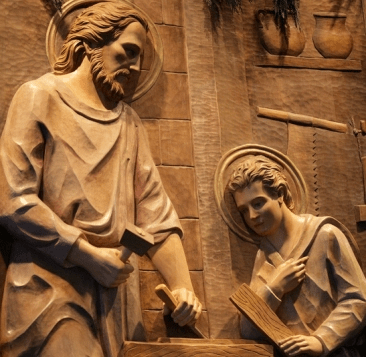
The Carpenter’s Son, Holy Cross Chapel, Houston, Texas

Unless the Lord builds the house,
    those who build it labor in vain.
Unless the Lord guards the city,
    the guard keeps watch in vain.
It is in vain that you rise up early
    and go late to rest,
eating the bread of anxious toil,
    for he gives sleep to his beloved.

Sons are indeed a heritage from the Lord,
    the fruit of the womb a reward.
Like arrows in the hand of a warrior
    are the sons of one’s youth.
Happy is the man who has
    his quiver full of them.
He shall not be put to shame
    when he speaks with his enemies in the gate. (New Revised Standard Version)

God is the Creator. We humans are creatures, created in the image and likeness of God. Therefore, we are inextricably tied to God, and quite dependent upon the Lord.

For the activities of our daily human life, we need God. When it comes to establishing a home, protecting our community, daily work, and raising children, we very much need God’s help to do all of this in a way that is successful and good.

Unless God is with us, in the center of all that we do, then our work in building a good life shall be in vain. How we go about living our lives with work and family, and who we look to as role models, makes a significant difference in the quality and effectiveness of our labor and relationships.

When my wife was growing up, her family had a prominent portrait of John Wayne in the living room above the television. That picture spoke volumes about the family ethos. They had horses and loved to ride and enjoy the outdoors. Hard work was a daily reality of life, as well as a rugged individualism that often suppressed all else in order to engage in work. 

Doing your best, striving for excellence, and learning responsibility are good things that mature people do every day. Yet, there is a fine line between hard work that provides and enriches, and lonely work that is frenetic and fueled by anxiety about the future.

The motives behind why we burn the candle at both ends are just as important to the Lord as the work itself. The psalm for today is a wake-up call for us to consider the frenetic pace of work and family life.

If we independently believe that our life is in our own hands, and we work with a worry that animates our every task, then we have lost touch with the understanding that it is God who ultimately provides us with every good thing in life. 

However, if we begin to relax and let go of our stubborn independent streak, then we work hard with the strength God gives. We let the Lord watch over us.

Trusting God in our work is connected to children being a heritage from the Lord. In the ancient world, children worked alongside their parents. Fathers and mothers did not go it alone – work was a family affair, as well as a community endeavor. 

Whenever we slip into a groove of worshiping individualism, rather than simply taking personal responsibility, then we must come back to the inter-dependence we were designed for as created human beings. 

The ethos the psalmist espoused is trust in God, reliance on others, and working together for the common good of all. 

Here are a few ways of working together and not carrying the load of work on our own:

Ask for what you want and need to accomplish the task. Whenever we don’t ask, we inevitably go the route of hustling for help through manipulation, guilt, and shaming others.

If someone says, “no,” simply ask another person or persons. Asking once just won’t do. And neither is commanding others to get things done. We have the ability to ask calmly, confidently, and compassionately. Accept the “no” which you might get, without retreating back to manipulation. This is especially needful when it comes to asking family members.

Ask God to help you in your work. Each day as I enter the hospital for which I am a Chaplain, I say a prayer, “God almighty, blessed Father, Son, and Spirit, please go before me, with me, and after me to each patient, their family members, and every team member I encounter today, with the love and compassion of Jesus Christ.”

Delegate, if possible. This is not the same thing as barking orders. Delegating is a realization that we are finite creatures with limitations of time, energy, and resources. It’s okay to share the load with others. In fact, most people are more than willing to help, if we but ask. It enables them to feel needed and important.

Be vulnerable and gracious. We all mess up our work, at times. And it’s important to own mistakes without heaping unnecessary criticism on ourselves, or others. Offering an apology, recognizing that you’ve bit off more than you can chew, and admitting your lack of energy are healthy, not sinful. Also, whenever others fall short of their responsibilities, it’s our job to handle it with grace – seeking to understand and help, rather than criticize and judge.

Working together, consulting, collaborating, and engaging in fellowship enable us to speak with those who may oppose, misunderstand, or misinterpret us. It’s also a more joyful way to live.

Sovereign God, you created all things and in you everything holds together. Preserve me with your mighty power that I may not fall into disconnection with you and others, nor be overcome by anxiety. In all I do direct me to the fulfilling of your purpose, through Jesus Christ my Lord. Amen.

The Tower of Babel (Genesis 11:1-9)

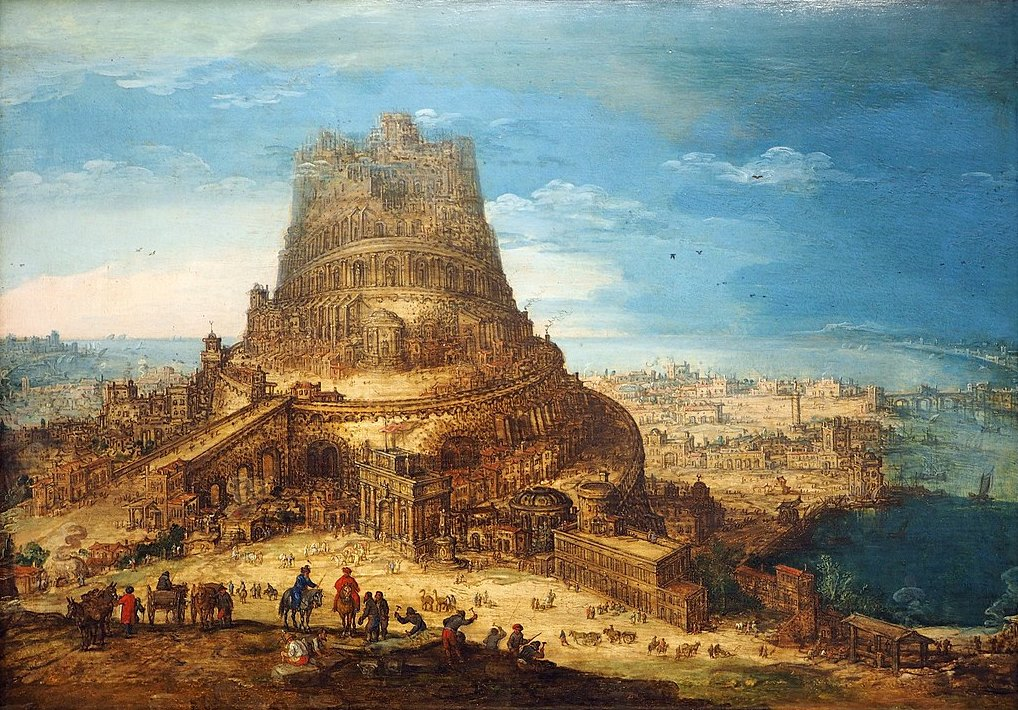
The Tower of Babel, by Hendrick van Cleve III (1525–1589)

At one time, the whole Earth spoke the same language. It so happened that as they moved out of the east, they came upon a plain in the land of Shinar and settled down.

They said to one another, “Come, let’s make bricks and fire them well.” They used brick for stone and tar for mortar.

Then they said, “Come, let’s build ourselves a city and a tower that reaches Heaven. Let’s make ourselves famous so we won’t be scattered here and there across the Earth.”

God came down to look over the city and the tower those people had built.

God took one look and said, “One people, one language; why, this is only a first step. No telling what they’ll come up with next—they’ll stop at nothing! Come, we’ll go down and garble their speech so they won’t understand each other.” Then God scattered them from there all over the world. And they had to quit building the city. That’s how it came to be called Babel, because there God turned their language into “babble.” From there God scattered them all over the world. (The Message)

At first glance, the Bible reader may wonder what the big deal is about people coming together to build a tower.

A mere cursory look at the text might seem as if God is having some sort of divine anal-retentive moment of control. After all, the people are just trying to get some work done; it’s not like they’re going to somehow invade God’s privacy with a very tall tower.

But that’s not what was going on, way back there several millennia ago. Something more subversive was afoot, and the Lord was completely savvy to what was happening.

The previous chapter (Genesis 10) presents a rather orderly spread of the burgeoning humanity across the earth – which is consistent with God’s original blessing and mandate at the creation of people:

“Prosper! Reproduce! Fill Earth! Take charge!
Be responsible for fish in the sea and birds in the air,
    for every living thing that moves on the face of Earth.” (Genesis 1:28, MSG)

Yet, here in Genesis 11, people have intentionally stopped discovering the earth. It appears they are more curious about heaven. So, they amassed themselves together and decided to move vertically rather than horizontally across the world.

There seems to have been a great deal of human ambition that was eyeing an assault and takeover of the divine realm, instead of busying themselves with their God-given human realm. Another way of putting it is that they were irresponsible – not caring for creation – but more concerned about having some leverage on God.

Ambition, in and of itself, is neither good nor bad; it’s where that ambition is aimed. And the early people were directing their sights up rather than out – trusting in their human ingenuity and technological abilities to achieve autonomy for themselves.

Because God created humans in the divine image and likeness, people were (and still are!) amazing creatures who can accomplish incredible feats of achievement in whatever they set their minds and hearts to do. Yet, in the case of constructing a tower (or ziggurat) humanity was ignoring their mandate to care about the earth and its inhabitants. Instead, they were working their own will to build a name for themselves, apart from God.

So, the Lord stepped in by confusing their common language so that they would have difficulty communicating with one another. On the surface, it might seem that God was being capricious. But examining just a bit deeper, we can observe what would happen if people threw off their responsibility to the planet and all of its creatures.

The entire world could be subject to terrible inattention. Much like a backyard garden that becomes overrun with weeds due to neglect, the whole earth was in jeopardy of falling into a system of evil that would care nothing for its abundant life and intricate ecosystems. In short, the earth could be ruined.

If this sounds eerily like what we humans are doing today, its probably because that is precisely what we are doing – putting a collective stiff-arm to God and doing whatever the heck we want in exploiting the earth for our own human purposes.

Never mind that entire species of fish and animals, along with flora and fauna and forests and wetlands and grasslands are being harmed and destroyed by so called human ingenuity and technological advance.

It is our own arrogant pride and hubris of abject selfishness, in setting up ourselves as masters of the universe, that brings us to the edge of an environmental holocaust – not to mention fighting amongst ourselves about who will be in charge and in control of it all. We’ll engage in wars and atrocities if that’s what it will take.

Therefore, the Tower of Babel is a symbol of all that is wrong – not right – with humanity. Until we can unlearn our ancient ways of arrogance and injustice, ignorance and lack of awareness, and recover even older ways of caring for one another and the earth, then we will find ourselves being broken by the divine gravity of judgment which exists whenever people choose to defy the order of the world.

In many ways, primeval history remains alive in our daily current events. Yet, it can change. But it will take a heavy dose of humility and confession of guilt to begin undoing the harm we have imposed on others and on our world. And it will take a return to Eden, to the responsibility of creation care, and of healthy relational connections with both other people and God.

Every one of us is culpable – whether we have been directly involved in systemic evil, or not. We all have participated in and benefited from our privilege as human beings living on this planet – sometimes to the extent of turning a blind eye to the great needs of the earth and its inhabitants.

So, what will you do about it? Who will you turn to? Where does your ultimate trust rest? Are you willing to work for good, to be merciful, just, kind, and loving in a pursuit of right relationships with God, others, and the earth?

Sovereign Lord and Creator, renew our spirits and cleanse our hearts. Renew our minds and transform our lives. Renew our cities and rebuild our ruins. Renew our world, in your name we pray, Amen.

Our Creator and Sustainer (Psalm 104:24-34, 35b)

Our Lord, by your wisdom
    you made so many things;
the whole earth is covered
    with your living creatures.
But what about the ocean
    so big and wide?
It is alive with creatures,
    large and small.
And there are the ships,
    as well as Leviathan,
the monster you created
    to splash in the sea.

All of these depend on you
    to provide them with food,
and you feed each one
with your own hand,
    until they are full.
But when you turn away,
    they are terrified;
when you end their life,
    they die and rot.
You created all of them
    by your Spirit,
and you give new life
    to the earth.

Our Lord, we pray
that your glory
    will last forever
and that you will be pleased
    with what you have done.
You look at the earth,
    and it trembles.
You touch the mountains,
    and smoke goes up.
As long as I live,
I will sing and praise you,
    the Lord God.
I hope my thoughts
    will please you,
because you are the one
    who makes me glad…

With all my heart
I praise you, Lord!
    I praise you! (Contemporary English Version)

In the wake of the Day of Pentecost, we are reminded by the psalmist that the Spirit was not only involved in forming the church, but was already experienced in forming creation. Everything about the Spirit’s work at the origins of the earth was immensely good, wonderfully complex, and intricately interrelated. Indeed, it all reflects the wisdom and majesty of God.

According to the psalmist, God is the Creator and is therefore sovereign over all of this vast dominion of earthly space and ecological systems. We humans are workers in this ordered world; and created in God’s image and likeness as the Lord’s vice-regents over this incredible domain. Humanity is thus both intimately connected with and distinctly separate from all the rest of the world.

This sustaining force of God includes gracious, loving, and compassionate guidance. Everything holds together and has its meaning within God. The breath of God – the Spirit – gives life to both our physical and spiritual selves.

The psalmist paints a picture of creation as full of life – with life itself as the highest expression of its purpose. Our delight in living and being comes from a profound connection with the Creator, Sustainer, and Guide of the universe.

Because of humanity’s deep connection with God and the rest of creation, everything we do as people on this earth impacts God and God’s big world. Every human action exerts an influence. Theology, anthropology, and ecology all exist with complex interconnectedness. God, people, and the world are bound to each other. Since God is relationship itself, relational connection is built into all creation.

Humanity is the apex and climax of God’s creative activity; yet, at the same time, we are but one piece within this intricate whole of creation. We humans are tasked by God to serve the earth and care for it – not to rule in such a way that exploits its grand resources, but to maintain and strengthen the existing connected systems of the earth.

This means we are meant to think of the common good of all earth’s citizens, as well as to consider future generations, and equip them to steward our vast world with practical wisdom and spiritual sensitivity.

Everything that brings disconnection, and thus harm, is to be weeded out and discarded. Wickedness, injustice, oppression, exploitation, unrighteousness, and arrogance are to be purged from the good earth, so that all creatures great and small can thrive and enjoy what God has provided.

Even the seemingly uncontrollable elements of this world – sea monsters and leviathans, chaos and evil – are ultimately subject to the sovereign God of this realm. It is the Lord who brings order from chaos, life from death, and calms the churning waters – quieting all of those ancient leviathans which cause so much of a stir.

It would be great if everyone everywhere found joy in their lives, brought God joy, and enjoyed being with everyone else and caring for all creation. Yet, those chaotic disconnecting powers are there – causing harm and division, splitting that which is designed to be connected, and disrespecting the inherent goodness of God’s image bearers and God’s world.

By being in harmony and in sync with God’s Spirit, we can work together against wickedness and not separate or dismantle what God has built and joined. Through our spiritual awareness, we can help, and not harm. In maintaining our proper spiritual connections, we can be agents of upholding the good, the right, and the just; and not underhandedly undermining God’s sovereignty.

Let us then offer our hallelujahs; our praise, adoration, and gratitude, to God who is the source of life. Because it’s awfully hard to be bad when you’re being good.

May you be able to say with the psalmist – and with all creation, including the trees and even the rocks – that with my whole heart I praise you, almighty God, Creator and Sustainer of heaven and earth.

And may your prayers be pleasing to the Lord and be full of mercy and love. Amen, amen.

You Have Inherent Worth (Genesis 2:4b-7)

Elohim Creating Adam, by William Blake, 1795

In the day that the Lord God made the earth and the heavens, when no plant of the field was yet in the earth and no vegetation of the field had yet sprung up—for the Lord God had not caused it to rain upon the earth, and there was no one to till the ground, but a stream would rise from the earth and water the whole face of the ground—then the Lord God formed man from the dust of the ground and breathed into his nostrils the breath of life, and the man became a living being. (New Revised Standard Version)

The word “Genesis” comes from the Septuagint, an ancient Greek translation of the Old Testament, and means “origin.” The first book of the Bible does indeed have to do with origins. And in the early chapters, Genesis addresses the origins of the earth and all it’s life and systems, including humans.

Genesis 1 is a poetic account of those origins. Genesis 2-3 provide a complementary narrative account of creation and the beginning of the world. These three chapters together affirm the inherent goodness of all creation, as well as how complex it all truly is.

God is the Creator of the earth and humanity. The original man, Adam, is a name transliterated from the Hebrew adamah, which means ‘ground’ or ‘dirt/dust.’ This relationship between Adam and the literal dirt of the planet is the basis for humanity’s special relationship with the land and taking good care of it as a proper steward of the earth. In the beginning, working the actual ground was set up as a blessing.

We are living creatures, having been given breath (Hebrew nephesh). Along with all the living breathing animals on this earth, we share a basic creaturehood and are thus connected with each other. In addition, only people are formed in God’s likeness and enjoy a special relationship with the Lord in being God’s image-bearers. (Genesis 1:27)

God created you and me as good. The Lord has made provision for us to glorify God, and to be successful in doing the Lord’s will. People who are ineffective in living out their spiritual lives are persons who do not know the truth about themselves. 

Both truth and error are powerful. If people are misguided about who they are, then they become like empty wells with no water to draw from. Many of our problems, failures, and shortcomings are largely due to a misunderstanding of our basic personhood. 

A profound result of this misunderstanding is a lack of self-worth. Whenever we are in error about who we really are, we have automatically limited ourselves to what we can do in our lives. Comparing ourselves to others is not helpful; nor is trying to simply gin-up good feelings about ourselves. 

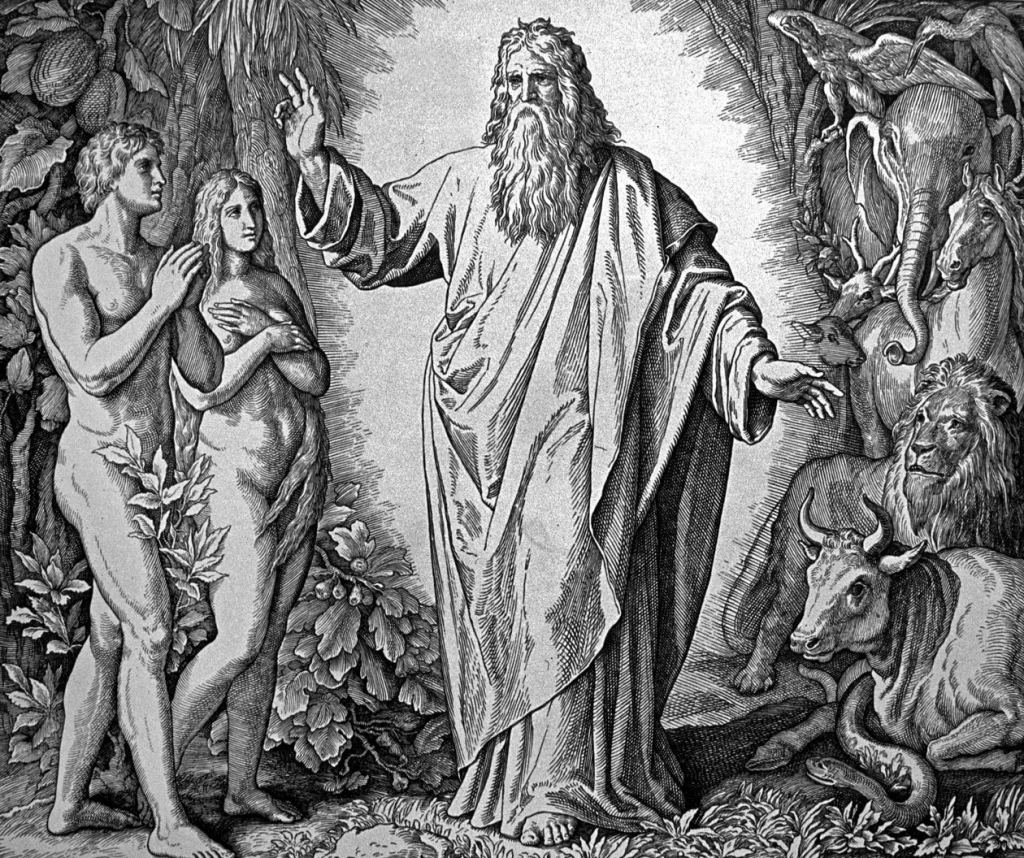
God Creates Adam and Eve, by Julius Schnorr von Carolsfeld (1794-1872)

Only by accepting who we truly and really are, can we actually be helped, and discover human fulfillment in this life. Let us consider that it is vitally important what the Holy Scriptures say about us; and also equally significant to respond in faith to the recognition of our great worth on this earth.

An important bedrock truth we must understand is that people been created in the image and likeness of God (Genesis 1:16-17). We can only begin to understand ourselves if we begin with creation. Since God is a Person of infinite perfection and goodness, to be created in God’s image means we are persons of great potential and value.

To be a person means that we are self-conscious and can make decisions. We also have inherent rights to know, to be heard, to feel, to have an opinion, to be honored, to develop potential, to assume responsibility, and to enjoy life and all creation. In other words, God treats us as persons; therefore, we may not treat ourselves any less than that.

People were created to know God, to understand spiritual truth, and to perform spiritual functions. 

Because we are created by God, we are sacred individuals. We commit a profound shortcoming when we do not develop our potential and live as though life and fulfillment were graciously given by God for our good. 

Accepting erroneous thoughts about ourselves (and we all have) leads us to misinterpret our circumstances, relationships and opportunities. Without even realizing it, we bring confusion and failure into many, if not all, areas of our life.

One of the clearest evidences that we may not know, accept, and practice the biblical truth of our self-worth, is seen in our response to Holy Scripture. Too often we observe altruistic people and say, “I can’t be like that!” Or we read scriptural promises and commands and say, “I can’t do that!” Living with that kind of unbelief and error in our lives results in discouragement and/or criticism of others who seem to be successful in their spiritual lives.

Here is the truth about you:

You are loved by God (John 15:9; 17:23). This means that God recognizes us as persons, gives us our rightful place in the divine life, and will do right by us. God has our back. Therefore, let us accept this truth.

You are called to live in fellowship with God (1 Corinthians 1:9). No greater honor could be bestowed on us than the invitation to interact with the Living God. As we do, the door is open, so that God can minister to us and lead us into the knowledge and practice of the divine will.

You have been given divine revelation (Hebrews 1:1-3). Having the Bible available to us (in our own language!) is one of the greatest possessions we could ever receive. There is nothing more powerful than the truth about God and divine desires for our daily life. Therefore, let us pay attention to divine revelation and obey it, since God has so graciously given it to us.

You are the object of divine redemption (Romans 5:8-9). The great evidence of our human worth is the reality that Jesus Christ has secured our redemption from guilt, shame to himself. Jesus, the Son of God, loved us and gave himself for us. (Galatians 2:20)

You are the temple of the Holy Spirit (1 Corinthians 6:19-20). The actual physical temple of the Old Testament was filled with the glory of God. Today, through Christ’s redeeming love on the cross, every believer in Jesus is God’s temple. Therefore, God wants to work in us and through us for the Lord’s glory and honor.

The conclusion to the matter is that the way to know our true self-worth is to accept what Holy Scripture says about us; and then respond by faith and love to its loving and redeeming message. 

According to the book of Genesis, you are no accident. You are a person of infinite worth to God. So live into this wonderful truth.

Soli Deo Gloria