The Real Thing (Hebrews 9:24-28)

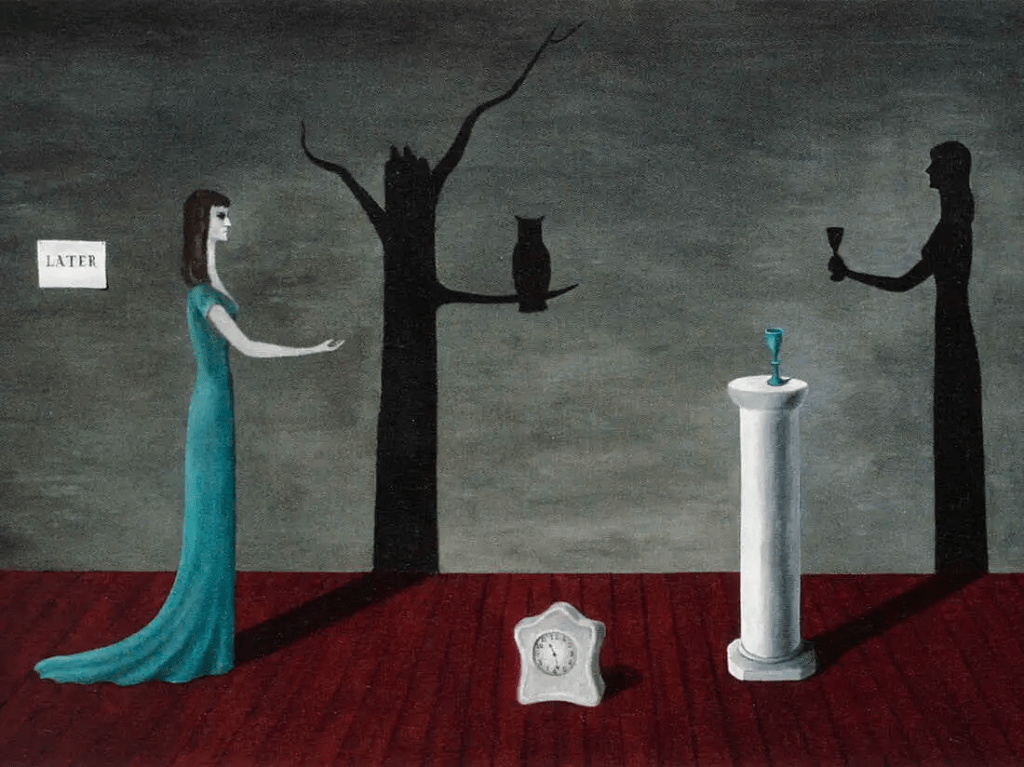
Strange Shadows (Shadows and Substance), by Gertrude Abercrombie, 1950

For Christ did not enter a sanctuary made by human hands, a mere copy of the true one, but he entered into heaven itself, now to appear in the presence of God on our behalf. 

Nor was it to offer himself again and again, as the high priest enters the holy place year after year with blood that is not his own, for then he would have had to suffer again and again since the foundation of the world.

But as it is, he has appeared once for all at the end of the ages to remove sin by the sacrifice of himself. And just as it is appointed for mortals to die once and after that the judgment, so Christ, having been offered once to bear the sins of many, will appear a second time, not to deal with sin but to save those who are eagerly waiting for him. (New Revised Standard Version)

I admit that the Book of Hebrews in the New Testament is one of my favorite books of the Bible. I also recognize that Hebrews is one of the most difficult books to deal with. And specifically, chapter 9 can be quite mind-boggling.

The author of Hebrews, whoever he was actually was, did the intellectually and theologically staggering job of establishing continuity between the two testaments of the Bible.

He compared and contrasted the old (or first) covenant with the new (or second) covenant, examining the Levitical priesthood and its sacrificial system, with Christ as the high priest whose singular sacrifice ended all sacrifices.

The old sacrificial system began on Mount Sinai. Moses sprinkled the sacrificial blood of bulls and goats on both the people and the tabernacle. He was consecrating them, and the sacrificial implements, so that everyone could participate in the worship of Yahweh.

In the new covenantal system, blood is also used to purify. Yet, the heavenly tabernacle could not be cleansed with the blood of animals. It required a better and superior sacrifice. (Hebrews 9:23)
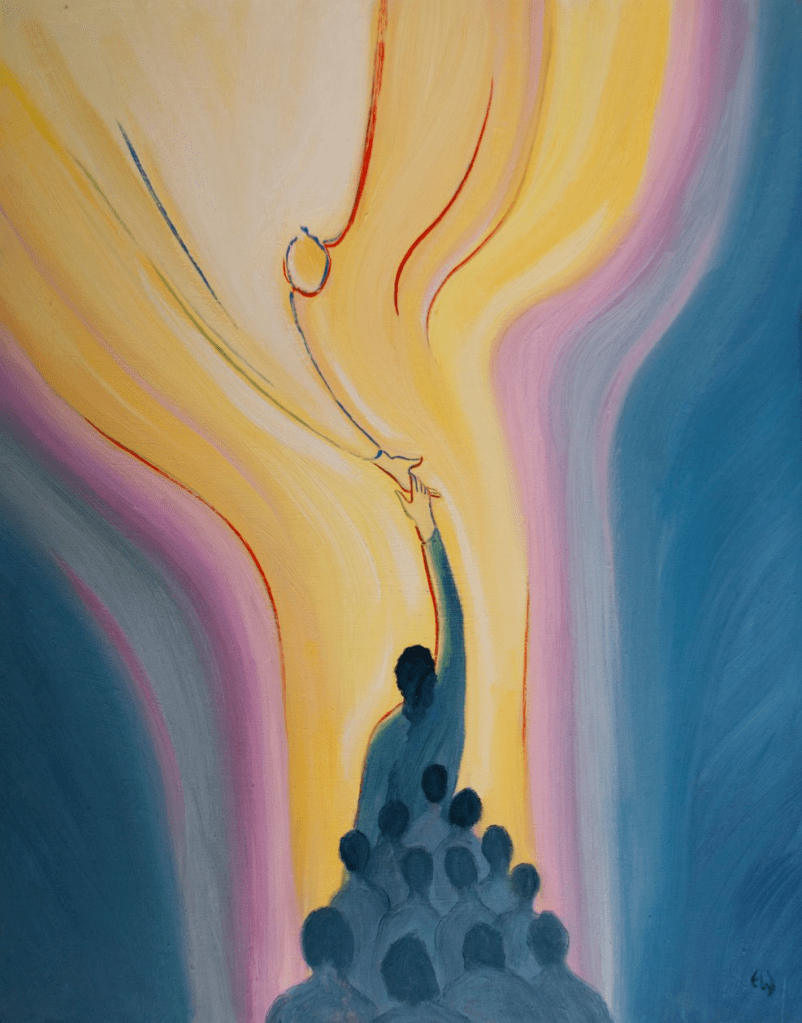
The Sacrifice of Christ, by Elizabeth Wang, 2002

That sacrifice is Jesus. He was both the high priest officiating the ritual, and the actual sacrificial offering. It is the life of Jesus, given in self-sacrificial death, which enables worshipers to come to God without any obstruction whatsoever.

Jesus does not have to keep offering himself. It was a one and done affair. One sacrifice on behalf of everyone. Once for all.

This is, of course, a distinctively Christian view and approach to the problem of guilt, shame, disobedience, and death. It has been a very compelling view for millions of people over the past two millennia.

In whatever way one seeks to understand and make sense of the author’s line of reasoning concerning a Christian approach to sacrifice and dealing with sin, what is apparent to me is that the author talked of a reality that we do not presently see.

The author of Hebrews was lifting up something important that he wanted us to notice. He was pointing out the reality of spiritual forces that have the power to both destroy and give life.

The earthly objects that we can see, touch, feel, hear, and smell are mere representations or shadows of heavenly things.

Many people, if not most people, today would say that invisible things such as our ideas and philosophies of religion are mere mental ways of understanding the objective reality in front of us that we can use our five senses to detect.

But the author of Hebrews insists – and I believe rightly so – that it’s the other way around. Everything we are presently experiencing with our objective senses is a projection of the ultimate invisible reality.

In other words, this entire world will pass away, because it is but a shadow in the history of eternity. The invisible God is the real deal. The heavenly sanctuary is reality. Love is the permanent operating system of eternity, and not your 401(k) or the next political election.

Jesus the Christ has offered himself once for all time, and for all sins. And he did it because the triune God – Father, Son, and Spirit – is a community of unitive love. That is, God is Love. So therefore, God can only do that which is love.

The end of time is not yet here. This present world with all of its inconsistent ways of doing both good and bad is still with us. But Jesus will come again.

The sin issue has been dealt with, once and for all. Christ did that. Jesus will return in order to bring salvation to those who are waiting for him.

If we must wait, let us do it patiently, with all of the faith and endurance it requires. Yet, this is not a passive waiting. We are to be busy proclaiming the good news of God’s invisible realm with both words and sacraments – with the signs and shadows and representations we have that point to the reality of God.

Everything visible and tangible on this earth is mirroring a greater, better, and superior reality which we cannot see with our eyes or touch with our hands.

Christianity is unabashed that all things point to Christ, who is the first and the last, the alpha and omega, the be all and end all of everything.

Come, Lord Jesus, Son of God, Son of Humanity. We long for you to return in glory and set us and this entire sinful world aright with your divine justice.

Be our guest, Lord Jesus, our Savior and Friend. We receive in faith your salvation. We trust that both the physical food and spiritual food you give will sustain us for our work and worship in this world.

May it be so, to the glory of God, and through the enablement of the Holy Spirit. You are one God – Father, Son, and Spirit – in one holy community of Love, now and forevermore. Amen.

Avoid the Downward Spiral (Judges 6:1-10)

The Israelites did evil in the eyes of the Lord, and for seven years he gave them into the hands of the Midianites. Because the power of Midian was so oppressive, the Israelites prepared shelters for themselves in mountain clefts, caves and strongholds. Whenever the Israelites planted their crops, the Midianites, Amalekites and other eastern peoples invaded the country. 

They camped on the land and ruined the crops all the way to Gaza and did not spare a living thing for Israel, neither sheep nor cattle nor donkeys. They came up with their livestock and their tents like swarms of locusts. It was impossible to count them or their camels; they invaded the land to ravage it. Midian so impoverished the Israelites that they cried out to the Lord for help.

When the Israelites cried out to the Lord because of Midian, he sent them a prophet, who said, “This is what the Lord, the God of Israel, says: I brought you up out of Egypt, out of the land of slavery. I rescued you from the hand of the Egyptians. And I delivered you from the hand of all your oppressors; I drove them out before you and gave you their land. I said to you, ‘I am the Lord your God; do not worship the gods of the Amorites, in whose land you live.’ But you have not listened to me.” (New International Version)

Frankly, the biblical Book of Judges is rather depressing. Its descriptive arc is a sad downward spiral of forgetfulness and disobedience – with the people crying out for deliverance and being saved – and then another slide, even lower than before, into memory issues, and negligence of the law.

Newer and greater levels of depravity occur, the further one reads into the Book of Judges. Indeed, early in the book we are given the reason for such an immoral and idolatrous slide:

The people served the Lord throughout the lifetime of Joshua and of the elders who outlived him and who had seen all the great things the Lord had done for Israel…

After that whole generation had been gathered to their ancestors, another generation grew up who knew neither the Lord nor what he had done for Israel. Then the Israelites did evil in the eyes of the Lord and served the Baals. They forsook the Lord, the God of their ancestors, who had brought them out of Egypt. They followed and worshiped various gods of the peoples around them. They aroused the Lord’s anger because they forsook him and served Baal and the Ashtoreths. 

In his anger against Israel the Lord gave them into the hands of raiders who plundered them. He sold them into the hands of their enemies all around, whom they were no longer able to resist. Whenever Israel went out to fight, the hand of the Lord was against them to defeat them, just as he had sworn to them. They were in great distress. (Judges 2:7, 10-15, NIV)

In today’s Old Testament lesson, yet another round of disobedience brought yet another threat, in the form of the Midianites and Amalekites. Midian’s annual raids of Israelite land destroyed crops and led to the livestock eventually starving. The people were left just trying to eek-out a living and survive.

The Midianites were a nomadic people, subsisting mostly through trade. They were not farmers, and really did not need to raid Israel. It seems they came and did their damage just to keep Israel weak and under their thumb, unable to compete in the caravan markets that Midian depended upon.

The story of crop destruction, and Midianites as thick as locusts, communicates divine judgment and connects with Joshua’s warning to remember God and be faithful to the covenant law:

“If you violate the covenant of the Lord your God, which he commanded you, and go and serve other gods and bow down to them, the Lord’s anger will burn against you, and you will quickly perish from the good land he has given you.” (Joshua 23:16, NIV)

The Israelites cried out in their distress to God for deliverance. They were answered by an unknown prophet who clearly connected the people’s disloyalty to their adverse situation. Although Canaanite gods may have been tolerant of worshiping other deities, the Lord, Israel’s God, is certainly not.

In the case of the ancient Israelites, the people’s disobedience caused their suffering. The prophet did not promise any sort of deliverance. And the distressed people were left wondering if they had been abandoned by God.

This entire situation is a set up for the character of Gideon, who will come on the scene as one of the dominant deliverers in the Book of Judges. And Gideon’s story further illustrates the ever-increasing relationship between Israel, Canaan, and immoral behavior.

By the time we get to the end of the book, there is a sort of morbid and depressing anarchy that has settled amongst the people, ending in the statement:

In those days Israel had no king; everyone did as they saw fit. (Judges 21:26, NIV)

That was not a statement of freedom, but of depravity. It was almost like living in a dystopian society in which nobody was really safe.

Yet God always has had a remnant of people who are faithful and remember the great things which the Lord has done.

So, if we want to avoid the downward spiral in the Book of Judges, the believer is encouraged to keep memory of God’s works, words, and ways in this world; and to remain faithful in obeying God’s law and embracing God’s love.

We need the law of love, and the love of law, in order to rightly relate to our neighbor and be concerned for the common justice of all persons – instead of living in a bubble of supposed safety, doing only what seems right to me.

Lord God, almighty and everlasting Father, you have brought us in safety to this new day: Preserve us with your mighty power, that we may not fall into sin, nor be overcome by adversity; and in all we do, direct us to the fulfilling of your purpose; through Jesus Christ our Lord. Amen.

The Farewell Speech of Joshua (Joshua 23:1-16)

The tomb of Joshua in the West Bank

After a long time had passed and the Lord had given Israel rest from all their enemies around them, Joshua, by then a very old man, summoned all Israel—their elders, leaders, judges and officials—and said to them:

“I am very old. You yourselves have seen everything the Lord your God has done to all these nations for your sake; it was the Lord your God who fought for you. Remember how I have allotted as an inheritance for your tribes all the land of the nations that remain—the nations I conquered—between the Jordan and the Mediterranean Sea in the west. The Lord your God himself will push them out for your sake. He will drive them out before you, and you will take possession of their land, as the Lord your God promised you.

“Be very strong; be careful to obey all that is written in the Book of the Law of Moses, without turning aside to the right or to the left. Do not associate with these nations that remain among you; do not invoke the names of their gods or swear by them. You must not serve them or bow down to them. But you are to hold fast to the Lord your God, as you have until now.

“The Lord has driven out before you great and powerful nations; to this day no one has been able to withstand you. One of you routs a thousand, because the Lord your God fights for you, just as he promised. So be very careful to love the Lord your God.

“But if you turn away and ally yourselves with the survivors of these nations that remain among you and if you intermarry with them and associate with them, then you may be sure that the Lord your God will no longer drive out these nations before you. Instead, they will become snares and traps for you, whips on your backs and thorns in your eyes, until you perish from this good land, which the Lord your God has given you.

“Now I am about to go the way of all the earth. You know with all your heart and soul that not one of all the good promises the Lord your God gave you has failed. Every promise has been fulfilled; not one has failed. 

“But just as all the good things the Lord your God has promised you, have come to you, so he will bring on you all the evil things he has threatened, until the Lord your God has destroyed you from this good land he has given you. If you violate the covenant of the Lord your God, which he commanded you, and go and serve other gods and bow down to them, the Lord’s anger will burn against you, and you will quickly perish from the good land he has given you.” (New International Version)

Orthodox icon of Joshua

The Person

Joshua, the son of Nun, was the protégé of Moses, as the Israelites wandered the wilderness. After the death of Moses, Joshua became their military commander, leading the people into the Promised Land.

The biblical book of Joshua involves the Israelite conquest and settlement of Canaan. After securing decisive victories in the middle, north, and south of Canaan, the land was allotted to the twelve tribes of Israel.

Close to his death at 110 years old, Joshua gave a farewell speech to the people in which he called them to remember God’s actions, and be faithful to the Lord. He also warned them that if they failed in their memory and in their faith, they would lose the very land which was promised to them.

The Conquest

Throughout the Book of Joshua, there is a very positive view of conquering the land of Canaan. There are several notable stories of stepping out in faith despite the fear of engaging a much larger foe.

God is pictured as the real force behind all of the Israelite success, bringing the people into the land by through a miraculous parting of the Jordan River, and securing victory over great cities like Jericho by means of supernatural help.

After entering the land, the covenant with God was reaffirmed. The Israelites had moved around the Sinai desert for 40 years, and the new generation of people needed both circumcision and law in order to become faithful inhabitants of the land.

By the end of chapter 12 of Joshua, each of the native nations in Canaan had fallen. The conquest was complete, albeit with some of the Canaanites still living in the land. This would eventually prove to be a problem after Joshua’s death.

Allocation of the Land

A detailed account of the land’s division for all of the Israelite tribes covers chapters 13 to 22 in Joshua. Nearly all of the tribes settled between the Jordan River and the Mediterranean Sea, with a few exceptions settling along the eastern bank of the Jordan.

The reason for this traces back to a story in the Book of Numbers in which the tribes of Gad, Reuben, and Manasseh ask to settle there. At the time, Moses agreed to their request on the condition that they help complete the conquest of the land before being allowed to return and settle in their own, which they did.

Moses and Joshua

The book of Joshua and the story of Moses have a lot of similarities, such as:

  • Moses led the Israelites out of Egypt; and Joshua led them into Canaan.
  • Moses led the Israelites miraculously through the Red Sea; and Joshua led them miraculously across the Jordan River.
  • Moses sent out spies into Canaan; and Joshua sent spies to Jericho.
  • Moses allocated land on the east side of the Jordan River; and Joshua allocated land on the west side of the Jordan.
  • Moses gave a prolonged address before dying; and Joshua also gave a parting address to the people.

The Farewell Speech

Joshua’s farewell speech was both an exhortation and an encouragement to the Israelites. Joshua gave them a charge to remain faithful to God, just as God had faithfully fulfilled the promise of giving the people the land of Canaan. We get the sense that Joshua knew what was coming down the pike, and that unfaithfulness was in their future.

We also get the spiritual sense from Joshua that unless one’s heart is filled to the full of God’s law and love, something or someone else will come along and fill the void, no matter how big or small. Our happiness, fulfillment, and satisfaction is to be found in the Lord.

Joshua was insistent that to remain true to God is to remember what God has done. The Israelites were to always keep in their memory how the Lord brought them victory and fought their battles for them. By being continually reminded, the people would always trust and obey their God.

Indeed, even for believers today, if we can keep in mind God’s past faithfulness, it will help us have faith in God for the present time.

And just as the Israelites needed to hold onto and keep the Book of the Law in their minds and hearts, so we are to be ever mindful of God’s Holy Word. Christians are especially to realize the connection we have with Jesus and the Spirit.

“Be strong and very courageous. Be careful to obey all the law my servant Moses gave you; do not turn from it to the right or to the left, that you may be successful wherever you go. Keep this Book of the Law always on your lips; meditate on it day and night, so that you may be careful to do everything written in it. Then you will be prosperous and successful.”

Joshua 1:7-8, NIV

We are to avoid compromising our faith and marrying into foreign concepts that would take us away from our fidelity to the Lord. As Christians, our lives are to maintain the center of Christ. It is therefore imperative that we continually have the words and ways of Jesus ever before us. Otherwise, false gods can easily take over our lives.

The consequences of disobedience are much like those of trying to defy the law of gravity. It won’t go well with you to believe you can walk off the roof of your house in faith and be just fine.

Whereas many people may believe that God is punishing them when there are devastating consequences, typically we create our own problems by refusing to pay attention and listen to God’s warnings to avoid stupidity.

But if we remember our history with God, and God’s history with others, perhaps we will not take our spiritual lives for granted, nor let our spirits fall into disuse.

Not one good promise from God failed to be realized for the ancient Israelites. And all the good promises fulfilled in the person of Jesus are connected to his Church. Ultimately, our blessings come through the person and work of Christ – and not our own abilities, or lack thereof.

God almighty, Lord of heaven and earth, renew us with your divine love, energize our souls, nourish our spirits, empower us to show our faith, help us to walk with you, abide in us always, and teach us to continually remember you and follow you at all times and in every way. Amen.

There Is Hope (Psalm 89:20-37)

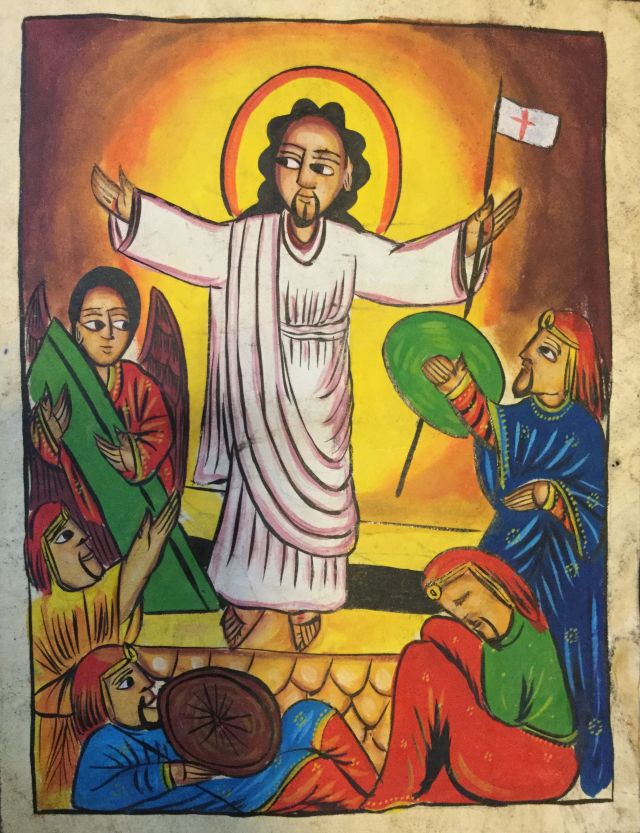
Ethiopian Orthodox depiction of Jesus

“I have found my servant David;
    with my holy oil I have anointed him;
my hand shall always remain with him;
    my arm also shall strengthen him.
The enemy shall not outwit him;
    the wicked shall not humble him.
I will crush his foes before him
    and strike down those who hate him.
My faithfulness and steadfast love shall be with him,
    and in my name his horn shall be exalted.
I will set his hand on the sea
    and his right hand on the rivers.
He shall cry to me, ‘You are my Father,
    my God, and the Rock of my salvation!’
I will make him the firstborn,
    the highest of the kings of the earth.
Forever I will keep my steadfast love for him,
    and my covenant with him will stand firm.
I will establish his line forever
    and his throne as long as the heavens endure.
If his children forsake my law
    and do not walk according to my ordinances,
if they violate my statutes
    and do not keep my commandments,
then I will punish their transgression with the rod
    and their iniquity with scourges,
but I will not remove from him my steadfast love
    or be false to my faithfulness.
I will not violate my covenant
    or alter the word that went forth from my lips.
Once and for all I have sworn by my holiness;
    I will not lie to David.
His line shall continue forever,
    and his throne endure before me like the sun.
It shall be established forever like the moon,
    an enduring witness in the skies.” (New Revised Standard Version)

Back when today’s psalm was originally crafted, there was a lot of stress for the Jews in Jerusalem. The city was in ruins, the land without their king, and the people were experiencing divine judgment from their God.

Into this situation, the psalmist brought some light from darkness; and hope for the survivors, that blessings lay in the future. The psalm is a song of prayer, speaking of the Lord’s faithfulness and steadfast love because of the promises made to the people’s ancient ancestor, King David.

The covenant between God and the people, made so many centuries ago, will never be broken. Why? Because fidelity to that covenant doesn’t depend on the people, but on the faithfulness of God and God’s timeless moral law.

The Lord God, the Almighty, did not forsake nor forget the people. The Lord’s mercies are new every morning; and God’s faithful love is forever.

Renewal and restoration are very real possibilities, despite the dire circumstances, and the people’s spiritual infidelity. Once again in history, one worthy of the throne of David will sit to judge the people with equity and grace.

The Son of David will be the custodian of God’s covenant promises. Evil shall be defeated. Authority to forgive sins, and to grant eternal life, will be established on earth. Indeed, the Lord’s enduring words and ways will be accomplished on this earth, as they are always done in God’s heaven.

The divine covenant will find its ultimate fulfillment in One whose throne is established for all eternity. The anointed one, the God-Man, will carry the burden of government on his shoulders; his rule and authority shall extend over the whole earth. (Isaiah 9:7)

Acting with the power of God, this Ruler is the visible image of the invisible God – the Mighty God, Eternal Father, Prince of Peace. For the Christian, these qualifications and descriptions are all met in the person of Jesus the Christ.

In a thoroughly and unabashed Christo-centric reading of the psalm, Jesus is the ultimate Messiah and High Priest who offered himself as the faultless, acceptable, eternal, and final sacrifice on behalf of the whole world. (Isaiah 53)

Therefore, since we are justified by faith, we have peace with God through our Lord Jesus Christ, through whom we have obtained access to this grace in which we stand, and we boast in our hope of sharing the glory of God. (Romans 5:1-2, NRSV)

Through Jesus, the New Testament perspective is that the old Mosaic Covenant became obsolete, and the New Covenant – promised by the prophets Jeremiah and Ezekiel – took its place. (Jeremiah 31:31-34; Ezekiel 36:25-27; Hebrews 8:13)

Although this High Priest died, he also was raised to life, and ascended to heaven – where he continues to intercede for God’s people.

He holds his priesthood permanently because he continues forever. Consequently, he is able for all time to save those who approach God through him, since he always lives to make intercession for them. (Hebrews 7:24-25, NRSV)

Before David was anointed king, Saul and his enemies hunted him and tried to kill him. Yet, through all of those twists and turns of harrowing circumstances, David trusted in the Lord and patiently waited for God to ensconce him as king. In time, that is precisely what happened. And David became the greatest king Israel ever had.

In much the same way, that fox King Herod tried to kill Jesus. Then later, Herod’s son, along with the religious establishment, sought to kill Jesus, as well. Behind the murderous intent, and every intent of doing away with the innocent, are the dark evil forces of this world.

The Accuser, Satan, the devil, tried to tempt the Christ and subvert the will of God, thus making the New Covenant something that would never happen. But Jesus was obedient to the Father – obedient even to death. (Philippians 2:8)

Christ Jesus offered himself willingly. His death may have been orchestrated by the existence of evil on this earth, yet it was God who allowed it all to occur, so that evil’s murderous tool, death, would become impotent.

The power of sin, death, and hell has been broken; but it will take awhile before the kingdom of God is established in all its grace and glory, and David’s fallen Tabernacle restored.

No matter how difficult, chaotic, and frustrating our current earthly situation may be, God will still establish the king; the good work begun and effected shall ultimately be thoroughly fulfilled. Jesus is coming again.

Until then, the good news is proclaimed that the kingdom of God is near. There is grace and forgiveness in the name of Jesus. Peace is no longer a pipe dream. Hope is real.

O Lord, when evil darkens our world, give us light. When despair numbs our souls, give us hope. When we stumble and fall, lift us up. When doubts assail us, give us faith. When nothing seems sure, give us trust. When ideals fade, give us vision. When we lose our way, be our guide, so that we may find serenity in Your presence, and purpose in doing Your will. Amen.