Daniel 6:1-28 – A Time and a Place for Prayer

Daniel in the Lions Den by John August Swanson

Darius decided to appoint one hundred twenty chief administrators throughout the kingdom, and to set over them three main officers to whom they would report so that the king wouldn’t have to be bothered with too much. One of these main officers was Daniel. Because of his extraordinary spirit, Daniel soon surpassed the other officers and the chief administrators—so much so that the king had plans to set him over the entire kingdom. As a result, the other officers and the chief administrators tried to find some problem with Daniel’s work for the kingdom. But they couldn’t find any problem or corruption at all because Daniel was trustworthy. He wasn’t guilty of any negligence or corruption.

So, these men said, “We won’t find any fault in Daniel, unless we can find something to use against him from his religious practice.”

So, these officers and chief administrators ganged together and went to the king. They said to him, “Long live King Darius! All the officers of the kingdom, the ministers, the chief administrators, the royal associates, and the governors advise the king to issue an edict and enforce a law, that for thirty days anyone who says prayers to any god or human being except you, Your Majesty, will be thrown into a pit of lions. Now, Your Majesty, issue the law and sign the document so that it cannot be changed, as per the law of Media and Persia, which cannot be annulled.” Because of this, King Darius signed the document containing the law.

When Daniel learned that the document had been signed, he went to his house. Now his upper room had open windows that faced Jerusalem. Daniel knelt, prayed, and praised his God three times that day, just like he always did. Just then these men, all ganged together, came upon Daniel praying and seeking mercy from his God. They then went and talked to the king about the law: “Your Majesty! Didn’t you sign a law, that for thirty days any person who prays to any god or human being besides you, Your Majesty, would be thrown into a pit of lions?”

The king replied, “The decision is absolutely firm in accordance with the law of Media and Persia, which cannot be annulled.”

So they said to the king, “One of the Judean exiles, Daniel, has ignored you, Your Majesty, as well as the law you signed. He says his prayers three times a day!”

When the king heard this report, he was very unhappy. He decided to rescue Daniel and did everything he could do to save Daniel before the sun went down. But these men, all ganged together, came and said to the king, “You must realize, Your Majesty, that the law of Media and Persia, including every law and edict the king has issued, cannot be changed.”

So, the king gave the order, and they brought Daniel and hurled him into the pit of lions.

The king said to Daniel: “Your God—the one you serve so consistently—will rescue you.”

A single stone was brought and placed over the entrance to the pit. The king sealed it with his own ring and with those of his princes so that Daniel’s situation couldn’t be changed. The king then went home to his palace and fasted through the night. No pleasures were brought to him, and he couldn’t sleep. At dawn, at the first sign of light, the king rose and rushed to the lions’ pit.

As he approached it, he called out to Daniel, worried: “Daniel, servant of the living God! Was your God—the one you serve so consistently—able to rescue you from the lions?”

Then Daniel answered the king: “Long live the king! My God sent his messenger, who shut the lions’ mouths. They haven’t touched me because I was judged innocent before my God. I haven’t done anything wrong to you either, Your Majesty.”

The king was thrilled. He commanded that Daniel be brought up out of the pit, and Daniel was lifted out. Not a scratch was found on him, because he trusted in his God. The king then ordered that the men who had accused Daniel be brought and thrown into the lions’ pit—including their wives and children. They hadn’t even reached the bottom of the pit before the lions overpowered them, crushing all their bones.

Then King Darius wrote the following decree:

To all the peoples, nations, and languages inhabiting the entire earth: I wish you much peace.I now issue this command: In every region of my kingdom, all people must fear and revere Daniel’s God because:

He is the living God.
    God stands firm forever.
His kingship is indestructible.
    God’s rule will last until the end of time.
He is rescuer and savior;
    God performs signs and miracles in heaven and on earth.
Here’s the proof:
    He rescued Daniel from the lions’ power.

And so, Daniel was made prosperous during the rule of Darius and during the rule of Cyrus the Persian. (CEB)

“If your day is hemmed in with prayer, it is less likely to come unraveled.”

Cynthia Lewis

When Daniel learned about King Darius’ decree, he went home to his upstairs room where the windows opened toward Jerusalem. Three times a day he got down on his knees and prayed, giving thanks to his God, just as he had always done. (Daniel 6:10).

It was Daniel’s regular habit of prayer which gave him the strength to ignore the king’s edict. Daniel was kept safe, not by being saved from the lions’ den, but in the lions’ den. Daniel is our best model in the Bible of one who consistently prayed, no matter the situation. Two characteristics of Daniel’s prayer stands out: a planned approach to prayer; and perseverance in prayer.

We need a plan for prayer.

Daniel had an intentional plan for prayer. He also prayed spontaneously throughout his life – all the time. That, however, was not his bread-and-butter daily life of prayer. Daniel had set times in which he prayed three times a day. 

I am not insisting we all ought to pray at the set times of 6am, 12pm, and 6pm, as Daniel did every day (although that is good biblical plan to emulate!). Yet, I will insist there needs to be some planning behind carving out time for prayer every day. We need to approach prayer with the same deliberate discipline we approach anything else – like housework, writing a paper, sports practice, or getting work accomplished on the job.

Prayer is the way we escape the gravitational pull of our fleshly lives and enter God’s orbit. It takes much planning, energy, commitment, and focus. And it is all worth it.

We need a set time and a set place to pray. Just as we set aside a special room in our house for sleeping (bedroom) and a particular place to sleep (bed) so we need a sacred space just for prayer. We understand the value of a good night’s sleep. So, we plan to go to bed at night and arise in the morning. In the same way, we must arrange a time and place for prayer. The value we place on prayer is demonstrated by our planning for it.

We need perseverance in prayer.

Daniel was a teenager when the Babylonians came to Jerusalem, tore down the wall, and took the best young people of the city into captivity. When the lions’ den event unfolded, Daniel was an old man of about 80 years old. For over sixty years, Daniel prayed three times a day, every day, without fail. His prayers were consistent and sustained. He never gave up. 

The reason Daniel always opened his window and prayed toward Jerusalem is that he was praying consistent with God’s promise. The exiles would someday return to Jerusalem. So, Daniel looked out his window every day, three times a day, praying repeatedly for God’s help and peace.

Daniel was so consistent about prayer that when the jealous rascals in the king’s service went after him, it did absolutely nothing to deter him from his usual routine. Daniel maintained his focus without being sidelined by all the drama. He kept up his regular practice of prayer in the same place at the same time. It is interesting his enemies knew exactly when and where Daniel would be praying every day, and they set their trap according to that knowledge.

Daniel was incredibly calm in facing the lions because of his planned, deliberate, and consistent practice of prayer. Daniel’s ability, confidence, courage, and lack of worry was not simply because he was some extraordinary person. Rather, he had decades of practiced prayer which equipped him for just such an encounter.

Daniel’s posture in prayer was consistently on his knees. It reminded him of his true position, not as a high mucky muck in the kingdom of Darius with all its rights and privileges, but as a humble servant in God’s kingdom with all its joy and responsibility.

Considering Daniel’s example of prayer, it would be wise for us to do some solid planning. Identify and set aside a dedicated space for prayer. Arrange your schedule so that prayer is a priority. You’ll be glad you did!

Our Beloved Father, dwelling in the heavenly realms,
    may the glory of your name
    be the center on which our lives turn.
Manifest your kingdom realm,
    and cause your every purpose to be fulfilled on earth,
    just as it is in heaven.
We acknowledge you as our Provider
    of all we need each day.
Forgive us the wrongs we have done as we ourselves
    release forgiveness to those who have wronged us.
Rescue us every time we face tribulation
    and set us free from evil.
    For you are the King who rules
    with power and glory forever. Amen. (Matthew 6:9-13, TPT)

Acts 4:23-31 – Why Not Us?

Hear My Plea by Rochelle Blumenfeld

The apostles Peter and John were arrested for preaching the good news about Jesus. After warning and threatening them to stop doing this, the ruling council of the Jews released them. This was the apostles’ response….

On their release, Peter and John went back to their own people and reported all that the chief priests and the elders had said to them. When they heard this, they raised their voices together in prayer to God. “Sovereign Lord,” they said, “you made the heavens and the earth and the sea, and everything in them. You spoke by the Holy Spirit through the mouth of your servant, our father David:

“‘Why do the nations rage
    and the peoples plot in vain?
The kings of the earth rise up
    and the rulers band together
against the Lord
    and against his anointed one.’

Indeed, Herod and Pontius Pilate met together with the Gentiles and the people of Israel in this city to conspire against your holy servant Jesus, whom you anointed. They did what your power and will had decided beforehand should happen. Now, Lord, consider their threats and enable your servants to speak your word with great boldness. Stretch out your hand to heal and perform signs and wonders through the name of your holy servant Jesus.”

After they prayed, the place where they were meeting was shaken. And they were all filled with the Holy Spirit and spoke the word of God boldly. (NIV)

The early believers in Jesus turned to God in a time of persecution. They found comfort in how God had worked in the past. The ancient church claimed the strength to carry on with speaking about Christ in their everyday lives. When they heard about threats against the apostles, the believers did not get angry or upset about how terrible things were. Instead:

The church decided to concentrate on corporate prayer together.

God is going to do what God is going to do. No government, nation, institution, group of people, or individual person can thwart God’s agenda for the church and world. God is sovereign over everything. We are not. Our place is to participate in God’s agenda through the ministry of prayer and speaking the word of God.

God acted in the past, on behalf of those first believers who came to Jesus and worshiped him with all their hearts. God is still transforming lives. It happened in ancient Jerusalem, throughout the history of the church, and in places today around the world. It can also happen with us.

Prayer is like breathing – inhaling more of God and exhaling less of me. Prayer takes the form of first remembering what God did in the past. Then, we pray specifically for our current situation which connects to the larger purposes of what God is doing. All the while we anticipate God will hear and act, just as has been done throughout history.

Remembrance is an important dimension to biblical prayer. Memory is necessary because we have a tendency toward forgetfulness. The older we get the more we tend to forget (probably because we have so much to remember!). So, continually rehearsing what God has done keeps us grounded in Scripture and tethered to what God can do now.

Remembering God’s saving actions and finding our own personal stories in the grand story of redemption helps us to pray in biblical ways.

The prayer of the early believers was a rehearsal of God’s mighty reputation, from creation to King David, to the redemptive events of Jesus. They reminded God of when, in the past, there was divine intervention. The church collectively quoted Psalm 2 about the Messiah. That psalm declares how the nations of the earth plot in vain because the Lord is the One who shall prevail over every hard circumstance. 

God bends each malevolent action toward the redemption and transformation of humanity. God will work out benevolent plans and purposes, even using people who have no acknowledgment of God. God is not surprised by our troubles and our tough situations.

God is never frustrated by people acting badly, because divine providence and guidance is in control, even if we cannot always perceive it or see it in the moment.

Remembering and rehearsing what God has done in the past helps us realize that, during any trouble, God is in control and will accomplish good plans on this earth. The prayer of the believers in Acts made the connection between what God has done and what they needed.

Photo by Pixabay on Pexels.com

Interestingly, the believers did not pray for relief from oppression or for God to judge their persecutors. Instead, they prayed for boldness to speak the word of God in the middle of their trouble. They rightly discerned that they needed to pray for courage to speak about Jesus. So, the church prayed for God to act in power, for God’s Word to go forth, and for Christ’s Name to be glorified.

God’s response to the prayer was immediate. The place where the church was praying shook. God did exactly what they asked for – filling them up with the Spirit, so that they spoke boldly about Jesus. Just as God empowered people for service in the past, so it was done in the present. What’s more, God will empower us with the same courage.

It is completely normal to simultaneously yearn for bravery while being afraid of getting a prayer for boldness answered. This is more than trying to overcome feelings of awkwardness or shyness. For the early believers, a very real and immediate danger to speaking up about Jesus was present.

It seems to me we need more people who know how to ask good questions and have the patience and attention to listen well and respond thoughtfully. It does no good to simply dispense answers to questions people aren’t asking. Speaking about Jesus does not mean making spiritual cold calls on strangers. And it certainly doesn’t involve being obnoxious or acting like a spiritual pester pup.

Discussing Jesus mostly means speaking casually, one-on-one, with a friend, co-worker, neighbor, or family member you already know. Too often we might try to fly under the radar and avoid people because we think talking about Jesus is going to be too hard, or out of our league.

Confidence and courage are not telling people what they ought to believe. It is rather like sharing a precious gift with someone. It begins in relationships with people we care about and extends to a relationship with God. It is about discovering God together, and not arm-twisting others to personal ethics or churchgoing.

Yet, it may still all sound too scary. So, maybe we start with this: “Tell me what’s going on.” Then listen. After listening, say, “I’ll pray for you.”  The next time you encounter the person, ask how that situation went.  Express that you’ll pray again. Keep doing it and watch what God will do through you.

When we pray for boldness, and courageously make ourselves available to God, then we are living sacrifices. This is our spiritual act of worship. (Romans 12:1-2) Who knows? Why not here? Why not now? Why not us? After praying, we might find our meeting places shaken, lives transformed, and everyone filled with God’s Holy Spirit.

God almighty, as you sent the Son, send us into the world with your compelling love. Help us by means of your Spirit, to share your good news of love, forgiveness, justice, peace, compassion, and care. Revive your Church, o Christ. Gracious God, work everywhere reconciling, loving, and healing your people and your creation. Open our eyes to your mission in the world. Send us to serve with Christ, taking risks to give life and hope to all people and all your creation. Amen.

Acts 2:14-24 – From Flaky to Faithful

Preaching of the Apostles (crayon on paper) by Peter Gorban, 1990

Peter stood up with the Eleven, raised his voice and addressed the crowd: “Fellow Jews and all of you who live in Jerusalem, let me explain this to you; listen carefully to what I say. These people are not drunk, as you suppose. It’s only nine in the morning! No, this is what was spoken by the prophet Joel:

“‘In the last days, God says,
    I will pour out my Spirit on all people.
Your sons and daughters will prophesy,
    your young men will see visions,
    your old men will dream dreams.
Even on my servants, both men and women,
    I will pour out my Spirit in those days,
    and they will prophesy.
I will show wonders in the heavens above
    and signs on the earth below,
    blood and fire and billows of smoke.
The sun will be turned to darkness
    and the moon to blood
    before the coming of the great and glorious day of the Lord.
And everyone who calls
    on the name of the Lord will be saved.’

“Fellow Israelites listen to this: Jesus of Nazareth was a man accredited by God to you by miracles, wonders and signs, which God did among you through him, as you yourselves know. This man was handed over to you by God’s deliberate plan and foreknowledge; and you, with the help of wicked men, put him to death by nailing him to the cross. But God raised him from the dead, freeing him from the agony of death, because it was impossible for death to keep its hold on him. (NIV)

In the New Testament Gospels of the Holy Bible, the Apostle Peter was a flake. He sometimes got it, and sometimes didn’t. Peter could discern Jesus was Messiah, but then would turn around and refuse that Christ had to die on a cross. He would get bold and walk on water, then, end up falling short and needing help from drowning. Peter stood tall for Jesus, and then denied him three times.

However, following the Gospels in the Acts of the Apostles, Peter is a completely changed man. He now gets it. He is brave. He confesses Christ with confidence and boldness. And, while the reader might be waiting for the other shoe to drop yet again, all the while Peter does not falter, flinch, or back down. Alright, Peter, way to go!

So, what is the difference between the Gospels and Acts with Peter? Why is there such a turnaround from flaky to faithful? The Scriptures make it plain: The Holy Spirit comes upon Peter. And he is never the same again. Everything falls into place for Peter. He proclaimed the life and death of Jesus in such a way that thousands changed their way of thinking, as well as their way of life, and placed their faith and hope in Christ as Savior and Lord. Not a bad day’s work for a former fisherman.

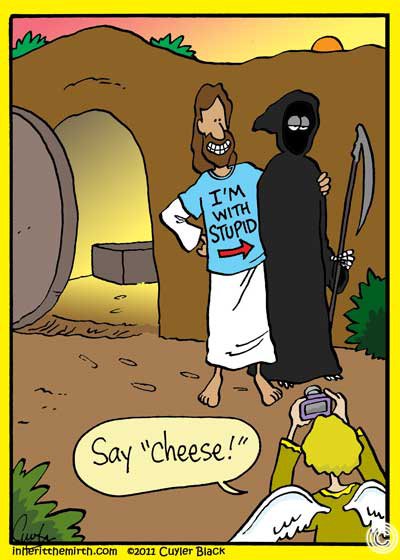
Peter’s message was pointed and straightforward: God raised Jesus up, forever changing the nature of death. Peter was dogmatic about stating that it wasn’t even possible for death to get a grip on Jesus. Oh, death thought it had him, the Grim Reaper believed he had Christ nailed to death for certain. Not so. The grave could not contain the immense and incredible power of divine love for humanity.

Inherit the Mirth

If it was impossible for death to keep its grip on Jesus, then there is absolutely nothing that can deter Jesus or hold him back from accomplishing what he wants to accomplish. Flaky believers are not going to frustrate Jesus or upset his plans; he’ll just send the Holy Spirit. 

We too often imprison ourselves in self-made spiritual jail cells, flaking-out in the Christian life, sometimes getting it right and once-in-a-while hitting upon some right combination we can’t explain, like a golfer who hits an amazing shot but can’t reproduce it no matter how hard he tries. The truth is: Jesus has conquered sin, death, and hell. By faith, we have forgiveness of sins in Christ and have the way opened to a new life in the Spirit. It isn’t a secret; it is a new reality.

The season of Lent is a time of remembering those things which hinder us in our walk with Jesus and repenting of our sins so that we can live anew. As we quickly approach Holy Week, the golf clubs of vulnerability, confession and prayer will keep us in God’s fairway and allow us to shoot par.

Gracious God, who raised Jesus from the dead, may the same power reside in me so that I can do your will in every situation through the power and presence of your Holy Spirit.  Amen.

Psalm 107:1-16 – The Necessity of Telling Our Secrets

Photo by Brett Sayles on Pexels.com

O give thanks to the Lord, for he is good;
    for his steadfast love endures forever.
Let the redeemed of the Lord say so,
    those he redeemed from trouble
and gathered in from the lands,
    from the east and from the west,
    from the north and from the south.

Some wandered in desert wastes,
    finding no way to an inhabited town;
hungry and thirsty,
    their soul fainted within them.
Then they cried to the Lord in their trouble,
    and he delivered them from their distress;
he led them by a straight way,
    until they reached an inhabited town.
Let them thank the Lord for his steadfast love,
    for his wonderful works to humankind.
For he satisfies the thirsty,
    and the hungry he fills with good things.

Some sat in darkness and in gloom,
    prisoners in misery and in irons,
for they had rebelled against the words of God,
    and spurned the counsel of the Most High.
Their hearts were bowed down with hard labor;
    they fell down, with no one to help.
Then they cried to the Lord in their trouble,
    and he saved them from their distress;
he brought them out of darkness and gloom,
    and broke their bonds asunder.
Let them thank the Lord for his steadfast love,
    for his wonderful works to humankind.
For he shatters the doors of bronze,
    and cuts in two the bars of iron. (NRSV)

The psalmist calls upon others to give thanks to the good Lord who shows enduring love to people. The psalmist furthermore exhorts those who have been redeemed to say so, to declare God’s praises for delivering them from trouble. 

Whatever the circumstances and however difficult the experiences may have been, the believer is not to remain in silence but is to publicly thank God.

Speaking our spiritual stories to others is important for those who share them, and for those who listen, so that the community of the redeemed will be strengthened in their faith and emboldened to share with others. Far too many Christians are reticent to talk about what God has done or is doing in their lives. Shame, embarrassment, or a host of other reasons might prevent us from being vulnerable enough to let others in on God’s deep work within us. But the psalmist does not let us off the hook, even if we feel we are not articulate or are too afraid to speak.

We all likely have had the privilege of hearing another person share their heart and experience of hardship and God’s deliverance. It was uplifting, encouraging, and helpful. So, let’s not keep our stories to ourselves. Stories are meant to be told, not hidden. 

Bringing to light our faith journey is healing for all, as well as declaring the light of Jesus to the world.

Author Frederick Buechner wrote a book several years ago entitled, “Telling Secrets.” Buechner tells of his own experience of keeping some stories inside and never letting them see the light of day. One of those stories was growing up with an alcoholic father and all the other stories that went along with that singular story. It was only in finally telling the family secret of alcoholism that he discovered a better path forward to healing and blessing. He writes:

“What we hunger for perhaps more than anything else is to be known in our full humanness, and yet that is often just what we also fear more than anything else. It is important to tell at least from time to time the secret of who we truly and fully are because otherwise we run the risk of losing track of who we truly and fully are and little by little come to accept instead the highly edited version which we put forth in hope that the world will find it more acceptable than the real thing. It is important to tell our secrets, too, because it makes it easier for other people to tell us a secret or two of their own.”

“My story is important not because it is mine, God knows, but because if I tell it, the chances are you will recognize that, in many ways, it is also your story. It is precisely through these stories in all their particularity, as I have long believed and often said, that God makes himself known to each of us more powerfully and personally. If this is true, it means that to lose track of our stories is to be profoundly impoverished not only humanly but also spiritually.”

Shame is like a vampire. It lives in the shadows, thirsting for and feeding upon secrets.

But when our stories are told and see the light of day, the vampire of shame is destroyed by the bright rays of truth and vulnerability. We then become open to genuine relationships without propping up a false self to pose for others. We place ourselves in a position to receive and give love. In short, we can meaningfully connect with both God and others because we found our voice and told our story.

Great God of deliverance, I praise you that I have a story to tell of your grace and faithfulness. Help me to tell of your mercy in my life so that the name of Jesus will be exalted, and that your people might be built up in the faith.  Amen.