Reverence, Humility, and Contentment (Ecclesiastes 5:1-20)

Guard your steps when you go to the house of God; to draw near to listen is better than the sacrifice offered by fools, for they do not know how to keep from doing evil. Never be rash with your mouth nor let your heart be quick to utter a word before God, for God is in heaven and you upon earth; therefore let your words be few.

For dreams come with many cares, and a fool’s voice with many words.

When you make a vow to God, do not delay fulfilling it, for he has no pleasure in fools. Fulfill what you vow.It is better that you should not vow than that you should vow and not fulfill it. Do not let your mouth lead you into sin, and do not say before the messenger that it was a mistake; why should God be angry at your words and destroy the work of your hands?

With many dreams come vanities and a multitude of words, but fear God.

If you see in a province the oppression of the poor and the violation of justice and right, do not be amazed at the matter, for the high official is watched by a higher, and there are yet higher ones over them. But all things considered, this is an advantage for a land: a king for a plowed field.

The lover of money will not be satisfied with money, nor the lover of wealth with gain. This also is vanity.

When goods increase, those who eat them increase, and what gain has their owner but to see them with his eyes?

Sweet is the sleep of laborers, whether they eat little or much, but the abundance of the rich will not let them sleep.

There is a grievous ill that I have seen under the sun: riches were kept by their owners to their hurt, and those riches were lost in a bad venture; though they are parents of children, they have nothing in their hands. As they came from their mother’s womb, so they shall go again, naked as they came; they shall take nothing for their toil that they may carry away with their hands. This also is a grievous ill: just as they came, so shall they go, and what gain do they have from toiling for the wind? Besides, all their days they eat in darkness, in much anger and sickness and resentment.

This is what I have seen to be good: it is fitting to eat and drink and find enjoyment in all the toil with which one toils under the sun the few days of the life God gives us, for this is our lot. Likewise, all to whom God gives wealth and possessions and whom he enables to enjoy them and to accept their lot and find enjoyment in their toil—this is the gift of God. For they will scarcely brood over the days of their lives because God keeps them occupied with the joy of their hearts. (New Revised Standard Version)

Life can be paradoxically both meaningful and meaningless. Yet, if we can live consistent with who we are and how we were created to be, then it is likely we shall find a semblance of meaning, purpose, and even joy in this present life.

Reverence

Too much talk leads to sin. Be sensible and keep your mouth shut. (Proverbs 10:19, NLT)

We are to be cautious in our speech, especially in addressing God. We must choose our words carefully and deliberately, in prayer, as well as with others.

God is God, and we are not. Therefore, since God is far above us, the high and holy One, it is wise to minimize our talking. There’s no need for lengthy and showy prayers. It is the mark of a fool that talks too much, just as much as it is the mark of a fool to let daydreams occupy too much of their thoughts.

Even fools who keep silent are considered wise; when they close their lips, they are deemed intelligent. (Proverbs 17:28, NRSV)

To be reverent and respectful before God involves not only the volume of words, but also the sanctity of words.

Whenever a person makes a vow or a promise to God, they need to be diligent about fulfilling that vow. The Lord takes our words seriously, and is not pleased with flippant promises that we have little intention of keeping.

On the flipside, good intentions are just that – they do not constitute a promise to do anything. We make vows so that we will be accountable to ourselves and others, and then follow through with the promise, no matter what.

Reneging on any promise, whether the vow is to another or God, is a foolish act with real consequences. Therefore, we should consider our promises well before making them, and avoid being rash.

Humility

All of us have both observed and experienced oppression and injustice of another or a group of people. In our anger, we may want to play both judge and jury. Humility teaches us that this is not our role, and to accept that a right and just God will deal with injustice.

The Lord sneers at those
    who sneer at him,
but he is kind to everyone
    who is humble. (Proverbs 3:34, CEV)

The injustice of this world does not necessarily need to create a deep theological conflict within us. We rarely, if ever, have the big picture on the circumstances and complexities of what is going on. But God does.

The Lord is watching. God neither slumbers nor sleeps. There is never a Divine nap time. So, God knows all, and will handle arrogant people according to their deeds and motives.

People who are proud will soon be disgraced. It is wiser to be modest. (Proverbs 11:2, GNT)

Contentment

It is the proud and arrogant person who never seems content. They continually want more – likely because they have the wrongheaded notion that they deserve more, even if it comes by taking resources from others.

Yet, the reality is that both kings and commoners rely upon the produce which comes from the soil. And regardless of whether a person has lots of money, or not, wealth isn’t the thing which makes for a truly happy life.

So, it is pointless and foolish to hoard food, money, stuff, resources, and even intangible things such as love and encouragement. Having a liberal outlook of sharing and giving creates joy. Misers, however, are typically curmudgeons who rarely smile and enjoy what they have.

The more stuff and wealth a person has, the less it is of benefit to humanity, whenever it is stockpiled and/or selfishly used and spent. Besides, when somebody has a lot, they have a lot to worry about. But workers living a simple life sleep just fine.

It is foolish to work so hard for something, only to end up with nothing you can take with you into eternity; or to have it taken by someone with an evil scheme to get it. On top of it, leaving this life with no humility and charity means that such a person really does leave with absolutely nothing to show for their life.

There’s no need to waste your life by filling it with nothing but aggravation and worry. Life has purpose and joy when there are liberal amounts of gratitude, encouragement, and friendship.

Let’s live today according to what is most important in life. Instead of chasing wealth, power, and control, we have the opportunity – no matter who we or our station in life – to live honestly and reverently, humbly and gently, with satisfaction and contentment.

What will you choose this day?

Almighty God of mercy, thank You for extending grace to me as I humble myself before You. Help me to be careful with my words, and to approach You with reverence and respect. Enable me to listen more and speak less, and to fulfill my vows to You. Guide me in being content with what You have given me and not to be consumed by the pursuit of wealth. I pray for wisdom and discernment in all my dealings and decision-making. Amen.


The Ways of Wisdom (Proverbs 30:18-33)

There are four things that are too mysterious for me to understand:

an eagle flying in the sky,
a snake moving on a rock,
a ship finding its way over the sea,
and a man and a woman falling in love.

This is how an unfaithful wife acts: she commits adultery, takes a bath, and says, “But I haven’t done anything wrong!”

There are four things that the earth itself cannot tolerate:

a slave who becomes a king,
a fool who has all he wants to eat,
a hateful woman who gets married,
and a servant woman who takes the place of her mistress.

 There are four animals in the world that are small, but very, very clever:

Ants: they are weak, but they store up their food in the summer.
Rock badgers: they are not strong either, but they make their homes among the rocks.
Locusts: they have no king, but they move in formation.
Lizards: you can hold one in your hand, but you can find them in palaces.

There are four things that are impressive to watch as they walk:

lions, strongest of all animals and afraid of none;
goats, strutting roosters,
and kings in front of their people.

If you have been foolish enough to be arrogant and plan evil, stop and think! If you churn milk, you get butter. If you hit someone’s nose, it bleeds. If you stir up anger, you get into trouble. (Good News Translation)

If there is an overall theme in the wise sayings from this chapter in the Book of Proverbs, it is that we ought to renounce arrogant greed; while at the same time, we should uphold and embrace a humble life of contentment.

The four lists of wisdom address four observations of creaturely ways on this earth: mysterious ways, antisocial ways, instinctive ways, and impressive ways. We are meant to observe that each of these four numbered lists contain wisdom that is available to all of us, that is, if we will but apply the observational understanding to our own lived situations.

Mysterious Ways

The first list observes four invisible ways; the way of the eagle, snake, ship, and man, all leave no trace of where they have been and what they are up to. Thus, their ways are mysterious, causing us to wonder what is really going on with them.

Why is the eagle flying, the snake moving over the rock, the ship navigating the water, and the man interacting with the woman?

We are to apply wisdom to our circumstances, and discern that a single act of one being is, in reality, up for interpretation. We simply do not know why each is doing what they’re doing.

As wise persons, we understand that intentions and motivations vary from person to person, and from one observer to another.

The eagle may be enjoying the spread of his wings and the feel of the wind; or he might be the predator surveying the land to attack an unsuspecting fish or squirrel.

The snake may be seeking to warm himself in the sun, or he could be slithering with malevolent intent.

The ship may be hauling needed goods to bring into port; or it might be moving to pirate others and steal.

And the man may be intending to love a fair maiden; or he might be attempting to seduce her for his own advantage.

The point is that we must be wise and discerning, not always having a singular interpretation or belief about what we are seeing and observing. What at first glance may appear innocuous, may in fact come from a place in the heart of covetous greed, and vice versa.

Antisocial Ways

The second list, dealing with general societal roles, cites four instances of role reversal which turns the social order into antisocial ways that cause trouble in society.

A slave who becomes king may believe that he knows better than the ruler. He probably talked about how he could do a better job. Yet, when given such a responsible position, such a person is way out of their expertise and depth. Statecraft is a real thing; and if one hasn’t been duly trained in it, and had some experience in it, things will go south quickly.

A fool who has all he wants to eat is like the person without any self-control. He goes out to eat at an all-you-can-eat buffet; and it will not end well, especially if it’s done a regular basis.

A hateful woman who gets married is a train wreck waiting to happen. I’m not sure I need to comment on this, because likely you are already covering your eyes, imagining what will happen in such a relationship.

And a servant woman who takes the place of her mistress has perhaps had a fantasy about how easy it is to be in charge and simply tell others what to do. Little does she know how stressful it truly is to be in charge and be the administrator of an entire household. Like the slave becoming a king, she will soon learn that the role she coveted is not all it’s cracked up to be.

All four of these persons do not (yet) have the wisdom to fulfill a role; they need training, experience, and a proper character to do the job. Their limited perspectives, and their foolish character, will lead to disaster.

Instinctive Ways

The third list, dealing with natural instincts, cites four creatures who model survival because of their instincts and wisdom, not their strength.

An ant may be small, and not carry near as much as a bigger creature, yet they have sense enough to diligently work and have everything they need when it is needed.

Rock badgers compensate for any lack of strength by making their home a fortress where a much stronger creature cannot penetrate. They have sense enough to know how to live in safety.

Locusts are many. Even though they have no leader, and are small creatures, they know enough to move together and work together in order to accomplish thriving and flourishing on this earth.

And even though lizards are common, and not all that difficult to catch and possess, nevertheless they can be found in high places. They are taken care of by bigger and greater creatures than themselves.

When any creature lives into their true self, and doesn’t try to be something they are not, their needs are cared for. Humanity could take a big lesson from such small creatures about how to get along in life.

Impressive Ways

The fourth list, dealing with displays of majesty, cites four creatures who are stately in their appearance because of their position, design, and context.

Lions are majestic creatures. Their very appearance and the sound of the male’s roar elicits awe and fear in others. This is an important part of how the lion pride gets around in this world and is able to meet their own needs.

Goats and roosters strut around like the own the place. Their sense of presence and confidence is palpable. If you’re ever around them, you’ll need to match or exceed their level of acting in charge.

Which is precisely what a king does within his realm. Each of these four are an example of taking charge and acting the part that you ought to be playing.

Whereas the earlier list had examples of people who were trying to act a role they weren’t ready for, this list of examples are creatures who are living into the role they need to exhibit, no matter whether they feel brave or competent, or not.

Concluding Ways

The wise person takes the time to observe, listen, and learn from a variety of sources, including all of creation. Everything and everyone can teach us, that is, if we will but put ourselves in a position to learn from them.

The first two lists describe people who covet for more, and are discontent with their situation. The last two lists observe creatures who know their limits and weaknesses, yet nevertheless, have found resilient ways to meet their needs – ways that are consistent with who God created them to be.

So, which way will you go?

Almighty God, I humbly ask that You fill me with the Spirit of wisdom and revelation in the knowledge of You. Open the eyes of my heart to see Truth more clearly. Sharpen my spiritual discernment to distinguish good from evil, good from bad, better from best.

Help me not lean merely on my own finite understanding, but trust wholeheartedly in Your infinite wisdom given to me in creation. May divine wisdom from above flow through me each day in thought, word, and action. Amen.

The Beauty of Love (Song of Songs 1:1-17)

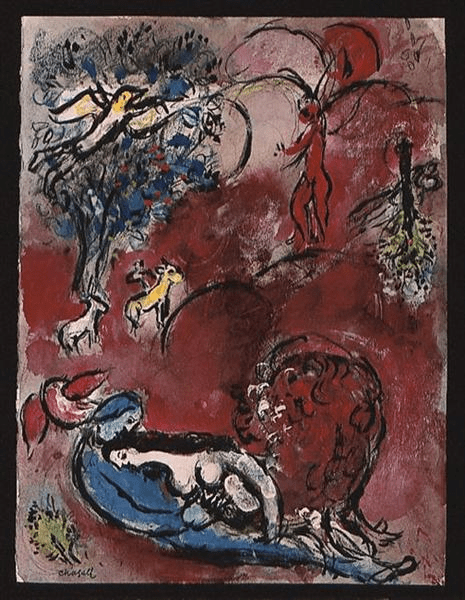
Song of Songs I, by Marc Chagall, 1960

The Song of Songs, which is for Solomon.

[Woman]

If only he would give me some of his kisses . . .

Oh, your loving is sweeter than wine!
Your fragrance is sweet;
        your very name is perfume.
        That’s why the young women love you.
Take me along with you; let’s run!

My king has brought me into his chambers, saying,
“Let’s exult and rejoice in you.
Let’s savor your loving more than wine.
        No wonder they all love you!”

Dark am I, and lovely, daughters of Jerusalem—
        like the black tents of the Kedar nomads,
        like the curtains of Solomon’s palace.
Don’t stare at me because I’m darkened
        by the sun’s gaze.
My own brothers were angry with me.
        They made me a caretaker of the vineyards—
        but I couldn’t care for my own vineyard.

Tell me, you whom I love with all my heart—
        where do you pasture your flock,
        where do you rest them at noon?—
            so I don’t wander around with the flocks of your companions.

[Man]

If you don’t know your way,
    most beautiful of women,
        then follow the tracks of the herds
            and graze your little goats
            by the tents of the shepherds.

I picture you, my dearest,
        as a mare among Pharaoh’s chariots!
Lovely are your cheeks, adorned with ear hoops;
        your neck, with beads.
Let’s make hoops of gold beaded with silver for you!

[Woman]

With my king close by,
        my perfume filled the air.
A sachet of myrrh is my love to me,
        lying all night between my breasts.
A cluster of henna flowers is my love to me
        in the desert gardens of En-gedi.

[Man]

Look at you—so beautiful, my dearest!
        Look at you—so beautiful! Your eyes are doves!

[Woman]

Look at you—so beautiful, my love!
        Yes, delightful! Yes, our bed is lush and green!
The ceilings of our chambers are cedars;
        our rafters, cypresses. (Common English Bible)

The Song of Songs is an unabashedly sensuous biblical book. It is, throughout its contents, an erotic paean to love. In eight chapters, a man and a woman pursue each other through verdant fields and lush valleys. The excitement they have, being together, is palpable.

For most of church history, the Song of Songs has been viewed as an allegory, a love poem between Christ and the Church. And in the case of Hebrew Scripture, the covenant love which exists between God and Israel, has been the predominant interpretive lens.

Seen from this perspective, the Song of Songs reflects that we ought to love the Lord with overpowering commitment, as if we were love-sick for our Beloved. Our thoughts are constantly on the object of our love – how we can please our beloved one.

And yet, there still seems to be room to read the Song in the very down-to-earth realness of physical love between two lovers. Since we are embodied people, such love ought to be celebrated, and is anything but base or to be refused. Sex is a gift from the Creator, and encouraged by God.

I think that the Song of Songs is not an either/or; it is a both/and; it’s both literal and allegorical. That’s not a weird thing. On the allegorical level, the Song is a beautiful poem describing the Divine Eros for God’s people, and the faithful’s heartfelt love for the God whose very name is Love.

Concerning a literal view, the Song celebrates the sanctity of human love, seeing within it the symbol of God’s love for us. Our very real bodies are themselves sacred, just as much as our souls.

Yet, however one chooses to look at the Song of Songs, it remains a statement of mutual admiration, of committed love and affection. It is indeed a poetic lifting of love above all else.

Indeed, if love isn’t the answer, we are not asking the right question.

Believe it or not, the Song of Songs was once viewed as an important key, capable of unlocking the entirety of Holy Scripture.

In fact, C.H. Spurgeon, the Prince of Preachers, in the nineteenth century, preached 59 sermons from this book; in Victorian England, no less. Spurgeon discerned the Song as central to the whole of the Bible. Reflecting on Song of Songs 1:7, he said:

“These words express the desire of the believer after Christ, and his longing for present communion with Him…. Tell me where Thou feeds, for wherever Thou stands as the Shepherd, there will I lie down as a sheep; for none but Thyself can supply my need. I cannot be satisfied to be apart from Thee. My soul hungers and thirsts for the refreshment of Thy presence….

“Satan tells me I am unworthy; but I always was unworthy, and yet Thou hast long loved me; and wherefore my unworthiness cannot be a bar to my having fellowship with Thee now. It is true I am weak in faith, and prone to fall, but my very feebleness is the reason why I should always be where Thou feeds Thy flock, that I may be strengthened, and preserved in safety beside the still waters.

“Why should I turn aside? There is no reason why I should, but there are a thousand reasons why I should not, for Jesus beckons me to come. If He withdraw Himself a little, it is but to make me prize His presence more. Now that I am grieved and distressed at being away from Him, He will lead me yet again to that sheltered nook where the lambs of His fold are sheltered from the burning sun.” Charles Haddon Spurgeon

The Song, in history past, once functioned as a beautiful path to deep intimacy with God. Methinks it behooves us to recover this.

The two lovers in the Song see beauty everywhere. They see it in each other, in the fields where the sheep are pastured, in the orchards where love is consummated, in the seasons, in the animals, trees, and hills. Beauty is all around them, and it is they themselves.

All things which God has created are lovely. Nothing is too small or too insignificant when the eyes of love look upon them. Beauty is designed to be noticed, celebrated, and praised. Love is meant to be expressed out loud, with flavor.

Each time love is stated, every exhalation of adoration, and all of the instances when beauty is acknowledged and affirmed, the ones who speak bind themselves more deeply to God and God’s big world. Together, they call all of it good.

Today’s Old Testament lesson is a wondrous reminder that beauty and love will have its way. Regardless of class, race, family, or societal norms, lovers will continue to seek and find one another and claim their relationship.

While the daughters may stare, and the brothers may be angry, the lovers will yet affirm the beauty of their love. And they will find contentment with each other.

You and I are no accident on this earth; we were created by a loving Creator who has an eye for beauty. And no matter how separated we may get from our divine source, God will seek us out; and if we seek the Lord, he will be found.

O God, you have prepared for those who love you such good things as surpass our understanding: Pour into our hearts such love towards you, so that we, loving you in all things and above all things, may obtain your promises, which exceed all that we can desire. Amen.

Beat the Swords into Plowshares (Micah 4:1-5)

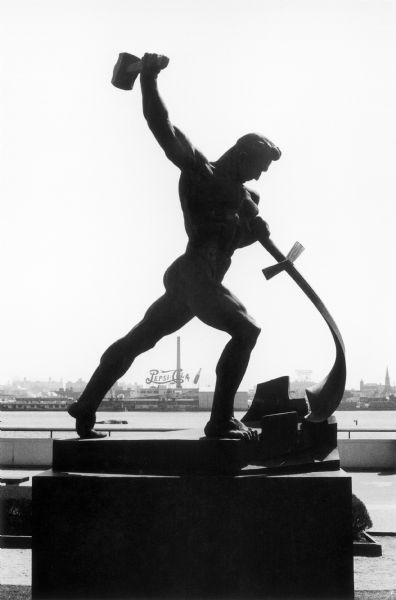
Let Us Beat Swords into Plowshares, by Yevgeniy Vuchetich (1908-1974)

In days to come
    the mountain of the Lord’s temple
shall be established as the highest of the mountains
    and shall be raised up above the hills.
Peoples shall stream to it,
    and many nations shall come and say:
“Come, let us go up to the mountain of the Lord,
    to the house of the God of Jacob,
that he may teach us his ways
    and that we may walk in his paths.”
For out of Zion shall go forth instruction,
    and the word of the Lord from Jerusalem.
He shall judge between many peoples
    and shall arbitrate between strong nations far away;
they shall beat their swords into plowshares
    and their spears into pruning hooks;
nation shall not lift up sword against nation;
    neither shall they learn war anymore;
but they shall all sit under their own vines and under their own fig trees,
    and no one shall make them afraid,
    for the mouth of the Lord of hosts has spoken.

For all the peoples walk,
    each in the name of its god,
but we will walk in the name of the Lord our God
    forever and ever. (New Revised Standard Version)

Yes, we are presently in the muck of the world. But no, it will not always be this way. There is a time coming, when all is said and done, when justice shall prevail. People will seek after God, and they will stop thinking about how to kill each other.

Weapons will be a thing of the past. They’ll just be repurposed for fostering life instead of death. Peace and security will take hold so that each person will be able to work and rest without worrying about poverty or protection.

If this sounds like an idyllic world and a utopian society, that’s because it is. I believe there is a longing within each of us to realize this hope. And someday, in God’s good time, it will happen.

It seems almost impossible, in this contemporary world of ours, that we could live without constant fear and anxiety, that people could actually live together in unity, harmony, and wholeness of being. We were meant for peace, which is why we yearn for it more than an Iowa boy yearning for bacon at breakfast.

Just because this is a prophetic utterance that the faithful believe will happen, doesn’t mean that we need not work toward this ideal now. For it is very possible, and likely real, that we have a large part to play in God’s drama of making a new world.

The day of the Lord will come like a thief. The heavens will disappear with a roar; the elements will be destroyed by fire, and the earth and everything done in it will be laid bare. Since everything will be destroyed in this way, what kind of people ought you to be? You ought to live holy and godly lives as you look forward to the day of God and speed its coming. (emphasis mine, 2 Peter 3:10-12, NIV)

If we are impatient to see an end to wars and rumors of wars, of oppression and hate, then let’s roll up our sleeves and do everything humanly possible (and trusting in divine power!) to bring justice everywhere we can. The future idyllic hope we have is not yet a present reality. We have a bit of say whether it’s going to be sooner or later.

It’s easy to destroy. It takes little imagination and effort to criticize and tear down someone with our words. It’s nothing to send missiles and rockets of destruction in order to raze a community. Bombs can be dropped with but a switch. A neighborhood can disappear in days with just a few bulldozers.

But to bring life and security and peace to a people requires our best efforts and everything we’ve got to make it happen. It’s hard, and takes a lot of committed sweaty work. Building something that will last always takes a great deal of time, resolve, and struggle.

We need the hard work of healers, not the easy path of harmers; we need peacemakers, not warmongers; public servants, not public strangers; faithful leaders, not fat louses; arbitrators, not disputers; religious penitents, not pious know-it-alls; and lovers, not haters.

In short, we need a whole cadre of caring citizens for a new society that prizes egalitarian relations, social and economic justice, personal and public righteousness, and compassionate service.

Injustice must be dismantled; and we need to become content with having enough. That’s what it means to walk in the name of the Lord our God.

If all things belong to God (which they do) and believers hold all things loosely as stewards (which they should) then there is no need to dig in and defend something which is not ours to begin with. Fear is taken away. Injustice becomes irrelevant.

Although we may not be able to make everything right in this present evil age, we can still make a difference and continue to pray:

Maranatha. Come, Lord Jesus, come. Amen.