Wise Living Is Clean Living (Proverbs 15:1-17)

A gentle answer quiets anger, but a harsh one stirs it up.

When wise people speak, they make knowledge attractive, but stupid people spout nonsense.

The Lord sees what happens everywhere; he is watching us, whether we do good or evil.

Kind words bring life, but cruel words crush your spirit.

It is foolish to ignore what your parents taught you; it is wise to accept their correction.

Righteous people keep their wealth, but the wicked lose theirs when hard times come.

Knowledge is spread by people who are wise, not by fools.

The Lord is pleased when good people pray, but hates the sacrifices that the wicked bring him.

The Lord hates the ways of evil people, but loves those who do what is right.

If you do what is wrong, you will be severely punished; you will die if you do not let yourself be corrected.

Not even the world of the dead can keep the Lord from knowing what is there; how then can we hide our thoughts from God?

Conceited people do not like to be corrected; they never ask for advice from those who are wiser.

When people are happy, they smile, but when they are sad, they look depressed.

Intelligent people want to learn, but stupid people are satisfied with ignorance.

The life of the poor is a constant struggle, but happy people always enjoy life.

Better to be poor and fear the Lord than to be rich and in trouble.

Better to eat vegetables with people you love than to eat the finest meat where there is hate. (Good News Translation)

Here is today’s Proverbs lesson in my own colloquial words:

A calm and kind response sucks the anger out of the room, but hot-headed words set the place on hellfire.

A level-headed person gives helpful answers, but a know-it-all only keeps on babbling nonsense.

Just because you cannot see God, doesn’t mean that God cannot see you, both the good and the bad.

Kind words given to another person are life-giving, but unkind words catapulted at a person ends up crushing their spirit.

You can tell a fool by how their refusal to accept counsel from their parents, but a wise person freely receives parental instruction.

Wise folk understand they need to save for a rainy day, but fools spend everything they have, then wonder why they’re in dire straits.

Wisdom and common sense are akin to one another; foolishness and nonsense are two peas in a pod.

The Lord perks up when the righteous pray, but does a face palm when the wicked offer up anything.

The ways of evil people make the Lord nauseous, but the way of the righteous is delightful to God.

A stupid dog doesn’t live very long, because he won’t heed his training or learn from any natural consequences.

If God can see everything that goes on with death and destruction, why would not the Lord see all things within your own heart?

Prickly people won’t listen to advice, and they refuse to consult anyone when making decisions.

Truthful persons smile when they’re happy and frown when they’re sad, but falsehood smiles when it’s sad and frowns when it’s happy.

Learners are curious about life, but ignorant folk only feed on tabloid information.

Once in survival mode, it’s hard to ever get out of it; but those who thrive have learned how to be content in any circumstance.

It’s a whole lot better to be poor and right with God, than to be rich and on the wrong side of the Lord.

Peanut butter sandwiches eaten on the floor with love are much more delicious than eating a filet mignon with hatred around the table.

Our words reflect what is truly the attitude of our heart. And our attitudes betray what we actually think about God and others.

If you drop a foolish person into a roomful of people, it’s like putting a rotten egg in with the rest of the eggs when making an omelet. Or, to put it according to an old adage, “One bad apple spoils the whole bushel basket of them.”

This is why it’s the responsibility of everyone to develop wisdom and a virtuous life. A faith community, a neighborhood, a workplace, a family, or any group of people are adversely affected whenever there’s one arrogant fool amongst them.

But just as he who called you is holy, so be holy in all you do; for it is written: “Be holy, because I am holy.” (1 Peter 1:15-16, NIV)

It only takes one drop of arsenic to ruin a gallon of water and make it undrinkable. And if you choose to drink it anyway, well, you’ll suffer the consequences.

And this is why purity of heart, righteousness, justice, and goodness are so very important. It’s also why holiness is placed as a premium in Holy Scripture, because impurity ruins the community and defiles any group of people.

For where you have envy and selfish ambition, there you find disorder and every evil practice. But the wisdom that comes from heaven is first of all pure; then peace-loving, considerate, submissive, full of mercy and good fruit, impartial and sincere. Peacemakers who sow in peace reap a harvest of righteousness. (James 3:16-18, NIV)

Wise living is clean living, in every sense of a person’s complete self – in body, mind, emotions, and spirit. The Book of Proverbs can help us with that.

O God, by whom the meek are guided in judgment, and light rises up in darkness for the godly: Grant us, in all our doubts and uncertainties, the grace to ask what you would have us to do, so that the Spirit of wisdom may save us from all false choices, and that in your light we may see light, and in your straight path may not stumble. Amen.

Wisdom for Life (Proverbs 11:1-31)

The Lord detests dishonest scales,
    but delights in an accurate weight.
When pride comes, so does shame,
    but wisdom brings humility.
Integrity guides the virtuous,
    but dishonesty ruins the treacherous.
Riches don’t help in the day of wrath,
    but righteousness rescues from death.
The righteousness of the innocent makes their path straight,
    but the wicked fall in their wickedness.
Those who do right are saved by their righteousness,
    but the untrustworthy are caught by their own desires.
When the wicked die, their hope perishes.
    Yes, any hope based on money perishes.
The righteous are saved from distress,
    and the wicked take their place.
The godless destroy their neighbors by their words,
    but the righteous are saved by their knowledge.
When the righteous succeed, a city rejoices;
    when the wicked perish, there are shouts of joy.
A city is honored by the blessing of the virtuous;
    it is destroyed by the words of the wicked.
Whoever despises their neighbor lacks sense;
    a sensible person keeps quiet.
A slanderer walks around revealing secrets,
    but a trustworthy person keeps a confidence.
Without guidance, a people will fall,
    but there is victory with many counselors.
Guaranteeing the debt of a stranger brings big trouble,
    but the one who refuses to shake hands will be secure.
A gracious woman gains honor;
    violent men gain only wealth.
Kind persons benefit themselves,
    but cruel people harm themselves.
The wicked earn false wages,
    but those who sow righteousness receive a true reward.
The righteous are headed toward life,
    but those who pursue evil, toward death.
The Lord detests a crooked heart,
    but he favors those whose path is innocent.
The evil person will surely not go unpunished,
    but the children of the righteous will escape.
Like a gold ring in a pig’s nose
    is a beautiful woman who lacks discretion.
The desires of the righteous end up well,
    but the expectations of the wicked bring wrath.
Those who give generously receive more,
    but those who are stingy with what is appropriate will grow needy.
Generous persons will prosper;
    those who refresh others will themselves be refreshed.
People curse those who hoard grain,
    but they bless those who sell it.
Those who look for good find favor,
    but those who seek evil—it will come to them.
Those who trust in their wealth will wither,
    but the righteous will thrive like leafy trees.
Those who trouble their family will inherit the wind.
    The fool will be servant to the wise.
The fruit of the righteous is a tree of life,
    and the wise gather lives.
If the righteous receive their due on earth,
    how much more the wicked and sinners? (Common English Bible)

The good and the bad, the wise and the foolish, the righteous and the wicked. When it comes to proverbial wisdom, there are two kinds of people: Those who take a right, just, and good path of life; and those who take the wrong exit, practice injustice, and embrace being bad.

We are all, of course, a strange amalgam of sinner and saint. Everyone has some altruism, along with a devious bent. So, life really comes down to our choices. Will our decision-making be wise, or foolish?

This is where the Book of Proverbs helps us. It lays out a prudent course of action for us, so that we can gain a perspective on the consequences of those actions, whether good or bad.

We have to carefully weigh our decisions and consider the likely outcomes of the choices we make.

As we decide, keep in mind that honesty is the best policy (11:1-4); choices have consequences (11:5-6); certain choices lead to rewards (11:7-10); good brings good, and bad brings bad (11:11-31).

Honesty Is the Best Policy

Making the decision to be honest in all things is what builds our capacity to resist evil. Poor choices often come from simply giving in, because we don’t have our resistance to saying “no” built up yet.

Humility enables us to keep our minds on the task at hand, rather than compromise on our integrity in order to achieve something we believe we need or want. The humble person understands that all things are a gift from God – and that the Lord can give, and the Lord can take away. Humility teaches us to say, “Blessed be the name of the Lord.”

When we are emptied of self-promotion, and filled with honest humility, righteousness results. And the righteous person automatically and reflexively denies all evil and wickedness.

Choices Have Consequences

Just because no one sees it, doesn’t mean there won’t be consequences. And just because there was no lightning strike from God immediately after a transgression, doesn’t mean that God’s judgment isn’t coming later.

I talk to far too many people, in my line of work as a hospital chaplain, who are filled with regret about some decision they made earlier in their life. Because now they are experiencing the physical consequences of that choice (and the emotional and relational consequences, as well).

A set of choices made earlier in life not only have real consequences later that one can see and feel; those decisions also erode the ability to make sound decisions in the present. It is a tough uphill struggle to gain some spiritual and emotional health, whenever any reserve of righteousness was not properly developed and maintained.

Certain Choices Lead to Rewards

Conversely, however, consistently good decisions, made over a stretch of time, provide solid spiritual and emotional dividends from which we can draw from in difficult times.

The chief reward for the righteous is that they have a robust life of faith and goodness because of their relationship to the Lord and a good supportive community of persons.

Foolish living leads to punishment; wise living leads to reward. A good life is really a reward itself. That’s because we are meant to live this way, to be merciful and just in all we do, walking humbly with our God. (Micah 6:8)

When the wicked die, that’s it. But when the righteous die, they leave a profound legacy in the form of others who have been encouraged, helped, and loved by their righteousness. They carry on the legacy of good. It makes a big difference.

I cannot imagine any greater reward than to know that I have been faithful to my God, and good to my fellow humanity. Such persons become like a great cloud of witnesses, testifying to the worth of investing in wisdom and humility.

Good Brings Good, Bad Brings Bad

A just and good life inspires others, invigorates groups of people, and leads to holistic health of individuals. Purity of heart is beneficial to the individual, and is contagious to the community.

A foolish life trusts in their own bad attitudes and personal opinions – and then they will wonder why they don’t get anywhere in life, and nobody wants to be around them.

King Solomon himself, gatherer of the biblical proverbs, knew all too well about both the good and the bad, and their eventual outcomes.

Solomon was quite humble and wise at the beginning of his reign. He did everything his father David asked of him, and more. But his wild success as king gradually brought him to acquire more stuff, more wives, and to fudge on the responsibilities and requirements of being king.

If a guy like King Solomon, who was the wisest person who ever lived, can ignore his own nation’s God and Holy Scripture to get whatever he wanted, then how much more do we, who have less wisdom, need the grace of loving people speaking truth to our hearts?

The people we surround ourselves with, no matter who we are, is vitally important. Everyone needs loving persons around them who will tell them what they need to hear in a spirit of love and grace. 

None of us do well with success unless we have humble and wise persons close to us who have the gumption and the grace to speak into our lives to help us, not hurt us. When we don’t have that, things go sideways.

I encourage you to go back and read Proverbs chapter 11 again, slowly, letting its wisdom seep into you. Also, a good practice is to read a chapter of Proverbs each day for the next month; and to occasionally, in the future, come back to this practice.

May the proverbial biblical wisdom fill your heart and your mind, so that you are able to make sage decisions in all of the various circumstances you encounter in this life. Amen.

The Effects of Bad Decisions (2 Samuel 12:15-25)

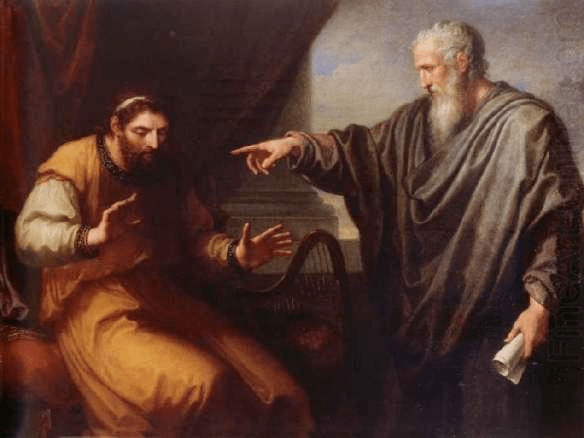
David and Nathan, by Angelika Kauffman (1741-1807)

After Nathan had gone home, the Lord struck the child that Uriah’s wife had borne to David, and he became ill. David pleaded with God for the child. He fasted and spent the nights lying in sackcloth on the ground. The elders of his household stood beside him to get him up from the ground, but he refused, and he would not eat any food with them.

On the seventh day the child died. David’s attendants were afraid to tell him that the child was dead, for they thought, “While the child was still living, he wouldn’t listen to us when we spoke to him. How can we now tell him the child is dead? He may do something desperate.”

David noticed that his attendants were whispering among themselves, and he realized the child was dead. “Is the child dead?” he asked.

“Yes,” they replied, “he is dead.”

Then David got up from the ground. After he had washed, put on lotions and changed his clothes, he went into the house of the Lord and worshiped. Then he went to his own house, and at his request they served him food, and he ate.

His attendants asked him, “Why are you acting this way? While the child was alive, you fasted and wept, but now that the child is dead, you get up and eat!”

He answered, “While the child was still alive, I fasted and wept. I thought, ‘Who knows? The Lord may be gracious to me and let the child live.’ But now that he is dead, why should I go on fasting? Can I bring him back again? I will go to him, but he will not return to me.”

Then David comforted his wife Bathsheba, and he went to her and made love to her. She gave birth to a son, and they named him Solomon. The Lord loved him; and because the Lord loved him, he sent word through Nathan the prophet to name him Jedidiah. (New International Version)

The backstory to today’s Old Testament lesson is that King David not only screwed up, but he also jumped off the diving board into a big nasty pool of immoral excrement.

He saw a woman, Bathsheba, and had to have her. Thinking of only his desire, and not her needs, or that she was a married woman, he used his royal authority to get her. And he slept with her. What’s more, she became pregnant by the king.

At that point, David went to the dark side by covering up his immorality and shame. He eventually went so far as to ensure that Bathsheba’s husband, Uriah (who was both an upright man and an innocent victim) was killed in battle. The king again used his authority to arrange a murder to look like a death in military battle.

With Uriah dead, David brought Bathsheba to his palace as another one of his wives. And no one was the wiser… Except God, who was very displeased with the entire affair. So, the Lord sent Nathan the prophet to David. Through the savvy use of parable, Nathan was successful in helping the king to see his own terrible guilt.

To King David’s credit, he came to the point of recognizing his great faults, and repented of his awful doings. And to God’s credit, David was forgiven.

However, despite the reality of repentance and forgiveness, there are still consequences to our actions. And what is heartbreaking, is that the effects of our bad decisions and bad actions can and do affect others.

As a result of one man’s sin, a woman was violated, a man was murdered, and a baby was conceived, born, and soon died.

Bathsheba attends to her child as David fasts and prays, by W.A. Foster, 1897

King David came to the point of understanding this reality. True repentance, forgiveness, and faith, leads us to a real life which exudes genuineness and authenticity. It won’t undo the past; yet, it will affect the present, and can change the future – that is, if we let mercy and grace have its way.

David’s genuine fatherly love came from his restored place, and was shown by his authentic grieving and mourning. He did not want Bathsheba’s baby son to die. Yet, the child did die. Unfortunately, innocent people often become collateral damage because of another’s unthinking actions.

The king’s behavior, after the child died, shows his pained acceptance of the situation. And his consoling of Bathsheba is the first real evidence we have of David thinking of her instead of himself.

The story reassures us that God loves the next child born from Bathsheba and David. This baby (the future King Solomon) will not pay for his father’s crimes; nor will any other child that David fathers.

The typical trajectory of David’s life was to learn from God’s law and from the experiences God gave him. Yet, in the case of Bathsheba and Uriah, King David ended up learning the hard way that he could not rest on his laurels once he was in a secure and successful place in his life.

Maybe because David spent so much of his adult life facing life-and-death situations, that once he could relax a bit and not have to worry about his life, he let his spiritual and emotional guard down and fell into sin.

After committing adultery, David found himself in a spiritual and emotional place he had never been in before. Yet, instead of confessing his crime to God and making things right with Bathsheba and Uriah, he worked to cover up everything.

Specifically, shame is the place that David had never experienced before, at least to this degree. And when shame gets its poisonous talons into us, it is very hard to be open, real, genuine, and authentic.

In an effort to keep the secrets, the lies morph into more bad decisions, and more bad decisions become ever-increasing bad actions. It becomes a downward spiral of icky guilt which will never be assuaged apart from the divine tools of confession, repentance, faith, and reconciliation.

I trust and hope that it will not take a prophet like Nathan to show you and I how egregious some of our decisions and actions actually are.

Instead, we can make the daily decision to practice our spiritual disciplines, so that when we find ourselves in that good position of no longer having to fight for survival, we will be able to exercise wisdom from the largess of God’s grace which fills us.

Have mercy on me, O God,
    according to your unfailing love;
according to your great compassion
    blot out my transgressions.
Wash away all my iniquity
    and cleanse me from my sin. Amen. (Psalm 51:1-2, NIV)

Confronting the Evil in Front of Us (Mark 6:14-29)

St. John the Baptist rebuking Herod, by Giovanni Fattori (1825-1908)

King Herod heard of it, for Jesus’s name had become known. Some were saying, “John the baptizer has been raised from the dead, and for this reason these powers are at work in him.” But others said, “It is Elijah.” And others said, “It is a prophet, like one of the prophets of old.” But when Herod heard of it, he said, “John, whom I beheaded, has been raised.”

For Herod himself had sent men who arrested John, bound him, and put him in prison on account of Herodias, his brother Philip’s wife, because Herod had married her. For John had been telling Herod, “It is not lawful for you to have your brother’s wife.” 

And Herodias had a grudge against him and wanted to kill him. But she could not, for Herod feared John, knowing that he was a righteous and holy man, and he protected him. When he heard him, he was greatly perplexed, and yet he liked to listen to him. 

But an opportunity came when Herod on his birthday gave a banquet for his courtiers and officers and for the leaders of Galilee. When his daughter Herodias came in and danced, she pleased Herod and his guests, and the king said to the girl, “Ask me for whatever you wish, and I will give it.” And he swore to her, “Whatever you ask me, I will give you, even half of my kingdom.” 

She went out and said to her mother, “What should I ask for?” She replied, “The head of John the baptizer.” Immediately she rushed back to the king and requested, “I want you to give me at once the head of John the Baptist on a platter.” The king was deeply grieved, yet out of regard for his oaths and for the guests, he did not want to refuse her. 

Immediately the king sent a soldier of the guard with orders to bring John’s head. He went and beheaded him in the prison, brought his head on a platter, and gave it to the girl. Then the girl gave it to her mother. When his disciples heard about it, they came and took his body and laid it in a tomb. (New Revised Standard Version)

Feast of Herod with the Beheading of St John the Baptist, in the Museo del Prado, Madrid, Spain

The earthly life and mission of Jesus was connected to the social and political affairs of Judea and the Roman Empire. In truth, Christ’s impact is never only ethereal; rather, it smacks against every system and organization in this world.

John the Baptist’s death was closely connected to Christ’s mission and ministry; and it was also a result of the social and political forces John was subjected to. This would explain why Herod thought of Jesus as a resurrected John, after killing him. Both the messages of John and Jesus were met with resistance by the powers that be.

Marriages in the ancient world, especially among governmental officials, were primarily political affairs, and not love arrangements. The more authority and power a person had, the greater the political implications and impact there was. And marriage was one way of consolidating more power.

Herod’s marriage to Herodias may have been politically expedient, but was ethically repugnant, and John let him know about it. Herod was both a Jew and a Roman official, with his actual allegiance being to himself.

Herodias considered John as politically repugnant and found it unethically expedient to silence him once and for all when she had the opportunity. John the Baptist discovered first-hand that hell hath no fury like a woman’s scorn. Herodias hated him and waited for an opportune time to be rid of him once and for all.

But not only did Herodias orchestrate John’s demise, she did it in a way that sought to humiliate him. To die in battle at the hand of an enemy soldier was an honorable death; but to be executed because of a woman’s handiwork was a mark of shame.

Anyone who lives for God and speaks truth to power will nearly always suffer deep consequences. Hence, this is why a great many prophets ended up dead, often by tortuous methods – including Jesus and nearly all his original disciples.

Unfortunately, there are individuals in this world who are incapable of doing good.

Whenever such persons talk a good line, or do a good deed, it’s always in the service of a larger evil agenda. They often end up in positions of authority, simply because they have no scruples and will lie to you with a straight face.

And they will do anything to not only hold on to their power, but to acquire more so that they can be in control of everything around them. Of course, the people around such a person are miserable. They typically feel powerless to change the situation.

So, if there’s going to be transformation, there will need to be a prophet – someone like John the Baptist – who has the courage to speak truth to power and remind the world that God is the sovereign of the universe.

The Gospel writer Mark presents Herodias as a person with influence and power who only cares about her own interests. She had no scruples in using her daughter for malevolent purposes.

Whereas the young daughter of the synagogue ruler Jairus was (earlier in Mark’s account) raised to life by Jesus, in today’s story the young daughter of Herodias became the vehicle of a grisly murder. And, of all things, it’s this girl who brought the severed head of John the Baptist on a platter to her mother.

We are meant to see the impact and consequence when those in power have self-centered objectives and dark hearts. This is in direct contrast to both Jesus Christ and John the Baptist, both of whom gave their lives for that which is right, just, and good.

God’s mercy and redemption will eventually overwhelm all of creation. The cross and resurrection of Christ have won the victory over evil. Yet, until Christ returns, the dark forces of this old world know their time is short; and they are doing everything they can to throw a monkey wrench into the benevolent machine of grace, before the demonic forces themselves are thrown into the pit forever.

Christian mission and ministry was never designed to be easy nor pain-free. But it is meant to bring hope, love, redemption, peace, and satisfaction to all who believe.

Christ has connected himself to us. Let’s keep that gracious connection going by doing what is right and living a good and just life, and confronting the evil in front of us – to the glory of God. Amen.