1 Corinthians 12:12-27 – One People for the Common Good of All

The body of Christ has many different parts, just as any other body does. Some of us are Jews, and others are Gentiles. Some of us are slaves, and others are free. But God’s Spirit baptized each of us and made us part of the body of Christ. Now we each drink from that same Spirit.

Our bodies don’t have just one part. They have many parts. Suppose a foot says, “I’m not a hand, and so I’m not part of the body.” Wouldn’t the foot still belong to the body? Or suppose an ear says, “I’m not an eye, and so I’m not part of the body.” Wouldn’t the ear still belong to the body? If our bodies were only an eye, we couldn’t hear a thing. And if they were only an ear, we couldn’t smell a thing. But God has put all parts of our body together in the way that he decided is best.

A body isn’t really a body unless there is more than one part. It takes many parts to make a single body. That’s why the eyes cannot say they don’t need the hands. That’s also why the head cannot say it doesn’t need the feet. In fact, we cannot get along without the parts of the body that seem to be the weakest. We take special care to dress up some parts of our bodies. We are modest about our personal parts, but we don’t have to be modest about other parts.

God put our bodies together in such a way that even the parts that seem the least important are valuable. He did this to make all parts of the body work together smoothly, with each part caring about the others. If one part of our body hurts, we hurt all over. If one part of our body is honored, the whole body will be happy. Together you are the body of Christ. Each one of you is part of his body. (Contemporary English Version)

“If instead of a gem, or even a flower, we should cast the gift of a loving thought into the heart of a friend, that would be giving as the angels give.”

George MacDonald (1824-1905)

It’s easy to take things for granted.

For instance, we don’t typically think too much about our toes… until we stub them, drop something on them, break them, or need a podiatrist to operate on them. Then, we not only know they’re still there, but our entire body (along with the mind and emotions!) feels the need to give a lot of attention to the lowest end of our body that enables us to stand and walk without thinking much about it.

The body is an apt metaphor for how to think about humanity and its various systems and institutions. We might see the face of any church or organization, but there are scads of people behind the scenes doing all kinds of good work. For example, the golfing profession understands the importance of caddies; lawyers know the need of paralegal professionals; healthcare facilities and organizations rely not only on nurses and social workers, but also on cooks and housekeepers; schools need the coordination of teachers, parents, students, volunteers, and the entire community to effectively realize the education of children.

Also, as you well know, it’s easy to take for granted services we receive… until we don’t receive them, or in a way to our liking. Then, we pay attention. We want action and resolution. We want our food now and to our exact specifications. Sometimes we might even forget that we are dealing with people, not cogs in a machine or parts in a system. Millions of people labor every single day, sometimes even seven days a week, just to make ends meet and provide for their families. When we neglect to see or understand this, we have done our fellow human beings a gross disservice.

It’s also awfully easy to forget how radical the Apostle Paul’s words were for first-century folks, especially in religious circles. Throughout the Old Testament, the Hebrew community was God’s people. If you wanted to worship the one true God, you came to Jerusalem and learned from Jews.

But Pentecost and the giving of the Holy Spirit changed things in such a profound and organic way that the world would never be the same again.

Paul preached with fervor and flavor that there would not be a separate Jewish church and Gentile church. They have become one Body of Christ through the redemptive events of Jesus. Both Jews and Gentiles have the same Spirit – not different Spirits for each group. Jesus did not die so that people could be fragmented from each other; Christ was crucified to end, once and for all, the segregation, discrimination, and ostentation of one group of people above another. 

The cross was the ultimate radical act of justice against the powers of this dark world that seek to rank people according to their relative importance and worth.

The power of resurrection is the energy of God raising Christ from death to triumph over the realm and system of evil throughout the earth. All kinds of people everywhere are to rise with Christ in a great demonstration of God’s power to subvert the status quo of discriminatory racism, extreme individualism, gender inequality, social and economic classism, and any kind of “ism” which places one group of people in subjection to another in misguided notions of superiority.

The church is to be a community of redeemed people reflecting the diversity of God’s big world.

No two groups of people could have been more different than Middle-Eastern Jews and Greek Gentiles. Yet, Paul adamantly insisted that they together, not separate, make up the one Body of Christ.

It isn’t easy listening to another group of people who think and act differently than you and me. But listen we must. And respond we must. It is our biblical responsibility as believers in the way of Christ. Believers are only the Body of Christ when we are united and together as one people of God.

There is no ability to look down your nose on another person if you are already kneeling on the ground in humble prayer at the foot of the cross. There is only the chance to look up. There is even the opportunity to allow someone less privileged and fortunate to assist you.

Yes, we all need one another – even if it doesn’t seem that way at first.

It isn’t our job to colonize other people’s culture and society to make it more like our own. It is our duty to share good news, make room at the Table, extend love in the name of Jesus, and work together as the one people of God, formed by the Spirit.

Almighty God of all creation, I understand we don’t struggle merely against flesh and blood but against powers and principalities – those institutions and systems that keep separatisms alive by perpetuating the lie that some members of the family are inferior and others superior.  Create in us a new mind and heart that will enable us to see brothers and sisters in the faces of those divided by human constructed categories of power disparities. 

Give us the grace and strength to rid ourselves of stereotypes that oppress some of us while providing entitlements to others. Help us to create a Church and nation that embraces the hopes and fears of oppressed people everywhere, as well as those around the world. Heal your family, God, and make us one with you, in union with our Lord Jesus, and empowered by your Holy Spirit. Amen.

*Above photo credit: music4life on Pixabay

Deuteronomy 34:1-7 – Take the Long View

Then Moses climbed Mount Nebo from the plains of Moab to the top of Pisgah, across from Jericho. There the Lord showed him the whole land—from Gilead to Dan, all of Naphtali, the territory of Ephraim and Manasseh, all the land of Judah as far as the Mediterranean Sea, the Negev and the whole region from the Valley of Jericho, the City of Palms, as far as Zoar. Then the Lord said to him, “This is the land I promised on oath to Abraham, Isaac and Jacob when I said, ‘I will give it to your descendants.’ I have let you see it with your eyes, but you will not cross over into it.”

And Moses the servant of the Lord died there in Moab, as the Lord had said. He buried him in Moab, in the valley opposite Beth Peor, but to this day no one knows where his grave is. Moses was a hundred and twenty years old when he died, yet his eyes were not weak, nor his strength gone. (New International Version)

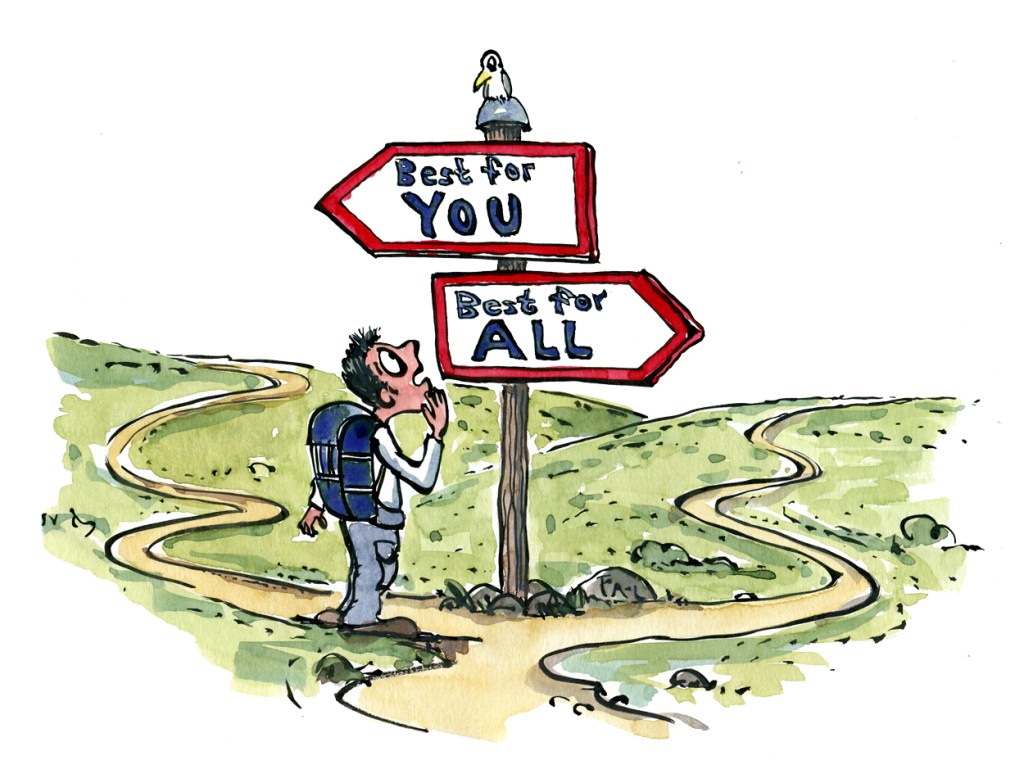
A signpost stands at a fork in the road.

Pointing in one direction, the sign says “Victory.”

Pointing in another direction, the sign says, “Fulfillment.”

We must pick a direction.

Which one will we choose?

If we choose the path to Victory,

the goal is to win!

We will experience the thrill of competition,

as we rush toward the finish line.

Crowds gather to cheer for us!

And then it’s over.

And everyone goes home.

If we choose the path to Fulfillment,

The journey will be long.

There will be times in which we must watch our step.

There will be times we can stop to enjoy the view.

We keep going.

We keep going.

Crowds gather to join us on the journey.

And when our lives are over,

those who joined us on the path to Fulfillment,

will keep going without us and

inspire others to join them, too.

–Simon Sinek

Fulfillment

It wasn’t all about Moses. The dream and vision of entering the Promised Land didn’t die with Moses. He was just one character, albeit an especially important character, along generations of Israelites who anticipated the fulfillment of God’s promises to the people.

In Christianity, the victory has already been won. In Christ, every good promise of God is and will be fulfilled. Therefore, we can choose fulfillment. We can live into Christ’s victory over sin, death, and hell by choosing to be fulfilled in our Christian lives and our Christian service.

Fulfillment of our godly dreams, good vision, and compassionate ministry requires looking beyond the short term. Long term sustainable thriving in Christian mission and flourishing as a Christian community requires an eternal perspective.

Change

To have the end in mind, a future far ahead of us, demands systemic change. This alternative system will be inspirational, not fear-based. Rather than afraid of what might happen, a long term view is for the next generation – not the next budget crisis due to the next building need.

Maybe because I have been a pastor for so long and know my tenure in each place is only temporary, I know that my vision needs to look further down the road than my own time with a group of people. And a vision of any faith community needs to outlast our own mortal existence. If such a perspective and vision appear as if it will take the energy and will you do not have, then there is no shame in saying so and planning for a good death.

Resilience

The church is resilient. It has lasted two millennia. She has weathered a lot of challenge and adversity.

Metaphors matter. The word pictures we use are important. I choose not to view the church as the first bite of the apple, which I believe is the best bite. Instead, I see the church as a fine cigar. It’s the last puff of a cigar which to me is the best of all. Christ’s Church is far from its last puff. Rather, I’m saying that the best is yet to come.

Perseverance

Your best years are not in the past; they are in the future. And that is exactly what the author of the New Testament book of Hebrews wanted his readers to see. Yes, it is difficult in the present. You might be tired and weary, feeling as if you cannot keep going with this whole church thing. Maybe you’ve even dropped out altogether. So, according to Hebrews, this is what we do:

You must encourage one another each day. And you must keep on while there is still a time that can be called “today.” If you don’t, then sin may fool some of you and make you stubborn. (Hebrews 3:13, CEV)

Since we have a great high priest who has ascended into heaven, Jesus the Son of God, let us hold firmly to the faith we profess. For we do not have a high priest who is unable to empathize with our weaknesses, but we have one who has been tempted in every way, just as we are—yet he did not sin. Let us then approach God’s throne of grace with confidence, so that we may receive mercy and find grace to help us in our time of need. (Hebrews 4:14-16, NIV)

Let us draw near to God with a sincere heart and with full assurance of faith…. Let us hold unswervingly to the hope we profess…. And let us consider how we may spur one another on toward love and good deeds…. So do not throw away your confidence; it will be richly rewarded. You need to persevere so that when you have done the will of God, you will receive what he has promised. (Hebrews 10:22-24, 35-36, NIV)

So then, with endurance, let’s run the race that is laid out in front of us, since we have such a great cloud of witnesses surrounding us. Let’s throw off any extra baggage, get rid of the sin that trips us up,and fix our eyes on Jesus, faith’s pioneer and perfecter. He endured the cross, ignoring the shame, for the sake of the joy that was laid out in front of him, and sat down at the right side of God’s throne. Think about the one who endured such opposition from sinners so that you won’t be discouraged, and you won’t give up. (Hebrews 12:1-3, CEB)

So, through Jesus we should never stop offering our sacrifice to God. That sacrifice is our praise, coming from lips that speak his name. And don’t forget to do good and to share what you have with others, because sacrifices like these are very pleasing to God. (Hebrews 13:15-16, ERV)

Community

If we are united in a common cause; choose to collaborate with others; then, even if there is no clear end in sight; we will be on a road of contributing to something bigger than ourselves; something with value that will last well beyond our own lifetimes.

We can anticipate fulfillment.

This is a hard road. It requires counting the cost of discipleship. More important than our doing, is our way of being together, how we are with one another.

For, in the end, relationships bring fulfillment because relationships are the only things we will take with us.

Amos 8:11-13 – Not Just Some

We all do better when we all do better.

“The days are coming,” declares the Sovereign Lord,
    “when I will send a famine through the land—
not a famine of food or a thirst for water,
    but a famine of hearing the words of the Lord.
People will stagger from sea to sea
    and wander from north to east,
searching for the word of the Lord,
    but they will not find it.

“In that day the lovely young women and strong young men
    will faint because of thirst.
(New International Version)

Global Ears

Christians are presently in the season of Eastertide. It is a time of celebrating resurrection and new life… for all, not just some.

A Christian vision of the world is concerned with the common good of all persons, not just some. God is concerned for the entire planet, not just some of it. The Lord calls people from everywhere, all nations, every ethnicity and race of humanity, not just some.

Somewhere along the line, the people of God began hearing God’s voice, as if it were Charlie Brown’s teacher just saying, “Blah, blah… blah, blah.” Smug in their positions of power, and ever-expanding in their desire for more money and possessions, they stopped up their ears to the cries of the poor, needy, and indigent surrounding them.

Self-Centered Ears

Whenever we cease listening to others, we then construct stories in our heads about why they’re the way they are. “The poor? I’ll tell you why they are poor,” says the person with no significant interaction with anyone struggling in poverty. “Those people are lazy. They don’t like to work. They’re only looking for a free handout. Well, believe you me, they aren’t getting a thing from me! I work hard for what I have,” the satisfied person insists.

Then, with a callous disregard for who and what is right under their noses, the privileged person turns to his wife and says, “What’s for supper?” Food aplenty. Clothing galore. Fresh water with no worries. And no thought to helping fellow humanity with even the dignity of listening to the poor person’s plight.

And God will have none of it from the smug self-justifying person. There won’t be a famine of food. It will be a famine of God’s voice, God’s Word. Those who do not listen will not be listened to.

Individualist Ears

For four-hundred years there was a famine of God’s Word, the time between the Old Testament and the New Testament in Holy Scripture. No voice from God. No divine words for anybody, not just some.

As a human community, what one person or one group of people do, effects everyone else. Our individualism doesn’t like that. We chafe at the thought that other people’s actions influence us.

As a young couple, my wife and I rented an apartment. When I contacted the utility company, they informed me I needed to put an exorbitant amount of money down to begin electrical service in our apartment. It turns out, an older gentleman lived alone in the apartment before us. The neighbors said he always kept all the lights on, and that he had high watt bulbs in everything.

So, when the electric company gave me a figure for a down payment, it was based on the apartment’s average usage over the past year. One man’s single solitary decision about lighting impacted a struggling young couple trying to get through school with a new baby in tow.

Just because we don’t see the impact of our decisions, doesn’t mean there aren’t any.

God sees them all. And he hears the cries of the poor who must fork out the precious little cash they have on things not of their own doing.

Whenever people refuse listening to the poor, the entire human community is at risk of experiencing a famine of God’s speech. That’s for all people, not just some.

Biblical Ears

Scripture says people don’t live on food alone but by every word that comes from the mouth of God (Deuteronomy 8:3; Matthew 4:4). God’s Word is necessary sustenance, just as much as the need for three square meals a day. Withholding both physical and spiritual resources from others, either through sheer inattention or blatant disregard, damns a society to experiencing famine in the total sense of the word – for all, not just some.

Worshiping at the altar of capitalism or any other economic system is idolatry. Although I do not believe capitalism is inherently bad, it does have a shadow side to it which we need to see and acknowledge. Private ownership is a good thing. Yet, capitalism benefits only some, not all. We have class divisions and unequal access to goods and resources. A few control a lot. However, in the kingdom of God, all benefit, not just some.

Capitalist Ears

Capitalism is a good motivator to work. It is also the best motivator there is for greed. What’s more, people are viewed and treated more as commodities than human beings. We are not “giving units” to be exploited for our labor or our resources. We are persons. So, we need to be treated as such. Operating a sweat shop, failing to pay workers a living wage, and turning a blind eye to safety, just to make an extra buck, comes under the condemnation of Amos’ prophecy.

A capitalist approach really ends up bringing needless complexity and an exorbitant amount of goods and services, rather than a simple lifestyle which can care for people – instead of maintaining a bunch of stuff. The insatiable desire for more only causes deafness to both neighbor and God.

Common Good Ears

Our way of being together as one human family is vital. Even lovely young women and strong young men – people who have everything going for them – will be resource-less without any word from God. That is, unless we take the biblical prophets seriously. Then, perhaps we will squarely face our collective shadow side and seek the words of God so that we can love all our neighbors as ourselves, and not just some of them.

Do we have ears to hear?

Creator God of all living things: We are all hungry in a world full of abundance. We ask for the grace to see the abundant resources of our world, to have enough awareness of the dark places of our hearts to acknowledge our sins of greed and fear. Give us openness of soul and courageous, willing hearts to be with our sisters and brothers who are hungry and in pain. We intercede on behalf of every person who is hungry for earthly food and hungry for the Word of God. We pray in the name of our compassionate Savior who hears every cry, and not just some. Amen.

Psalm 95 – Worship and Whining

Psalm 95 verse 4, by Cecelia Nedlin

Come, let us sing for joy to the Lord;
    let us shout aloud to the Rock of our salvation.
Let us come before him with thanksgiving
    and extol him with music and song.

For the Lord is the great God,
    the great King above all gods.
In his hand are the depths of the earth,
    and the mountain peaks belong to him.
The sea is his, for he made it,
    and his hands formed the dry land.

Come, let us bow down in worship,
    let us kneel before the Lord our Maker;
for he is our God
    and we are the people of his pasture,
    the flock under his care.

Today, if only you would hear his voice,
“Do not harden your hearts as you did at Meribah,
    as you did that day at Massah in the wilderness,
where your ancestors tested me;
    they tried me, though they had seen what I did.
For forty years I was angry with that generation;
    I said, ‘They are a people whose hearts go astray,
    and they have not known my ways.’
So I declared on oath in my anger,
    ‘They shall never enter my rest.’”
(New International Version)

Revelation and Response

Praise and thanksgiving. Complaining and grumbling. These two sets of words are antithetical to each other. Yet, out of the same mouth can come both worship and whining. Maybe the psalmist was trying to teach us a thing or two by inviting us to sing and bow to the Lord, as well as hear God’s voice.

Worship and listening are meant to go hand in hand. Revelation and response are to be the spiritual rhythm of the believer. True worship is a divine conversation between us and God. The Lord speaks. We listen and answer. Back and forth we go together. God and God’s people are in dialogue.

When the worship rhythm is off, then our response will be off. And that is what happened to the ancient Israelites. They were miraculously delivered from their cruel bondage in Egypt. You can imagine the kind of praise and worship service the people had in the desert! After four-hundred years of slavery, freedom!

The Rhythm is Off

Before you know it, the thanksgiving turned sour into grumbling. At the first instance of adversity, when there was no water to drink, it was as if the people had some sort of collective dementia set in. Suddenly, hardness of heart. Talk about fickle! One minute hands are raised in praise, the next minute, those same hands clench into fists shaking at God.

The people forgot that this was an ongoing dialogue – not a one and done conversation of revelation and response. God acted by delivering the people. The people responded with praise and thanksgiving. And they didn’t want it to stop. Yet, all of life is a rhythm. What goes up, comes down. Good times eventually fade into tough times. The real muster of any person or group is the response when the hardship comes.

God knew exactly what he was doing. The Lord purposely brought the Israelites out into the desert to face a difficult circumstance. God was teaching them to trust. The Lord wanted a response of faith and prayer to the adverse situation. But the people weren’t looking for a dialogue. They were looking for water. And when they didn’t have it, their hearts hardened through murmuring, bellyaching, and dissatisfaction.

However, God was still in the conversation. The generation who saw the incredible deliverance from bondage would die in the desert, never setting eyes on the Promised Land. And it all began because of grumbling.

Complaining is Unhealthy

We need to take complaining seriously. Why? Because it rots the soul, like Mr. Grinch who incessantly complained every year about Christmas. Grumbling makes one into a Grinch-like creature, like the song says:

You’re as cuddly as a cactus
You’re as charming as an eel…

You got termites in your smile
You have all the tender sweetness
Of a seasick crocodile…

Your heart’s an empty hole
You got garlic in your soul.

It was only when the Grinch forsook his isolation of complaining and began connecting in conversation with the folks in Whoville, that he had his rhythm restored.

The Need for Encouragement

When our rhythm is off kilter, what will it take to get it back? The author of the New Testament letter to the Hebrews helps us here. After quoting our psalm lesson for today, the writer responded to the biblical revelation by saying:

Be careful, brothers and sisters, that none of you ever develop a wicked, unbelieving heart that turns away from the living God. Encourage each other every day while you have the opportunity. If you do this, none of you will be deceived by sin and become stubborn. After all, we will remain Christ’s partners only if we continue to hold on to our original confidence until the end. Scripture says, “If you hear God speak today, don’t be stubborn. Don’t be stubborn like those who rebelled.”

Hebrews 3:12-15, God’s Word Translation

Revelation and response are the rhythmic dynamism of the Christian community. Lone Ranger Christians are an oxymoron, as well as moronic. We are hard-wired by God for community. All of us need to encourage one another – every day. Without the communal connections of encouraging conversations, it will be difficult to sustain a divine dialogue of God speaking, with people listening and responding in obedient faith.

Celebration is wonderful. We need times and experiences of celebrating deliverance from bondage. Eventually, when Christ returns, there will be unending worship in the form of jubilation. That time is not yet here. This side of heaven, we must learn to engage God in ways which address our hardships and difficulties. Otherwise, our hearts will become stubborn and hard.

Let your heart become open enough to receive encouragement. And let it also be brave enough to encourage others.

Lord Jesus Christ, by your patience in suffering you caused earthly pain to be holy. And you gave us the example of obedience to your Father’s will. Be near me in my time of weakness and pain. Sustain me by your grace so that my strength and courage may not fail. Heal me according to you will. Help me always believe that what happens to me here is of little account if you hold me in eternal life, my Lord and my God. Amen.