1 Corinthians 12:4-11 – Spirituality for the Common Good

Jesus breathed on the disciples and said, “Receive the Holy Spirit.”

There are different spiritual gifts, but the same Spirit gives them. There are different ways of serving, and yet the same Lord is served. There are different types of work to do, but the same God produces every gift in every person.

The evidence of the Spirit’s presence is given to each person for the common good of everyone. The Spirit gives one person the ability to speak with wisdom. The same Spirit gives another person the ability to speak with knowledge. To another person the same Spirit gives courageous faith. To another person the same Spirit gives the ability to heal. Another can work miracles. Another can speak what God has revealed. Another can tell the difference between spirits. Another can speak in different kinds of languages. Another can interpret languages. There is only one Spirit who does all these things by giving what God wants to give to each person. (God’s Word Translation)

A gift is meant to be unpacked. It would be weird if someone was given a gift, then let it sit unopened. Instead, we typically receive the gift, rip it open, and express gratitude for the thoughtfulness. Then, we use and enjoy it.

The Spirit, likewise, has been marvelously given to God’s people. Each individual Christian is specially provided a gift to open, use, and enjoy. Spiritual gifts graciously given to us are meant for the common good of all. And this use for the common good is where the gift is different than Christmas or birthday presents.

Spiritual gifts are designed by God to be acts and words of service, dispersed for the benefit of others.

They are not meant solely for personal satisfaction. So, if a person’s spiritual gift is teaching, they do not stand in front of a mirror and talk at themselves. Instead, they jump into the fray of learning and explaining, and do it in such a gracious and loving way that the enablement of the Spirit is evident.

If a person’s gift is faith, they do not merely step out and act with unusual courage for the purpose of personal betterment in a holy belief from God. They also demonstrate faithfulness to God’s people and to God’s world. The gift is for the common good of all persons.

The accumulation of wisdom and knowledge is meant for the strengthening of faith in others. Spiritual gifts are intended by God to be shared freely for the common good of all people so that souls are buttressed and supported for the rigors of daily life in the world.

We are to take initiative in identifying our gift(s), unpacking them, and indiscriminately using them. 

Spiritual health and wholeness can only truly be realized through everyone’s active participation in distributing their God-given abilities. Spiritual gifts are neither to be hoarded, nor miserly dealt to only people I like or my own little world of groupies and friends. Any and every ability comes from God, and is, therefore given for the benefit of all persons. Underprivileged groups need the giftedness of others, as well as discovering their own resources so that everyone is built up in a society of redeemed persons.

Mavericks are not helpful here. The Lone Ranger is not to be the model of aspiration.

Christians are the Body of Christ, meant to function as one. Just as the Holy Trinity of divine three persons – Father, Son, and Spirit – work together in unity of purpose and harmony of being, so the persons of the Church are to unify and act as one in the mission of God. Diversity of gifts are to be expressed in unity of building up others and extending Christ’s love to the world. When we harmoniously coordinate our joint efforts in utilizing our collective spiritual gifts, the world is turned upside-down with kingdom grace and ethics.

Sometimes we might succumb to “gift envy.” We observe the talented gift of another and secretly wish it for ourselves. The proper remedy to such a malady is gratitude. When we give thanks to God for the gift(s) we truly possess, then envy has nowhere to reside and slithers away.

None of God’s gifts are “sexy” in the sense that they come easily without effort and always look appealing.

On the contrary, our gifts are meant to be received and developed with lots of daily mundane work so that we live into the special endowment bestowed upon us. This, in fact, takes a lifetime of development because the Spirit’s gifts are so generously large – much bigger than we originally observe at first glance. Like an engagement ring in a tiny box, receiving the gift and putting it on will involve commitments and challenges we cannot at the time perceive.

Whatever it is you do well, do it to the glory of God.

Allow God to activate it and energize it for the prevailing needs of a church and a world which is in want of kindness, goodness, and love.

O Lord, you have taught me that without love, whatever I do is worth nothing.  Send your Holy Spirit and pour into my heart your greatest gift, which is love, the true bond of peace and of all virtue, without which whoever lives is accounted dead before you. Grant this for the sake of your only Son Jesus Christ, who lives and reigns with you and the Holy Spirit, one God, now and forever. Amen.

*Above painting by Jyoti Sahi, based on John 20:22

Mark 10:42-45 – True Leadership

Jesus called them together and said, “You know that those who are regarded as rulers of the Gentiles lord it over them, and their high officials exercise authority over them. Not so with you. Instead, whoever wants to become great among you must be your servant, and whoever wants to be first must be slave of all. For even the Son of Man did not come to be served, but to serve, and to give his life as a ransom for many.” (New International Version)

Leadership as Service

I remember a time when all politicians, government officials, and police were known as “public servants.” It was routinely assumed that such persons served the common good of all persons, regardless of who they are. I am also not delusional about the fact that, back in the day, just as today, there are those who served themselves first. However, at least, the ideal and vision of service was continually before the people.

Power is to be wielded for the benefit of the powerless. Authority is to be used to help those who cannot help themselves. Contemporary understandings of authority for many people today often do not have the common good as their guiding principles of leadership.

Misuse of Leadership

Rather, authority becomes the means of convincing others of the leader’s opinion or position. Power is used to influence, even arm-twist people toward the leader’s ideas. What’s more, those who enabled the leader to come to power expect that leader to use authority to benefit a particular agenda and only one slice of the human population. Lost is the vision of meeting needs for everyone, not just a certain constituency.

The ultimate use of power is to share it, even lay it down. Jesus did it in his incarnation, life, and death. He only took it up again after his mission was finished. We are to follow his cues on power and authority. We have opportunities galore to follow Christ in his leadership practice. For example, I once lived in a community with a large single parent family population. After talking with the elders of my church about this situation, they became excited about the prospects of reaching moms and children struggling to make it day to day.

The discussion did a hard turn of direction when I suggested we have some of those moms come in, sit around the table with us, and dictate what would constitute effective ministry which meets their needs. I was intentionally proposing that we, as church authority figures, share our power with the moms. The elders weren’t having it. One of them said outright, “Well, we can’t do that! We know better!” (than the moms do)

Whenever those in power and authority believe it is their mandate to make decisions without even having conversations with those whom those decisions effect, then they have become masters of small worlds, lords of folly, and ideational bullies. It is not the way of Jesus.

Appropriate Use of Leadership

Proper use of authority doesn’t mean we boss people around. It means we do what we need to do to help everyone in our scope of power. Taking charge must always begin with self. The self-control and self-discipline of the leader is the basis of leadership.

The heart of Christianity is loving service to one another as Christians, and humble service to a world which doesn’t believe, or act like us. Christian leaders are to focus on others’ well-being, success, and growth. They are to value character over career.

Christian disciples follow Jesus in the use of power and authority through:

  • Taking a humble posture of consulting and collaborating with others. And when decisions are made, they maintain relational connections.
  • Including others, and never vilifying or casting blame when stating a case for something.
  • Dealing with trouble and working to clear a toxic environment of noxious attitudes.
  • Directly confronting those they have an issue with, without creating destructive triangles to diffuse responsibility.
  • Encouraging a healthy dynamic of love and service which seeks listening before acting.

Leadership is more about being than about doing. Responsible use of authority comes from the person who understands themselves, is curious about others, and seeks to wisely apply Christ’s compassion to meet human need.

The Leadership of Jesus

Jesus healed people and delivered them from evil, sometimes at great risk to himself. He continually eschewed the perks of power to single-mindedly pursue the Father’s will. Even in his selection of disciples, Jesus purposely overlooked others to choose a rather motley band of men made up of uneducated country bumpkins, the poor, and the overzealous.

The Lord Jesus proclaimed a kingdom that belongs to children, using power to drive out demons and forgive sins. Christ delegated his authority to the disciples to do this same sort of work.

Jesus isn’t offering leadership theories; he is offering himself. Christ is our model of the appropriate use of power. Therefore, humbling ourselves must become our ambition! Our Lord, the ultimate authority above all authorities, humbled himself. Though being powerfully divine, he took the form of a servant, and became obedient to death, even the particularly shameful death on a cross—the ultimate humiliation. Yet God exalted Jesus Christ as Lord of the universe. (Phil 2:5-11)

Will you divest yourself of the pride in believing you know what is best for everyone around you? Will you cease speaking and start listening? Will you follow Jesus to the risky place of sharing power and authority with the powerless?

God, I am far too often influenced by what others think of me. I am always pretending to be either richer or smarter or nicer than I really am. Please prevent me from trying to attract attention. Don’t let me gloat over praise on one hand or be discouraged by criticism on the other. Nor let me waste time weaving imaginary situations in which the most heroic, charming, witty person present is myself. Show me how to be humble of heart, like you. Amen.

Amos 8:11-13 – Not Just Some

We all do better when we all do better.

“The days are coming,” declares the Sovereign Lord,
    “when I will send a famine through the land—
not a famine of food or a thirst for water,
    but a famine of hearing the words of the Lord.
People will stagger from sea to sea
    and wander from north to east,
searching for the word of the Lord,
    but they will not find it.

“In that day the lovely young women and strong young men
    will faint because of thirst.
(New International Version)

Global Ears

Christians are presently in the season of Eastertide. It is a time of celebrating resurrection and new life… for all, not just some.

A Christian vision of the world is concerned with the common good of all persons, not just some. God is concerned for the entire planet, not just some of it. The Lord calls people from everywhere, all nations, every ethnicity and race of humanity, not just some.

Somewhere along the line, the people of God began hearing God’s voice, as if it were Charlie Brown’s teacher just saying, “Blah, blah… blah, blah.” Smug in their positions of power, and ever-expanding in their desire for more money and possessions, they stopped up their ears to the cries of the poor, needy, and indigent surrounding them.

Self-Centered Ears

Whenever we cease listening to others, we then construct stories in our heads about why they’re the way they are. “The poor? I’ll tell you why they are poor,” says the person with no significant interaction with anyone struggling in poverty. “Those people are lazy. They don’t like to work. They’re only looking for a free handout. Well, believe you me, they aren’t getting a thing from me! I work hard for what I have,” the satisfied person insists.

Then, with a callous disregard for who and what is right under their noses, the privileged person turns to his wife and says, “What’s for supper?” Food aplenty. Clothing galore. Fresh water with no worries. And no thought to helping fellow humanity with even the dignity of listening to the poor person’s plight.

And God will have none of it from the smug self-justifying person. There won’t be a famine of food. It will be a famine of God’s voice, God’s Word. Those who do not listen will not be listened to.

Individualist Ears

For four-hundred years there was a famine of God’s Word, the time between the Old Testament and the New Testament in Holy Scripture. No voice from God. No divine words for anybody, not just some.

As a human community, what one person or one group of people do, effects everyone else. Our individualism doesn’t like that. We chafe at the thought that other people’s actions influence us.

As a young couple, my wife and I rented an apartment. When I contacted the utility company, they informed me I needed to put an exorbitant amount of money down to begin electrical service in our apartment. It turns out, an older gentleman lived alone in the apartment before us. The neighbors said he always kept all the lights on, and that he had high watt bulbs in everything.

So, when the electric company gave me a figure for a down payment, it was based on the apartment’s average usage over the past year. One man’s single solitary decision about lighting impacted a struggling young couple trying to get through school with a new baby in tow.

Just because we don’t see the impact of our decisions, doesn’t mean there aren’t any.

God sees them all. And he hears the cries of the poor who must fork out the precious little cash they have on things not of their own doing.

Whenever people refuse listening to the poor, the entire human community is at risk of experiencing a famine of God’s speech. That’s for all people, not just some.

Biblical Ears

Scripture says people don’t live on food alone but by every word that comes from the mouth of God (Deuteronomy 8:3; Matthew 4:4). God’s Word is necessary sustenance, just as much as the need for three square meals a day. Withholding both physical and spiritual resources from others, either through sheer inattention or blatant disregard, damns a society to experiencing famine in the total sense of the word – for all, not just some.

Worshiping at the altar of capitalism or any other economic system is idolatry. Although I do not believe capitalism is inherently bad, it does have a shadow side to it which we need to see and acknowledge. Private ownership is a good thing. Yet, capitalism benefits only some, not all. We have class divisions and unequal access to goods and resources. A few control a lot. However, in the kingdom of God, all benefit, not just some.

Capitalist Ears

Capitalism is a good motivator to work. It is also the best motivator there is for greed. What’s more, people are viewed and treated more as commodities than human beings. We are not “giving units” to be exploited for our labor or our resources. We are persons. So, we need to be treated as such. Operating a sweat shop, failing to pay workers a living wage, and turning a blind eye to safety, just to make an extra buck, comes under the condemnation of Amos’ prophecy.

A capitalist approach really ends up bringing needless complexity and an exorbitant amount of goods and services, rather than a simple lifestyle which can care for people – instead of maintaining a bunch of stuff. The insatiable desire for more only causes deafness to both neighbor and God.

Common Good Ears

Our way of being together as one human family is vital. Even lovely young women and strong young men – people who have everything going for them – will be resource-less without any word from God. That is, unless we take the biblical prophets seriously. Then, perhaps we will squarely face our collective shadow side and seek the words of God so that we can love all our neighbors as ourselves, and not just some of them.

Do we have ears to hear?

Creator God of all living things: We are all hungry in a world full of abundance. We ask for the grace to see the abundant resources of our world, to have enough awareness of the dark places of our hearts to acknowledge our sins of greed and fear. Give us openness of soul and courageous, willing hearts to be with our sisters and brothers who are hungry and in pain. We intercede on behalf of every person who is hungry for earthly food and hungry for the Word of God. We pray in the name of our compassionate Savior who hears every cry, and not just some. Amen.

Luke 22:24-30 – Just Shadow Jesus

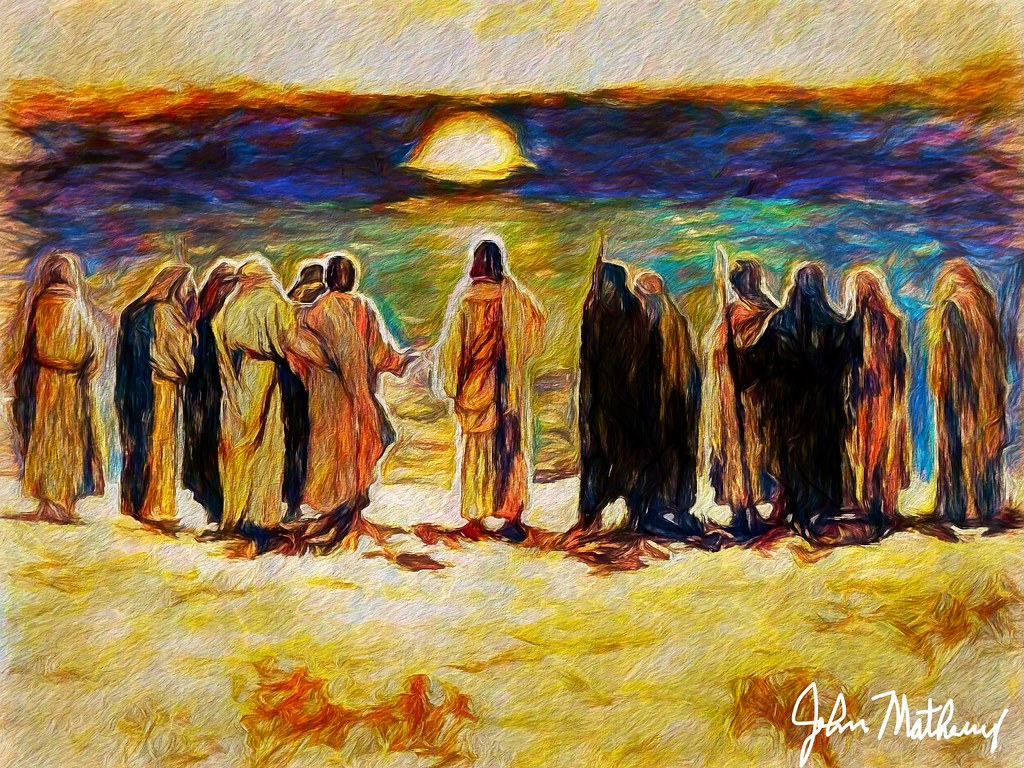
Digital painting of Jesus and the disciples by John Mathews

A dispute also arose among them as to which of them was considered to be greatest. Jesus said to them, “The kings of the Gentiles lord it over them; and those who exercise authority over them call themselves Benefactors. But you are not to be like that. Instead, the greatest among you should be like the youngest, and the one who rules like the one who serves. For who is greater, the one who is at the table or the one who serves? Is it not the one who is at the table? But I am among you as one who serves. You are those who have stood by me in my trials. And I confer on you a kingdom, just as my Father conferred one on me, so that you may eat and drink at my table in my kingdom and sit on thrones, judging the twelve tribes of Israel. (NIV)

Jesus is a different sort of leader.

While the kings of his day were concerned with power and using their authority to ensure even more power and privilege, Jesus went about things differently. In a world of patronage where it was necessary for the lower classes to connect with and suck-up to the higher classes, Jesus operated by a different system.

Jesus, Lord of the universe, King of creation, absolute Leader of the Church, and Ruler over God’s realm was and is a servant of the people.

“Follow my example: Even the Son of Man did not come for people to serve him. He came to serve others and to give his life to save many people.”

mark 10:45, erv

On the surface, striving to be the best might seem noble and good. Yes, working toward being the greatest might motivate us to do all things with excellence. It can solve a lot of problems and issues. On the other hand, it may also result in attitudes and behavior which fosters unhealthy competition and an inordinate focus on becoming the greatest.

Think about it. Not everyone can be the greatest. If everyone is, nobody is. This results in lower self-esteem for nearly everybody. And it creates ripe conditions for leadership paranoia in which the greatest is always looking over their shoulder worrying about being toppled from their lofty position. At the least, all this ballyhoo about greatness only takes away from caring for the people who most need our efforts – family members get the shaft from someone with an imbalanced life who is laser-focused on getting to the top and staying there.

It’s as if a person is living a one-dimensional existence in a three-dimensional world. It won’t work. Fortunately, we don’t have to live like that.

Jesus shows us a better way.

Jesus was present to his disciples. He is present to us in the person of the Holy Spirit. Christ encouraged relational connections and using one’s gifts, talents, and abilities for the common good of all people. For Jesus Christ, the dynamics of power and authority are not to be leveraged for personal greatness but for collective uplift. Authority is to be carefully applied for everyone’s benefit, including those we think don’t deserve it.

The disciples understood far too little about the community their leader was trying to build. Judas Iscariot is likely the one disciple who first realized what Jesus was truly up to. The greatest are the least and the least are the greatest. It wasn’t what Judas signed up for, so he cut his losses and betrayed Jesus.

True exaltation is a gift of grace. The kingdom of God turns on mercy and operates on the economy of grace. It is those who faithfully serve who will sit with Jesus, the ultimate Servant, at the table. Peacocks and pretenders will never realize their dream to be the center of attention.

In a great twist of irony, those who wish to compete and occupy a high standing will discover they have worked to obtain the lowest rung on the ladder leaning against the wall of Satan’s kingdom.

Jesus consistently, patiently, and carefully established the kingdom of God on earth. He went about his task in a manner none of us would even consider. He focused on character, not skills; willing hearts, not intelligent brains; new life, not reformed habits. On the job orientation involved following Jesus around everywhere.

Just shadow Jesus.

Here I am washing your feet. Do the same. Here I am being present to and serving the poor, the lonely, the outcast, the moral failure, and the lowest of society. Do the same. Here I am showing sacrificial self-emptying unconditional love. Do the same. Just shadow me. Do what I do, period.

An obsession with greatness will inevitably lead to petty kingdom building enterprises. Instead, we are to love the neighbor next to us. We make room at the committee table for somebody who looks, acts, and talks different than me. We freely let Jesus live through us, thus, giving the gift of him to those we encounter. We purposely look for ways to serve underprivileged communities rather than use the people living there in ways to make us look better.

Indeed, this following Jesus thing is subversive – even for many professing Christians.

What will you do?

Go in peace to love and serve the Lord, in the name of Christ. Amen.