Colossians 2:6-15 – Our Identity in Christ

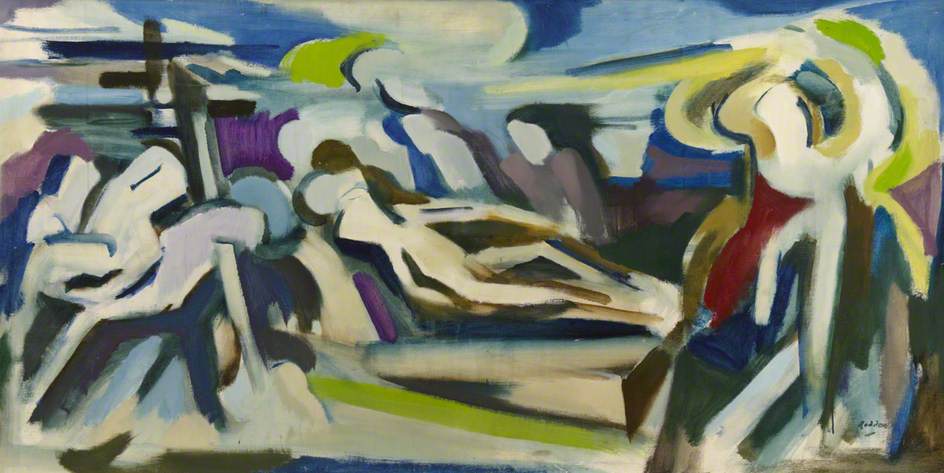
Death, Burial, and Resurrection of Christ by Guy Roddon (1919-2006)

So then, just as you received Christ Jesus as Lord, continue to live your lives in him, rooted and built up in him, strengthened in the faith as you were taught, and overflowing with thankfulness.

See to it that no one takes you captive through hollow and deceptive philosophy, which depends on human tradition and the elemental spiritual forces of this world rather than on Christ.

For in Christ all the fullness of the Deity lives in bodily form, and in Christ you have been brought to fullness. He is the head over every power and authority. In him you were also circumcised with a circumcision not performed by human hands. Your whole self, ruled by the flesh, was put off when you were circumcised by Christ, having been buried with him in baptism, in which you were also raised with him through your faith in the working of God, who raised him from the dead.

When you were dead in your sins and in the uncircumcision of your flesh, God made you alive with Christ. He forgave us all our sins, having canceled the charge of our legal indebtedness, which stood against us and condemned us; he has taken it away, nailing it to the cross. And having disarmed the powers and authorities, he made a public spectacle of them, triumphing over them by the cross. (New International Version)

I like kids. Since I believe them to be closer to God’s kingdom than most adults, I respect them by bending down to talk with them on their level. I take an interest in what they have to say and what’s going on with them. And I pay attention in ways that helps solidify their sense of worth, identity, and belonging. Indeed, how we treat children within the family, the church, and in public can make a significant difference in the trajectory of how they grow up and think of themselves.

One of the most fundamental of all Christian truths is that we belong to Christ. We are God’s children. God has given us everything we need for a solid awareness of our true identity. 

The follower of Jesus is a person who has moved from the realm of being in the world to the sphere of being in Christ. The Christian’s knowledge, understanding, and sense of identity are vitally important because we tend to live up to how we view ourselves.  

Today’s New Testament lesson is dense with the teaching of who we are in Christ. We are to live our lives in Christ. We are rooted and built up in Christ. We have been filled in Christ. We have a spiritual circumcision in Christ. We have been raised in Christ to new life. We are triumphant in Christ.  All this is meant to saturate us with the richness and security of being in the realm of Jesus Christ.

In Jesus Christ:

I am God’s child (John 1:12)

I have been justified (Romans 5:1)

I am Christ’s friend (John 15:15)

I belong to God (1 Corinthians 6:20)

I am a member of Christ’s Body (1 Corinthians 12:27)

I am assured all things work together for good (Romans 8:28)

I am confident that God will perfect the work begun in me (Philippians 1:6)

I am a citizen of heaven (Philippians 3:20)

I am hidden with Christ in God (Colossians 3:3)

I am brave, strong, and self-disciplined (2 Timothy 1:7)

I am born of God and the evil one cannot touch me (1 John 5:18)

I am blessed in the heavenly realms with every spiritual blessing (Ephesians 1:3)

I am chosen before the creation of the world (Ephesians 1:4, 11)

I am holy and blameless (Ephesians 1:4)

I am adopted as God’s child (Ephesians 1:5)

I am lavishly given God’s glorious grace (Ephesians 1:5,8)

I am redeemed (Ephesians 1:8)

I am forgiven (Ephesians 1:8; Colossians 1:14)

I am hopeful (Ephesians 1:12)

I am included (Ephesians 1:13)

I am sealed with the promised Holy Spirit (Ephesians 1:13)

I am a saint (Ephesians 1:18)

I am the salt and light of the earth (Matthew 5:13-14)

I am God’s coworker (2 Corinthians 6:1)

I am a minister of reconciliation (2 Corinthians 5:17-20)

I am alive with Christ (Ephesians 2:5)

I am raised up with Christ (Ephesians 2:6; Colossians 2:12)

I am seated with Christ in the heavenly realms (Ephesians 2:6)

I am rich with God’s grace (Ephesians 2:7)

I am a recipient of God’s kindness (Ephesians 2:7)

I am God’s workmanship (Ephesians 2:10)

I am close to God (Ephesians 2:13)

I am peaceful (Ephesians 2:14)

I am a member of God’s household (Ephesians 2:19)

I am secure (Ephesians 2:20)

I am a holy temple (Ephesians 2:21; 1 Corinthians 6:19)

I am a dwelling for the Holy Spirit (Ephesians 2:22)

I am a friend of God (Ephesians 3:6)

I am free and confident (Ephesians 3:12)

I am joyful in my sufferings (Ephesians 3:13)

I am loved and can love others (Ephesians 3:18)

I am called (Ephesians 4:1; 2 Timothy 1:9)

I am humble, gentle, patient, and tolerant of others (Ephesians 4:2)

I am truthful (Ephesians 4:17)

I am living a new life (Ephesians 4:21-32)

I am kind and compassionate to others (Ephesians 4:32)

I am forgiving of others (Ephesians 4:32)

I am good (Ephesians 5:8-9)

I am grateful (Ephesians 5:20)

I am secure (Ephesians 6:13)

I am dead to sin (Romans 1:12)

I am not alone (Hebrews 13:5)

I am growing (Colossians 2:7)

I am united with other believers (John 17:20-23)

I am victorious (I John 5:4)

I am chosen and dearly loved (Colossians 3:12)

I am blameless (I Corinthians 1:8)

I am more than a conqueror (Romans 8:37)

I am safe (I John 5:18)

I am healed (I Peter 2:24)

I am no longer condemned (Romans 8:1, 2)

I am not helpless (Philippians 4:13)

I am overcoming (I John 4:4)

I am persevering (Philippians 3:14)

I am protected (John 10:28)

I am born again (I Peter 1:23)

I am a new creation (2 Corinthians 5:17)

I am delivered (Colossians 1:13)

I am redeemed from the curse of the Law (Galatians 3:13)

I am qualified to share in Christ’s inheritance (Colossians 1:12)

I am victorious (1 Corinthians 15:57)

Take ten minutes today and focus on one of the phrases or words from these verses. Think about its meaning. Ponder how it makes a difference in your Christian life. Then decide what you will do with the insight God gives you. Finally, share it with a friend. In all these ways we can press the truth of our identity firmly into our souls and live into the reality that we belong to Christ.

Gracious God, you have brought me from death to life, from being of the world to being in Christ. Solidify my sense of identity with Jesus and release that self-knowledge into loving practice toward others. Amen.

Colossians 3:12-17 – Wear the Right Clothes

God loves you and has chosen you as his own special people. So be gentle, kind, humble, meek, and patient. Put up with each other, and forgive anyone who does you wrong, just as Christ has forgiven you. Love is more important than anything else. It is what ties everything completely together.

Each one of you is part of the body of Christ, and you were chosen to live together in peace. So let the peace that comes from Christ control your thoughts. And be grateful. Let the message about Christ completely fill your lives, while you use all your wisdom to teach and instruct each other. With thankful hearts, sing psalms, hymns, and spiritual songs to God. Whatever you say or do should be done in the name of the Lord Jesus, as you give thanks to God the Father because of him. (Contemporary English Version)

New life is fantastic!… Until it isn’t.

Like a new car eventually losing its new car smell, so it is quite easy for the Christian to experience the mountaintop of transformation, only to lug back down and walk through the boring old valley.

And it’s fun to have a new set of clothes… until they wear out, go out of style, or fall apart in the washing machine. the thing about those new clothes we were so excited about when we got them is that they are wearing out.

When I was eight-years-old (a long time ago!) I still remember my favorite pair of jeans. I wore them every day. My Mom had to order me to take them off so she could wash them. Finally, after having several patches sewn on them, having grown too much, and with the material so thin you could see through them in places, that old ratty pair of jeans actually just fell off my body in a heap, as if to say, “Enough is enough, boy!”

Our nice white spiritual clothes, given to us through Christ’s resurrection, are to be our favorites. We need to clothe ourselves in them every day.

Because of Christ’s redemptive events of crucifixion and resurrection, believers can experience new life, free from sin, death, and hell.  Oh, it isn’t that we never need to deal with evil; we very much do. The difference is that we now have a new awareness of our spirituality.  And with awareness comes choices. 

If we aren’t aware of our feelings, our spirit, and/or old nature, well, then, it’s as if we operate on auto-pilot – losing altitude in an immanent descent into tragedy. When we are aware of our inner selves, then we mindfully ascend through the clouds to join Christ.

You were taught, with regard to your former way of life, to put off your old self, which is being corrupted by its deceitful desires; to be made new in the attitude of your minds; and to put on the new self, created to be like God in true righteousness and holiness.

Ephesians 4:22-24, NIV

We can make choices about what to wear. With awareness, we look in the mirror and see that the grave clothes need to come off. The old raggedy garments of pride and hubris, greed and immorality, selfish lust, jealous envy, spiritual gluttony, unholy anger, and complacency get taken off and tossed in the garbage. 

We then go to God’s expansive walk-in closet and choose the bright raiment of compassion, kindness, humility, gentleness, patience, forgiveness, and grab the beautiful coat of love which covers it all with such dignity and honor.

It would be super weird to try and put the new clothes over the old raggedy grave clothes. That’s not only gross, but it’s also downright wrongheaded. Practical Christianity always involves two actions: taking-off and putting-on. 

“No one cuts up a fine silk scarf to patch old work clothes; you want fabrics that match. And you don’t put your wine in cracked bottles.”

Matthew 9:16-17, MSG

Human willpower and/or ingenuity tries to live a virtuous life while ignoring the vices. This will not do for the Christian. The endearing qualities we so desire to possess cannot be obtained without first dealing with the crud of sin which clings to us like so many stinky dirty clothes. To put this in theological terms: the cross and resurrection go together. Sin must be put to death before a victorious life is put on.

Once we have acknowledged sin, let Christ take it all off, and put on the new clothes. Then we’re ready to hit the town in style!  We walk out the door with a tremendous sense of peace, knowing God in Christ has cleaned us up.  We stroll into the world with lips whistling and a song in our hearts – singing with gratitude for what the risen Christ has accomplished on our behalf. 

After all, we just put on expensive clothes and it didn’t cost us a dime.  In fact, we’re so darned thankful that we don’t just talk to others, we sing our words to them – even though we can’t carry a tune.  It doesn’t matter.  Our coat of love compels us.

Almighty and everlasting God, you willed that our Savior should take upon him our clothing of death upon the cross so that all humanity would have the privilege of wearing humility, gratitude, and love. Mercifully grant that we may both follow the example of Christ’s life, and also be made aware of our participation in his glorious resurrection, in the power of your Holy Spirit.  Amen.

Colossians 1:15-23 – Worship That Is Fit for a King

The Son is the image of the invisible God, the firstborn over all creation. For in him all things were created: things in heaven and on earth, visible and invisible, whether thrones or powers or rulers or authorities; all things have been created through him and for him. He is before all things, and in him all things hold together. And he is the head of the body, the church; he is the beginning and the firstborn from among the dead, so that in everything he might have the supremacy. For God was pleased to have all his fullness dwell in him, and through him to reconcile to himself all things, whether things on earth or things in heaven, by making peace through his blood, shed on the cross.

Once you were alienated from God and were enemies in your minds because of your evil behavior. But now he has reconciled you by Christ’s physical body through death to present you holy in his sight, without blemish and free from accusation— if you continue in your faith, established and firm, and do not move from the hope held out in the gospel. This is the gospel that you heard and that has been proclaimed to every creature under heaven, and of which I, Paul, have become a servant. (New International Version)

Jesus is King. Neither you, nor I, are. 

A simple statement; yet, not easily engrafted into daily life. 

The original sin of Adam and Even was rebellion – to break the bonds of loving authority God provided for them. We (especially us Americans) have this nasty anti-authoritarian strain which runs rather deep in us. 

As a child, when my middle daughter was grappling with the implications of faith in Christ, she once blurted out an honest cry that we can likely resonate with: “I just don’t want another person in my life telling me what to do!” 

Indeed, Jesus is King; we are not.

The New Testament lesson for today is rich with the pre-eminence and lordship of Jesus Christ: 

  • All things were created through Jesus and for him. 
  • Everything in all creation is held together by Jesus. 
  • Christ is the head of the church. 
  • In Jesus Christ, complete divinity exists and reigns. 
  • Jesus made peace through the cross because he had the authority and the qualifications to do so. 
  • Broken relationships and proper lines of authority are now restored and redeemed in Christ.

We can also likely relate to, at times, indulging an illusion of being in control and independently dictating the course of our lives. Yet, mercifully, Jesus is the great Sovereign, and this is a good thing – because in Christ we find reconciliation and purity of life. 

“The supreme thing is worship. The attitude of worship is the attitude of a subject bent before the King… The fundamental thought is that of prostration, of bowing down.”

G. Campbell Morgan

Because Christ is King, we really ought to submit to him. In fact, we need to pay some attention to how our bodies are to submit to his lordship.

When the body moves to animating physical actions of submission, this helps the heart to follow. Whole person worship involves engaging the mind, spirit, emotions, and, yes, the body. To neglect the body in worship is to truncate the ability to connect with God in Christ.

A typical metaphor for the Church is the “Body of Christ.” We can live into that phrase through an embodied spirituality of submission. Our individual bodies are temples of the Holy Spirit, important for expressing worship. (1 Corinthians 3:16)

God created us with literal physical bodies. And Jesus has a literal physical body. Bodies are important for whole person worship. This means the physical postures we take in worshiping King Jesus are significant. We need to pay attention to them.  

A healthy practice for Christians is to kneel in the presence of the Lord. I realize some Christian traditions do it as a part of their worship, and some do not. Some like it, some don’t. Yet, bowing, even prostrating oneself (if you are physically able!) can be a powerful symbol of the heart’s desire and disposition to submit to the lordship and authority of Jesus Christ. 

Crawling out of bed in the morning onto one’s knees and beginning the day aiming to live into the will of God, and ending the day in the same manner, are a practical means of remembering who Jesus is and who we are.

I believe all believers need to feel free in adopting a physical posture of worship which helps them connect with God in Christ. For some, that will be sitting in a comfortable position in contemplation. Others will want to stand, raise their hands, even dance in praise.

It also behooves us to let our bodies respond to whatever is happening with us spiritually. Exuberant praise needs the expression of hand clapping and toe tapping. Confession of sin needs a bit of bowing, kneeling, even prostrating. For prayer, hands open and palms facing up to receive blessing from God is a good bodily position of worship.

You get the idea. Just remember we need to strive for congruence in our worship, that is, what is happening with our outward bodily movements needs to match what is occurring inward with our spirits. And when the two are in sync, meaningful worship can happen – worship of submission fit for a king.

Sovereign God, in your mercy you have sent your Son, the Lord Jesus, who has brought reconciliation to a once broken relationship.  I bow before you in obedience, submission, and worship.  Let me live a cross-shaped life through enjoying the peace you have given me in Christ in both body and soul. Amen.

Colossians 4:2-18 – The Christian Life as Its Meant To Be Lived

Devote yourselves to prayer, being watchful and thankful. And pray for us, too, that God may open a door for our message, so that we may proclaim the mystery of Christ, for which I am in chains. Pray that I may proclaim it clearly, as I should. Be wise in the way you act toward outsiders; make the most of every opportunity. Let your conversation be always full of grace, seasoned with salt, so that you may know how to answer everyone.

Tychicus will tell you all the news about me. He is a dear brother, a faithful minister and fellow servant in the Lord. I am sending him to you for the express purpose that you may know about our circumstances and that he may encourage your hearts. He is coming with Onesimus, our faithful and dear brother, who is one of you. They will tell you everything that is happening here.

My fellow prisoner Aristarchus sends you his greetings, as does Mark, the cousin of Barnabas. (You have received instructions about him; if he comes to you, welcome him.) Jesus, who is called Justus, also sends greetings. These are the only Jews among my co-workers for the kingdom of God, and they have proved a comfort to me. Epaphras, who is one of you and a servant of Christ Jesus, sends greetings. He is always wrestling in prayer for you, that you may stand firm in all the will of God, mature and fully assured. I vouch for him that he is working hard for you and for those at Laodicea and Hierapolis. Our dear friend Luke, the doctor, and Demas send greetings. Give my greetings to the brothers and sisters at Laodicea, and to Nympha and the church in her house.

After this letter has been read to you, see that it is also read in the church of the Laodiceans and that you in turn read the letter from Laodicea.

Tell Archippus: “See to it that you complete the ministry you have received in the Lord.”

I, Paul, write this greeting in my own hand. Remember my chains. Grace be with you. (New International Version)

Every church has its problems. Much like individual believers, each faith community has its own character and personality – which makes their particular issues unique to them.

The Apostle Paul wrote his letter to the church in the ancient city of Colossae to address an issue which was weighing on his heart.

Broadly speaking, the problem of the church was legalism. That is, boiling down and condensing the Christian life into spiritual rules to live by. Although, on the surface, that may not sound so terrible, for Paul it was damaging to Christianity.

Whenever anyone or any group of people systematize Christianity into a list, it is a fool’s errand. Let’s face it: the worship of God, and thus the Christian life, is, for the most part, ethereal and mysterious. Throughout church history there have been legions of folks who have attempted to nail down Christianity into laws we can clearly see and hold people accountable to.

Whether it is making human contrived lists of sins to avoid and codifying them as something like the Terrible Ten or the Nasty Nine; or whether it is trying to humanly comprehend salvation in a tidy Five Spiritual Laws or Basic Principles for Life – all this predilection for list-making does nothing but discourage the Christian heart and divide one another about things that just don’t matter.

Paul wanted all his churches to be encouraged and united in the love of God in Christ through the enablement of the Holy Spirit. This requires prayer – lots of it! Because we must live by faith, trusting God for each step to take in the Christian life, rather than relying on the list to tell me what to do.

So, that’s why Paul ended his letter to the church on a note exhorting the people to never give up praying.

“Prayer enlarges the heart until it is capable of Containing God’s gift of himself.”

Mother Teresa (1910-1997)

Devoting ourselves to prayer means that we will need to quit devoting ourselves to something else – namely, the nice, neat, packaged formula of do’s and don’ts on the list. Paul didn’t just want the people to adopt a different list; he wanted all the lists tossed into hell!

Instead of always trying to control outcomes, Paul wanted perseverance in prayer without knowing what the result and outcome would be. His deep desire was that believers would rely on God and the mystery of Christ. He longed for the church to pray with all their doubts and uncertainties – not believing they always needed sure answers for everything.

The Christian life cannot be made into some geeky algorithm so that we can avoid suffering, know all the right things to say in a conversation, and always keep God happy. God is not some algebra equation to figure out. He is not a gumball machine to put a quarter in and get what you want. He is not Santa God. 

Christianity requires living in the tension of not knowing everything and yet having cogent answers for others who inquire about our faith.  It is a dynamic relationship in which we must continually interact in prayer to God as we largely improvise our lives, spontaneously applying what understanding we have for each situation we face.

“The whole reason why we pray is to be united into the vision and contemplation of God to whom we pray.”

Julian of Norwich (1342-c.1416)

Christians need an ongoing dialogue with the God who answers in his own good time, according to his own good will. We are to make good use of the time God has given through choosing our words with others wisely as we simultaneously carry on a silent prayer conversation with God. This is a Christianity that’s far above rules and laws and checklists. It is Christianity as it’s meant to be lived, depending on Jesus, and relaxed in the Spirit.

This takes practice, practice, practice. Failure is both inevitable and expected. And that’s okay. We’re not living by lists and human contrived rules. We’re living a new life in the power of Christ’s resurrection.

God of Mystery, the One who conceals and reveals, forgive me for my attempts at reducing faith to a few spiritual rules to keep. Help me to speak in ways which are gracious, loving, and redemptive. May the person and work of Jesus come tumbling out of my mouth while I inhale the breath of your Holy Spirit. Amen.

*Above paintings of prayer by African artist Angu Walters