Wear the Right Clothes (1 Samuel 2:18-21)

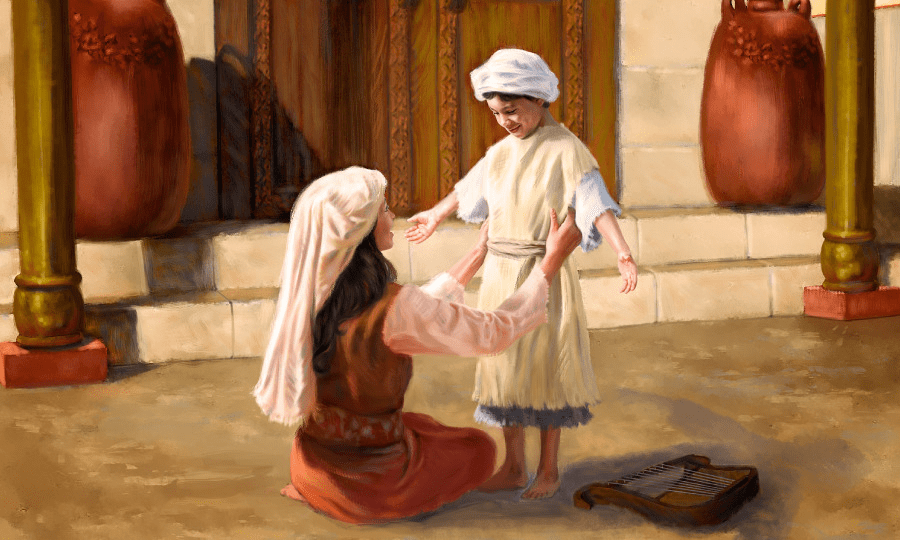
Hannah fits Samuel with a priestly robe, by Unknown artist

But Samuel was ministering before the Lord—a boy wearing a linen ephod. Each year his mother made him a little robe and took it to him when she went up with her husband to offer the annual sacrifice. Eli would bless Elkanah and his wife, saying, “May the Lord give you children by this woman to take the place of the one she prayed for and gave to the Lord.” Then they would go home. And the Lord was gracious to Hannah; she gave birth to three sons and two daughters. Meanwhile, the boy Samuel grew up in the presence of the Lord. (New International Version)

Hannah had to deal with infertility, a rival who taunted her mercilessly, and the societal shame of it all. But the God who is rich in mercy heard Hannah’s prayer at the Tabernacle in Shiloh. She was given a son, Samuel.

And when he was old enough – about 3 or 4 years of age – Hannah and her husband Elkanah presented Samuel to Eli the priest at the Tabernacle. She had vowed to do so if the Lord granted her a son. Hannah made good on that promise.

It turns out that the small boy Samuel was head-and-shoulders above the adult priests. Eli and his two sons, Hophni and Phineas, were no good, too small for the office of priest they occupied. Their service to God was anything but that. They served themselves, especially the two sons.

Eli’s adult children blatantly engaged in sacrilege, aggressively grabbing whatever they wanted from the sacred space of the Tabernacle. They made a mockery of the Lord’s instructions regarding sacrifices and worship in that holy place. The two of them cursed others (which would come back on them soon enough).

In contrast, the boy Samuel was a blessed child. His dear mother Hannah would make him a new priestly robe year after year as he served faithfully. His growing stature, and the need for clothing which suited him, were a light shining in the darkness of two sons who were outfitted in priestly garb that didn’t spiritually fit them at all.

The thing about our clothes is that they can either be an expression of who we truly are; or they can be a covering which hides the true identity. The story makes it plain that Samuel had a beautifully handcrafted robe which suited him perfectly. But Hophni and Phineas inherited priestly threads that seemed like ill-fitting hand-me-downs.

All of us are either revealing who we really are for all to see with unabashed authenticity, or we are concealing ourselves behind a disingenuous false façade, so that our true self is obscured and hidden in the shadows.

We are embodied people living on a physical earth. Our clothes aren’t just mere coverings of the body; they are a material means of communicating important immaterial aspects of ourselves and the world. The elaborate garb of the priest has significance, and ought not to be taken lightly.

In the case of Eli’s sons, they used their clothing to fleece incoming worshipers who were making genuine animal sacrifices to God. The priestly outfits themselves were not the problem; at issue was two people committing sacrilege against the Lord, and injustice toward the Lord’s people.

Material things neither contaminate nor purify a person; the heart does that. We just need to ensure that material objects like clothing are set apart for specific and good purposes. Those clothes ought to be congruent with the person and the task at hand. And clothing ought never to demean or deceive ourselves or others.

Although we aren’t told what sort of clothing Hannah wore, I’m sure that everything she wore spoke to her humility before others, devotion to God, and spirit of doing what is right and just. The Lord gave her clothes fitted for a mother by blessing Hannah with even more children. I can imagine that the biblical writers had women like her in mind when they wrote some of their words:

I want women to enhance their appearance with clothing that is modest and sensible, not with elaborate hairstyles, gold, pearls, or expensive clothes. They should make themselves attractive by doing good, which is appropriate for women who claim to honor God. (1 Timothy 2:9-10, CEB)

It is not fancy hair, gold jewelry, or fine clothes that should make you beautiful. No, your beauty should come from inside you—the beauty of a gentle and quiet spirit. That beauty will never disappear. It is worth very much to God. (1 Peter 3:3-4, ERV)

For all of us, we are encouraged to wear actual and metaphorical clothing that is consistent with what is good:

Right living was my clothing. Fairness was my robe and turban. (Job 29:14, ERV)

Because we belong to the day, we must live decent lives for all to see. Don’t participate in the darkness of wild parties and drunkenness, or in sexual promiscuity and immoral living, or in quarreling and jealousy. Instead, clothe yourself with the presence of the Lord Jesus Christ. And don’t let yourself think about ways to indulge your evil desires. (Romans 13:13-14, NLT)

Therefore, as God’s chosen people, holy and dearly loved, clothe yourselves with compassion, kindness, humility, gentleness and patience. (Galatians 3:12, NIV)

The boy Samuel lived up to the priestly clothes he was wearing; they fit him like a hand in a glove. But the adults who should have known better, Eli and his sons, dressed down their priestly garments and demeaned the office of priest for the people they should have been serving.

It is high time to dress appropriately and clothe ourselves with Christ, so that the very life of Jesus may flow powerfully in us and through us, to the glory of God. Amen.

It’s In the Details (Exodus 28:29-38)

Aaron the High Priest

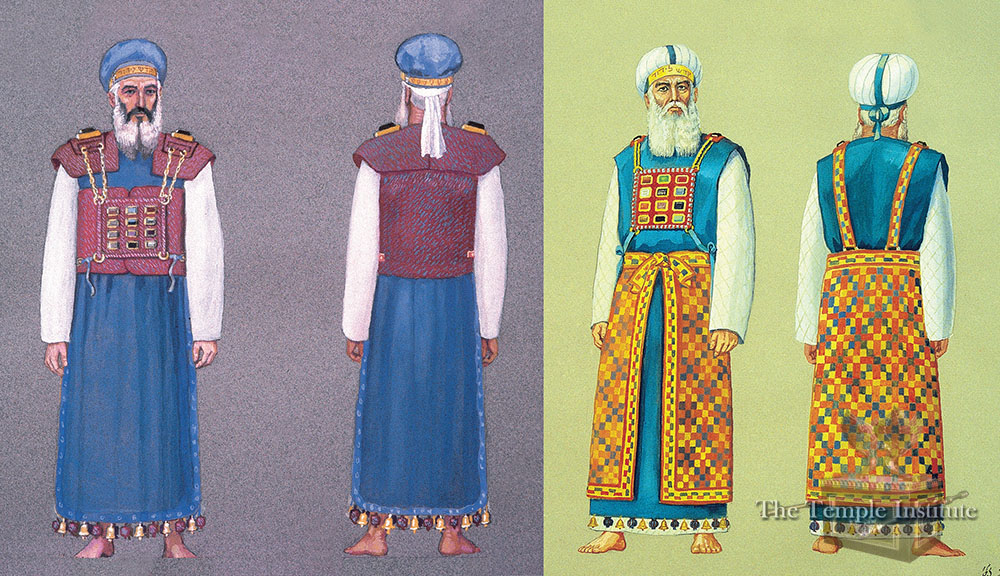
“Whenever Aaron enters the Holy Place, he will bear the names of the sons of Israel over his heart on the breast-piece of decision as a continuing memorial before the Lord. Also put the Urim and the Thummim in the breast-piece, so they may be over Aaron’s heart whenever he enters the presence of the Lord. Thus Aaron will always bear the means of making decisions for the Israelites over his heart before the Lord.

“Make the robe of the ephod entirely of blue cloth, with an opening for the head in its center. There shall be a woven edge like a collar around this opening, so that it will not tear. Make pomegranates of blue, purple and scarlet yarn around the hem of the robe, with gold bells between them. The gold bells and the pomegranates are to alternate around the hem of the robe. Aaron must wear it when he ministers. The sound of the bells will be heard when he enters the Holy Place before the Lord and when he comes out, so that he will not die.

“Make a plate of pure gold and engrave on it as on a seal: holy to the Lord. Fasten a blue cord to it to attach it to the turban; it is to be on the front of the turban. It will be on Aaron’s forehead, and he will bear the guilt involved in the sacred gifts the Israelites consecrate, whatever their gifts may be. It will be on Aaron’s forehead continually so that they will be acceptable to the Lord. (New International Version)

This area of Holy Scripture is likely not one of the more popular places to read. Frankly, it’s boring and pedantic. Yet, contained within the Bible it is, for us to examine.

After giving Moses the Ten Commandments in Exodus 20, the next several chapters, from Exodus 20-31 contain detailed instructions from God concerning the covenant code stipulations with the Israelites. Plans for liturgical and sacrificial worship are covered with a fine tooth comb. Instructions for building implements for worship are precise.

And the special garments of the priests’ clothing are described in detail, both as to their design and the material to be used. It’s as if we’re all sitting in a virtual meeting just trying to stay awake, let alone pay attention. Yet, the fact of the details lets us know that the plan is important.

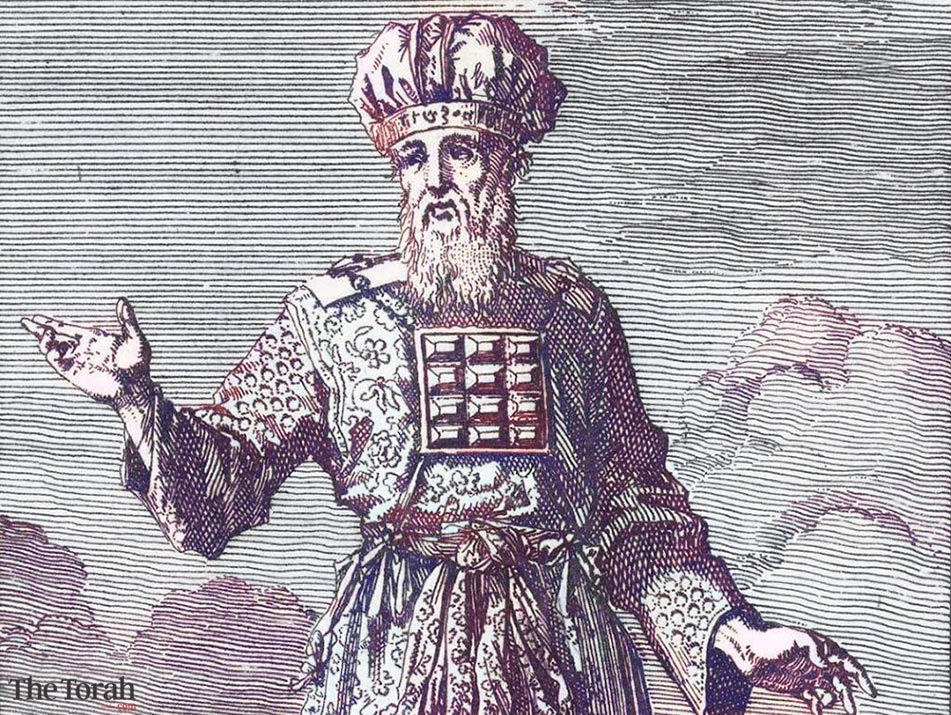
Aaron the High Priest, by Jan Luyken (1669-1712)

Today’s Old Testament lesson deals specifically with the vestments of Aaron, the first high priest of the covenant. An ephod was made – which is a richly embroidered, apron-like vestment having two shoulder straps and ornamental attachments for securing the breastplate, worn with a waistband. (Exodus 28:1-30)

The garment which Aaron was to wear, when he entered the sacred space, symbolically kept the nation of Israel in front of Yahweh, and also over the high priest’s heart.

There was a robe which covered the ephod, equipped with bells. As Aaron moved, the bells rang, signaling that he was coming into and out of the presence of God. Only the high priest was consecrated to enter the most holy place; and the high priest alone wore the special clothing for the unique service which was done.

The entire ritual of the high priest’s service was a visual display of God’s glory and of the reality that no one may enter God’s presence flippantly or carelessly. God is gracious and merciful; and God also has no tolerance for impurity, unrighteousness, and pride.

God expects divine laws, stipulations, and commands to be obeyed without prejudice. The Israelites could not pick and choose what directives from God they would do, or not do. And that is the core of what holiness before the Lord really is.

An interesting observation about this text of Scripture is that Aaron the high priest is given no instructions or commands about what to say when he entered and then left God’s presence. No mantras. No incantations or formulaic words. The inference is that Aaron was silent.

Instead, the garments spoke. “Holy to the Lord” on the plate affixed to the turban said a lot – along with the ephod and the robe, affirming that holiness is needed in order to make any sort of decisions before God.

We never get an explanation in Scripture about what the Urim and Thummim are – which is why, when translating the words from Hebrew, we merely have English transliterations of them. We only know that they were used when making decisions. Evidently, the high priest was an earthly source of God’s wisdom and direction.

Whatever we think about these verses in the book of Exodus, it seems that we are meant to understand that details matter; and how we go about our obedience, down to the last jot and tittle, matters.

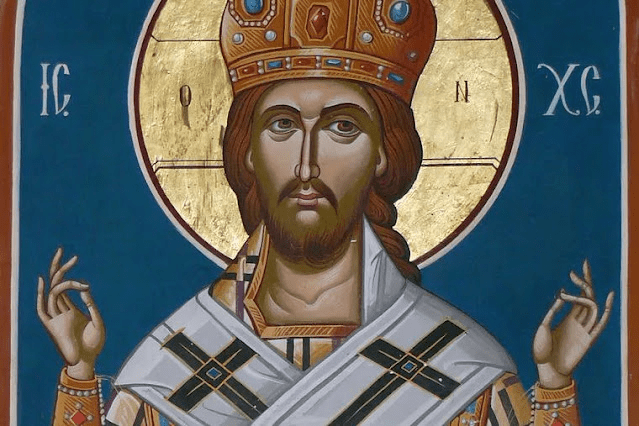
Orthodox icon of Jesus Christ, the High Priest of a New Covenant

In the ministry of Christ, there were people wondering if all of his talk was upending or replacing those detailed imperatives of God. Jesus responded:

“Do not think that I have come to abolish the Law or the Prophets; I have not come to abolish them but to fulfill them. For truly I tell you, until heaven and earth disappear, not the smallest letter, not the least stroke of a pen, will by any means disappear from the Law until everything is accomplished.” (Matthew 5:17-18, NIV)

Jesus furthermore upheld God’s expectation that divine commands be obeyed:

“Therefore anyone who sets aside one of the least of these commands and teaches others accordingly will be called least in the kingdom of heaven, but whoever practices and teaches these commands will be called great in the kingdom of heaven.” (Matthew 5:19, NIV)

At issue was the nature of righteousness – right relations with both God and others. Justice is imperative. Being humble, pure, merciful, and a peacemaker matters. The laws and directives of God are never to be used for walking around like a peacock to display what a wonderfully important and religious person you are.

In other words, the ornate garments of the high priest are not the person; they are special clothing used for a special purpose. Clothes may be important, yet it’s the heart that truly matters. And a heart devoted to God will seek to humbly obey God’s words down to the most minute detail.

O God, by whom the humble are guided, and light rises up in darkness for the godly: Grant us, in all our doubts and uncertainties about obedience, the grace to ask what you would have us to do, that the Spirit of wisdom may save us from all false choices, and that in your light we may see light, and in your straight path may not stumble; through Jesus Christ our Lord. Amen.