Visible Signs of Invisible Realities (Hebrews 9:15-24)

For this reason Christ is the mediator of a new covenant, that those who are called may receive the promised eternal inheritance—now that he has died as a ransom to set them free from the sins committed under the first covenant.

In the case of a will, it is necessary to prove the death of the one who made it, because a will is in force only when somebody has died; it never takes effect while the one who made it is living. This is why even the first covenant was not put into effect without blood. When Moses had proclaimed every command of the law to all the people, he took the blood of calves, together with water, scarlet wool and branches of hyssop, and sprinkled the scroll and all the people. He said, “This is the blood of the covenant, which God has commanded you to keep.” In the same way, he sprinkled with the blood both the tabernacle and everything used in its ceremonies. In fact, the law requires that nearly everything be cleansed with blood, and without the shedding of blood there is no forgiveness.

It was necessary, then, for the copies of the heavenly things to be purified with these sacrifices, but the heavenly things themselves with better sacrifices than these. For Christ did not enter a sanctuary made with human hands that was only a copy of the true one; he entered heaven itself, now to appear for us in God’s presence. (Hebrews 9:15-24)

The Hebrew Christians were tired. They had faced adverse circumstances, unjust imprisonments, persecution, prejudice, confiscation of their property, and public ridicule.

Most of all, they encountered rejection from their Jewish families of origin. There was precious little support for them, outside of their group.

The suffering went on long enough that the Christians began to experience a weakening of faith. In their distress, they started considering whether to return to Judaism, and renege on their commitment to Christ.

The author of Hebrews saw the struggle and spoke up, encouraging and exhorting the believers to keep going, to exercise faith and perseverance in the face of their ongoing troubles.

The author’s overall message to the discouraged believers was that Jesus Christ is superior over everything and everyone. Christ is better than the angels, Moses, and Aaron. Jesus is the ultimate high priest who offered himself as a sacrifice, once for all.

By means of the cross, Jesus became the mediator of a new and better covenant. There is, therefore, no more need of another high priest. Christ now occupies that office permanently.
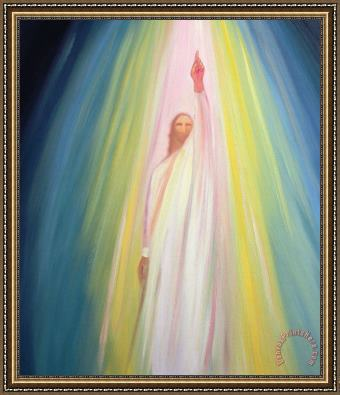
Jesus Christ Points us to God, by Elizabeth Wang

Christ’s death was efficacious for all. The sacrificial system with all of the officiating Levitical priests was the old order of things, meant to point us to Christ.

Offering sacrifices day after day, and engaging in prescribed liturgical rituals in order to access God, are no longer necessary. Perpetual anxiety exists wherever people keep wondering if they have done enough to satisfy their guilt and/or responsibility.

The answer of Christianity is yes, the work is finished; Jesus completed it, once and for all.

There is no longer anything that can distress us. Sin, death, and hell have been conquered through the death of Christ. His singular sacrifice has achieved victory over the sinful powers, and reconciliation and peace with God.

Blessed is the one
    whose sin the Lord does not count against them
    and in whose spirit is no deceit. (Psalm 32:2, NIV)

The covenant code’s sacrificial system was never designed to be a permanent way of doing things. All of the implements used in that system were symbols pointing to the real deal. They were a temporary means of leading people to Christ, who is the once for all sacrifice to end all sacrifices, the one who truly takes away our guilt and shame forever.

The picture is of Christ, as our high priest, who sprinkled us with his own blood and made us clean – not only today or for some temporary period of time – but for all time. We are not only made clean; we are made clean forever by the blood of Christ.

Cleanse me with hyssop, and I will be clean;
    wash me, and I will be whiter than snow. (Psalm 51:7, NIV)

The historical person of Jesus – his life, ministry, crucifixion, death, resurrection, ascension and glorification – was a visible image showing us the great importance of invisible realities.

The Ark of the Covenant was a visible sign of God’s invisible presence, and the need for a restoration of the divine/human connection.

The temple, the worship implements, and the whole sacrificial system was a visible sign of God’s invisible holiness, and the need for purity of heart amongst the people.

Jesus was a real person with a real body and real human needs, a visible reality which showed us the invisible God, and what God truly deems as right and good.

It is Jesus Christ, the Son of God and Son of Humanity, in whom we have redemption the forgiveness of sins. He is the image of the invisible God. (Colossians 1:14-15)

Christ is our Mediator, bridging the gap between heaven and earth.

Christ is our Savior, delivering us from our guilt and shame, our worry and anxiety, and our old enemy, death itself.

Christ is our Advocate, stepping in and acting on our behalf, and sending the Holy Spirit to be his continuing presence on this earth.

Christ is our champion, the pioneer of our salvation, securing redemption for us through his singular death.

Christ is our Intercessor, who even now lives to intercede for us, as we strive and struggle to live in humility, justice, and righteousness, as peacemakers in this world.

What this all means, from the vantage of Christianity, is that we need Jesus.

Without Christ, there is no hope. With Christ, all things are possible.

Jesus is the answer to every question, because Jesus is the center of all things. He is the fertile soil from which all of life sprouts; the first-fruit which provides life; and the continuing sustenance which saves us from a disconnected, fragmented, discouraging existence.

Along with the ancient Hebrew Christians, let us be encouraged with Christ, who is truly our everything.

Accept, O Lord, our thanks and praise for all that you have done for us. We thank you for the disappointments and failures that lead us to acknowledge our dependence on you alone.

Above all, we thank you for your Son Jesus Christ; for the truth of his Word, and the example of his life; for his steadfast obedience, by which he overcame temptation; for his dying, through which he overcame death; and for his rising to life again, in which we are raised to the life of your kingdom.

Grant us the gift of your Spirit; that we may know you and make you known; and through your Spirit, at all times and in all places, may give thanks to you in all things. Amen.

Wise Living Is Clean Living (Proverbs 15:1-17)

A gentle answer quiets anger, but a harsh one stirs it up.

When wise people speak, they make knowledge attractive, but stupid people spout nonsense.

The Lord sees what happens everywhere; he is watching us, whether we do good or evil.

Kind words bring life, but cruel words crush your spirit.

It is foolish to ignore what your parents taught you; it is wise to accept their correction.

Righteous people keep their wealth, but the wicked lose theirs when hard times come.

Knowledge is spread by people who are wise, not by fools.

The Lord is pleased when good people pray, but hates the sacrifices that the wicked bring him.

The Lord hates the ways of evil people, but loves those who do what is right.

If you do what is wrong, you will be severely punished; you will die if you do not let yourself be corrected.

Not even the world of the dead can keep the Lord from knowing what is there; how then can we hide our thoughts from God?

Conceited people do not like to be corrected; they never ask for advice from those who are wiser.

When people are happy, they smile, but when they are sad, they look depressed.

Intelligent people want to learn, but stupid people are satisfied with ignorance.

The life of the poor is a constant struggle, but happy people always enjoy life.

Better to be poor and fear the Lord than to be rich and in trouble.

Better to eat vegetables with people you love than to eat the finest meat where there is hate. (Good News Translation)

Here is today’s Proverbs lesson in my own colloquial words:

A calm and kind response sucks the anger out of the room, but hot-headed words set the place on hellfire.

A level-headed person gives helpful answers, but a know-it-all only keeps on babbling nonsense.

Just because you cannot see God, doesn’t mean that God cannot see you, both the good and the bad.

Kind words given to another person are life-giving, but unkind words catapulted at a person ends up crushing their spirit.

You can tell a fool by how their refusal to accept counsel from their parents, but a wise person freely receives parental instruction.

Wise folk understand they need to save for a rainy day, but fools spend everything they have, then wonder why they’re in dire straits.

Wisdom and common sense are akin to one another; foolishness and nonsense are two peas in a pod.

The Lord perks up when the righteous pray, but does a face palm when the wicked offer up anything.

The ways of evil people make the Lord nauseous, but the way of the righteous is delightful to God.

A stupid dog doesn’t live very long, because he won’t heed his training or learn from any natural consequences.

If God can see everything that goes on with death and destruction, why would not the Lord see all things within your own heart?

Prickly people won’t listen to advice, and they refuse to consult anyone when making decisions.

Truthful persons smile when they’re happy and frown when they’re sad, but falsehood smiles when it’s sad and frowns when it’s happy.

Learners are curious about life, but ignorant folk only feed on tabloid information.

Once in survival mode, it’s hard to ever get out of it; but those who thrive have learned how to be content in any circumstance.

It’s a whole lot better to be poor and right with God, than to be rich and on the wrong side of the Lord.

Peanut butter sandwiches eaten on the floor with love are much more delicious than eating a filet mignon with hatred around the table.

Our words reflect what is truly the attitude of our heart. And our attitudes betray what we actually think about God and others.

If you drop a foolish person into a roomful of people, it’s like putting a rotten egg in with the rest of the eggs when making an omelet. Or, to put it according to an old adage, “One bad apple spoils the whole bushel basket of them.”

This is why it’s the responsibility of everyone to develop wisdom and a virtuous life. A faith community, a neighborhood, a workplace, a family, or any group of people are adversely affected whenever there’s one arrogant fool amongst them.

But just as he who called you is holy, so be holy in all you do; for it is written: “Be holy, because I am holy.” (1 Peter 1:15-16, NIV)

It only takes one drop of arsenic to ruin a gallon of water and make it undrinkable. And if you choose to drink it anyway, well, you’ll suffer the consequences.

And this is why purity of heart, righteousness, justice, and goodness are so very important. It’s also why holiness is placed as a premium in Holy Scripture, because impurity ruins the community and defiles any group of people.

For where you have envy and selfish ambition, there you find disorder and every evil practice. But the wisdom that comes from heaven is first of all pure; then peace-loving, considerate, submissive, full of mercy and good fruit, impartial and sincere. Peacemakers who sow in peace reap a harvest of righteousness. (James 3:16-18, NIV)

Wise living is clean living, in every sense of a person’s complete self – in body, mind, emotions, and spirit. The Book of Proverbs can help us with that.

O God, by whom the meek are guided in judgment, and light rises up in darkness for the godly: Grant us, in all our doubts and uncertainties, the grace to ask what you would have us to do, so that the Spirit of wisdom may save us from all false choices, and that in your light we may see light, and in your straight path may not stumble. Amen.

From the Heart (Mark 7:9-23)

Art by Anna Startseva

Then he said, “You skillfully sidestep God’s law in order to hold on to your own tradition. For instance, Moses gave you this law from God: ‘Honor your father and mother,’ and ‘Anyone who speaks disrespectfully of father or mother must be put to death.’ But you say it is all right for people to say to their parents, ‘Sorry, I can’t help you. For I have vowed to give to God what I would have given to you.’ In this way, you let them disregard their needy parents. And so you cancel the word of God in order to hand down your own tradition. And this is only one example among many others.”

Then Jesus called to the crowd to come and hear. “All of you listen,” he said, “and try to understand. It’s not what goes into your body that defiles you; you are defiled by what comes from your heart.”

Then Jesus went into a house to get away from the crowd, and his disciples asked him what he meant by the parable he had just used. “Don’t you understand either?” he asked. “Can’t you see that the food you put into your body cannot defile you? Food doesn’t go into your heart, but only passes through the stomach and then goes into the sewer.” (By saying this, he declared that every kind of food is acceptable in God’s eyes.)

And then he added, “It is what comes from inside that defiles you. For from within, out of a person’s heart, come evil thoughts, sexual immorality, theft, murder, adultery, greed, wickedness, deceit, lustful desires, envy, slander, pride, and foolishness. All these vile things come from within; they are what defile you.” (New Living Translation)

There is nothing inherently wrong with tradition. Ideally, traditions are helpful ways of remembering and maintaining the values that are important to us.

Yet, what can happen over time is that the tradition itself can become equal to the value we hold to; and eventually, the tradition can become more important than the value it is supposed to remind us of.

In the worst case scenario, the tradition is kept, and the value is forgotten and lost. Whenever that happens, traditions easily become weaponized to protect our interests while harming others. And that is a phenomenon Jesus wanted nothing to do with.

So, Christ affirmed and upheld the essential purpose of the Torah (scriptural law) as the foundation of morality to live justly and righteously in the world. Keeping Torah, therefore, is a matter of inner motives, and intents of the heart, rather than external compliance to ritualized traditions.

Unfortunately, the outward form had supplanted the inward disposition of the heart. Purity then became a matter of observable rituals, and defilement a matter of failing to do the ritual properly. And the original values behind the rituals were lost – which caused souls to become lost, and other people victimized by religious traditions.

Whether one is ritually clean or unclean is not ultimately determined by material objects; it is, instead, determined by the state of the heart.

Art by Andy Perez

In other words, no outward ritual can ever really make a person clean or unclean, pure or impure, spotless or polluted. Inner transformation is what scrubs a person clean and makes them pure.

Ritual traditions, and even scriptural law itself, is unable to effect a transformative change.

Torah can require purity, cleanness, and moral uprightness; but it cannot affect a metamorphosis. We need something other than traditions, rituals, and laws to bring true and sustainable transformation of life.

I say that it is time to hear and observe Jesus. Millions of people throughout history, and up to the present time, have found in Christ (and not in Christian rituals, traditions, church codes, nor in a political Christendom) the answer and the key to what life is really all about.

Again, there is not a problem with our human traditions per se, but with traditions replacing Torah and the word of God.

Jesus gave an example of just such a contradiction between religious tradition and divine law: According to tradition, if a person makes a vow concerning their property and/or possessions as a gift to God at the temple, then those assets cannot be used to support that person’s parents in their old age.

Christ pointed out that this clearly contradicts the command to honor your father and mother. Ironically, the very tradition that was supposed to purify became the means to contamination – because the tradition forbids the person from obeying the command of God.

In a word picture that everyone could understand, Jesus explained that impurity and defilement have to do with what passes through the heart, not the bowels.

People obey or disobey the Ten Commandments due to the state of their heart, and not whether they keep every detail of traditional washing of the hands and body.

People lack virtue not because they fail to do human traditions; but because of what is in their hearts.

This is why Jesus, in his Sermon on the Mount, gets to the heart of why people break commands. For example:

  • The outward act of murder is a result of the inward anger of nurturing bitterness in the heart. (Matthew 5:21-22)
  • The physical act of adultery is the culmination of dozens of mental adulteries which originated in the heart. (Matthew 5:27-28)

Everything that harms and hurts is sourced in the heart, and not in failing to keep a tradition.

Furthermore, the Gospel writer Mark, added the very interesting parenthetical comment that in speaking this way, Jesus meant to declare that all foods are clean; there is nothing eaten that can make us impure.

That may not seem remarkable to most people, but to Jews this statement is cataclysmic and revolutionary. Levitical law details the separating of clean and unclean food, for the purpose of distinguishing the Israelites from all the other surrounding nations. (Leviticus 11:43-44; 20:24-26)

Holding to food laws, and traditional hand washings when it comes to eating, are a way of preserving religious identity and national identity. Jesus had no intention of doing away with Jewish identity, but he very much intended to do away with maintaining practices that keep strict separation from other people.

In other words, Christ was opening the way for ministry to Gentiles. He wanted to bring connection where there was deep division. He wanted the world to know God.

This gets at the “heart” of true religion. Distinctiveness as God’s people does not necessarily nor ultimately come by observing particular traditions; it comes primarily through purity of heart.

And the means of bringing purity of any kind, comes through love. Love always makes a way and finds connections. Love is the sine qua non mark of God.

Traditions infused with love, point people to God, and let them know that they belong.

But traditions for tradition’s sake, repel people, and communicate to them that they don’t belong, and should go away and not pollute the pure ones.

This approach of Jesus toward the religious leaders raises for me several probing questions:

  1. What is the true state of your heart?
  2. Are you aware of your own heart’s dark shadows?
  3. In what sort of direction is your heart inclined to speak and act?
  4. Does encouragement or criticism typically arise from your heart?
  5. Is love the compass of your heart, or does bitterness give you direction?
  6. Will you acknowledge your need of a savior? Will you ask for help?

Blessed God and Father of our Lord Jesus Christ: Make us quick to listen, and slow to speak, so that the Word implanted in our hearts may take root to nourish all of our living. And may the the Word within us overflow into speech and action which blesses the world. Amen.

Spiritual Spring Cleaning (2 Chronicles 29:1-11, 16-19)

Hezekiah became king when he was twenty-five years old and was king in Jerusalem for twenty-nine years. His mother was Abijah daughter of Zechariah. In God’s opinion he was a good king; he kept to the standards of his ancestor David.

In the first month of the first year of his reign, Hezekiah, having first repaired the doors of The Temple of God, threw them open to the public. He assembled the priests and Levites in the court on the east side and said, “Levites, listen! Consecrate yourselves and consecrate The Temple of God—give this much-defiled place a good housecleaning.

Our ancestors went wrong and lived badly before God—they discarded him, turned away from this house where we meet with God, and walked off. They boarded up the doors, turned out the lights, and canceled all the acts of worship of the God of Israel in the holy Temple. And because of that, God’s anger flared up and he turned those people into a public exhibit of disaster, a moral history lesson—look and read! This is why our ancestors were killed, and this is why our wives and sons and daughters were taken prisoner and made slaves.

“I have decided to make a covenant with the God of Israel and turn history around so that God will no longer be angry with us. Children, don’t drag your feet in this! God has chosen you to take your place before him to serve in conducting and leading worship—this is your life work; make sure you do it and do it well….”

The priests started from the inside and worked out; they emptied the place of the accumulation of defiling junk—pagan rubbish that had no business in that holy place—and the Levites hauled it off to the Kidron Valley. They began the Temple cleaning on the first day of the first month and by the eighth day they had worked their way out to the porch—eight days it took them to clean and consecrate The Temple itself, and in eight more days they had finished with the entire Temple complex.

Then they reported to Hezekiah the king, “We have cleaned up the entire Temple of God, including the Altar of Whole-Burnt-Offering and the Table of the Bread of the Presence with their furnishings. We have also cleaned up and consecrated all the vessels which King Ahaz had gotten rid of during his misrule. Take a look; we have repaired them. They’re all there in front of the Altar of God.” (The Message)

Hezekiah Destroys the Idols, by Maerten de Vos, 1585

This is the time of year when many of us begin to plan for some Spring housecleaning. And it’s definitely needed! All the rooms of the house, along with the garage, are in need of going through all the contents contained in them, as well as a good old fashioned scrubbing down and thorough cleaning.

And that is really what the Christian season of Lent is intended for on the spiritual level of things. We seek to identify any and all hindrances to living the Christian life and get rid of them; spruce up the things we keep that are helpful to us; and do the hard work of scraping off all the encrusted barnacles on our hearts.

Hezekiah was a faithful king, having come from a long line of faithless ones. In the beginning of his reign, Hezekiah’s first act of royal business was to thoroughly cleanse the Temple. And did it ever need a serious cleaning!

The evil kings who reigned before him did not treat the Temple as a sacred space devoted specifically to the prayer and worship of the one true God, Yahweh. Instead, they defiled it by introducing all sorts of unhealthy practices from other gods. As a result, the holy implements used in the Temple, as well as the structure itself, fell into terrible neglect.

Therefore, Hezekiah assembled an impressive team of people, and tasked them with getting the Temple in shape again with a complete and thorough purification that would make any German house frau proud. Hezekiah sought to restore things so that the Temple could once again be used as it ought. 

The team of Levites meticulously took their time and worked diligently to consecrate the Temple and give it a good and sacred cleaning, tossing everything unholy into the Kidron Valley – the garbage dump.

Perhaps there is no better passage of Scripture than today’s Old Testament lesson, in order to embody what the season of Lent is really all about. We are to do the holy work of carefully consecrating our hearts, so that our lives are prepared and ready for the new life of Easter. 

This task of spiritual Spring cleaning and heart purification is hard and courageous work. Just as Hezekiah had the bravery to uphold the Temple’s true purpose through cleansing it, so we are to bravely enter the shadowy places of our hearts, bring out the sin within, and toss it in the metaphorical incinerator. It’s definitely not a pretty process, but a necessary one.

One of the greatest needs that many believers have today is the courage to be vulnerable, to expose and bring into the light our besetting sins, so that they can be carried away and tossed into the dump. 

Instead of spending inordinate amounts of energy and time trying to hide our true selves, it is much better to let the example of Hezekiah clear a path forward by confronting the darkness within.

Holy God, my life is a Temple of your Holy Spirit. I invite you to come in and do the sort of cleansing work that needs to be done so that my words and actions are thoroughly consecrated to you. Help me have the courage to go to the places within that frighten me, for the sake of Jesus, my Lord. Amen.