All Saints Day (John 11:32-44)

The Forerunners of Christ with Saints and Martyrs, by Fra Angelico, 15th century

When Mary came where Jesus was and saw him, she knelt at his feet and said to him, “Lord, if you had been here, my brother would not have died.” When Jesus saw her weeping and the Jews who came with her also weeping, he was greatly disturbed in spirit and deeply moved. He said, “Where have you laid him?” They said to him, “Lord, come and see.” Jesus began to weep. So the Jews said, “See how he loved him!” But some of them said, “Could not he who opened the eyes of the blind man have kept this man from dying?”

Then Jesus, again greatly disturbed, came to the tomb. It was a cave, and a stone was lying against it. Jesus said, “Take away the stone.” Martha, the sister of the dead man, said to him, “Lord, already there is a stench because he has been dead four days.” Jesus said to her, “Did I not tell you that if you believed you would see the glory of God?” So they took away the stone.

And Jesus looked upward and said, “Father, I thank you for having heard me. I knew that you always hear me, but I have said this for the sake of the crowd standing here, so that they may believe that you sent me.” When he had said this, he cried with a loud voice, “Lazarus, come out!” The dead man came out, his hands and feet bound with strips of cloth and his face wrapped in a cloth. Jesus said to them, “Unbind him, and let him go.” (New Revised Standard Version)

Every year on the Christian Calendar, the Church commemorates the saints who have gone before us. This day provides an opportunity to acknowledge the spiritual reality that contemporary believers stand on the shoulders of those who lived and died before us. Those saints of yester year deserve our recognition.

Since many believers know little about Christian history, it is good to take the time and reflect on the contributions of our spiritual ancestors. Our own personal spiritual growth isn’t just something we did on our own; we owe a lot to the saints who preceded us, and made it possible for us to know Christ.

In our Gospel lesson for today, Mary’s brother Lazarus had died. She was distraught and mourned her loss. Jesus reminded Mary that physical death is not the end; it is a temporary move to a higher plan of existence, until we all share in the final resurrection of the dead together as believers.

Although dead, the saints we recognize and remember can still speak to us, making significant contributions to our lives. All sorts of books, including Holy Scripture, have timeless reminders of how to live in this world. And, for some Christian traditions, the saints of long ago still maintain a real interaction with us in the present.

Times may change, yet the basic nature of people does not. The saints of the past have incredible wisdom for us, if we will but listen.

The Raising of Lazarus, by John Reilly (1928-2010)

In this way, Lazarus serves as an example of one who has a unique, powerful, and compelling testimony. He speaks, not only actually in his post-resurrection awakening by Jesus, but also virtually in speaking to us through the text and from his historical and heavenly place.

The presence and testimony of Lazarus was incredibly real enough for the religious leaders to begin plotting Christ’s demise; and even planning to kill Lazarus, because of his powerful testimony.

There is a place for grief and tears, and a place for joy and celebration. It seems that too much of our present time is given to the lament which comes from loss. The death and then resurrection of Lazarus by Jesus is a foretaste of Christ’s return.

We, along with all of the saints of bygone eras, will share together in a great resurrection at the end of time.

The author of Hebrews understood this, and spoke about the saints’ anticipation. Even though their lives were often characterized by adversity and suffering, they were able to exercise patience and perseverance, knowing there is something better ahead, along with us:

Some faced jeers and flogging, and even chains and imprisonment. They were put to death by stoning; they were sawed in two; they were killed by the sword. They went about in sheepskins and goatskins, destitute, persecuted and mistreated—the world was not worthy of them. They wandered in deserts and mountains, living in caves and in holes in the ground.

These were all commended for their faith, yet none of them received what had been promised, since God had planned something better for us so that only together with us would they be made perfect. (Hebrews 11:36-40, NIV)

Death is our enemy. Each one of us will succumb to it. Even Lazarus, although dead and then raised to life, ended up dying again. Yet he, along with us, shall be raised immortal.

Until that glorious time, we need to keep going and enduring in this life. We are mortals, subject to all that mortality means for us. Death is that ever-present specter that continually lingers in the background of everyone’s life. The reality of death can upend us, either through the bereavement of loved ones, or through anxious thoughts of our own impending death.

Although Christ has won the war against our old enemy, the fight, however, is not yet over. We need to keep up a future orientation, as Jesus did, and as the faithful saints of the past did.

The risen Lord shall not only cry with us, but shall wipe away every tear, and make it so that we will never be put to shame.

This makes the Christian recognition of All Saints Day not only a remembrance of the past, but also a way of viewing the future. Let us, then, join with all the saints in looking forward to the day of Christ, and letting that perspective shape how we live today.

Beloved God, you deal with us kindly and in steadfast love. You lift up those bent over with heavy burdens, and sustain the weak and oppressed. Release us from our present anxious fears, so that we who hold fast to your commandments, may honor you with faith and patience for all that you have done for us, and will do for us; through Jesus Christ our Lord, in the power of the Holy Spirit. Amen.

Pentecost (John 15:26-27, 16:4b-15)

The Holy Spirit, by He Qi

“When the Advocate comes, whom I will send to you from the Father, the Spirit of truth who comes from the Father, he will testify on my behalf. You also are to testify because you have been with me from the beginning…

“I did not say these things to you from the beginning, because I was with you. But now I am going to him who sent me, yet none of you asks me, ‘Where are you going?’ But because I have said these things to you, sorrow has filled your hearts. Nevertheless, I tell you the truth: it is to your advantage that I go away, for if I do not go away, the Advocate will not come to you, but if I go, I will send him to you. 

“And when he comes, he will prove the world wrong about sin and righteousness and judgment: about sin, because they do not believe in me; about righteousness, because I am going to the Father, and you will see me no longer; about judgment, because the ruler of this world has been condemned.

“I still have many things to say to you, but you cannot bear them now. When the Spirit of truth comes, he will guide you into all the truth, for he will not speak on his own but will speak whatever he hears, and he will declare to you the things that are to come. He will glorify me because he will take what is mine and declare it to you. All that the Father has is mine. For this reason I said that he will take what is mine and declare it to you. (New Revised Standard Version)

Pentecost, by John August Swanson (1938-2021)

This is the Christian Day of Pentecost. It is often referred to as the birthday of the Church. Pentecost marks the time when the Holy Spirit came upon the fledgling believers in power. 

Pentecost is significant for Christians because it marks the age of the Spirit, the era of new spiritual life and power. Ten days after recognizing Christ’s Ascension, and fifty days after Christ’s resurrection from death, the Christian Year observes the Day of Pentecost (which literally means “fifty” in Greek). 

An implication of Pentecost is that it brings both change and stability, of being uprooted as well as deeply grounded. To experience Pentecost, it is necessary to invite change and to allow ourselves to be changed.

To live a truly spiritual life, full of the Holy Spirit, means that things will never be the same again. With the Spirit, there is a new form of consciousness, an emerging awareness of both self and the world, and new interests and commitments which are followed.

Change involves unlearning old thinking and ways of doing things, becoming uprooted and planted in fresh spiritual soil. The spiritual person will discover new, necessary, and expansive ways of living the faith of Jesus Christ in today’s topsy-turvy world.

Today’s Gospel lesson has Jesus talking to his disciples for the last time before his crucifixion and resurrection. He communicated to them that he was going away, and they were sad and confused about it all. So, Jesus assured them that they would not be alone – his presence would be with them in the person of the Holy Spirit.

Jesus made it plain that the One who is coming, the Paraclete, is the One who comes alongside and offers to the disciples a ministry of advocating, testifying, speaking truth, glorifying, and proving the world wrong about sin and righteousness and judgment.

The Spirit advocates for us and all creation. The Spirit hears our pain, moaning, and desperation, bringing it all to God in helpful language (Romans 8:26). The Spirit testifies about Jesus to us and about his ministry. The Spirit speaks truth to us whenever we go astray from the words and ways of Jesus; and so, will challenge us and provoke us to live into our majesty as people created in God’s image and redeemed by Christ’s death and resurrection.

If and when our Christian life and worship becomes a ho-hum hodge-podge of ritualistic or legalistic goo, where no spiritual growth or life transformation is happening – and worse, if it becomes characterized by injustice – then the Spirit will have something to say in regard to sin, righteousness, and judgment.

A lack of faith can take many forms. For many Christians, the separation between belief and practice is a form of apostasy. Signing off on a set of doctrinal beliefs means nothing unless it has feet and hands to it by going after those who are suffering, giving restitution for what we’ve taken, and putting the love of Christ where love is not found.

A confession of faith is hollow and useless without first having a confession of sin. Jesus did not say that people will know Christians by their doctrinal confessions and ancient creeds, but that others will know the Christian by the fruit of a life given to righteousness and justice. (Matthew 7:16)

The worldly ruler is the one who perpetuates systems of evil and oppression; and ignores poverty, hunger, and need. The ruler of this world is condemned by the Spirit because of meanness, brutality, violence, and abject greed and selfishness.

Anyone who turns the life-giving good world which God has made into a death-dealing world of ignorance, sloth, and power politics is under the judgment of the Spirit, on orders by Judge Jesus. Whenever the bent of the will is developed into only being concerned with personal happiness, while ignoring communal needs, the person is existing far from the teachings of Jesus to his disciples.

On this Day of Pentecost, and into this proper Pentecostal season, our call is to have a genuine spiritual life that allows the true self to make a difference in this old fallen world. The spiritual person seeks to tap into the Spirit and insist on caring for others without prejudice or favoritism; and will ground themselves in healthy spiritual dynamics of positive change and transformation as living sacrifices to God. (Romans 12:1-3)

With the reality of Pentecost, believers in Jesus, and the whole Church everywhere, has the full power of the Holy Spirit with them at all times. This means our ultimate trust is not in the power of authoritative positions, economic budgets, polished programs, personal ingenuity, or a consumer self-realization.

Our trust is in the name of the Lord who made heaven and earth, in Jesus Christ, God’s only Son, and in the strength of the Holy Spirit who is the continuing presence of Jesus. Such power is given for a purpose. So let us be responsible and conscientious in living the Christian life.

And may the blessing of the Spirit move you to know Jesus better, love the world more, and be the person you were created to be – to the glory of God. Amen.

Epiphany of the Lord (Isaiah 60:1-6)

Adoration of the Magi, Basilica of the National Shrine of the Immaculate Conception, Washington D.C.

“Arise, shine, for your light has come,
    and the glory of the Lord rises upon you.
See, darkness covers the earth
    and thick darkness is over the peoples,
but the Lord rises upon you
    and his glory appears over you.
Nations will come to your light,
    and kings to the brightness of your dawn.

“Lift up your eyes and look about you:
    All assemble and come to you;
your sons come from afar,
    and your daughters are carried on the hip.
Then you will look and be radiant,
    your heart will throb and swell with joy;
the wealth on the seas will be brought to you,
    to you the riches of the nations will come.
Herds of camels will cover your land,
    young camels of Midian and Ephah.
And all from Sheba will come,
    bearing gold and incense
    and proclaiming the praise of the Lord. (New International Version)

We are drawn to light. I don’t know if you have ever been in a situation with complete darkness surrounding you. When things are totally dark, we begin to fear and panic.

I grew up in a rural area in which there were no lights at night, other than the moon and the stars. More than once, I got myself into a situation, when the sky was overcast, in which I didn’t have a flashlight and could not see my hand in front of my face. I was groping to discern any little bit of light that I could see. Without the light, I was lost.

Our souls are also drawn to light. We no longer want to have darkness enveloping us; we cannot live with the darkness residing within our hearts. This is one reason why the Magi were attentive to the bright star over Bethlehem, and traveled toward it. We have a need for light because nobody can abide in darkness for too long.

The glory of the Lord is associated with bright light. Spiritually, we can find ourselves in such darkness that it’s impossible to discover light, unless God shows up displaying divine mercy and glory.

The Christian season of Epiphany has to do with this divine light. Each year on January 6, on the Church Calendar, and after the twelve days of Christmas, is the celebration of Epiphany. 

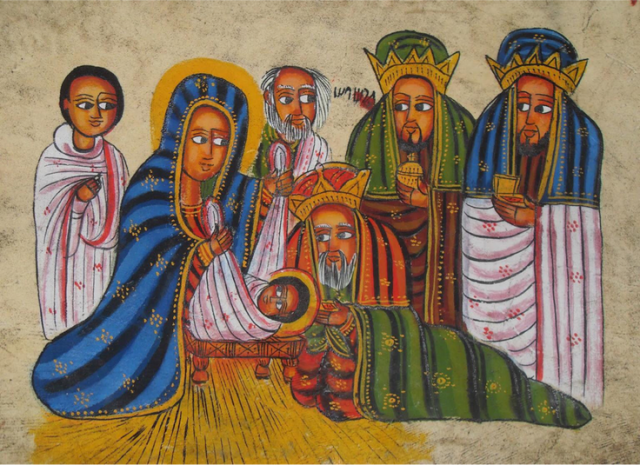
The Three Kings, Ethiopian Orthodox Church

It is a celebration of light – that Christ came to this earth as a child and became like us. Epiphany helps to bring a vision and understanding of God’s glory to all kinds of people in the world.

“Epiphany” literally means “manifestation” or “appearance.” The event most closely associated with this season is the visit of the Magi to Jesus. Included in this time of the year between the seasons of Christmas and Lent is a special emphasis on the teaching and healing ministry of Jesus. 

The people walking in darkness
    have seen a great light;
on those living in the land of deep darkness
    a light has dawned. (Isaiah 9:2; Matthew 4:16, NIV)

The great celebration and focus of these weeks is that salvation is not limited to Israel but extends to the Gentiles, as well.

“I will also make you a light for the Gentiles, that my salvation may reach to the ends of the earth.” (Isaiah 49:6; Luke 2:32; Acts 13:47, NIV)

In this season of Epiphany, the manifestation of God’s grace is one of the most scandalous truths of Christianity: God graces common ordinary people, who seem far from God, with the gift of Jesus. 

God grants repentance that leads to life for all kinds of people, no matter what their race, ethnicity, class, or background. It is a wondrous and astounding spiritual truth that God’s merciful concern is not limited to a certain type of person or a particular group of people.

Grace is (and ought to be) the guiding factor in how we interact with people. 

Losing sight of grace leads to being critical and defensive. Like King Herod of old, a graceless person becomes enamored with earthly power and control. But embracing grace, leads to humility, so that we see the image of God in people very different from ourselves. 

Like the Apostle Peter, who learned in a vision to bring the gospel to non-Jews, old legalisms begin to wear away so that people from all walks of life can have access to Jesus and his gracious saving and healing ministry. 

Grace brings down barriers and causes us to do away with unnecessary distinctions between others. And so, the appropriate response to such a grace is to glorify God for this marvelous and amazing work.

It is a gracious and merciful reality that the Magi, or Wise Men, who were really pagan astrologers, were directed to the Messiah. A light was provided to lead them to Jesus. Apart from God’s care and intervention they would have remained in darkness. 

And it is no less true for people today. This old broken world has a lot of shadowy places to it; there is darkness all around.  All kinds of people have no light at the end of the tunnel of their lives for hope and new life. But the gospel of Jesus Christ brings that light to those walking around with no ability to see. And Jesus exhorted his followers to be the reflectors of divine light for the world.

“Let your light shine before others, that they may see your good deeds and glorify your Father in heaven.”

Jesus (Matthew 5:16, NIV)

Sometimes, maybe oftentimes, the best way to bring resolution to our own troubles and problems is through helping others make sense of their lives through the gracious light of Christ so that they can see an appearance, an epiphany, of what their lives can be in the gracious rule of the kingdom of God. 

As we celebrate Epiphany and journey with Jesus through his earthly upbringing and into his gracious ministry to people, let us keep vigilance to not let our light grow dim. Instead, let us hunger and thirst after Christ’s righteousness so that our joy is full and our light is bright.

God of radiant light, your love illumines our hopes before we know them, and our needs before we ask. Kindle your flame within us, that in our prayers and service, we may know your transforming presence at work in the world around us. All this we ask through Jesus Christ, our Lord. Amen.

Be Careful (Luke 21:34-38)

“Be careful, or your hearts will be weighed down with carousing, drunkenness and the anxieties of life, and that day will close on you suddenly like a trap. For it will come on all those who live on the face of the whole earth. Be always on the watch, and pray that you may be able to escape all that is about to happen, and that you may be able to stand before the Son of Man.”

Each day Jesus was teaching at the temple, and each evening he went out to spend the night on the hill called the Mount of Olives, and all the people came early in the morning to hear him at the temple. (New International Version)

Nobody wakes up in the morning, sits up at the end of the bed, and says to themselves, “Well, today, I think I’ll be anxious, go to the bar, drink, and feel awful.” No, of course, we don’t do that. Instead, we are more likely to sit up and, at least, long for a good day and maybe even pledge to change some things; and at most, we make some good solid plans about how to have a fulfilling day.

Yet, for all of us, there are times when we find ourselves in a place in life we neither expected nor wanted. For sure, we cannot control the world and the circumstances and people within it. However, we can take charge of our own hearts and ensure that they do not become weighed down. In such a position, it becomes difficult to pray and have an accurate awareness of what’s happening around us.

This is precisely why even the Lord Jesus himself took the initiative to have regular times of withdrawal in order to connect with the Father in prayer. He could only give from the largess of his heart and soul. If Christ needed to pay attention to the Father, the world, and himself, then how much more must we regularly reorient ourselves so that grace and wisdom rule our lives, instead of anxious dissipation?

We are now in the first season of the Church Year on the Christian Calendar – the time of Advent. Advent literally means “anticipation” because Christians everywhere anticipate Christmas, the coming of Jesus the Messiah. 

While we wait, we pray. Jesus himself tells us to watch ourselves, stay awake at all times, and keep on praying. There is no patience apart from prayer. Show me an impatient person, and I will show you a person who has little discipline for prayer. But show me a patient person, and I will show you a person given to prayer in all circumstances for all kinds of matters.

This season of the year, despite all of its secular busyness and rush, is one of the most ideal times in the Christian Calendar to reconnect with a disciplined prayer life. Many Christians throughout the world desire more of God than a once-a-day “quiet time.” They want their entire lives to be a continual offering of prayer and connection with Jesus the Messiah. 

If one is not in the habit of punctuating each day with short, designated times of prayer, then perhaps begin taking the time in both the morning and evening to intentionally read Scripture, sing, and pray; this may be the best place to start. More outgoing persons may want to recruit others to participate with them. Yet, however its done, allow this Advent season to be an intentional time of reconnecting in prayer.

Let your longings translate into realizations. As we devote ourselves to basic spiritual disciplines, it helps us connect with others in basic human kindness – which is a basic foundational human need that keeps us away from a frivolous life of worrying, and leads us to a fruitful life of love and community.

People become trapped when they spend too much time alone with themselves, or in too much time with others who are only trying to deaden their physical and/or emotional pain. In both cases, they become trapped in their heads, thinking irrational thoughts and believing concocted conspiracy theories (or complicated end times scenarios). This is, at best, a dead end, and at worst, a one way road to destruction.

There is no substitute for prayer, spiritual reading, and wholesome community. Without these, we shall inevitably amble down a path of temptation and get lost in our heads. Christianity, for me, is unintelligible without the hope and the promise of a new and coming order of love, peace, and justice.

A great reversal of moving from anxious worry to ebullient hope is rooted in being able to understand that the words and ways of Jesus will not pass away. And that will only happen if we can locate ourselves as those who are spiritual beggars, in need of continually begging (praying) and searching (reading) for the words of God to become a reality in everyday life.

Our present contemporary life, daily experiences, and world situation is being called toward a future of God’s promises becoming fulfilled. And, at the same time, the future state of justice and peace is being called to our present circumstances, so that we can have a glimpse and glimmer of the hope which awaits us. In other words, the coming of Christ is the future which gives shape to our life today.

Today is the day of encountering the gracious God because tomorrow is the day of judgment, the time of the second Advent… sounds like it’s time to pray!

Eternal God, in whose perfect kingdom no sword is drawn but the sword of righteousness, no strength known but the strength of love: So mightily spread abroad your Spirit, that all sorts of people everywhere may be gathered under the banner of the Prince of Peace, as children of one Father; to whom be dominion and glory, now and forever. Amen.