The Parable of the Tenants (Mark 12:1-12)

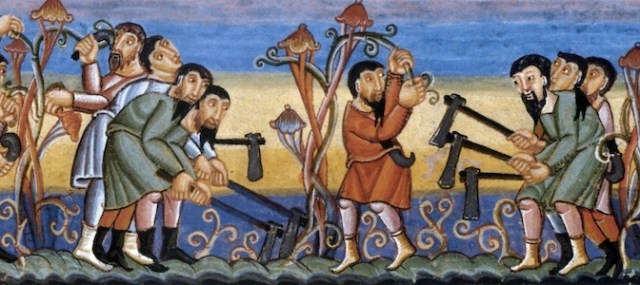
Parable of the Vineyard Workers, from Unknown Artist in the Middle Ages

Then he began to speak to them in parables. “A man planted a vineyard, put a fence around it, dug a pit for the winepress, and built a watchtower; then he leased it to tenants and went away. 

When the season came, he sent a slave to the tenants to collect from them his share of the produce of the vineyard. But they seized him and beat him and sent him away empty-handed. 

And again he sent another slave to them; this one they beat over the head and insulted. Then he sent another, and that one they killed. And so it was with many others; some they beat, and others they killed. 

He had still one other, a beloved son. Finally he sent him to them, saying, ‘They will respect my son.’ But those tenants said to one another, ‘This is the heir; come, let us kill him, and the inheritance will be ours.’ So they seized him, killed him, and threw him out of the vineyard. 

What then will the owner of the vineyard do? He will come and destroy the tenants and give the vineyard to others. Have you not read this scripture:

‘The stone that the builders rejected
    has become the cornerstone;
this was the Lord’s doing,
    and it is amazing in our eyes’?”

When they realized that he had told this parable against them, they wanted to arrest him, but they feared the crowd. So they left him and went away. (New Revised Standard Version)
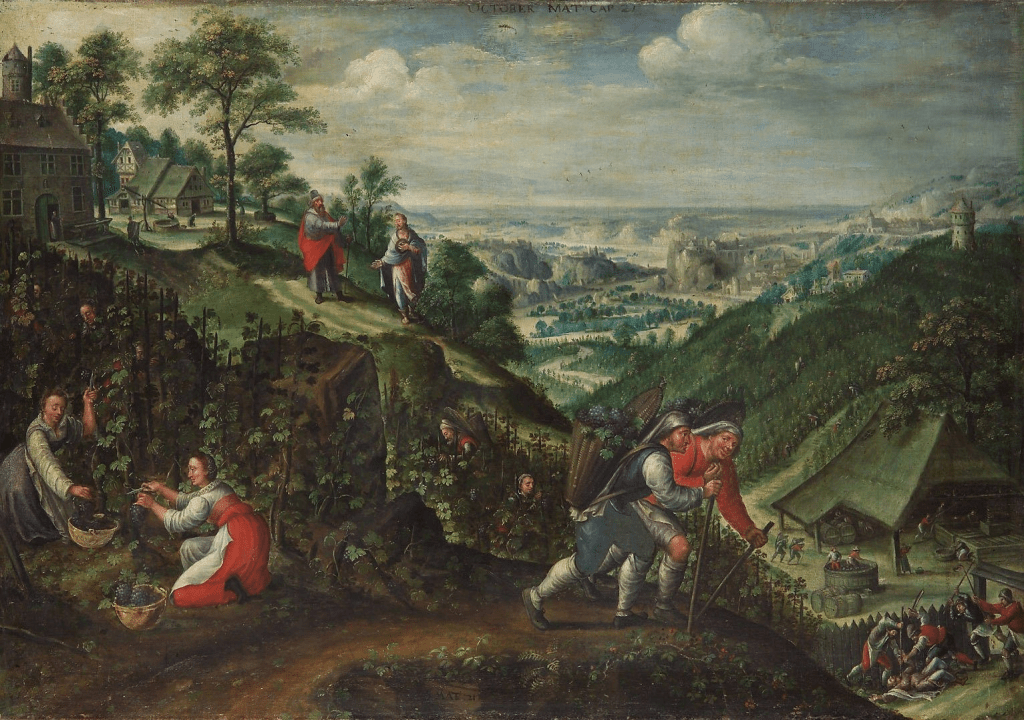
Parable of the Wicked Tenants, by Maarten Van Valckenborg (1535-1612)

Jesus was at the temple in Jerusalem. While there, the religious leaders confronted him over his supposed ministerial authority. Jesus, rather than become defensive, took the initiative by telling a parable.

The parable’s imagery comes directly from the second chapter of the prophet Isaiah in the Old Testament. It, too, was a parable concerning a vineyard. Isaiah leveled an accusation against the entire nation of Israel.

Jesus picked up the same imagery and directed his accusation against the people in front of him, the Jewish religious leaders. The connection between the parable of Isaiah and the parable of Jesus would not have been lost on those leaders.

In many ways, I can relate to the parable’s setting in the land. I grew up on a farm, and appreciate the deep connection of working the land and caring for it. I know something of owning land and having renters work it, since that it was my family did in my parent’s later years.

Anytime there is a relationship between owners, and renters or tenants or servants, it is an unequal relation. And whichever situation you relate to will affect your perspective of the parable.

If you understand what it means to be a landowner, with all of the rights and responsibilities of that ownership, and with the people who work that land, then you likely resonate with the landowner in Christ’s parable. You also will likely detest what the tenants in the parable do.

Perhaps you relate more to being a renter or a tenant. Having an understanding of what it means to rent from another, you may likely see the how the tenants in the parable think, and why they do what they do.

Having personal experiences on both sides of the owner/renter situation – for both good and bad – I can easily see how the violence in the parable could happen. I have my own stories of justice and injustice when it comes to each, the owners and the renters/tenants.

Much like today, ancient power dynamics were a fundamental part of life for many people. And those relations were, and are, fraught with all sorts of inequality.

Christ’s parable is a rather violent story. It’s not really bedtime reading. Notice that the owner has slaves, whom he sends to collect what is due him. Several of them are beaten and/or killed.

There is no backstory to the tenants situation. Yet, at the time of Christ’s ministry, there were many lower class folk who lost their land to unscrupulous owners, in a system of inequity. It’s possible that some of the men Jesus was talking to owned some land. And the religious leaders in the Gospels are rarely presented in a positive light.

Even today, there are violent struggles regarding land, especially in the Middle East. And the power dynamics and inequities are rife with injustice which is claiming to be justice. There are no easy answers to quelling the constant violence.

Feelings of hatred, anger, and fear are common. The desire to kill too often overcomes the desire for life. A group of people are outraged for being the brunt of murder, killing, and evil. Another group already feels neglected and have been the victims of unjust usury and death. They feel justified in their violence toward those they view as perpetrators.

Imagine how people on this earth, such as Palestinians, Israelis, Native Americans, and Ukrainians – just to name a few – feel about land. Land involves life, because the land has water, the potential for farming, trees, and a place to live. Thus, whoever controls land, in many ways, controls life. Agribusiness owns large chunks of land in the United States – and not the smaller family farms. Ah, but that is a topic for another time….

In Christ’s parable, everybody suffered in some way. Servants died. The landowner’s son died. The tenants were destroyed. Life was permanently altered for all involved.

Is that how any of us really want to live?

If we take a theological perspective, God owns everything. But we think we own the land and its resources. We believe we have the right to do whatever we want with it. And that is where the problem arises.

Until we truly hold to the notion that we humans are a society of equals, and that we are all subject to a God who owns everything, then we will continue to experience the effects of injustice, war, and death.

Can we, at least, change our minds? Yes, we can. And Christians are called to do just that:

Do not be conformed to this age, but be transformed by the renewing of the mind, so that you may discern what is the will of God—what is good and acceptable and perfect.

For by the grace given to me I say to everyone among you not to think of yourself more highly than you ought to think but to think with sober judgment, each according to the measure of faith that God has assigned. (Romans 12:2-3, NRSV)

The religious leaders of Christ’s day needed to change their minds about Jesus. Yet, no matter what they did, he would still become the cornerstone, if they rejected him as just one of the stones in the edifice of God’s kingdom.

Today, the parable is still meant to speak to people, to you and me. We have the chance to embrace the Prince of Peace, and walk in the way of peace, not violence. We still yet have the opportunity to be peacemakers, and live in a way that promotes human flourishing, and not human carnage.

If, like the parable of the prophet Isaiah, Christ’s parable is meant to speak to everyone, then it is most necessary that we heed the words of Jesus.

Almighty God our heavenly Father, guide the nations of the world into the way of justice and truth, and establish among them peace, which is the fruit of righteousness, so that they may become the kingdom of our Lord and Savior Jesus Christ. Amen.

Rejected (Luke 4:16-30)

Orthodox depiction of Christ in the synagogue at Nazareth

When he came to Nazareth, where he had been brought up, he went to the synagogue on the Sabbath day, as was his custom. He stood up to read, and the scroll of the prophet Isaiah was given to him. He unrolled the scroll and found the place where it was written:

“The Spirit of the Lord is upon me,
    because he has anointed me
        to bring good news to the poor.
He has sent me to proclaim release to the captives
    and recovery of sight to the blind,
        to set free those who are oppressed,
to proclaim the year of the Lord’s favor.”

And he rolled up the scroll, gave it back to the attendant, and sat down. The eyes of all in the synagogue were fixed on him. Then he began to say to them, “Today this scripture has been fulfilled in your hearing.” 

All spoke well of him and were amazed at the gracious words that came from his mouth. They said, “Is this not Joseph’s son?” 

He said to them, “Doubtless you will quote to me this proverb, ‘Doctor, cure yourself!’ And you will say, ‘Do here also in your hometown the things that we have heard you did at Capernaum.’ ” 

And he said, “Truly I tell you; no prophet is accepted in his hometown. But the truth is, there were many widows in Israel in the time of Elijah, when the heaven was shut up three years and six months and there was a severe famine over all the land, yet Elijah was sent to none of them except to a widow at Zarephath in Sidon. There were also many with a skin disease in Israel in the time of the prophet Elisha, and none of them was cleansed except Naaman the Syrian.” 

When they heard this, all in the synagogue were filled with rage. They got up, drove him out of the town, and led him to the brow of the hill on which their town was built, so that they might hurl him off the cliff. But he passed through the middle of them and went on his way. (New Revised Standard Version)

Reject:

  1. to refuse to have, take, recognize, etc.; to deny
  2. to refuse to grant (a request, a demand, etc.)
  3. to refuse to accept (someone or something); to rebuff, renounce, or repel
  4. to discard as useless or unsatisfactory; to jettison or eliminate
  5. to cast out or eject; vomit
  6. to cast out or off

Rejection can be mutual, and cut both ways. This appears to have been the case with Jesus and the synagogue goers in his hometown of Nazareth.

The townsfolk rejection of Jesus went far enough to want to throw him off a cliff. They were enraged with anger. Christ recognized the people’s rejection of him, long before they realized it themselves. Christ’s rejection of unjust and unbiblical ideas and practices went far enough to rebuke the congregation from the scriptures.

The difference in the two rejections was that the synagogue attenders were denying Jesus himself; whereas Jesus was refusing to accept a longstanding tradition of hate toward a certain group of people.

The nub of the rejection, which went both ways, had to do with non-Jewish persons, that is, Gentiles.

If you think this to be a silly sort of thing, especially of getting so worked up as to try and kill someone, then consider how frothed-up people get concerning contemporary political elections.

Jesus being pro-Gentile was not only unpopular; it was unheard of. So, the people rejected him.

The synagogue being anti-Christ meant that they were anti-Gentile and anti-God, as far as Jesus was concerned. And he wasn’t about to put up with it. So, he rejected not the people, but their entrenched hatred and unscriptural stance.

Jesus took the prophecy of Isaiah about proclaiming liberty to captives, and freedom for the oppressed, and then applied it, not to his fellow Jews who were present, but to, of all people, Gentiles.

Christ pointed out that in the days of Elijah, the prophet was sent to a Gentile woman. In addition, he let everyone know that the prophet Elisha cleansed a Gentile. 

The gathered synagogue worshipers understood exactly what Jesus was saying and doing – he was claiming to be the ultimate prophet, sent for those despised people. 

It was too much for the gathered folk to take. So all hell broke loose as the “worshipers” became so angry and insolent that they drove Jesus out of town and tried to chuck him off a cliff to his death.

Jesus had that kind of effect throughout his earthly ministry by saying and doing the unexpected, and the unwanted.

The people of Nazareth seemed to have always interpreted the message of Isaiah and the prophets as being for themselves, not others. 

This is a probing story for today’s Christian Church. Whenever we lose sight of a biblical message and re-interpret it as being for only us, then we end up like the Nazarenes of old who did not recognize Jesus for who he really is and what he really came to do. 

Perhaps the burning question from today’s Gospel lesson for individual Christians and all churches is this: Are you ready to throw Jesus off a cliff?

Spend some time alone with God today. Consider whether you have made Jesus into the image of what you want him to be, or whether you accept him as he is. 

One clue to this is if you believe some person or people group should not have Jesus – he belongs to people like us. This, by the way, is the very definition of “rejection.”

It could be that some soul-searching repentance is in order, so that Christians will be true worshipers of Jesus, and not just spectator fans of him.

O God, you made us in your own image and redeemed us through Jesus your Son: Look with compassion on the whole human family; take away the arrogance and hatred which infect our hearts; break down the walls that separate us; unite us in bonds of love; and work through our struggle and confusion to accomplish your purposes on earth; that, in your good time, all nations and races may serve you in harmony around your heavenly throne; through Jesus Christ our Lord. Amen.

You Are Not Far From the Kingdom of God (Mark 12:28-34)

One of the scribes came near and heard them disputing with one another, and seeing that he answered them well he asked him, “Which commandment is the first of all?” 

Jesus answered, “The first is, ‘Hear, O Israel: the Lord our God, the Lord is one; you shall love the Lord your God with all your heart and with all your soul and with all your mind and with all your strength.’ The second is this, ‘You shall love your neighbor as yourself.’ There is no other commandment greater than these.” 

Then the scribe said to him, “You are right, Teacher; you have truly said that ‘he is one, and besides him there is no other’; and ‘to love him with all the heart and with all the understanding and with all the strength’ and ‘to love one’s neighbor as oneself’—this is much more important than all whole burnt offerings and sacrifices.” 

When Jesus saw that he answered wisely, he said to him, “You are not far from the kingdom of God.” After that no one dared to ask him any question. (New Revised Standard Version)

Jewish religious leaders in the New Testament Gospels – high priests, scribes, Pharisees, Sadducees, the Sanhedrin – are typically portrayed in a negative light as opponents of Jesus. However, there are religious leaders in the Gospel accounts who genuinely engage Jesus, and are favorable to him.

Today’s Gospel lesson provides us with a wonderful conversation between Jesus and a scribe (that is, a professional handwriting copier of the Scriptures). This particular scribe is not mentioned by name.

The scribe was impressed by what he heard from Jesus. So, the man presented a question to him. The difference between this scribe and the other religious leaders is that the scribe asked a totally sincere question, with no alternative agenda to entrap Jesus. The guy just wanted to learn from him.

The Old Testament law contains 613 commands. Given the reality of so many instructions, which ones are priority? Are there commands which control other commands? What is the best way to look at the hundreds of divine instructions? The scribe’s question was really designed to discover how to best obey the law and be faithful to God.

There was no pondering or hesitation on Christ’s response. He went right to a foundational text for Jews. The passage serves as both a prayer and a succinct affirmation of faith:

“Hear, O Israel: The Lord is our God, the Lord alone. You shall love the Lord your God with all your heart and with all your soul and with all your might.”

Deuteronomy 6:4-5, NRSV

Yahweh is honored in this Scripture as the one true God. As such, Israel has an obligation to love and obey God. For Jesus, this is the cornerstone of faith and worship.

But that’s not all. Jesus provided a second commandment, on the same level of importance as the first:

“You shall love your neighbor as yourself: I am the Lord.”

Leviticus 19:18b, NRSV

I find it interesting that Jesus did not simply assume that everyone would understand that to love God is to love your neighbor. Christ intentionally gave the second command equal billing with the first.

To make it especially clear, Jesus emphasized that these two commands to love God and neighbor are the greatest commandments of all. In other words, every single command of Holy Scripture is tied to these two basic commands.

Indeed, the Ten Commandments are connected to them. The first four commands (you shall have no other gods; you shall not make yourself an idol and bow down to it; you shall not make wrongful use of God’s name; and remember the Sabbath) all have to do with loving God.

The next six commands (honor your father and mother; you shall not murder; you shall not commit adultery; you shall not steal; you shall not bear false witness; you shall not covet) all concern how to be loving to your neighbor.

Jesus intends for pious people to be concerned not only with their relation to God, but also with other people. Religious practices, for Jesus, must not only include devotion directed to God, but also commitments to the common good of all persons.

In order to truly love God, one must also love neighbor. The two are inextricably bound together.

Those who say, “I love God,” and hate a brother or sister are liars, for those who do not love a brother or sister, whom they have seen, cannot love God, whom they have not seen. (1 John 4:20, NRSV)

To the scribe’s credit, he affirmed the answer from Jesus concerning the commandments. And on top of this, the scribe added a beautiful paraphrasing of God’s law: The command to love God and neighbor “is much more important than all whole burnt offerings and sacrifices.”

This scribe was talking Christ’s language. Jesus delighted in his words. He commended and encouraged the man by saying, “You are not far from the kingdom of God.”

Christ’s statement is a positive one, not negative. Jesus was not trying to say that the scribe wasn’t yet in the kingdom, or that he needed to do more. He was affirming the scribe, and encouraging him with the reality that God’s kingdom is so close to us, that we can reach out and put our hand into it.

The kingdom of God is like a whole other world which can be found by some children in the back of a wardrobe; or like a different dimension beyond our three dimensional world. In other words, God’s kingdom is right here, right in front of our faces. The kingdom is here. It’s just a matter of whether we discern it’s presence, or not.

Jesus was right smack in front of the scribe. He could have literally reached out and touched Jesus. The man asked a good sincere question of Jesus, and got a good sincere answer. In addition, the man evidenced a good understanding of the spirit of God’s law.

I believe that Christ’s response concerning the kingdom to the scribe, opened his eyes to that otherworldly dimension:

Jesus is the logical and expected end of every search, and the answer to every question. The kingdom of God is among you.

Our Father in heaven,
    may your name be revered as holy.
    May your kingdom come.
    May your will be done
        on earth as it is in heaven. Amen.

I Am Among You As One Who Serves (Luke 22:24-30)

The Last Supper, by Mamdouh Kashlan (1929-2022)

A dispute also arose among them as to which one of them was to be regarded as the greatest. But he said to them, “The kings of the Gentiles lord it over them; and those in authority over them are called benefactors. But not so with you; rather the greatest among you must become like the youngest, and the leader like one who serves. For who is greater, the one who is at the table or the one who serves? Is it not the one at the table? But I am among you as one who serves.

“You are those who have stood by me in my trials; and I confer on you, just as my Father has conferred on me, a kingdom, so that you may eat and drink at my table in my kingdom, and you will sit on thrones judging the twelve tribes of Israel. (New Revised Standard Version)

Jesus and his disciples had prepared for the Passover meal. They ate and drank together. Christ gave them words which have endured throughout Christian history as the Lord’s Supper. He spoke of the bread as his body, and the cup as the new covenant in his blood. Jesus communed with them and communicated about his impending death.

It was a moving experience for all. The disciples received from their Lord an intense act of love; and a new humanity around Christ’s body and blood. Indeed, the essence of new life is self-sacrificial love.

And then… the disciples began quarreling with each other about positions, and titles, and honors, and who was better, and who would be top dog in God’s kingdom….

It was a moment that I think every parent can relate to, at some level. Sitting around a dinner table, enjoying a rich conversation, becoming close with one another as a family… and then the kids begin bickering with each other about the most mundane of things.

Just a minute ago, you believed you were getting somewhere, and experiencing a shared family bond of love, commitment, and purpose… and then, in a matter of seconds, it all crashes down in a ridiculous display of posturing and positioning of one sibling over another….

I admit, this has happened to me more than once, when my own kids were growing up. And I also admit that I lost my sanctification on more than one occasion, watching this crazy schizophrenic scene play out in front of me.

Which is why I have a lot of respect for Jesus in responding to his disciples with humility, calmness, and a forthright spirit. He addressed their puny questions in a way that rebuked them without making them feel like they just got a Dad lecture.

In the sort of table fellowship that Jesus practiced with his disciples throughout his earthly ministry, he consistently sought to undermine the existing systems of domination in all levels of society. Even the religious system of Christ’s day had a distinct stratifying of persons in an inequitable structure of power.

The kingdom of God, however, is different. God’s economy is characterized by equality, mutuality, diversity, and shared power. It’s all based in a communal, as well as individual, relational connection with the Creator God.

God almighty, Creator of heaven and earth, is gracious, merciful, and kind. The Lord brings rain on both the righteous and the wicked. Thus, any sort of claim to being greater or superior or better than another person or group of people, has no place around the table of Christ’s body and blood.

Catholics are no better than Protestants. Evangelical Christians have no superiority over Progressive Christians. The Coptic Church doesn’t have the high ground on Eastern Orthodoxy. Christians who observe the Lord’s Supper as a remembrance are not greater than those who discern the Table as a sacrament.

And if one has the ears to hear it, Christians really ought to know better than to believe they should have greater control over the world and its systems than Buddhists, Muslims, or Jews.

Puffing up one’s chest and insisting that “My Dad is better than your Dad” is the stuff of childish preoccupations, and not of God’s kingdom.

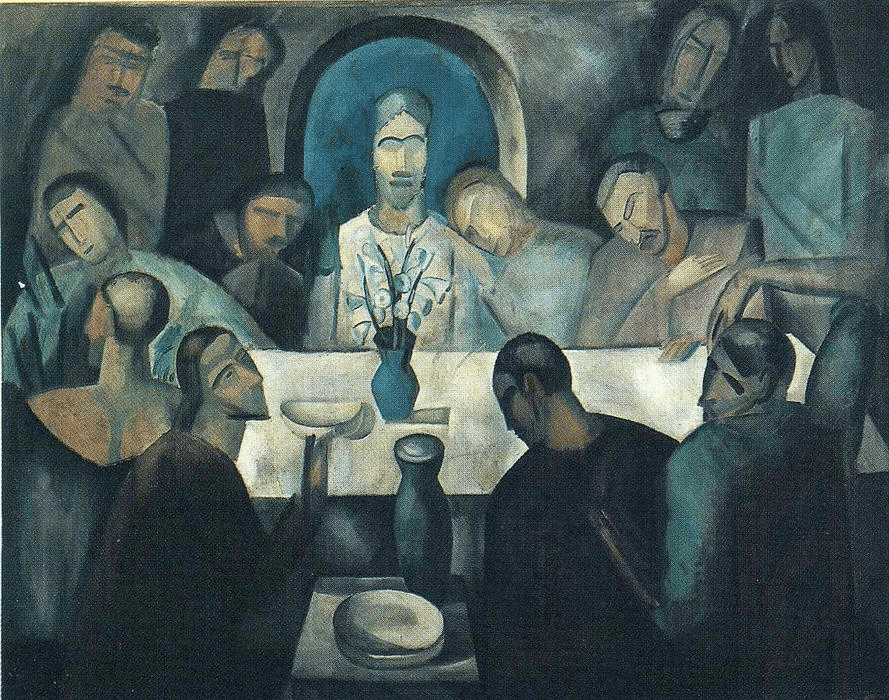
The Last Supper of Jesus, by André Derain (1880-1954)

There are plenty of people in this old messed-up world who lord their power and authority over others. If we take the words of Jesus seriously, Christians are not to be part of that structure and system.

And yet, here we are, in this contemporary time and place in history, having a chunk of the population thinking Christendom is the way to go, that a form of Christian Nationalism should be the political system – as if the kingdom of God and the kingdom of this world are what’s on the ballot.

Christians are the very folks who need to insist on serving, not leading; building up, not tearing down; loving, not hating; being integrated and connected, not fragmented and disconnected from others, as well as from reality.

Any sort of earthly power and authority the Christian has, must be used to include, help, and support, instead of excluding, ignoring, and destroying. The greatest among us must become like the youngest, and the leader like one who serves.

Christians must support and promote the idea of political office as a public service; and the concept of being a citizen as serving the common good of all persons, not just some persons.

Jesus came to this earth to serve. Therefore, his followers are also to serve. The words and ways of Christ centered in humble service, merciful justice, and prayer for one’s enemies. His followers must do no less.

Jesus Christ came to usher in a moral and ethical kingdom in which God’s gracious and benevolent will is done on this earth, as it is always done in heaven. He did not come to make sure Christians have lots of political power and authority over all the non-Christians.

Yes, indeed, we will be given power and authority – but not to baptize existing earthly structures so that the system serves the interests of Christians. We receive so that we can give. We give so that we might serve. And we serve because our Lord is a servant.

So, if Christians truly desire to bring change and transformation to this world, it will be through a compassionate and caring system of service to our fellow humanity – and not by imposing our beliefs and will upon others in a modern day form of the Inquisition.

Let us then, traffic in love; aspire to meekness; practice servanthood; and become the wait staff for the world’s needs.

That is what it really means to stand with Jesus in this time of trial.

Gracious and loving God, you work everywhere reconciling, loving, and healing your creatures and your creation. In your Son, and through the power of your Holy Spirit, you invite each of us to join you in your work.

I ask you to form me more and more in your image and likeness, through my prayers and worship of you; and through the study of Holy Scripture, so that my eyes will be fully opened to your mission in the world.

Send me into my family, church, community, workplace, and world to serve Christ with faith, hope, and love, through the power of the Holy Spirit. Amen.