Dealing with Disrespect and Disbelief (John 12:34-50)

Christ and the Pharisees, by Anthony van Dyck (1599–1641)

The crowd spoke up, “We have heard from the Law that the Messiah will remain forever, so how can you say, ‘The Son of Man must be lifted up’? Who is this ‘Son of Man’?”

Then Jesus told them, “You are going to have the light just a little while longer. Walk while you have the light, before darkness overtakes you. Whoever walks in the dark does not know where they are going. Believe in the light while you have the light, so that you may become children of light.” When he had finished speaking, Jesus left and hid himself from them.

Even after Jesus had performed so many signs in their presence, they still would not believe in him. This was to fulfill the word of Isaiah the prophet:

“Lord, who has believed our message
    and to whom has the arm of the Lord been revealed?”

For this reason they could not believe, because, as Isaiah says elsewhere:

“He has blinded their eyes
    and hardened their hearts,
so they can neither see with their eyes,
    nor understand with their hearts,
    nor turn—and I would heal them.”

Isaiah said this because he saw Jesus’ glory and spoke about him.

Yet at the same time many even among the leaders believed in him. But because of the Pharisees they would not openly acknowledge their faith for fear they would be put out of the synagogue; for they loved human praise more than praise from God.

Then Jesus cried out, “Whoever believes in me does not believe in me only, but in the one who sent me. The one who looks at me is seeing the one who sent me. I have come into the world as a light, so that no one who believes in me should stay in darkness.

“If anyone hears my words but does not keep them, I do not judge that person. For I did not come to judge the world, but to save the world. There is a judge for the one who rejects me and does not accept my words; the very words I have spoken will condemn them at the last day. For I did not speak on my own, but the Father who sent me commanded me to say all that I have spoken. I know that his command leads to eternal life. So whatever I say is just what the Father has told me to say.” (New International Version)

It seems that nowadays, the more one rises in popularity and garners national attention, the more some folks want to disrespect them.

Out of the many examples of this phenomenon, consider the case of a young woman from my home state of Iowa. Sportswriter Mike DeCourcy recently mused on why the University of Iowa’s Caitlin Clark has discovered that not all the greats of women’s college basketball welcome her success.

Several women – who ought to know better – have cynically reacted to Clark’s legitimate college greatness with a sort of “Why her, why not us?” attitude. They’ve indulged in misinformation and cheap shots that clearly say more about them than Caitlin Clark.

This is especially curious, since Clark has elevated women’s basketball to a level of attention that her now detractors and others have envied for decades. DeCourcy writes, “None of this [delegitimizing Clark] is a good look for NCAA women’s basketball, and neither does it appear to be the most prudent way to continue growing the sport.”

The same type of thing could be said about Jesus and the movement he was sparking during his ministry on this earth. Many of the religious leaders refused to acknowledge his greatness, nor believe in the words he was saying. Instead, they sought to knock down Jesus and the good work he was doing.

It seems the religious leaders wanted the praise and attention Jesus was getting. Even many who believed in what was happening, kept their mouths shut and let the misinformation spread, because they, too, loved the praise of others instead of praise from God.

Playing with the game of darkness, nobody wins. People end up only being a mere shadow of the person they could be. Trying to disrespect others in order to shine the light on yourself is a convoluted and misguided way of handling anyone or any situation.

Carl Jung (1875-1961) described this hidden shadow self as an unconscious aspect of the human personality. In other words, the shadow results from the conscious self being unaware or unconscious concerning areas of its own personality. Without the light of conscious awareness, the shadow self runs amok within the psyche of a person and far too often calls the shots in speaking and behavior.

“Everyone carries a shadow,” Jung wrote, “and the less it is embodied in the individual’s conscious life, the blacker and denser it is.” (Psychology and Religion, 1938)

According to Jung, the shadow side of a person is prone to psychological projection, in which a perceived personal inferiority is recognized as a perceived moral deficiency in someone else. If those projections remain hidden, they eventually come out sideways by harming others because there is a dark illusion, even delusion, that others are stealing what is rightfully mine.

Hence, the sinless Jesus is denigrated, disrespected, and disbelieved. And it is what led to him being tortured and killed by those who thought they are doing a good thing.

It’s easy to be hard on the religious rulers in the New Testament, but this is the Christian season of Lent, and so, we must shine the light of Scripture upon ourselves. This is the time to deliberately gain awareness of our own shadow selves.

Perhaps the burning question for all believers at this time of year is: Do I seek the presence of God more than the presence of anything or anyone else?  

Maybe you live in fear at work and are more concerned about the presence of people around you than the presence of God, so you keep quiet when you ought to speak up or turn a blind eye to the shadows of an organization. Or worse, you talk bad about someone good, just because they’re getting the attention you feel you deserve.

In these remaining days of Lent, as we journey with Jesus to Jerusalem, let’s let the light of his gracious ministry dispel the dark shadows of our hearts and make us aware of who we are, and what we need to change.

If we can learn to appreciate the God-given and hard-earned talents of a young woman playing basketball, then perhaps we can then also learn to glory in One who is greater than any sports celebrity, and celebrate the great work done on this earth for us and for our salvation.

Good and gracious God, we are far too often influenced by what others think of us. We sometimes pretend to be either richer or smarter or nicer than we really are. So, prevent us from trying to divert attention from others to ourselves. Don’t let us gloat over praise received from others, nor be discouraged by criticism from another. Show us, instead, how to be humble of heart, like the Lord Jesus, in whose name we pray. Amen.


Life Through Death (John 12:20-33)

Now among those who went up to worship at the festival were some Greeks. They came to Philip, who was from Bethsaida in Galilee, and said to him, “Sir, we wish to see Jesus.” Philip went and told Andrew, then Andrew and Philip went and told Jesus. Jesus answered them, “The hour has come for the Son of Man to be glorified. Very truly, I tell you, unless a grain of wheat falls into the earth and dies, it remains just a single grain, but if it dies it bears much fruit. Those who love their life lose it, and those who hate their life in this world will keep it for eternal life. Whoever serves me must follow me, and where I am, there will my servant be also. Whoever serves me, the Father will honor.

“Now my soul is troubled. And what should I say: ‘Father, save me from this hour’? No, it is for this reason that I have come to this hour. Father, glorify your name.” Then a voice came from heaven, “I have glorified it, and I will glorify it again.” The crowd standing there heard it and said that it was thunder. Others said, “An angel has spoken to him.” Jesus answered, “This voice has come for your sake, not for mine. Now is the judgment of this world; now the ruler of this world will be driven out. And I, when I am lifted up from the earth, will draw all people to myself.” He said this to indicate the kind of death he was to die. (New Revised Standard Version)

The fifth Sunday in Lent is now here. We are quickly approaching Jerusalem. Holy Week will be here before you know it. 

Why is this all significant? Because Jesus is important. By taking advantage of Lent with its focus on spiritual discipline, prayer, and repentance, we come face-to-face with the shadowy parts of our selves. We discover that within us there is the pull to hold-on to unhealthy rhythms and habits of life, as well as a push to arrange our lives with the fragmentation of disordered love.

Perhaps our reflexive response to things we do not like about ourselves is to either use sheer willpower to change or try to somehow manage our brokenness, as if we could boss our way out of darkness. The problem and the solution are much more radical than we often would like to admit.

We must die. 

Yes, you heard that right. This is the teaching of Jesus – to die to ourselves. Sin cannot be managed or willed away – it must be eradicated and completely cut out, like the cancer it is. Transformation can only occur through death. 

Jesus used the familiar example of a seed to communicate his point. A tiny little seed can grow, break the ground, and develop into something which provides sustenance for others. It does no good to remain a seed in the ground.

Christ was only telling others to do, what he himself was willing to do. Jesus is the ultimate example of the one who died to himself, and literally died for us. Through suffering and death, he secured deliverance for us from guilt and shame. 

By his wounds we are healed. Through his tortuous death a resurrection became possible – and we must always remember that there must be a death if there is to be a resurrection. Death always precedes life. There is suffering before glory.

Through dying to self, and following Jesus, there is the hope of transformative change which the world so desperately needs. If we persist in making puny attempts at trying to straddle the fence in dual/rival kingdoms, we will be spiritually schizophrenic and left with a divided soul. 

Following Jesus – leaving all to walk with him – is true repentance and authentic discipleship. The act of journeying with Christ is the means to a new life. Change is possible by letting Jesus Christ be the center from which all of life springs.

Maybe you think I’m being too forceful, too insistent about this Jesus stuff. 

Yes, you have perceived well. I am being quite single-minded about the need for dying to self and living for Christ. 

Somehow, within many corners of Christianity, this wrongheaded notion that suffering is not God’s will has made it into the life of the church. But I’m here to say, on the authority of God’s Holy Word (not to mention your own internal gut and conscience) that dying to ourselves is necessary. And it hurts. The epistle reading for today bears this out:

In the days of his flesh, Jesus offered up prayers and supplications, with loud cries and tears, to the one who was able to save him from death, and he was heard because of his reverent submission.  Although he was a Son, he learned obedience through what he suffered; and having been made perfect, he became the source of eternal salvation for all who obey him. (Hebrews 5:7-9, NRSV)

Christians are not above their Master. Even Christ’s life on this earth, before his death and resurrection, was marked with suffering. Even Jesus learned obedience through struggle and adversity. Jesus Christ did what he now asks of us. 

The Son gave up himself to do the Father’s will. So, we must give up ourselves in submission to King Jesus.  Jesus offered loud cries and tears, and submitted to what the Father wanted. His followers must do no less. 

We don’t get to choose which parts of Christ’s life and teaching we will adhere to, and which ones we won’t, as if Jesus were some spiritual buffet line. All who live for Jesus, follow him into the path of suffering, of death to self, and of new life through the power of his resurrection.

Those who love their life lose it, and those who hate their life in this world will keep it for eternal life.

How do we follow Jesus through dying to self? What does that mean for you and me on a practical daily basis?

Surrender

Every moment of every day is an opportunity for giving ourselves to Jesus. We have hundreds, maybe thousands, of small daily decisions with the use of our time, money, energy, and relationships. 

If we have tried to fix what is broken inside of us, we will likely just try to hastily fix the problems and the people in our lives – and then move on with getting things done on our to do list. 

Instead, there is a need to surrender ourselves – to create the sacred space for solitude and silence, prayer and repentance. 

Take the time to sit with a person in pain and listen. Reflect on how to use your money in a way which mirrors kingdom values. Begin to see your life as a holy rhythm of hearing God and responding to what he says. It takes intentional surrender to do that.

Sacrifice

Holding-on to our precious stuff and time is the opposite of sacrifice. 

Are we truly willing to give-up everything to follow Jesus? 

It is more than true that we are not Jesus. Our sacrifice and suffering are not efficacious, that is, it doesn’t deliver other people from sin. Only Christ’s death does that. Yet, we are still called to sacrifice. The Apostle Paul understood this, with a statement that I’ll let you wrestle with and mull over without comment on my part:

I am now rejoicing in my sufferings for your sake, and in my flesh I am completing what is lacking in Christ’s afflictions for the sake of his body, that is, the church. (Colossians 1:24, NRSV)

Happiness is important; but it isn’t the summum bonum of life. There is more to life than living for self. Jesus calls us to see our communities, neighborhoods, and families as a mission field of grace to a world who needs him. That takes sacrificial love on our part.

Christianity is not really a religion that’s for people who have put neat theological answers and tidy packaged certainties to all of life’s questions. 

Rather, Christianity is a dynamic religion of learning to follow Jesus, discovering how to die to self, and struggling to put Christ’s teaching and example into practice. 

Those who don’t struggle are in big trouble. But those who go through the pain of dying to themselves for the sake of their Lord, find that the fruit they harvest leads to eternal life.

May you struggle well, my friend.

Saints, Sinners, and Sacrifice (Mark 8:31-38)

Then he began to teach them that the Son of Man must undergo great suffering and be rejected by the elders, the chief priests, and the scribes and be killed and after three days rise again. He said all this quite openly. And Peter took him aside and began to rebuke him. But turning and looking at his disciples, he rebuked Peter and said, “Get behind me, Satan! For you are setting your mind not on divine things but on human things.”

He called the crowd with his disciples and said to them, “If any wish to come after me, let them deny themselves and take up their cross and follow me. For those who want to save their life will lose it, and those who lose their life for my sake, and for the sake of the gospel, will save it. For what will it profit them to gain the whole world and forfeit their life? Indeed, what can they give in return for their life? Those who are ashamed of me and of my words in this adulterous and sinful generation, of them the Son of Man will also be ashamed when he comes in the glory of his Father with the holy angels.” (New Revised Standard Version)

Saintly Sinners and Sinning Saints

People cannot be separated easily into the categories of saints or sinners. We are much more like saintly sinners or sinning saints. 

If we look closely, everyone is, at the same time, both beautiful and hideous; holy and depraved; full of faith and full of fear. And when it comes to the church, it is both the place of spiritual sensitivity toward others, as well as a den of decadent self-interested individuals. 

So, anyone searching for a church or a community that is a nice clean upward path of success with everything done to perfection with no one ever being hurt or unhappy, will be sorely disappointed. Such an organization or institution does not exist; and, it never did.

Yet, with that reality in mind, Jesus stands right alongside imperfect people, despite all their flaws, shallowness, and self-interest. Jesus is very well acquainted with people’s damaged emotions and open putrid spiritual abscesses. Yet, Christ treats everyone with mercy; Jesus never tires of rehabilitating and reforming.

Christ’s disciple, Peter, is the poster child for humanity’s mix of faith and failure. He stepped out of a boat in great faith and walked on the water, only to begin sinking because of his great fear. (Matthew 14:22-33)

It was Peter who made a bold and right confession of faith, and then turned around and bought into a satanic agenda. Yet, Jesus was right there, next to Peter all the way. Christ both rebukes and loves, all the while never abandoning us, but always working in and through us to accomplish good and right purposes.

The bald fact of the matter is that following Jesus involves pain and sacrifice. That’s the reality of living in a broken mixed-up world. What’s more, Christ’s Church is still imperfect and in the process of becoming holy. So, if we will admit it, we are all like Peter – a little devil who needs to get in line behind Jesus.

Everyone gets frustrated or disgusted with church, or really any consistent gathering of people. It’s easy to complain and even avoid others. It’s much harder to take up our cross and lose our life for the sake of Christ and others. We truly can choose to put love where love is not, even when we do not feel loved.

Imagine that your family has gathered for a holiday. Everyone is together. But you are struggling with tiredness and anger. Your spouse is sulking. Your teenage kids don’t want to be there. You worry about your aging parent. And you’re anxious about whether your crazy uncle is going to be nice or go on some weird political rant.

You want to be present, to celebrate the holiday. Your family is anything but a Hallmark card. Everyone’s hurts and hang-ups are not far from the surface. But you are together for a reason, to celebrate and experience joy. It may be a twisted human version of togetherness and spirituality, but it’s still a foretaste of the heavenly banquet that is to come. So, you deal with it all, and find some peace and satisfaction, transcending the carnal and experiencing the sacred.

In much the same way, the church gathers together in an imperfect way, a crazy mix of sinner and saint. But we gather in and around Jesus – and that makes all the difference. There’s a reason for doing this that is bigger than all our dysfunctional ways and dyspeptic attitudes. 

Jesus Christ is building his church, and he will keep it going until the end of the age. Fellow saints and sinners, Jesus isn’t finished with us yet!

The Sacrifice of Jesus Is Needed

Jesus openly stated openly that it is necessary for him to suffer deeply and die a cruel death. It’s God’s plan. But Peter didn’t like that plan, at all. So, he took Jesus aside and rebuked him, believing Jesus to be off his rocker for even suggesting such a terrible scenario. Jesus, however, turned the tables on Peter and rebuked him right back because being Christ-centered without being cross-centered is satanic.

Peter presumed to know what was best for Jesus. He believed the suffering of the cross would never happen. Peter’s perceptions were dim and limited. He did not the reality of how the world truly is; and that Jesus needed to offer himself as a sacrifice for the sins of the entire planet. 

Sometimes, like Peter, we may believe that the way I see and the way I perceive is the way things really are; or, at least, how I think they should be. 

Peter had been walking with Jesus for a few years, watching and enjoying him. It was all good. So, in his mind, it should never change; why try and fix something that isn’t broken? Oh my, but broken the world is!

Just because it was good for Peter did not mean it was good for everybody or should always be this way. If Peter had his way, we would likely be in hell. We, like Peter, are finite humans with limited understanding and perceptions.

One can easily slip into a satanic mode of believing that because something is going fine for me that everyone else is doing okay, too. I like it, I want it, so what’s the problem? 

The problem is that we too easily view life through selfish lenses. In such a state, we fail to:

  • see other people’s needs
  • perceive a lost world with any sense of reality
  • understand that Jesus has an agenda different from our own

Our limited perceptions come out in saying things such as:

  • “Oh, she’s just depressed because she is avoiding responsibility.” 
  • “People on government welfare are lazy.” 
  • “He’s addicted because he doesn’t want to help himself.” 
  • “They’re picketing because they’re a bunch of malcontents.”

Statements like those are legion, and betray a satanic worldview devoid of grace. It’s a compulsive need to find blame. It’s a belief that if there’s personal suffering, there must be personal sin. 

We belong to one human family, and therefore, we are all in this life together. One person’s joys are our joys; one person’s struggles are our struggles. The detachment we can have toward other humans is completely foreign to the words of Jesus. 

The Christian life always involves suffering, and Jesus invites us to follow him in his way of sacrifice.

The Sacrifice of Christ’s Followers Is Needed

There is a way to reverse a satanic agenda and demonic thinking: self-denial. Jesus issued an invitation to fall in line behind him and walk with him in his suffering. 

Self-denial is not so much doing something like giving up chocolate for Lent; rather, it’s giving up on ourselves as our own masters. It’s a decision to make the words and ways of Jesus the guiding direction for life. It’s the choice to quit holding onto the way I believe things ought to be, and take the time to listen to Jesus.

The logic of Jesus is relentless. Life comes through death. We give up our lives to find life. It’s unhelpful to adulterate our lives by serving the gods of success and perfectionism. Jesus invites us to quit our moonlighting job with the world, and go all in with him. In this way, we find abundant life. 

Jesus was encouraging not only submission to suffering, but also an embrace of suffering. In doing so, we find reward and joy. For those familiar with this path, suffering is a blessing. In walking this road, they find the true purpose and meaning of life. 

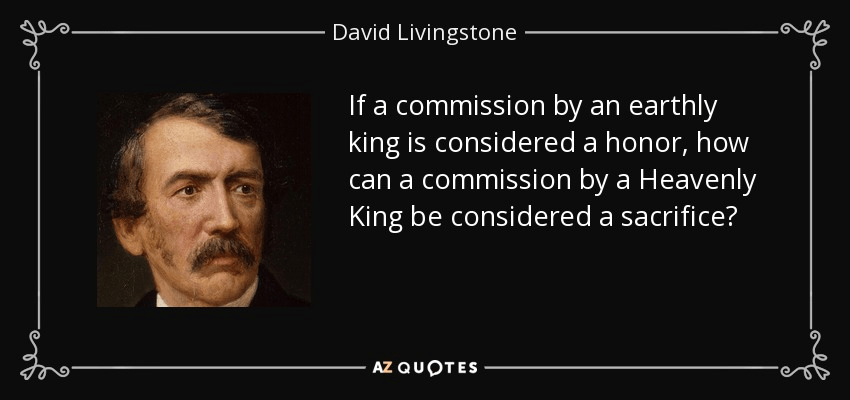
Few people suffered as much as the nineteenth-century missionary medical doctor to Africa, David Livingstone.  He was a pioneer explorer who opened up the interior of Africa to the outside world. He had two reasons for doing so: To take the good news of Christ’s suffering to the African people; and, to open Africa to legitimate trade, so that the illicit slave trade would end. 

Dr. Livingstone’s hand was bitten and maimed by a lion. His wife died while on the mission field. The one house he built was destroyed in a fire. He was often wracked with dysentery and fever, or some other illness in the jungle. 

Someone once commented to him that he had sacrificed a lot for following Jesus. His response: “Sacrifice? The only sacrifice is to live outside the will of God.” When asked what helped him get through the hardship, he said,  “The words of Jesus to take up my cross are always ringing in my ears.”

We may mistakenly believe that we must watch out for ourselves; push for our personal preferences; that if I accept the invitation to follow Jesus in the way of self-denial, I will be miserable and people will walk all over me. Those thoughts are merely demonic whispers in the ear.

There are two differing ways of thinking and acting: 

  1. The way of success, perfection, and a pain-free life as the evidence of God’s working. 
  2. The way of suffering as right and necessary in order to connect with God and be in solidarity with those who suffer. 

Suffering, rejection, and execution did not fit into Peter’s church growth plan. But according to Jesus, we do not exist only for ourselves, to be in some sort of spiritual country club. We exist to follow Jesus in his path of sacrifice and suffering for a world of people who desperately need to know the grace of forgiveness, and the mercy of Christ.

Since Jesus died, we are to die to ourselves. Since Christ lives, we are to live a new life. In God’s upside-down kingdom, joy comes through suffering. We follow Jesus as the mix of sinner and saint that we are. Amen.

What Do You Value? (Matthew 6:1-6, 16-21)

The Sermon on the Mount, by Beryl Lewis (1939-2021)

“Be careful not to practice your righteousness in front of others to be seen by them. If you do, you will have no reward from your Father in heaven.

“So when you give to the needy, do not announce it with trumpets, as the hypocrites do in the synagogues and on the streets, to be honored by others. Truly I tell you, they have received their reward in full. But when you give to the needy, do not let your left hand know what your right hand is doing, so that your giving may be in secret. Then your Father, who sees what is done in secret, will reward you.

“And when you pray, do not be like the hypocrites, for they love to pray standing in the synagogues and on the street corners to be seen by others. Truly I tell you, they have received their reward in full. But when you pray, go into your room, close the door and pray to your Father, who is unseen. Then your Father, who sees what is done in secret, will reward you….

“When you fast, do not look somber as the hypocrites do, for they disfigure their faces to show others they are fasting. Truly I tell you, they have received their reward in full. But when you fast, put oil on your head and wash your face, so that it will not be obvious to others that you are fasting, but only to your Father, who is unseen; and your Father, who sees what is done in secret, will reward you.

“Do not store up for yourselves treasures on earth, where moths and vermin destroy, and where thieves break in and steal. But store up for yourselves treasures in heaven, where moths and vermin do not destroy, and where thieves do not break in and steal. For where your treasure is, there your heart will be also. (New International Version)

Spiritual Disciplines

In Christ’s day, there were three spiritual disciplines that were especially important: giving, prayer, and fasting. For the Jewish faithful, these three practices were meant to work together in helping them to know God and serve others. 

Yet, over time, although the disciplines were maintained, they were observed for all the wrong reasons. Jesus was concerned to communicate that not only are people to do the right thing, but that they do the right things for the right reasons.

To do any less, is to be a hypocrite who maintains an outward form of religion, but is inwardly motivated by the praise and recognition of others. Such a person is, in reality, far from God. 

Ash Wednesday is the beginning of Lent on the Christian Calendar. This season is a time devoted to spiritual disciplines, especially fasting.

Fasting

Those who truly hunger and thirst for righteousness take the time eat spiritual food in order to pursue God and seek right relationships in this world. It’s not a matter if we fast, but when.

The Bible has a great deal to say about fasting:

  • Fasting is a sign of humility and brokenness before God in recognizing both personal and corporate guilt. (1 Samuel 7:2-6)
  • Fasting is a means of preparation for ministry. Jesus used fasting in the desert as preparation for his ministry, and to face down the devil (Matthew 4:1-2). And the apostles fasted when seeking God’s direction about a new ministry. (Acts 13:2-3)
  • Fasting is meant to connect with God and serve others; and not to simply go through the motions. (Isaiah 58:3-7)

Therefore, fasting is a time to get in touch with God, to know the divine will, and then to do it. 

God doesn’t operate on a point system. If we only go through the motions of a spiritual discipline, or do it so that others will notice that I am doing my duty, then we have come under the condemnation of Jesus and are proved as hypocrites.

True fasting in an outward practice reflecting an inner attitude of heart; it’s an expression of devotion in order to connect with God and do good works of service to others.

Framing the topic another way: Why don’t we fast? Because it’s culturally okay not to? Because nobody cares whether I do, or don’t?

The spiritual disciplines of giving, praying, fasting, and other Christian practices have changed my life because they are a vital means of connecting with God and engaging the world.

A farmer disciplines himself to plow, plant, and cultivate – not because he wants to impress others (“Y’all see my big ol’ tractor and my implements!?”) but so that he will receive the reward of reaping a harvest at the proper time. 

So, we also, can engage in spiritual disciplines, like fasting, in order to see a harvest of righteousness.

Earthly vs. Heavenly Treasure

Do not store up for yourselves treasures on earth. What are earthly treasures? It’s stuff, money, possessions, as well as control, power, position, and recognition from others.

You may rightly ask, “Is this really, in and of itself, wrong?” No, it’s not. The real question is not whether we possess earthly treasure (because we all do) but rather:

Do I use my earthly treasure to build heavenly treasure? Do I hoard earthly treasure for my own purposes apart from Christ’s kingdom values?

Jesus once illustrated the difference:

Someone in the crowd said to him, “Teacher, tell my brother to divide the inheritance with me.” 

Jesus replied, “Man, who appointed me a judge or an arbiter between you?” 

Then he said to them, “Watch out! Be on your guard against all kinds of greed; life does not consist in an abundance of possessions.” 

And he told them this parable: “The ground of a certain rich man yielded an abundant harvest. He thought to himself, ‘What shall I do? I have no place to store my crops.’ “Then he said, ‘This is what I’ll do. I will tear down my barns and build bigger ones, and there I will store my surplus grain. And I’ll say to myself, “You have plenty of grain laid up for many years. Take life easy; eat, drink and be merry.”’  “But God said to him, ‘You fool! This very night your life will be demanded from you. Then who will get what you have prepared for yourself?’ 

“This is how it will be with whoever stores up things for themselves but is not rich toward God.”(Luke 12:13-21, NIV)

Again, earthly possessions are tools to be used; and not for accumulating personal wealth, esteem, and success for the sake of security in money. Rather, everything the Christian has is for the advancement of God’s kingdom values. 

Why do this? Because earthly treasure is temporary, and heavenly treasure is permanent. 

Is what you are pursuing today really going to matter in 50 billion millennia?

Heavenly treasure is righteousness as defined by Jesus: right relationships with both God and other humans.  Humility, peace, grace, mercy, purity, forgiveness are all relational values. The only thing that we will take with us when we die is relationships.

If I am genuinely committed to God’s kingdom, my most cherished values will be established by God. 

Our real values consume our thoughts and our efforts; what is in our hearts directs our work. And our ultimate values derive from how we perceive our identity. 

For a great many Americans, the primary noun that characterizes and defines us is not American Christians, not American citizens, not American workers; we are known primarily as American Consumers. 

Jesus is not necessarily advocating that we take vows of poverty, or that we ought not to enjoy the good things we have; what he is asking of us is to make a decision where your loyalty is placed.

Spiritual disciplines such as fasting help us to maintain our most cherished values, to see them clearly, and to choose wisely based upon those values.

May it be so, to the glory of God. Amen.