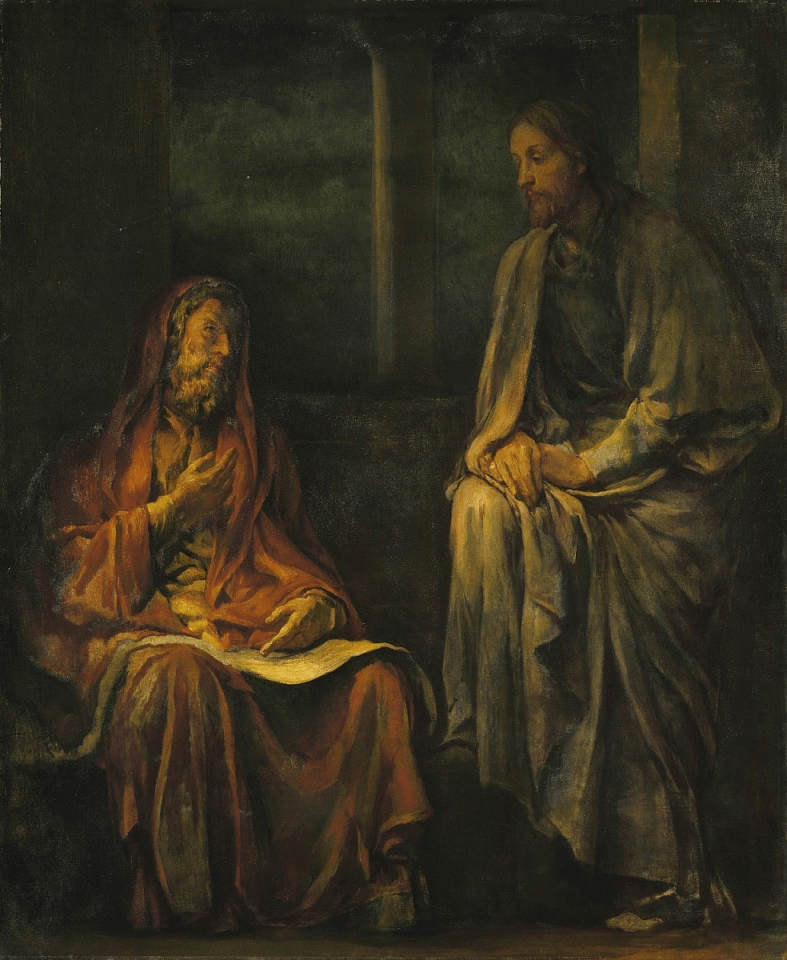
Pentecost (John 15:26-27, 16:4b-15)

The Holy Spirit, by He Qi

“When the Advocate comes, whom I will send to you from the Father, the Spirit of truth who comes from the Father, he will testify on my behalf. You also are to testify because you have been with me from the beginning…

“I did not say these things to you from the beginning, because I was with you. But now I am going to him who sent me, yet none of you asks me, ‘Where are you going?’ But because I have said these things to you, sorrow has filled your hearts. Nevertheless, I tell you the truth: it is to your advantage that I go away, for if I do not go away, the Advocate will not come to you, but if I go, I will send him to you. 

“And when he comes, he will prove the world wrong about sin and righteousness and judgment: about sin, because they do not believe in me; about righteousness, because I am going to the Father, and you will see me no longer; about judgment, because the ruler of this world has been condemned.

“I still have many things to say to you, but you cannot bear them now. When the Spirit of truth comes, he will guide you into all the truth, for he will not speak on his own but will speak whatever he hears, and he will declare to you the things that are to come. He will glorify me because he will take what is mine and declare it to you. All that the Father has is mine. For this reason I said that he will take what is mine and declare it to you. (New Revised Standard Version)

Pentecost, by John August Swanson (1938-2021)

This is the Christian Day of Pentecost. It is often referred to as the birthday of the Church. Pentecost marks the time when the Holy Spirit came upon the fledgling believers in power. 

Pentecost is significant for Christians because it marks the age of the Spirit, the era of new spiritual life and power. Ten days after recognizing Christ’s Ascension, and fifty days after Christ’s resurrection from death, the Christian Year observes the Day of Pentecost (which literally means “fifty” in Greek). 

An implication of Pentecost is that it brings both change and stability, of being uprooted as well as deeply grounded. To experience Pentecost, it is necessary to invite change and to allow ourselves to be changed.

To live a truly spiritual life, full of the Holy Spirit, means that things will never be the same again. With the Spirit, there is a new form of consciousness, an emerging awareness of both self and the world, and new interests and commitments which are followed.

Change involves unlearning old thinking and ways of doing things, becoming uprooted and planted in fresh spiritual soil. The spiritual person will discover new, necessary, and expansive ways of living the faith of Jesus Christ in today’s topsy-turvy world.

Today’s Gospel lesson has Jesus talking to his disciples for the last time before his crucifixion and resurrection. He communicated to them that he was going away, and they were sad and confused about it all. So, Jesus assured them that they would not be alone – his presence would be with them in the person of the Holy Spirit.

Jesus made it plain that the One who is coming, the Paraclete, is the One who comes alongside and offers to the disciples a ministry of advocating, testifying, speaking truth, glorifying, and proving the world wrong about sin and righteousness and judgment.

The Spirit advocates for us and all creation. The Spirit hears our pain, moaning, and desperation, bringing it all to God in helpful language (Romans 8:26). The Spirit testifies about Jesus to us and about his ministry. The Spirit speaks truth to us whenever we go astray from the words and ways of Jesus; and so, will challenge us and provoke us to live into our majesty as people created in God’s image and redeemed by Christ’s death and resurrection.

If and when our Christian life and worship becomes a ho-hum hodge-podge of ritualistic or legalistic goo, where no spiritual growth or life transformation is happening – and worse, if it becomes characterized by injustice – then the Spirit will have something to say in regard to sin, righteousness, and judgment.

A lack of faith can take many forms. For many Christians, the separation between belief and practice is a form of apostasy. Signing off on a set of doctrinal beliefs means nothing unless it has feet and hands to it by going after those who are suffering, giving restitution for what we’ve taken, and putting the love of Christ where love is not found.

A confession of faith is hollow and useless without first having a confession of sin. Jesus did not say that people will know Christians by their doctrinal confessions and ancient creeds, but that others will know the Christian by the fruit of a life given to righteousness and justice. (Matthew 7:16)

The worldly ruler is the one who perpetuates systems of evil and oppression; and ignores poverty, hunger, and need. The ruler of this world is condemned by the Spirit because of meanness, brutality, violence, and abject greed and selfishness.

Anyone who turns the life-giving good world which God has made into a death-dealing world of ignorance, sloth, and power politics is under the judgment of the Spirit, on orders by Judge Jesus. Whenever the bent of the will is developed into only being concerned with personal happiness, while ignoring communal needs, the person is existing far from the teachings of Jesus to his disciples.

On this Day of Pentecost, and into this proper Pentecostal season, our call is to have a genuine spiritual life that allows the true self to make a difference in this old fallen world. The spiritual person seeks to tap into the Spirit and insist on caring for others without prejudice or favoritism; and will ground themselves in healthy spiritual dynamics of positive change and transformation as living sacrifices to God. (Romans 12:1-3)

With the reality of Pentecost, believers in Jesus, and the whole Church everywhere, has the full power of the Holy Spirit with them at all times. This means our ultimate trust is not in the power of authoritative positions, economic budgets, polished programs, personal ingenuity, or a consumer self-realization.

Our trust is in the name of the Lord who made heaven and earth, in Jesus Christ, God’s only Son, and in the strength of the Holy Spirit who is the continuing presence of Jesus. Such power is given for a purpose. So let us be responsible and conscientious in living the Christian life.

And may the blessing of the Spirit move you to know Jesus better, love the world more, and be the person you were created to be – to the glory of God. Amen.

Are You In Need? (John 7:37-39)

On the last day of the festival, the great day, while Jesus was standing there, he cried out, “Let anyone who is thirsty come to me, and let the one who believes in me drink. As the scripture has said, ‘Out of the believer’s heart shall flow rivers of living water.’ ” Now he said this about the Spirit, which believers in him were to receive, for as yet there was no Spirit because Jesus was not yet glorified. (New Revised Standard Version)

Let’s take Christ’s words at the end of the Jewish Festival of Booths (or Tabernacles) at face value. Jesus said that if anyone is thirsty, they could come to him and drink. This is an unconditional statement with no caveats, qualifications, or fine print to it.

Jesus did not say that if anyone is spiritual enough, strong enough, or committed enough that then they could come to him.

The only qualifications one must have in coming to Jesus is to be needy. To be thirsty and want a drink is it, period. No interviews. No jumping through any hoops. No red tape. No having to go through one of the disciples to get to Jesus. No obstacles whatsoever.

Sheer need and want gets anybody an audience with Jesus.

“Thirsty” is Christ’s simple metaphor for need. Whenever we long to have our needs met, there is always the opportunity and possibility of going to Jesus. And all of us are thirsty because every single person has needs that aren’t getting met. These important and vital words of Jesus are encouraging. They help us admit whatever is going on, and say to him, “I need you, Lord.”

The Lord’s response to such a humble expression of need is this: “Please come here to me and drink till you are full.” No judgment. No condemnation. No big sighs. No snarky comments. No disappointed looks. Our confession of need accesses divine compassion and help.

Who will help us? The Holy Spirit will help.

Christ ascended and gave us the Spirit. On this day before the Christian celebration of Pentecost, we are reminded that Jesus delivered on his promise to give help. There is no better assistance in all the world than having a permanent live-in Guide, Helper, and Advocate who is continually alongside us, even in us.

Ask. Seek. Knock. That’s it. Help is just a call away.

We have a popular commercial figure in my city, a lawyer, whose one-liner is, “One call. That’s all!” And help will come. All we need to do is express our needs and wants.

And yet, that is so awfully hard for so many people. It seems weak or selfish to come right out and say what we need and what we want. Yet, if we are to embrace any sort of Christian discipleship, straight forward asking will be involved.

Believers can state their needs simply. They are breathed on by the Spirit. Then, we have our thirst satiated. If we make it more complicated than that, we lose the incredible simplicity of the gospel – good news for needy people. Yet, we sometimes make it complicated by not coming out and saying what we need.

Why, in tarnation, is it so hard for people to ask for what they need and want?

For many, it’s because they have never been given permission to do so. They were never encouraged to express their needs and wants. However, it is perfectly acceptable to state what you want, and what you really need. Ask for what you want, and you may be surprised at how often you get it.

The lack of asking goes much deeper than this. Our fear of vulnerability and being judged by God (and others) prohibits us from asking for what we really want.

Therefore, we must see and understand that vulnerability is crucial to having our needs met. Only through being open enough to share what you need will relational connection happen. A relationship with Jesus is based on humility and vulnerability. Without it, there is no relationship.

We also might be afraid of not getting what we ask for; so we don’t ask, at all. Or, conversely, we may be afraid of receiving our asking! On some level, it’s more comfortable to stay in a familiar situation. We think we want something different, but we’re worried about the downside of getting it. We fret and wonder about it, not trusting ourselves. So, we become paralyzed, unable to say what we really want or need.

All of this overthinking comes down to our own image of self. It’s as if we don’t believe we deserve to be treated well. But the reality is: This isn’t about whether you deserve to have something; it’s about your needing or wanting it. Plain and simple. There’s no shame, being in want or need.

Some folk are so used to putting others first and meeting another’s need that they become stymied by their own inability to state what they need. So, they try and feel better by meeting everyone else’s need. When they become bitter about being emotionally depleted, and when they are thirsty for someone to meet their needs, they end up not asking for help – because they feel they can’t.

But you can, and you must. Jesus says so. We don’t always get what we want in life. But we won’t get it if we don’t ask. It’s good to focus on what you want or need in life, instead of questioning whether you’re worthy to receive it. Jesus said:

“Keep on asking, and you will receive what you ask for. Keep on seeking, and you will find. Keep on knocking, and the door will be opened to you. For everyone who asks, receives. Everyone who seeks, finds. And to everyone who knocks, the door will be opened.” (Matthew 7:7-8, NLT)

So, what are you waiting for!?

Abide In Love (John 15:9-17)

As the Father has loved me, so I have loved you; abide in my love. If you keep my commandments, you will abide in my love, just as I have kept my Father’s commandments and abide in his love. I have said these things to you so that my joy may be in you and that your joy may be complete.

“This is my commandment, that you love one another as I have loved you. No one has greater love than this, to lay down one’s life for one’s friends. You are my friends if you do what I command. I do not call you servants any longer, because the servant does not know what the master is doing, but I have called you friends, because I have made known to you everything that I have heard from my Father. You did not choose me, but I chose you. And I appointed you to go and bear fruit, fruit that will last, so that the Father will give you whatever you ask him in my name. I am giving you these commands so that you may love one another. (New Revised Standard Version)

We Need Love

The world, in truth, spins on the axis of love. Without love, there is no beauty. Apart from love, we would all be living in a dystopian world of mere survival. But with love, there is life, hope, purpose, and meaning; there is fulfillment, satisfaction, and security. With love, our most basic needs as people are met.

So, love is a word that must be intentionally pursued and valued; because we cannot live without it.

The very word “love” gets used in various and different ways in our world. Jesus used the word in a sacrificial sense – that love willingly gives up one’s life for the benefit of another.

Love is large. It involves the whole person – body, mind, emotions, and spirit. Love in today’s Gospel lesson is used by Jesus as an action. And it’s even more than that. Christ defined love in the Upper Room to his disciples as a willingness to die – not necessarily for a spouse or a child – but for a friend, a fellow follower of Jesus.

It seems that for most Christians, giving up one’s life for another is not at the forefront of our idea of loving another. Yet, to love our neighbor as ourselves does involve the willingness to die so that another may live. To know precisely what this is like, we need look no further than the love which exists within God.

God is Love

Love is seen above all in the love of God the Father shown forth in God the Son. Because God so loves the people of this world, the Father sent the Son, Jesus, to give his life for us. And Jesus, embodying the very love of God, willingly gave himself on our behalf. It hearkens us to Christ’s earlier words about this:

“For God so loved the world that he gave his only Son, so that everyone who believes in him may not perish but may have eternal life.”

Jesus (John 3:16, NRSV)

Just as the Father loved the Son, and the Son loved us, so we are to love others with the same sort of sacrificial love which was graciously shown to us. The Apostle John made this plain in his first epistle:

God’s love was revealed among us in this way: God sent his only Son into the world so that we might live through him. In this is love, not that we loved God but that he loved us and sent his Son to be the atoning sacrifice for our sins. Beloved, since God loved us so much, we also ought to love one another. (1 John 4:9-11, NRSV)

Therefore, it is our privilege and responsibility to abide in this divine love and let it fill us to the full, so that God’s love moves powerfully in us and through us, for the life of the world.

Remain in Love

Love is the end result of an abiding relationship and close connection between Christ and his followers. We are to remain in the love of Christ, just as Christ remains in the love of God. Jesus asks nothing of us that he has not already modeled for us in his sacrificial service to the world. Living in union with Christ, loving Jesus, and keeping God’s commands are all a single package, bound up together in a mutual relationship.

We don’t need to wonder what God wants for us and from us: Love. The commands of Jesus are not general; they are focused and specific. Christ commands that we love one another. Our continuing work on this earth is to keep on loving people as Christ has loved us and gave himself for us.

No Greater Love

There is no greater love than that shown in the giving of one’s life for one’s friends. The power of God’s love is focused in Christ. It is confirmed in Christ’s resurrection from death. And it flows from Christ giving his life on the cross for us.

Yes, Christians are servants who are committed to serving others with sacrificial love. Yet, the disciples and all those who follow Christ are much more than servants; they are considered primarily as friends of Jesus.

Through the cross and resurrection of Christ, believers have discovered the divine power of love. There is no greater love than this. And it is this sort of love that binds Christians together as united in their mission to love as Jesus loved them.

We have been called, chosen, and appointed by Jesus to embody love’s mission and purpose. What’s more, we are equipped for the active work of love.

Whatever You Ask in Love

The very name of Jesus is love itself. So, whatever you ask, “in my name,” said Jesus, “the Father will give you.”

Because Christians are united to Christ, they are to remain in and abide with Christ. This relational connection opens up the power of prayer. And the content of those prayers – if we are truly in Christ – will always come from a place of love, be directed to love, and go to great lengths to accomplish love.

Prayer is an activity which is grounded in the abiding relationship of Father, Son, Spirit, and the Christian community. Love directs our prayers. And prayers are directed toward the action of love.

A confidence in the power of prayer is an abiding trust in the power of Love. With love animating our prayers and infusing our service, we are bold to ask God for what is right, just, and good in this world. Indeed, we pray that we will give love to each other with the love we have received from God.

Love and Joy

Being called and appointed by God to love is a privilege and a joy. There isn’t any begrudging service when love is involved. Perhaps one of the greatest prayers we can pray is to pray that our hearts be filled with love. If you don’t feel love for others, then pray for it. And be assured that you will receive it.

Love and joy go together like mashed potatoes and gravy, peanut butter and jelly, grits and honey. We know we are loving others if our joy is complete in doing so.

Jesus came to this earth so that we might experience an overflowing life of abundant love and joy. Christ longs for his joy to be in us, and for us to abide in his love. Our joy comes from knowing that we have been loved by God – chosen, called, and sent out into the world with love and for the purpose of love.

And it is this divine love that has the power to renew and transform everything – even the most troubling and stubborn of people and problems that you are presently facing. Indeed, if love is not the answer, then you are not asking the right question.

Creator God, by the mercies of your son, our Lord, Jesus, compel us to turn our hearts to his way of Love, so that we might follow Christ together as your faithful people. Dear Jesus, guide us in your way. Amen.

I Am Coming to You (John 14:18-31)

Upper Room, by Gail Meyer

“I will not leave you orphaned; I am coming to you. In a little while the world will no longer see me, but you will see me; because I live, you also will live. On that day you will know that I am in my Father, and you in me, and I in you. They who have my commandments and keep them are those who love me, and those who love me will be loved by my Father, and I will love them and reveal myself to them.” 

Judas (not Iscariot) said to him, “Lord, how is it that you will reveal yourself to us and not to the world?” Jesus answered him, “Those who love me will keep my word, and my Father will love them, and we will come to them and make our home with them. Whoever does not love me does not keep my words, and the word that you hear is not mine but is from the Father who sent me.

“I have said these things to you while I am still with you. But the Advocate, the Holy Spirit, whom the Father will send in my name, will teach you everything and remind you of all that I have said to you. Peace I leave with you; my peace I give to you. I do not give to you as the world gives. Do not let your hearts be troubled, and do not let them be afraid. You heard me say to you, ‘I am going away, and I am coming to you.’

“If you loved me, you would rejoice that I am going to the Father, because the Father is greater than I. And now I have told you this before it occurs, so that when it does occur you may believe. I will no longer talk much with you, for the ruler of this world is coming. He has no power over me, but I do as the Father has commanded me, so that the world may know that I love the Father. Rise, let us be on our way.” (New Revised Standard Version)

Ethiopian Orthodox Church depiction of the Last Supper in the Upper Room

“He’s leaving!? What!? Huh!?” Although Jesus had tried to prepare the disciples for his impending cross and resurrection, they didn’t quite catch on. It was in the Upper Room, in their final meal together, that Jesus made it plain he was leaving and going back to the Father. (John 14:1-17)

There was both confusion and distress amongst the men. Anticipatory grief had suddenly smacked them like a golf club upside the head. Dizzied and dazed with thoughts that their Lord would no longer be with them, Jesus sought to assure them that this would be temporary.

Christ is coming, again. In fact, three comings are to be realized:

  • Rising from death and appearing to the disciples
  • Sending the Spirit as the continuing presence of Christ on earth
  • Returning at the end of the age to judge the living and the dead

Jesus was caring for his followers, including us, by providing future hope.

That is just what happened with the first two comings. Christians everywhere celebrate the rising of Christ from death, his ascension into heaven, and the giving of the Holy Spirit at Pentecost. The Christian tradition holds that the Spirit – the Paraclete, Advocate, Comforter, and Counselor – is now presently with us.

Although the world no longer sees Jesus, believers see him with eyes of faith, hope, and love. Christians intuitively perceive another spiritual dimension in which Christ is beside them in the person of God’s Spirit. Some things can’t be intellectually explained. They just are.

Meanwhile, while Christians everywhere await the return of Christ to this earth, they are busy loving their Lord through obedience to his commands. And his command is to love one another as he demonstrated his love for them. Love and obedience go hand in hand. To know the love of God in Christ is to willingly give oneself to obey the merciful Lord.

We are not left alone to fumble around on this earth, trying to love in our own strength or ability. The Spirit is present, helping us to do loving work. There is real spiritual assistance in applying Christ’s teaching to the practical aspects of life in the here-and-now. Such constructive down-to-earth support gives Christians a sense of peace and integrity of living.

Worldly peace, which typically uses war to try and end war, has merely the absence of conflict as its goal. However, the peace of Christ is intensely personal and has the goal of unity, harmony, and love. It is his very own peace. Through Christ’s suffering and death, he absorbed in himself the malice and hatred of others and introduced a true and settled peace.

The profound absence of love, the rebellion of humanity against concern for the common good of all, and the shame of selfishness that damns the world, is overthrown by the obedience and self-sacrifice of Jesus. The world will learn this – either by discovering the love of Christ now or, at the end of the age, with the return of Christ.

Jesus came in the past through the incarnation and resurrection. Jesus is presently here in the person of the Holy Spirit. Jesus will come again in the future to judge the living and the dead.

These comings are for us and for our deliverance from all that is unjust and broken in this world. We are not alone. There is ever-present help. This is the basis of the Christian’s confidence.

Come, Holy Spirit, and fill the hearts of your faithful with divine love. Come as the wind that blows, come as the fire that refines, come as the dew that refreshes. Convict, convert and consecrate us until we are wholly yours, through Jesus Christ, our Lord. Amen.