Jesus Is In the Room (Luke 24:36b-48)

Jesus appears to the apostles, by Duccio di Buoninsegna (1255-1319)

Jesus himself stood among them and said to them, “Peace be with you.” They were startled and terrified and thought that they were seeing a ghost. He said to them, “Why are you frightened, and why do doubts arise in your hearts? Look at my hands and my feet; see that it is I myself. Touch me and see, for a ghost does not have flesh and bones as you see that I have.” 

And when he had said this, he showed them his hands and his feet. Yet for all their joy they were still disbelieving and wondering, and he said to them, “Have you anything here to eat?” They gave him a piece of broiled fish, and he took it and ate in their presence.

Then he said to them, “These are my words that I spoke to you while I was still with you—that everything written about me in the law of Moses, the prophets, and the psalms must be fulfilled.” 

Then he opened their minds to understand the scriptures, and he said to them, “Thus it is written, that the Messiah is to suffer and to rise from the dead on the third day and that repentance and forgiveness of sins is to be proclaimed in his name to all nations, beginning from Jerusalem. You are witnesses of these things. (New Revised Standard Version)

Hanging Out and Scratching Their Heads

Christ’s disciples were abuzz. Two dudes showed up and told eleven of the original disciples that they had seen and talked to Jesus himself! This was a lot to wrap both their heads and their hearts around. Could they dare to hope it is true?

Peter and John encountered an empty tomb. And now these guys from Emmaus are giving this wild testimony of a risen Savior. Into the weird mix of doubt, curiosity, grief, hope, wondering, and outright confusion, Jesus materialized out of the blue saying, “Peace be with you.”

Already feeling unsettled and uncertain, the disciples had anything but a peaceful response to the presence of their Lord. Startled, troubled, and frightened they were, as if somebody had just dropped a skunk into the room.

Why the fear? Why not be overjoyed or overcome with sheer delight at seeing Jesus?

The disciples were caught off guard, as if they had zero expectation of seeing Jesus. Believing him to be dead, they immediately went to thinking this was some ghost. After all, the door was locked. Nobody could have gotten into the room without the disciples knowing it. (John 20:19)

A fresco of Christ appearing to the disciples, in the Visoki Dečani Monastery, Deçan, Kosovo

Face to Face with Faith

As it turns out, faith and belief are not uniform static terms. There are layers to faith. Yes, the disciples really did believe, and their faith developed over time with Jesus. However, their belief had not yet come to full bloom. So, in this sense, they still possessed a lack of faith and were rebuked by Jesus for it. (Mark 16:14)

A full-orbed belief in the Lord Jesus Christ is more than words, more than making professions, and more than signing-off on a doctrinal statement of faith. Faith is shown for what it is through our actions. (James 1:19- 2:26)

Faith comes to fruition when the head, the heart, and the hands all align together and conspire to proclaim the gospel in thought, word, and deed. If they are misaligned or incongruent with each other, then that faith is inadequate. There is yet another level to the belief which needs to emerge.

Perhaps this is instructive for people today. While maintaining beliefs about the person and work of Jesus, and acknowledging Christ’s death and resurrection, some Christians live as though Jesus had never risen from the grave. If Jesus were to suddenly show up and say, “Peace be with you,” like a startled puppy, they’d likely have an accident on the floor.

It’s a Real Resurrected Body

As Jesus had done so many times before in his earthly ministry, he invited the disciples to experience him in a real, tangible, visceral way. This is no ghost. This is a Christ who has physical flesh and bones. You can eat with this Jesus, real food and drink. Look at his hands and feet. Touch and feel them if you must. But, by all means, believe!

Christ is risen. So, now what? This is what the earliest of disciples struggled to understand – how to live in the reality of resurrection, and how Jesus is present with his followers. Christ is with us as a real human and as the real God.

Although Jesus appeared to be a ghost because he could seemingly pass through things, he is not. Christ has a very real body with flesh and bones, although it is a glorified resurrected body which isn’t quite the same as our current earthly bodies. He feels hunger and eats food.

Today’s story follows the Emmaus Road experience in which two people encounter the resurrected Christ. They didn’t even notice that it was Jesus and that they were looking at a glorified body. In that story, Jesus went with them and had a meal around the table.

The Disciples Are Now Witnesses

The eyes of the disciples were opened so that they could truly see Jesus for who he really is. And it happened in their communal eating together – just as it did in the previous story with the friends from the Emmaus Road. Specifically, their new spiritual sight enabled them to be witnesses to the reality of Christ’s resurrection.

The disciples seeing Jesus empowered them to proclaim the good news that repentance for the forgiveness of sins is real; deliverance from our guilt and shame can really happen, when we confess it and turn from it. No more being locked-up in a room in fear, or in a metaphorical personal prison of anxiety.

We Are Now Empowered

The post-resurrection encounter of the disciples and Jesus would not be confined to a one room lock-in experience. The Spirit of God will come upon all sorts of people, all over the world. The sadness of crucifixion and death transforms into the joy and confidence of gospel proclamation. A true release from the shackles of fear and guilt result in a giddy blabbering about Jesus everywhere one goes.

It turns out that seeing and touching Christ’s wounds on his hands and feet doesn’t evoke bad nightmares, but elicits good dreams for the future of faith – that resurrection is a reality, is reachable, and is a path to experience the blessing of God.

Jesus is in the room, my friend. Let your fear be changed into joy.

Holy and righteous God, you raised Christ from the dead and glorified him at your right hand. Let the words of Holy Scripture, fulfilled in Jesus your Son, burn within our hearts and open our minds to recognize him in the breaking of bread. Amen.

The Blessing of Unity (Psalm 133)

How very good and pleasant it is
    when kindred live together in unity!
It is like the precious oil on the head,
    running down upon the beard,
on the beard of Aaron,
    running down over the collar of his robes.
It is like the dew of Hermon,
    which falls on the mountains of Zion.
For there the Lord ordained his blessing,
    life forevermore. (New Revised Standard Version)

In the ancient world, the temple in Jerusalem sat at the highest point of the city. In fact, Jerusalem itself sits relatively high in its geographic region – about 2,500 feet above sea level. A person walking literally goes up to Jerusalem, and up even higher to the temple mount. It was here, at the highest point, that the worship of God happened.

And as the worshipers made their pilgrimage to Jerusalem, and then to the temple, they sang the psalms, including today’s psalm, where they anticipated meeting with God. The Psalms of Ascent (Psalms 120-134) all express a joy of coming together in faith to worship Yahweh.

To meet with God is to experience an abundant life and joyous unity. It is to be blessed, having a settled peace in being with God and God’s people.

From the vantage of Christianity, the great high place for Christians is the Easter celebration of Christ’s resurrection. Since Jesus rose from death, he raises us up from unbelief to faith, and from death to eternal life.

Everything for the believer in Jesus flows from this infinite and powerful fount of resurrection grace. And everything unites and galvanizes around the center of the person and work of Christ. Because of the resurrection, believers are united into one spiritual family; we are all brothers and sisters.

It is a very good thing that Christ has united us, and it is a very pleasant thing when we consider one another as kindred and maintain the unity that we have been given. And not only are we joined by the gracious action of God, but today’s psalm calls all people to worship God and be united together.

The abundant blessing of unity with each other is maintained by allowing it to flow. The psalm lets us know that the two liquid elements of oil and dew help us to keep things moving and flowing in the right direction for our sense of family and working together. And when those elements flow from the top of Mount Calvary, the result is a world of blessing.

Oil provides the lubrication for our unity here on this earth. This sort of oil was used to consecrate a priest for service.

Moses poured some of the anointing oil on Aaron’s head and anointed him, to consecrate him. (Leviticus 8:12, NRSV)

The consecrated oil was special, to be used for the purpose of anointing the priests. It was both expensive and precious, yet God encouraged liberality with it in the consecration ritual. The oil is poured out so lavishly on the priest’s head that it ran down over the beard and onto the collar of the robe.

This was, indeed, symbolic that God is not stingy, but generous; and that unity with both God and others is pleasant, and not an onerous chore. For the Christian, this recalls the Gospel story of Mary liberally pouring out an entire bottle of perfume on Jesus:

Then turning toward the woman, Jesus said to Simon, “Do you see this woman? I entered your house; you gave me no water for my feet, but she has bathed my feet with her tears and dried them with her hair. You gave me no kiss, but from the time I came in she has not stopped kissing my feet. You did not anoint my head with oil, but she has anointed my feet with ointment.” (Luke 7:44-46, NRSV) 

The Lord has always been a generous God. And because of Christ’s resurrection, a new life of abundance and generosity is possible. It’s like the dew of Mount Hermon.

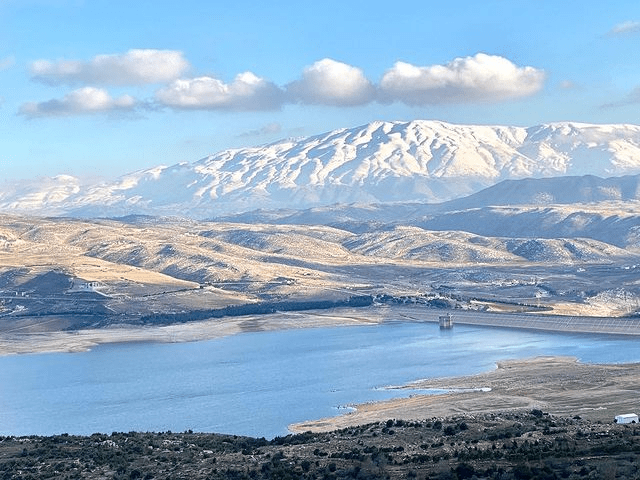
Mount Hermon is on the border between Lebanon and Syria

Mount Hermon is well north of the temple mount in Jerusalem. It too, is high up. Mount Hermon  rises to 9,232 feet and is the highest point on the east coast of the Mediterranean Sea. When the snow-capped ridge of the mountain melts, it liberally flows down and feeds the Jordan River, providing life for the valley.

Without Mount Hermon, there would be nothing and no one in the valley, which is why this water source is so important. Just like the oil flowing down Aaron’s beard, so the dew of Mount Hermon flows well beyond the mountain’s peak to provide abundant life. It enables us to come together united as one family in one place together.

Life and unity are not scarce. The resurrection of Christ opened the floodgates of heaven with life-giving grace, instead of death-dealing judgment, as in Noah’s day. Jesus is the wellspring of life who makes us one big family of faith by providing people with living water.

“Those who drink of the water that I will give them will never be thirsty. The water that I will give will become in them a spring of water gushing up to eternal life.” (John 4:14, NRSV)

No longer does life need to be quantified and measured in terms of years of time. Yes, we are mortal. But this will give way to immortality because a resurrected life is an everlasting life – made possible by Jesus.

My prayer and my hope is that our psalm for today will be like a glass of cold water on hot day when you are feeling parched. And this water will keep coming, as much of it as you need. The oil will keep flowing, with as much love and grace as you need for today. And there will be plenty more when tomorrow comes. It never runs out.

Perhaps you are encouraged with your own faith walk, but are awfully discouraged with the lack of unity in your family, neighborhood, church, workplace, nation, and world. Unity is not a piece of pie in which some get only a sliver, if any at all. In reality, there is plenty to go around. The power of the resurrection has made it possible.

In this present evil age, there are times of angry conflict and emotional distress, along with periods of great separation and sorrow. People everywhere who are divided and estranged from one another can hear God’s call to live together in unity. It is a call of love which beckons us to participate in the generous overflowing love of the Savior who has paved the way for an abundant life by bringing people together in faith.

Jesus prayed, “Holy Father, protect them in your name that you have given me, so that they may be one, as we are one.” (John 17:11)

Resurrection of the Lord (John 20:1-18)

Mosaic of Mary Magdalene in the garden with Jesus, Resurrection Chapel, Washington National Cathedral, Washington D.C.

Early on the first day of the week, while it was still dark, Mary Magdalene came to the tomb and saw that the stone had been removed from the tomb. So she ran and went to Simon Peter and the other disciple, the one whom Jesus loved, and said to them, “They have taken the Lord out of the tomb, and we do not know where they have laid him.” 

Then Peter and the other disciple set out and went toward the tomb. The two were running together, but the other disciple outran Peter and reached the tomb first. He bent down to look in and saw the linen wrappings lying there, but he did not go in. 

Then Simon Peter came, following him, and went into the tomb. He saw the linen wrappings lying there, and the cloth that had been on Jesus’s head, not lying with the linen wrappings but rolled up in a place by itself. 

Then the other disciple, who reached the tomb first, also went in, and he saw and believed, for as yet they did not understand the scripture, that he must rise from the dead. Then the disciples returned to their homes.

But Mary stood weeping outside the tomb. As she wept, she bent over to look into the tomb, and she saw two angels in white sitting where the body of Jesus had been lying, one at the head and the other at the feet. They said to her, “Woman, why are you weeping?” She said to them, “They have taken away my Lord, and I do not know where they have laid him.” 

When she had said this, she turned around and saw Jesus standing there, but she did not know that it was Jesus. Jesus said to her, “Woman, why are you weeping? Whom are you looking for?” Supposing him to be the gardener, she said to him, “Sir, if you have carried him away, tell me where you have laid him, and I will take him away.” 

Jesus said to her, “Mary!” She turned and said to him in Hebrew, “Rabboni!” (which means Teacher). Jesus said to her, “Do not touch me, because I have not yet ascended to the Father. But go to my brothers and say to them, ‘I am ascending to my Father and your Father, to my God and your God.’” 

Mary Magdalene went and announced to the disciples, “I have seen the Lord,” and she told them that he had said these things to her. (New Revised Standard Version)

Do Not Hold On To Me, by He Qi

Although Peter and John have a role in this story about Christ’s resurrection, the main character is Mary Magdalene. This is significant and symbolic for several reasons:

  1. It was Mary who experienced one of the most profound and deep changes of life due to the ministry of Jesus. Mary had been an immoral woman and spiritually enslaved to the machinations of seven demons. Jesus thoroughly delivered her from her personal hell.
  2. Mary was forever thankful to Jesus for changing her life, and so, she followed Christ and supported him in any way she could. 
  3. Mary was at the foot of the cross when Jesus died. While other disciples were keeping their distance out of fear, Mary was bold in standing with the other women for all to see that they were completely devoted to Jesus. Mary never turned her back on Jesus. 
  4. It was Mary who was there on the Sunday morning of Christ’s resurrection. Whereas the other followers were nowhere to be found, Mary came to the grave, still with a heart given to Jesus and grieving over his death. 

Because Mary had been given a new chance at life, she was deeply thankful and everything she had belonged to Jesus. Mary Magdalene was forgiven much, and, so she loved much. Here she is, after her Lord’s crucifixion, death, and burial, at the grave of Jesus. 

Mary came to the tomb on Easter Sunday still living in a Good Friday world – grieving, sad, and discouraged.  She soon discovered, however, that Christ is risen!

In the midst of your days of disappointment, loss, or sadness, how have you been surprised by joy and the presence of the risen Christ?  How has your grief been turned to gratitude?  Have you seen the risen Lord?  

Let Mary Magdalene’s experience be of encouragement to you. Mary was given new life and was transformed by the Lord. Yet, on Easter Sunday she did not immediately get what the heck was going on. Jesus rising from death was not anywhere on her radar. 

The empty tomb and the angels did not immediately lead her to faith – not until she saw Jesus, and even then, she did not recognize him. Only when Jesus called her name did Mary recognize him and respond, believing it was her Lord. 

And Jesus is still calling out names. He is calling your name. Jesus had said to his disciples that the sheep listen to the shepherd’s voice; he calls his own sheep by name and leads them out (John 10:3-4). One little word can change our lives forever: our name.

Easter opens a whole new world for us, as it did for Mary – a future of announcing good news and proclaiming resurrection.

There is a simple reason why the grave clothes were left in the tomb just lying there – they were not needed anymore! We no longer need the grave clothes of discouragement, defeat, and despair. We no longer need to weep and wonder because Christ is risen! Jesus Christ has called us by name, and we hear his voice.

The twentieth century theologian, Karl Barth, said that what brings people to worship God – not just on Easter, but any day – is an unspoken question clinging to our minds and hearts: Is it true? Is it true that God lives? Is it true that Jesus is alive? Could it be true that I can live a new life in Christ? Is it true that I can rebuild my life?  Is it all true? 

Mary Magdalene approached the tomb and found that it was true: Christ Jesus is risen from death!

Today, all over the world, followers of Jesus are testifying that this day and it’s deep implications for life is real: Christ is risen, and there is new life in Jesus. Believers across the globe are worshiping the risen Lord because they declare along with us, “I have seen the Lord!”

God has always been in the business of changing lives. British author A. N. Wilson, used to be known for his scathing attacks on Christianity and proclaimed the death of God. Yet he celebrated Easter in 2009 at a church with a group of other church members, proclaiming that the story of Jesus is the only one that makes sense out of life and its challenges. Wilson said:

“My own return to faith has surprised none more than myself…. My belief has come about in large measure because of the lives and examples of people I have known—not the famous, not saints, but friends and relations who have lived, and faced death, in light of the resurrection story, and in the quiet acceptance that they have a future after they die.”

The moment Jesus calls a person’s name, the power of the resurrection is enabled—the same power that raised Jesus from the dead. 

Come now, see what you consider as immovable slabs of stone in your life—bitterness, insecurity, fear, self-doubt or cynicism. Those immense rocks can be rolled away. To know Jesus is to know the power of the resurrection. 

We don’t need to merely hear testimonies of changed lives like Mary Magdalene’s; we can experience new life ourselves.

There is one word, one name, which has forever changed the world: “Jesus.”  And Jesus wants to change the world by uttering one simple word, one name, your name, so that you can exclaim with great joy, “I have seen the Lord!”

Loving Lord Jesus, you are our freedom. When I was lost in a dark hole of guilt and shame, you liberated me. You lifted me from sin, death, and hell.

Almighty God, hear today our prayers for the salvation of the world. Grant mercy to everyone who has turned away from you. Open their hearts and minds with your gracious light. Gather your children from the east and the west, from the north and the south. 

O God, bring people everywhere out of the darkness of disease and death, and into your marvelous light. Hear our prayers and answer us. May the benevolent way of Jesus be the hope of the world; among all nations may your salvation come.

Gracious Lord, our neighbors, relatives, friends, and co-workers, along with the sick, the poor, the prisoner, the widow, and all creation are in your hands. Therefore, fill us all with your love and your mighty resurrection power! And, grant us peace through Jesus Christ, our risen Lord. Amen.

Life Through Death (John 12:20-33)

Now among those who went up to worship at the festival were some Greeks. They came to Philip, who was from Bethsaida in Galilee, and said to him, “Sir, we wish to see Jesus.” Philip went and told Andrew, then Andrew and Philip went and told Jesus. Jesus answered them, “The hour has come for the Son of Man to be glorified. Very truly, I tell you, unless a grain of wheat falls into the earth and dies, it remains just a single grain, but if it dies it bears much fruit. Those who love their life lose it, and those who hate their life in this world will keep it for eternal life. Whoever serves me must follow me, and where I am, there will my servant be also. Whoever serves me, the Father will honor.

“Now my soul is troubled. And what should I say: ‘Father, save me from this hour’? No, it is for this reason that I have come to this hour. Father, glorify your name.” Then a voice came from heaven, “I have glorified it, and I will glorify it again.” The crowd standing there heard it and said that it was thunder. Others said, “An angel has spoken to him.” Jesus answered, “This voice has come for your sake, not for mine. Now is the judgment of this world; now the ruler of this world will be driven out. And I, when I am lifted up from the earth, will draw all people to myself.” He said this to indicate the kind of death he was to die. (New Revised Standard Version)

The fifth Sunday in Lent is now here. We are quickly approaching Jerusalem. Holy Week will be here before you know it. 

Why is this all significant? Because Jesus is important. By taking advantage of Lent with its focus on spiritual discipline, prayer, and repentance, we come face-to-face with the shadowy parts of our selves. We discover that within us there is the pull to hold-on to unhealthy rhythms and habits of life, as well as a push to arrange our lives with the fragmentation of disordered love.

Perhaps our reflexive response to things we do not like about ourselves is to either use sheer willpower to change or try to somehow manage our brokenness, as if we could boss our way out of darkness. The problem and the solution are much more radical than we often would like to admit.

We must die. 

Yes, you heard that right. This is the teaching of Jesus – to die to ourselves. Sin cannot be managed or willed away – it must be eradicated and completely cut out, like the cancer it is. Transformation can only occur through death. 

Jesus used the familiar example of a seed to communicate his point. A tiny little seed can grow, break the ground, and develop into something which provides sustenance for others. It does no good to remain a seed in the ground.

Christ was only telling others to do, what he himself was willing to do. Jesus is the ultimate example of the one who died to himself, and literally died for us. Through suffering and death, he secured deliverance for us from guilt and shame. 

By his wounds we are healed. Through his tortuous death a resurrection became possible – and we must always remember that there must be a death if there is to be a resurrection. Death always precedes life. There is suffering before glory.

Through dying to self, and following Jesus, there is the hope of transformative change which the world so desperately needs. If we persist in making puny attempts at trying to straddle the fence in dual/rival kingdoms, we will be spiritually schizophrenic and left with a divided soul. 

Following Jesus – leaving all to walk with him – is true repentance and authentic discipleship. The act of journeying with Christ is the means to a new life. Change is possible by letting Jesus Christ be the center from which all of life springs.

Maybe you think I’m being too forceful, too insistent about this Jesus stuff. 

Yes, you have perceived well. I am being quite single-minded about the need for dying to self and living for Christ. 

Somehow, within many corners of Christianity, this wrongheaded notion that suffering is not God’s will has made it into the life of the church. But I’m here to say, on the authority of God’s Holy Word (not to mention your own internal gut and conscience) that dying to ourselves is necessary. And it hurts. The epistle reading for today bears this out:

In the days of his flesh, Jesus offered up prayers and supplications, with loud cries and tears, to the one who was able to save him from death, and he was heard because of his reverent submission.  Although he was a Son, he learned obedience through what he suffered; and having been made perfect, he became the source of eternal salvation for all who obey him. (Hebrews 5:7-9, NRSV)

Christians are not above their Master. Even Christ’s life on this earth, before his death and resurrection, was marked with suffering. Even Jesus learned obedience through struggle and adversity. Jesus Christ did what he now asks of us. 

The Son gave up himself to do the Father’s will. So, we must give up ourselves in submission to King Jesus.  Jesus offered loud cries and tears, and submitted to what the Father wanted. His followers must do no less. 

We don’t get to choose which parts of Christ’s life and teaching we will adhere to, and which ones we won’t, as if Jesus were some spiritual buffet line. All who live for Jesus, follow him into the path of suffering, of death to self, and of new life through the power of his resurrection.

Those who love their life lose it, and those who hate their life in this world will keep it for eternal life.

How do we follow Jesus through dying to self? What does that mean for you and me on a practical daily basis?

Surrender

Every moment of every day is an opportunity for giving ourselves to Jesus. We have hundreds, maybe thousands, of small daily decisions with the use of our time, money, energy, and relationships. 

If we have tried to fix what is broken inside of us, we will likely just try to hastily fix the problems and the people in our lives – and then move on with getting things done on our to do list. 

Instead, there is a need to surrender ourselves – to create the sacred space for solitude and silence, prayer and repentance. 

Take the time to sit with a person in pain and listen. Reflect on how to use your money in a way which mirrors kingdom values. Begin to see your life as a holy rhythm of hearing God and responding to what he says. It takes intentional surrender to do that.

Sacrifice

Holding-on to our precious stuff and time is the opposite of sacrifice. 

Are we truly willing to give-up everything to follow Jesus? 

It is more than true that we are not Jesus. Our sacrifice and suffering are not efficacious, that is, it doesn’t deliver other people from sin. Only Christ’s death does that. Yet, we are still called to sacrifice. The Apostle Paul understood this, with a statement that I’ll let you wrestle with and mull over without comment on my part:

I am now rejoicing in my sufferings for your sake, and in my flesh I am completing what is lacking in Christ’s afflictions for the sake of his body, that is, the church. (Colossians 1:24, NRSV)

Happiness is important; but it isn’t the summum bonum of life. There is more to life than living for self. Jesus calls us to see our communities, neighborhoods, and families as a mission field of grace to a world who needs him. That takes sacrificial love on our part.

Christianity is not really a religion that’s for people who have put neat theological answers and tidy packaged certainties to all of life’s questions. 

Rather, Christianity is a dynamic religion of learning to follow Jesus, discovering how to die to self, and struggling to put Christ’s teaching and example into practice. 

Those who don’t struggle are in big trouble. But those who go through the pain of dying to themselves for the sake of their Lord, find that the fruit they harvest leads to eternal life.

May you struggle well, my friend.