Luke 10:25-37 – The Parable of the Good Samaritan

Good Samaritan by He Qi

A legal expert stood up to test Jesus. “Teacher,” he said, “what must I do to gain eternal life?”

Jesus replied, “What is written in the Law? How do you interpret it?”

He responded, “You must love the Lord your God with all your heart, with all your being, with all your strength, and with all your mind, and love your neighbor as yourself.”

Jesus said to him, “You have answered correctly. Do this and you will live.”

But the legal expert wanted to prove that he was right, so he said to Jesus, “And who is my neighbor?”

Jesus replied, “A man went down from Jerusalem to Jericho. He encountered thieves, who stripped him naked, beat him up, and left him near death. Now it just so happened that a priest was also going down the same road. When he saw the injured man, he crossed over to the other side of the road and went on his way. Likewise, a Levite came by that spot, saw the injured man, and crossed over to the other side of the road and went on his way. A Samaritan, who was on a journey, came to where the man was. But when he saw him, he was moved with compassion. The Samaritan went to him and bandaged his wounds, tending them with oil and wine. Then he placed the wounded man on his own donkey, took him to an inn, and took care of him. The next day, he took two full days’ worth of wages and gave them to the innkeeper. He said, ‘Take care of him, and when I return, I will pay you back for any additional costs.’ What do you think? Which one of these three was a neighbor to the man who encountered thieves?”

Then the legal expert said, “The one who demonstrated mercy toward him.”

Jesus told him, “Go and do likewise.” (Common English Bible)

In Christianity, no one justifies themselves. The kingdom of God turns on grace, and not with us working more or harder. As we anticipate Reformation Day, Christians remember the famous posting of the 95 Theses by Martin Luther on the Castle Church door in Wittenberg, Germany in 1517. 

Justification by grace through faith, apart from human effort, is the great theological emphasis and legacy of the Reformers. I suppose one would expect to look at the New Testament books of Romans and Galatians when it comes to dealing with justification. However, there might just be a better place to go….

Christ’s parable of the Good Samaritan is a famous and familiar story to many people, even for those outside of the Christian faith tradition. The parable is likely not the place one thinks to go when considering the Reformation. Yet, this parable is just the right place for considering the grand Reformation doctrine of justification.

“Every week I preach justification by faith to my people, because every week they forget it.”

Martin Luther (1483-1546)

The Gospel writer, Luke, gives us insight into the thought process of the person for whom Jesus told the parable to. That man sought to justify himself. 

When we view the parable from the angle of justification, we see the perspective of the wounded and hapless man, the victim of robbers. He was left for dead, and, indeed, in the story we know that he would die apart from help – the kind of help the man could not do for himself. He was completely dependent on someone to rescue him from his plight.

The Samaritan, the Christ figure in the story, comes and shows the man mercy. This grace was free, lacked any sort of favoritism, and was full of sheer kindness. Without the Samaritan’s actions of binding up the man’s wounds and getting him to a safe place, the victim would have died.  

Reformation Day, and every day, is a good day to celebrate the wonderful and glorious reality that Jesus Christ saves people from their terrible plight. 

Christ’s mercy is not dependent on what kind of people we are but is simply based on need. God graciously gives us the gift of faith and the mercy of deliverance. By Christ’s wounds we are healed. 

Take some time today to reflect on this most gracious of biblical truths: We do not need to justify ourselves. As Christians, we already possess justification by grace alone apart from human effort. 

Read the parable of the Good Samaritan carefully and slowly, absorbing it from this angle of the inability to justify ourselves and the incredible mercy of Christ. Let this wonderful truth sink deep in your soul to bring increased awareness, emotional wholeness, and spiritual healing.

Lord God, heavenly Father, you did not spare your only Son, but gave him up for us all to be our Savior, and along with him you have graciously given us all things. We thank you for your precious, saving gospel, and we pray that you would help us to believe in the name of our Savior faithfully and steadfastly, for he alone is our righteousness and wisdom, our comfort and peace, so that we may stand on the day of his appearing, through Jesus Christ, your dear Son, our Lord. Amen. – A Lutheran Collect of Thanksgiving

Luke 16:19-31 – Does God Know Your Name?

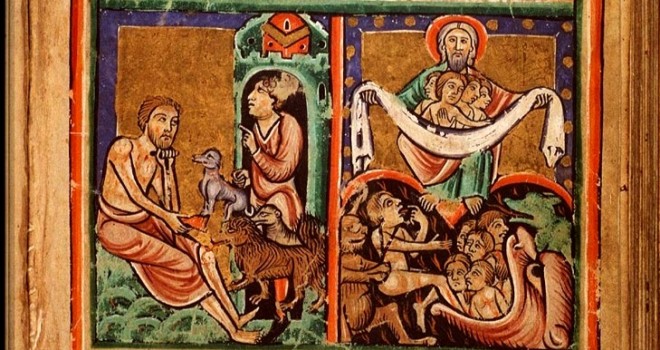
The Rich Man and Lazarus, from a French pictorial Bible, c.1200 C.E.

“There was a rich man who was dressed in purple and fine linen and lived in luxury every day. At his gate was laid a beggar named Lazarus, covered with sores and longing to eat what fell from the rich man’s table. Even the dogs came and licked his sores.

“The time came when the beggar died, and the angels carried him to Abraham’s side. The rich man also died and was buried. In Hades, where he was in torment, he looked up and saw Abraham far away, with Lazarus by his side. So, he called to him, ‘Father Abraham, have pity on me and send Lazarus to dip the tip of his finger in water and cool my tongue, because I am in agony in this fire.’

“But Abraham replied, ‘Son, remember that in your lifetime you received your good things, while Lazarus received bad things, but now he is comforted here, and you are in agony. And besides all this, between us and you a great chasm has been set in place, so that those who want to go from here to you cannot, nor can anyone cross over from there to us.’

“He answered, ‘Then I beg you, father, send Lazarus to my family, or I have five brothers. Let him warn them, so that they will not also come to this place of torment.’

“Abraham replied, ‘They have Moses and the Prophets; let them listen to them.’

“‘No, Father Abraham,’ he said, ‘but if someone from the dead goes to them, they will repent.’

“He said to him, ‘If they do not listen to Moses and the Prophets, they will not be convinced even if someone rises from the dead.’”  (New International Version)

Everyone looks for a miracle at some point in life, especially for family. Whenever we see relatives walking far from God or siblings living without much thought to the words and ways of Jesus, it can be disconcerting. We may reason that if they could just experience or see some great miracle, then they will surely believe and embrace Christ. 

Yet, Jesus’ parable to us of the rich man and Lazarus graphically depicts an important message: God has already revealed divinity to humanity through Moses and the Prophets (the Old Testament). If people are not convinced by what already exists and is, they will not respond when the miraculous slaps them in the face.

Maybe we too often look for the dramatic because the mundane typically rules the day. Perhaps what we are looking for is already present in God’s revelation to us. It could be that the greatest task we have is not to beg for a miracle (even though there is nothing wrong with that!) but first to be quiet and listen to the Spirit of God speak through the Word of God so that our prayers to God arise in God’s way and God’s time.

Today’s Gospel story gets at the heart of where we immediately and reflexively turn when in dire straits. There is nothing wrong with turning to others, consulting trusted resources, or even Google. Yet, Holy Scripture is timeless. It contains everything we need for life and godliness in this present age. And I believe it has the answers to life’s most pressing questions.

Everyone has their trusted sources, as well as sources we don’t trust. If a person has had a pattern of not consulting or trusting the source material of Scripture, then it doesn’t matter who encourages them, even if it is a trusted person who shows up from the grave, to look into the Bible’s contents and believe it’s message.

If we look closely at the story, we are told the poor man’s name: Lazarus. And we are not told the rich man’s name. You see, the poor man, Lazarus, had his name written in the Book of Life. The rich man’s name cannot be spoken because it is not found there.

There are two opposite choices in life. One is to choose pleasure and overlook the great needs of the earth. Like old Jacob Marley in the Christmas Carol, it is to forge a chain, link by link, day after day, which will eventually leave one in bondage and regret.

The other choice is hope. To look ahead by faith and see the eternal things which are coming, then shaping our existence to act in sync with permanent values, is to choose life. Although this may bring deprivation, even suffering, in this present existence, the decision to forego temporary pleasure for eternal glory shall be rewarded. It is to live for future prosperity through present affliction.

So, how shall we then live?

Will we anchor our souls in the good bosom of bettering our fellow humanity?

Is there an acknowledgment that the measure we give to others shall eventually be given to us?

Do we seek to hold faith with a neighbor in his poverty?

Are we trusting so much in our five senses – sight, smell, taste, hearing, touch – that we either cannot or will not trust in the sixth sense of the spirit which tells us to believe Moses and the prophets?

Christ has risen. Christ is coming again. If we align our lives with spiritual truth, we shall find our names written in the Book of Life. Let us actively look for Lazarus in our lives, so that we don’t carelessly step over him day after day while selfishly indulging in the good things of this life.

Mighty God, you have done miraculous things. Help me see what you have already done and teach me to listen so that your revelation becomes alive to me. Holy Spirit, impress the redemptive event of Christ’s resurrection on the hearts of all who do not know you so that they might know your amazing grace. Amen.

Matthew 17:23-32 – Parable of the Two Sons

The Parable of the Two Sons by Jorge Cocco

Jesus entered the temple courts, and, while he was teaching, the chief priests and the elders of the people came to him. “By what authority are you doing these things?” they asked. “And who gave you this authority?”

Jesus replied, “I will also ask you one question. If you answer me, I will tell you by what authority I am doing these things. John’s baptism—where did it come from? Was it from heaven, or of human origin?”

They discussed it among themselves and said, “If we say, ‘From heaven,’ he will ask, ‘Then why didn’t you believe him?’ But if we say, ‘Of human origin’—we are afraid of the people, for they all hold that John was a prophet.”

So, they answered Jesus, “We don’t know.”

Then he said, “Neither will I tell you by what authority I am doing these things.

“What do you think? There was a man who had two sons. He went to the first and said, ‘Son, go and work today in the vineyard.’

“‘I will not,’ he answered, but later he changed his mind and went.

“Then the father went to the other son and said the same thing. He answered, ‘I will, sir,’ but he did not go.

“Which of the two did what his father wanted?”

“The first,” they answered.

Jesus said to them, “Truly I tell you – the tax collectors and the prostitutes are entering the kingdom of God ahead of you. For John came to you to show you the way of righteousness, and you did not believe him, but the tax collectors and the prostitutes did. And even after you saw this, you did not repent and believe him. (New International Version)

The people entering God’s kingdom may not be the ones we expect. 

That’s because God’s kingdom is an upside-down kingdom. The spiritual insiders are really on the outside, while the spiritual outsiders are the ones inheriting the kingdom.

Today’s Gospel parable is a warning to all the spiritually serious to beware, lest their energies be spent entirely in correctness, believing the right things, and making obedience to Christ of secondary importance. 

This parable also encourages moral failures with the wonderful possibilities of a changed life. 

That’s because talk is cheap. Only what one believes, one will do.

Lip service to God, without loving service, is hollow and means nothing.

The Warning: Don’t Assume

Christ’s parable warns those who arrogantly assume they have an inside track by their belief, when in reality they aren’t obeying God, at all.  It’s a bit hard for us to imagine how offensive this story was to the religious authorities of the day, so here is a restatement of the parable in a more contemporary form:

What do you think? There was once a man well-respected in the community. He had two sons. The one son grew up and also became a respectable member of the community. This son was a successful businessman, and willingly gave a lot of money to causes in his community, including new lights for the football field – which was no small cost. He only asked that appropriate and prominent recognition be given him with a plaque on each of the light poles with his name on it. 

The other son was not so successful.  He was the one in school of whom the teachers said, “Why can’t you be more like your brother?”  There was nothing spectacular about this son. In fact, he lived an alternative lifestyle and seemed to always be the talk of people behind his back. 

One day the father said to him, “Son, go and work at my place of business today. I am going away and need you to do some of the tedious paperwork I have gotten behind on so that I can get away.” “I will not,” he answered, but later felt heartsick about the way he had spoken to his father and decided to go to his place of business and do all the grunt work his father needed done.

The father also went to the other son, the well-respected one, and said the same thing about needing him to do all the thankless paperwork that was piled up. That son answered, “Yes, sir, I will. Anything you need I will do.”  However, that son did not follow through and go do the tedious work. Instead, he chose to go golfing with some people whom he was trying to coy favor with.

After telling the story, Jesus asked all the upstanding church leaders and people listening, “Which of the two sons did what his father wanted?” “The first,” they all answered.

Then, Jesus said to them, “I tell you the truth, the gay, lesbian, bisexual, transgender, and queer people are entering the kingdom of God ahead of you. For you have had heard hundreds if not thousands of sermons about grace and the true way of righteousness, and you did not believe by putting the Word of God into practice; but they did. And even after you saw how grace can transform a life from the inside-out, you yourselves did not repent and believe.

For Jesus to tell such a story was so incredibly scandalous that it could get him killed – and it did. Simply believing the right things and living as an upstanding citizen is not the way of salvation. Tax collectors and prostitutes were the most despised people in Christ’s time. It was assumed they were on the outside and could never come to God, much like some might believe it unthinkable that a Muslim terrorist could be saved by Jesus. 

The proof of genuine belief is not in talking a good line; it is in actively obeying God when no one is looking to see what a good person you are.

Those who say, “I love God” and hate their brothers or sisters are liars. After all, those who don’t love their brothers or sisters whom they have seen can hardly love God whom they have not seen! This commandment we have from him: Those who claim to love God ought to love their brother and sister also.

1 John 4:20-21, CEB

The Christian life hinges on obedience to the words and ways of Jesus. It is to be a blessing to a lost world in need of the grace and love of God.

There was once a Pastor in the 1890’s, Pastor Wright, who pronounced from his pulpit and wrote an article for his denomination’s newsletter on how people flying was both impossible and contrary to the will of God.  Pastor Wright had two sons named Orville and Wilbur. The Pastor was so sure of himself, but he was surely wrong.

The Invitation: Walk Through the Open Door

This parable is more than a warning; it is also a story that opens a door of grace and mercy for unlikely people, far from God, who have said “no” to God. It is a wonderful invitation for all us screw-ups and people with little to no faith to come to Jesus, and he will give rest.

One of my favorite Old Testament references is from the life of David. It is rather obscure and tucked away where no one notices it in Scripture. David was on the outside looking in. King Saul was trying to capture him, even though he had done nothing wrong:

David got away and escaped to the Cave of Adullam. When his brothers and others associated with his family heard where he was, they came down and joined him. Not only that, but all who were down on their luck came around—losers and vagrants and misfits of all sorts. David became their leader. There were about four hundred in all. (1 Samuel 22:1-2, MSG)

This rag-tag group of outsiders in Israel became Israel’s insiders as David eventually became king. These were the men, referred to later, as David’s mighty men, people on the cutting edge of bringing Israel into prominence. 

Jesus, Son of God, Son of Humanity, came and clearly identified himself as the Savior to the outsider when he quoted the prophet Isaiah: 

“The Spirit of the Lord is on me.
    He has chosen me to tell good news to the poor.
He sent me to tell prisoners that they are free
    and to tell the blind that they can see again.
He sent me to free those who have been treated badly
    and to announce that the time has come for the Lord to show his kindness.” (Luke 4:18-19, ERV)

In Christ, there is no lost cause and no person too far to be rescued and redeemed. And if we believe that, we will participate with God’s desire to reach the outsider.

Conclusion

Practicing the words and ways of Jesus happens when we locate ourselves within this parable. For the true outsider, this is the most wonderful news possible – that Jesus is reaching out and bringing you to himself – that changing a “no” to saying “yes,” entry to life is possible. 

Yet, maybe some of us need to locate ourselves as the insider who needs to get a clue before we miss out on the grace of God in Christ.

Take heart, for Jesus came to seek and to save that which is lost. It is time to act on what we believe – to affirm truth and right doctrine, and to embody it with obedience to God’s call on our life.

Luke 15:1-7 – Lost and Found

Tax collectors and sinners were all crowding around to listen to Jesus. So, the Pharisees and the teachers of the Law of Moses started grumbling, “This man is friendly with sinners. He even eats with them.”

Then Jesus told them this story:

If any of you has a hundred sheep, and one of them gets lost, what will you do? Won’t you leave the ninety-nine in the field and go look for the lost sheep until you find it? And when you find it, you will be so glad that you will put it on your shoulder and carry it home. Then you will call in your friends and neighbors and say, “Let’s celebrate! I’ve found my lost sheep.”

Jesus said, “In the same way there is more happiness in heaven because of one sinner who turns to God than over ninety-nine good people who don’t need to.” (Contemporary English Version)

Lost people matter to God… a lot!

From God’s perspective, it really doesn’t matter why a sheep has strayed from the flock. That stuff only matters to us. It seems many folks only believe a person is worth going out and looking for after we have properly deemed them worthy of pursuing.

“They made their bed; now they need to sleep in it,” “You reap what you sow,” and “They don’t want to be found,” are all human contrived justifications for letting a strayed sheep remain in the wilderness, vulnerable to the wolves.

The mercy of God makes no distinctions between a person who purposely leaves and squanders their resources, and one who accidentally wanders off because of hardship which wasn’t their fault. Lost is lost. Mercy is mercy, period.

Lost people matter so much to God that one lost soul is worth sending out the hounds of heaven to find them. And, once found, becomes the ground for a big celestial party! 

Please note this simple observation of today’s Gospel reading: If there is rejoicing in the presence of angels in heaven over one sinner who repents, then who is doing the rejoicing?  God!  God is crazy giddy with joy over one lost person being found. 

Celebration is a spiritual discipline.

Yes, indeed, it is. Celebration is an important activity for the Church and for believers everywhere. Just as pursuing lost people is a spiritual practice and a skill to be developed, so celebration is a spiritual discipline which needs time, attention, and resources.

But the religious insider might doth protest, why care about this, especially the celebration? Aren’t we being faithful already, and properly focusing on Scripture, sacrament, worship, and prayer? Isn’t this just all a waste of our limited time, energy, and assets?

Short answer: We celebrate because God celebrates.

God throws the best parties, filled with plenty of joy and recognition of persons restored to fellowship.

As people created in the image and likeness of God, we are hardwired for celebration. If God can go uncorked with joy and celebration, I’m going to say with confidence that open unabashed blowouts rejoicing over people’s transformation and new life is welcome and expected.

Folks baptized in pickle juice can join the grumbling of all the high mucky-muck dudes who smugly look down on the marginal persons among us. Hopefully, the party-poopers won’t be heard because of all the noise at God’s party.

This parable of Jesus is meant to give us a glimpse of God’s own heart. 

God would do anything to find a lost person, to restore and reconcile a person to relational connection. God would go dumpster diving and wade through the stinky nasty garbage to find that one lost valuable person.

Why should reaching out to marginal people with the grace and love of Jesus Christ be a high priority? 

Because restoring lost people is a high priority for God. 

God has placed the highest of priorities on recovering those who are spiritually lost and wandering around life without a purpose or a place to call home. Such people matter so much that God sent the Son, Jesus, to this earth. 

Christ went to the greatest lengths possible through enduring a cruel death on a cross in order to reconcile a broken lost relationship between people and God.

I still remember what it felt like to be separated from God and estranged from the church – it was lonely and sad, like being in a deep black hole with no way of getting out and no one around to help. 

But God, with immense mercy, sent spiritual commandos to extract me from my captivity of the soul. So, my greatest desire is to live my life basking in the grace shown to me, grateful for new mercies which come every day, and giving that same grace to others – especially those considered as the lost, the least, and the lonely in society.

In leaving the ninety-nine and going after the one sheep, God gave preferential attention to the lost. So, because of this, I ask a sincere and probing question which I believe needs to be asked: Can you live with that? 

My own answer is: “I sure can, because I was once that lone lost sheep!”

Jesus, you are the Good Shepherd. Thank you for going after me when I was lost. Help me remember that you will often leave my pasture to go after others. I’ll be willing and happy to go with you when you do. Let’s also take the Spirit with us.  Amen.