Welcome, friends! Our help is in the name and with the love of the Lord who made heaven and earth. Grace and peace to you from God our Father and our Savior, Jesus Christ.
1 Corinthians 13 is the great love chapter of the New Testament. All Christian ministry and mission is to be thoroughly grounded and bathed in love. Love is a deliberate and intentional decision to meet the need of another person without showing favoritism or discrimination – because that’s what God does.
Click the videos below, and let’s consider together the essential, effective, and eternal nature of love…
Pastor Tim Ehrhardt, 1 Corinthians 13:1-13
Life is short and we have too little time to gladden the hearts of those who travel the way with us. So, be swift to love and make haste to be kind….and may the blessing of God Almighty, Father, Son and Holy Spirit be with you now and always. Amen.
You see, at just the right time, when we were still powerless, Christ died for the ungodly. Very rarely will anyone die for a righteous person, though for a good person someone might possibly dare to die. But God demonstrates his own love for us in this: While we were still sinners, Christ died for us.
Since we have now been justified by his blood, how much more shall we be saved from God’s wrath through him! For if, while we were God’s enemies, we were reconciled to him through the death of his Son, how much more, having been reconciled, shall we be saved through his life! Not only is this so, but we also boast in God through our Lord Jesus Christ, through whom we have now received reconciliation. (New International Version)
In Christianity, there is only one way of approaching God: Through the death of Jesus Christ. That means we cannot approach God by our good works, doing things right, or by our spiritual pedigree. We are justified and declared righteous by grace alone through faith in the cross of Christ.
Back when my youngest daughter was still living at home, sometimes I needed to go into her room to get something. More often than not, it ended up becoming an archaeological dig. I had to wade through layers of stuff. I didn’t always find what I was looking for, and other times I discovered things I didn’t know I had even lost.
When the magisterial Reformer, Martin Luther (1483-1546) went digging into the Bible, he found he was wading through layers of church tradition and came upon something that was lost. Luther rediscovered that God justifies sinners by grace through faith apart from any good works done by us. Luther found in the Scriptures that we are completely and totally at the mercy of God in Christ.
The cross of Jesus Christ is the means of salvation from what ails us because the cross is an attack on human sin. Luther discovered we all have layers of stuff that has grown around our hearts to the degree that we no longer see the sheer grace of God in Christ alone to meet the most pressing needs of our lives.
The Reformation has taught believers that apart from Christ, we are addicted to ourselves. The cross is the intervention we need to help us confront our constant me-ism.
We might justify ourselves with the fact we do good works. However, one of the legacies of the Reformation, coming from the book of Romans, is that good works do not earn us deliverance from sin. In fact, Luther said that our good deeds are the greatest hindrance to our salvation because we have the tendency to trust in those good deeds instead of the death of Christ.
So, Luther actually called our good works a mortal sin that sets off God’s wrath and leads straight to hell. In other words, good deeds can be deadly, if they are done as a means of approaching and appeasing God.
It is through the suffering of Jesus on the cross, his death for us while we were still sinners, not when we were lovely and looking fine with all our pious actions, that we are saved.
“He who does not know Christ does not know God hidden in suffering. Therefore, he prefers works to suffering, glory to the cross, strength to weakness, wisdom to folly, and, in general, good to evil. These are the people who are under God’s wrath! God can only be found in suffering and the cross. It is impossible for a person not to be puffed by his good works unless he has first been deflated and destroyed by suffering and evil until he knows that he is worthless and that his works are not his but God’s.”
Martin Luther’s Heidelberg Disputation
God does not come to us in our beauty and goodness but in our ugliness and sin.
While we were still sinners, ungodly, enemies of God, powerless to save ourselves, Christ died on the cross for us. We spend too much time and effort concerned about looking good and doing good things in order to present ourselves acceptable to each other and even to God.
But that is the very sin that sends people to a hellish existence. The hottest places of damnation are actually reserved for outwardly pious persons who trusted all their lives in themselves and how they looked to others without a thought, at all, about justification, reconciliation, and being restored to God through Christ.
Like a gold ring in a pig’s snout, is a person who has good deeds but knows nothing of God’s grace.
It is a totally human tendency to decide which sinful actions are trivial and which are the biggie sins. The Apostle Paul was really hard on his fellow Jews in the book of Romans because they tended to place their trust in who they were and what they did – being the covenant people and practicing all the good things a good person does. And Paul says the wrath of God is reserved for them.
The way of approaching God is by seeing our true ugliness, our rebellious hearts, and that the hope of salvation is through the cross of Christ. We are justified by and reconciled to God because of Jesus, and not for any other reason. A new relationship is established based solely in God’s grace.
“Jesus Carrying The Cross” by Olga Bakhtina, 2017
When Christians grasp this truth, even a little bit, it should cause us to repent of our sinful good works (yes, sinful good works). Wherever there is humility that leads to a complete turning to Jesus, there is revival to new life in God, and a personal reformation around the doctrine of grace instead of the doctrine of my glorious works that I perform.
We, then, as Christians, saved and justified through the blood of Jesus, ought to be the most joyful and grateful people on the planet. We have deliverance from the deception of our hearts to life in Christ. Apathy and lethargy to the things of God are the twin evils that reign in the place of awe and appreciation for what God has done for us in Christ.
There is nothing more God can do to show us that he loves us than by actually dying for us, and by doing so, satisfying God’s own wrath against the sin which seeks to destroy us. The late Brennan Manning once told the story about how he got the name “Brennan.”
While growing up, his best friend was Ray. The two of them did everything together: bought a car together as teenagers, double-dated together, and went to school together. They even enlisted in the Army together, went to boot camp together and fought on the frontlines together.
One night while sitting in a foxhole, Brennan was reminiscing about the old days in Brooklyn while Ray listened and ate a chocolate bar. Suddenly, a live grenade came into the foxhole. Ray looked at Brennan, smiled, dropped his chocolate bar and threw himself on the live grenade. It exploded, killing Ray, but Brennan’s life was spared.
Later in life, when Brennan became a priest, he was instructed to take on the name of a saint. He thought of his friend, Ray Brennan. So, he took on the name “Brennan.”
Years later he went to visit Ray’s mother in Brooklyn. They sat up late one night having tea when Brennan asked her, “Do you think Ray loved me?” Mrs. Brennan got up off the couch, shook her finger in front of Brennan’s face and shouted, “What more could he have done for you?” Brennan said that at that moment he experienced an epiphany. He imagined himself standing before the cross of Jesus wondering, Does God really love me? And Jesus’ mother Mary pointing to her son, saying, “What more could he have done for you?”
The cross of Jesus is God’s way of doing all he could do for us. And yet we often wonder: Does God really love me? Am I important to God? Does God care about me? We tend to ask those questions when we are trusting in ourselves, because we never really know where we stand with God.
No matter how bad or how good you are, the path of suffering of our Lord Jesus has taken care of the sin issue once for all.
Week after week for the past two-thousand years, God’s people have gathered together to worship this same Lord Jesus who died on the cross. The only thing left for us to do, since Jesus has done it all for us, is to offer our lives to him.
While we were still sinners, enemies, estranged, hopeless, lost, despondent, proud, and stained by sin, Jesus died a cruel death on a cross to wash away your sins with his blood. It is my hope and prayer that today you are rediscovering the great Reformation truth that we are justified by grace alone through faith in Jesus alone, and the life of unbounded joy in knowing that we have now received reconciliation with God in Christ.
Lord God Almighty, the ground is level at the foot of the cross. We need you, Lord Jesus, and come to you on the basis of nothing else but your shed blood. I pray for all those who are wrestling with you right now. Oh, that you would revive those that need new life, that you would renew those who have become cold, and that you would reform all of our hearts so that our lives would completely be devoted around the person and work of Jesus Christ!
Thank you, Lord Jesus, for dying for us while we were still powerless, sinful, and ungodly. Thank you for saving us from God’s wrath. Thank you, God Almighty, for reconciling us back to yourself through the cross. There are those needing you to break through their stubborn hearts; and those who need peace to their troubled hearts. O God, save us from ourselves, whether it is from our trust in our own perceived goodness, or our sense of shame and guilt. Thanks be to God, who gives us the victory through our Lord Jesus Christ. Amen.
When he was gone, Jesus said, “Now the Son of Man is glorified, and God is glorified in him. If God is glorified in him, God will glorify the Son in himself, and will glorify him at once.
“My children, I will be with you only a little longer. You will look for me, and just as I told the Jews, so I tell you now: Where I am going, you cannot come.
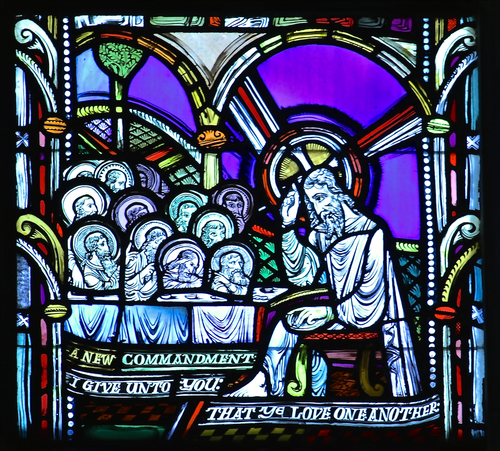
“A new command I give you: Love one another. As I have loved you, so you must love one another. By this everyone will know that you are my disciples if you love one another.” (New International Version)
The Church was formed to represent Christ on earth. The Church is a new community of believers in Jesus, called and empowered by the Holy Spirit for mission.
Christianity was never intended to be just a personal faith; it was designed by God to be the community of the redeemed. Christian community is vital to every individual’s faith.
“No one can have God for his Father who does not have the Church for his Mother.”
John Calvin (1509-1564)
Loyalty and commitment to God translates to having a dedicated and devoted spirit to one another in the church.
One of the last commands Jesus gave to his disciples before he went to the cross was to “love one another.” The Old Testament instructed the Israelites to love each other (Leviticus 19:18). Yet, Jesus gives new meaning to the command through four distinctions of loving one another.
A New Model of Love: Jesus
Our Lord’s life and teaching gave new meaning to the command to love each other. Notice what Jesus did in the Upper Room just before giving the command to love one another:
It was almost time for the Jewish Passover festival. Jesus knew that the time had come for him to leave this world and go back to the Father. Jesus had always loved the people in the world who were his. Now was the time he showed them his love the most.
Jesus and his followers were at the evening meal. The devil had already persuaded Judas Iscariot to hand Jesus over to his enemies. (Judas was the son of Simon.) The Father had given Jesus power over everything. Jesus knew this. He also knew that he had come from God. And he knew that he was going back to God. So while they were eating, Jesus stood up and took off his robe. He got a towel and wrapped it around his waist. Then he poured water into a bowl and began to wash the followers’ feet. He dried their feet with the towel that was wrapped around his waist. (John 13:1-5, ERV)
Jesus modeled a service-oriented love of compassionately meeting the need of another, regardless of who that person is. It is instructive to us that Jesus washed the feet of Judas Iscariot, along with all the other disciples.
Christ died for us while we were still sinners. This demonstrates God’s love for us.
Romans 5:8, GW
We are to love everyone in the community of saints, and not just our friends or the ones we like. Loving one another also means we will be realistic in understanding that community is messy and downright hard work.
A New Motive: Christ First Loved Me
Jesus has loved us with a love that took care of our brokenness once for all. Because of that love, we are now motivated to love each other. John would later say in his first epistle:
God showed his love for us by sending his only Son into the world, so that we might have life through him. This is what love is: it is not that we have loved God, but that he loved us and sent his Son to be the means by which our sins are forgiven. Dear friends, if this is how God loved us, then we should love one another. (1 John 4:9-11, GNT)
Love is an attitude and a frame of mind. The motivation for the Christian is different than anyone else’s motive: We are so thankful for Christ’s love to us, that we cannot help but extend that same love to one another in the church.
This kind of love transcends human willpower. This is love as a grateful response for the grace shown us in Christ.
A New Motivator: The Holy Spirit
The Spirit energizes and enables us to love each other. Jesus also said in the Upper Room:
If you love me, you will do as I command. Then I will ask the Father to send you the Holy Spirit who will help you and always be with you. (John 14:15-16, CEV)
There are times when we may lack the ability or spiritual energy needed for the work of loving each other. It is in those times that we need to check our spiritual electrical box to make sure we haven’t tripped a breaker by trying to live the Christian life on our own strength.
We need the Spirit. The Spirit gives us the zeal we need to love one another.
We typically don’t do anything in life unless we have the motivation for it. The Spirit is like the Christian’s personal trainer – encouraging, exhorting, getting in our face, comforting, and spurring us – toward the new way of love.
A New Mission: World Evangelization
All people will know we are Christ’s disciples if we love one another. The way we treat each other in the church is foundational and fundamental to the mission of loving our neighbors who don’t know Jesus.
“Mission is putting love where love is not.”
St. John of the Cross (1542-1591)
When the church has a healthy and even supernatural dynamic of loving one another, they joyfully proclaim the good news to every person that Jesus is the answer to the terrible brokenness of this world.
Community is necessary to mission. Lesslie Newbigin (1909-1998) was a British missionary to India for forty years. After retiring and returning to Britain, he found his homeland was very different than when he left. He was astounded to find Britain had become very less Christian and was now predominantly un-Christian. It was clearly a post-Christian society. What to do about it? Here is Newbigin’s response:
“I have come to feel that the primary reality of which we have to take account in seeking for a Christian impact on public life is the Christian congregation. How is it possible that the gospel should be credible, that people should come to believe that the power which has the last word in human affairs is represented by a man hanging on a cross?
I am suggesting that the only answer, the only hermeneutic of the gospel [the only way society can discern who Jesus is] is a congregation of men and women who believe it and live by it. I am, of course, not denying the importance of the many activities by which we seek to challenge public life with the gospel – evangelistic campaigns, distribution of Bibles and Christian literature, conferences, and even books such as this one. But I am saying that these are all secondary, and that they have power to accomplish their purpose only as they are rooted in and lead back to a believing community.”
Conclusion
The implications of community for our faith are significant. If we keep other Christians at a distance and give them the stiff arm, we are really giving God the stiff arm. Jesus identifies so closely in love to his people, that to love them is to love him.
The late African-American preacher E.V. Hill told the following story about an experience with a white Christian leader in the 1950s:
“As a freshman at Prairie View College (part of the Texas A&M system) I was actively involved and was one of two students selected to go to our denomination’s annual meeting in Memphis. The trip through the South was by car—three whites and two blacks traveling together. I had no idea how we’d eat or how we’d sleep. So great was my anxiety and hatred over how the trip might turn out that I almost backed out entirely …. In all my experience I had never seen a white man stand up for a black man and never felt I would.
But then Dr. Howard, the director of our trip and a white man spoke up. ‘We’ll be traveling together,’ he said. ‘If there isn’t a place where all of us can eat—none of us will eat. If there’s not a place all of us can sleep—none of us will sleep.’ That was all he said, but it was enough! For the first time in my life, I had met a white man who was Christian enough to take a stand with a Christian black man.”
May the Spirit give us the courage together to love one another.
Gracious Lord, I pray for those who will believe in you through the good news of forgiveness in Christ. I pray that all of them may be one just as you are one. May they be brought to complete unity to let the world know that you sent the Son, Jesus, and have loved them even as you have loved us. Righteous God, may you help us make you known in the world so that the love you have for us may be in them through the cross of Christ. Amen.
Jesus washing the feet of the disciples, by Leszek Forczek
Now before the festival of the Passover, Jesus knew that his hour had come to depart from this world and go to the Father. Having loved his own who were in the world, he loved them to the end. The devil had already put it into the heart of Judas son of Simon Iscariot to betray him. And during supper Jesus, knowing that the Father had given all things into his hands, and that he had come from God and was going to God, got up from the table, took off his outer robe, and tied a towel around himself. Then he poured water into a basin and began to wash the disciples’ feet and to wipe them with the towel that was tied around him. He came to Simon Peter, who said to him, “Lord, are you going to wash my feet?” Jesus answered, “You do not know now what I am doing, but later you will understand.” Peter said to him, “You will never wash my feet.” Jesus answered, “Unless I wash you, you have no share with me.” Simon Peter said to him, “Lord, not my feet only but also my hands and my head!” Jesus said to him, “One who has bathed does not need to wash, except for the feet, but is entirely clean. And you are clean, though not all of you.” For he knew who was to betray him; for this reason, he said, “Not all of you are clean.”
After he had washed their feet, had put on his robe, and had returned to the table, he said to them, “Do you know what I have done to you? You call me Teacher and Lord—and you are right, for that is what I am. So, if I, your Lord and Teacher, have washed your feet, you also ought to wash one another’s feet. For I have set you an example, that you also should do as I have done to you. Very truly, I tell you, servants are not greater than their master, nor are messengers greater than the one who sent them. If you know these things, you are blessed if you do them. (New Revised Standard Version)
One of the reasons I like Jesus so much is that he loves me as I am, and not as I should be. Jesus loves me even with my dirty stinky feet, my herky-jerky commitment to him, and my pre-meditated sin. Jesus loved even Judas and washed his feet. Jesus serves people because they need his love, and not so that they will love him back.
I read about a man who lives in Paris. His wife has Alzheimer’s. He was an important businessman, and his life was filled with busyness. Yet, he said when his wife fell sick, “I just couldn’t put her into an institution, so I kept her. I fed her. I bathed her. Through the experience of serving my wife every day, I have changed. I have become more human. The other night, in the middle of the night, my wife woke me up. She came out of the fog for a moment, and she said, ‘Darling, I just want to say thank you for all you are doing for me.’ Then she fell back into the fog. I wept for hours to know this grace.”
Sometimes Christ calls me to love people who either cannot or will not love me in return. They live in the fog of some sort of disability, depression, poverty, or common spiritual blindness. As I serve them, I may only receive brief glimpses of gratitude. Just as Jesus loves me within my own spiritual confusion, so I desire to continue loving others as they walk through whatever fog they are in.
Lord willing, my life will be useful through my words and my witness. If God desires, my life will bear fruit through my prayers, my service, and my love. Yet, the usefulness of my life is God’s concern, not mine; it would be indecent of me to worry about that. I simply desire follow my Lord’s example.
Neither many Christians nor churches wash feet anymore. So, the following is today’s Gospel lesson put in a slightly different context:
It was just before the biggest and most important feast of the year, Passover. Jesus knew that it was finally the time for him to face the cross and die for the world’s sins. Having spent the past three years loving his followers, he now wanted to leave them with a clear demonstration of his love that they would never forget.
The evening meal was being served, and the devil had already gotten a hold of Judas Iscariot to betray Jesus to those who wanted him dead and gone. But it was all according to plan. Jesus knew that his heavenly Father had given him all authority because he was his Son, and he was ready to do what needed to be done to secure salvation and return to his rightful place at his Father’s right hand. So, Jesus got up from the meal, rolled up his sleeves, put an apron on, and ran a sink full of hot water. Jesus told the servants to take the night off, and he began taking the dishes from the dinner table and started washing them, taking care to do all that waiters and dishwashers would do.
When Jesus came to take care of Simon Peter’s dishes and serve him dessert and coffee, Peter said to him, “Lord, are you going to serve me?” Jesus replied, “I know you do not understand why I am doing this since it seems like something that is beneath me to do, but later you will look back on this night and understand completely what I am doing.”
“No,” said Peter, “this is not right – you are the Master, and this is not what a well-respected rabbi does – you are only disrespecting yourself and making us all look foolish. You are not going to take my dishes and wash them.”
Jesus answered, “Unless I wash these dishes and serve you, you are not going to be able to follow me anymore and you will have no part of what I am doing in this world.”
“Well, then, Lord,” Simon Peter replied, “if that is the way it really is, then don’t just wash the dishes – come on over to my place and clean out the fridge and scrub the kitchen floor!”
Jesus answered, “A person who has had a decent meal needs only to wash the dishes so that he can enjoy the freedom of hospitable relationships with me and those around him. And all of you here have had a decent meal, though not every one of you.” For Jesus knew that Judas was only picking at his food in anticipation of betraying him.
When Jesus was all done washing the dishes and serving his disciples, he took his apron off, rolled his sleeves back down, and returned to the table. He looked them all squarely in the eye and said, “Do you understand what I just did for you? You call me ‘Teacher’ and ‘Master,’ and rightly so, for that is exactly what I am. So, now that I, your Master, and your Teacher have washed your dishes, you also should wash one another’s dishes. I have set you an example that you should do as I have done for you. I am telling you the plain truth that no follower is greater than the one he follows, nor is a preacher greater than the one he preaches about. Now that you know that it is your task in this life to provide humble loving service, you will have God’s stamp of approval on your life if you quit thinking about how to possess and use power for your own purposes and start thinking about how to use the authority I am giving you to love other people into the kingdom of God.
Loving Lord Jesus, how shocking it was for your disciples to be served by you in such a humble manner. But I cannot be spiritually cleansed unless I allow you to love me in an almost embarrassing fashion. Help me not to be so proud that I neither refuse your humble loving service toward me, nor neglect to offer that same kind of service to others. May love be the word, the idea, and the action that governs my every motivation and movement in your most gracious Name, I pray. Amen.










 Rev. Tim Ehrhardt