2 Samuel 10:1-5 – Misunderstood

Sometime later, King Nahash of Ammon died, and his son Hanun became king. David said, “Nahash was kind to me, and I will be kind to his son.” So, he sent some officials to the country of Ammon to tell Hanun how sorry he was that his father had died.

But Hanun’s officials told him, “Do you really believe David is honoring your father by sending these people to comfort you? He probably sent them to spy on our city, so he can destroy it.” Hanun arrested David’s officials and had their beards shaved off on one side of their faces. He had their robes cut off just below the waist, and then he sent them away. They were terribly ashamed.

When David found out what had happened to his officials, he sent a message and told them, “Stay in Jericho until your beards grow back. Then you can come home.” (Contemporary English Version)

Showing mercy, grace, and good faith doesn’t always have a happy ending.

Sometimes people get burned for their genuine gracious overtures. Not only do some folks not return or reciprocate with grace. There are times when someone refuses it and even responds with criticism and judgment.

King David was at the pinnacle of his rule. All Israel and Judah were under his gracious authority. David acted as a godly sovereign when he sought to use his power to show kindness and grace to those in his kingdom, even to those who were related to his former enemy, Saul. (2 Samuel 9:1-12)

Yet when David kept up his gracious ways and sent a delegation to the Ammonites in order to bring compassion to a grieving nation, they not only spurned the kindness but attributed evil intent to it.

Why in the world would they do such a thing? Why did Hanun, the new ruler of Ammon, reject David’s kindness? Because he severely misinterpreted David’s motives, and completely misjudged David’s intentions.

It is important to make wise assessments of others, and not quick judgments about people or their situations.

Being misunderstood is downright difficult to swallow. Yet we can avoid sinful reactions and respond with grace, even if grace isn’t being shown to us:

  • We can be gracious by not always needing to have the last word. Any fool can get easily get sucked into an argument. Know when to stop talking.

Too much talk leads to sin. Be sensible and keep your mouth shut. (Proverbs 10:19, NLT)

Even fools may be thought wise and intelligent if they stay quiet and keep their mouths shut. (Proverbs 17:28, GNT)

  • We can be gracious through cultivating a humble spirit. Pride assumes that another can be silenced with the power of words. What’s more, wounded pride typically manifests itself by gossiping to others about our hurt.

Destructive people produce conflict; gossips alienate close friends. (Proverbs 16:28, CEB)

Pride leads to destruction; humility leads to honor. (Proverbs 18:12, CEV)

God opposes arrogant people, but he is kind to humble people. (James 4:6, GW)

  • We can be gracious by developing our capacity for civility and empathy. Often when someone spews their off-base judgments and criticisms upon us, they have a world of their own past personal hurt behind the angry diatribe. We can choose to be gently curious about this, discovering why there is such a visceral reaction to our kindness.

“I tell you, love your enemies and pray for those who persecute you, that you may be children of your Father in heaven. He causes his sun to rise on the evil and the good and sends rain on the righteous and the unrighteous.” (Matthew 5:44-45, NIV)

Show respect for all people. Love your brothers and sisters in God’s family. Respect God and honor the king. (1 Peter 2:17, ERV)

  • We can be gracious through tapping into an inner storehouse of wisdom. Knowledge puffs up. Love builds up. Wisdom is insight into reality. For the believer, it is the ability to take God’s Word and lovingly apply it to the lived experience we are enduring.

Hold on to wisdom, and it will take care of you. Love it, and it will keep you safe. Wisdom is the most important thing; so, get wisdom. If it costs everything you have, get understanding. (Proverbs 4:6-7, NCV)

It is true, of course, that “all of us have knowledge,” as they say. Such knowledge, however, puffs a person up with pride; but love builds up. (1 Corinthians, 8:1, GNT)

One of life’s hard lessons is that bestowing grace and mercy to others does not necessarily mean they will receive it and respond in kind. 

In fact, there are some individuals who refuse grace and give back only scorn and derision. Even the Lord Jesus experienced this like no other before or after him. Christ endured all the foulness and degradation of a cruel cross because there were people who refused to see that he was extending God’s grace to them. He turned scorn on its head by despising shame and enduring pain so that we would be spared of such ignominy. (Hebrews 12:2-3)

In those times when we, at best, scratch our heads, and, at worst, weep uncontrollably over having our genuine love paid back with harsh misunderstanding, it is a good reminder that we are imitating the life of our precious Lord Jesus who knows exactly what shame is and what a profound lack of mercy can do. 

It is in the seasons and events of life which produce frustration that we understand this: Perfect peace will not be found in this life. So, we more fully attach ourselves to Jesus and find genuine grace and the solidarity of faith and love.

Consider what Christ went through; how he put up with so much hatred from those misinterpreting and misjudging him. Do not let yourselves become discouraged and give up from gross misunderstanding.

Loving God, I give you thanks for sending your Son, the Lord Jesus. Christ is the pioneer of my faith. Just as he endured the cross, scorning its shame, and sat down at your right hand, so help me to live into the grace you offer through Christ’s redemptive events so that I might persevere with grace through all the unmerciful acts of this world. Amen.

John 13:1-17, 31-35 – Maundy Thursday

Welcome, friends. The Gospel of John, chapter 13, provides the last words and final actions of Jesus Christ for his disciples. And it all centers in humble love. Click the videos below, and let us observe and remember…

Maundy Thursday, Pastor Tim Ehrhardt
Behold the Lamb (Communion Hymn) – sung by Keith & Kristyn Getty, words by Stuart Townsend, 2009

Holy God, you give us this meal of bread and wine in which we celebrate your great compassion; grant that we may work with you to fulfil our prayers, and to love and serve others as Christ has loved us; this we ask through Jesus Christ our Redeemer, who is alive with you in the unity of the Holy Spirit, one God, now and for ever. Amen.

Philippians 2:5-11 – Palm Sunday

In your relationships with one another, have the same mindset as Christ Jesus:

Who, being in very nature God,
    did not consider equality with God something to be used to his own advantage;
rather, he made himself nothing
    by taking the very nature of a servant,
    being made in human likeness.
And being found in appearance as a man,
    he humbled himself
    by becoming obedient to death—
        even death on a cross!

Therefore, God exalted him to the highest place
    and gave him the name that is above every name,
that at the name of Jesus every knee should bow,
    in heaven and on earth and under the earth,
and every tongue acknowledge that Jesus Christ is Lord,
    to the glory of God the Father. (NIV)

I often take the posture of kneeling or prostrating when I pray. I do this, not because I think my prayers are more effective that way, but because this embodies my petitions with a recognition of Christ’s lordship over my life. Also, for me, there is no experience quite like using the kneelers on church pews and bowing together in a common experience of recognizing the lordship of Jesus Christ.

I sometimes ponder a question as I am on my knees: What kind of people would we be if we looked like these verses in Philippians?  The Apostle Paul said to the church in Philippi that their “attitude” should be the same as that of Christ Jesus. Their mindset, the way they think about everything, ought to be just like the mind of Christ. If we want to know how to think well and live well, how to relate to others in a good way, then we ought to thoroughly adopt the mind and the attitude of Jesus.  

How we should think and live comes from God. Within the life of the triune God exists three persons: Father, Son, and Spirit. Within this great three-in-one God exists perfect love, absolute holiness, united harmony, and constant respect. The Holy Scriptures tell us that just as God is holy, we are to be holy. Just as God is love, so we are to love one another. Just as God is harmonious, we are to live in harmony with one another. And just as God is supremely exemplified in the person of Jesus as a humble servant, so we are to practice humility and service in all our relations.

None of this is optional for the Christian. There is no place in the believer’s life for pride, posturing, and power-broking. There is to be humility, taking the posture of lowliness, and using any kind of influence for the benefit and encouragement of others – just like Jesus did while on this earth.

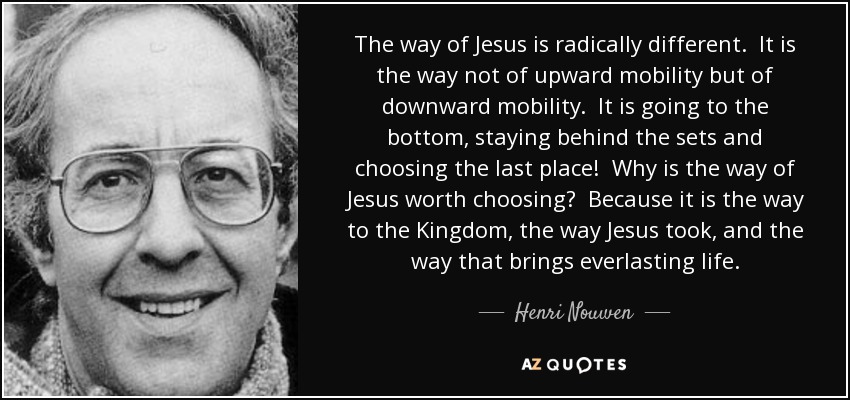
In a world pre-occupied with power and control, safety and security, influence and throwing its weight around, there is Jesus. He did just the opposite of engaging in upward mobility; he practiced downward mobility, and in doing so Christ descended into greatness as Lord and Savior.

Jesus did not consider equality with God as something to be grasped. The pre-incarnate Christ did not sit in heaven as the second person of the Trinity and hold onto his lofty position with tight fists – he did not grasp it tightly. When Jesus came to this earth, there was a humble willingness to open his hands and relinquish his rights and privileges as God. Christ made himself nothing, taking the very nature of a servant. Jesus gladly, not reluctantly, emptied himself for us. Jesus became one of us.

The television series, Undercover Boss, is a reality show in which high-level corporate executives leave the comfort of their offices and secretly take low-level jobs within their companies to find out how things are really working and what their employees are honestly thinking about their jobs and what is happening. In the process of this undercover mission, they learn of the perceptions about their companies, the spirit of their work forces and — maybe — something about themselves as well.

None of the executives cease to be executives. They just make a willing decision to take the lowest level job in their own company to hopefully benefit the employees and the entire corporation. The best episodes are when the most generous executives go above and beyond helping the employees around them at the end of the show. 

Jesus descended to earth. He never ceased to be God. Yet, Christ willingly put his kingly robe in the closet and donned Dickies and work boots. He came among us and purposely limited himself to identify with us fully – and secured for us the greatest generosity imaginable – an answer to the problem of guilt and shame through forgiveness of sins.

Jesus became a servant. He completely tied himself to us. Jesus did not come to this earth seeking to be served, but sought to serve and give his life as a ransom for many. Christ kept going lower and lower to the point of descending to the greatest humiliation of all – death on a cross. Jesus endured the ultimate shame of the ancient world by dying a terrible death. The King of the universe was killed by vicious humanity so that he might redeem and save those very same people from their terrible plight of bondage to evil.

We are to be humble people, embracing a lowly status of slaves to God and to one another. The ancient Philippian church had a real problem with pride which is why Paul talked about emulating the mind and attitude of Christ in his humiliation. The following are exhortations Paul gave to the Philippians, which were to reflect the practice of humility in relationships:

  • Whatever happens, conduct yourselves in a manner worthy of the gospel of Christ (1:27). 
  • Do nothing out of selfish ambition or vain conceit, but in humility consider others better than yourselves (2:3). 
  • Continue to work out your salvation with fear and trembling (2:12). 
  • Do everything without complaining or arguing (2:14). 
  • Join with others in following my example and take note of those who live according to the pattern we gave you (3:17). 
  • Do not be anxious about anything, but in everything, by prayer and petition, with thanksgiving, present your requests to God (4:6). 

Because of Christ’s humble obedience to the Father, he was exalted from the lowest place to the highest place.  King Jesus is on the throne, above everyone and everything. Because of his descent to this earth, Christ has ascended in glory and honor. We can now see God in a new way, through Jesus. And when we do, it causes us to kneel in prayer and profess that Jesus Christ is Lord.

In the ancient world, this was subversive language. If Jesus is Lord, Caesar is not, and ultimate allegiance does not belong to the Roman Empire. If Jesus is Lord, the local gods are not. And in our day, it is no different. Historical characters and religious deities may come and go, but the issue of ultimate allegiance still pertains to us. If Jesus is Lord, no politician or celebrity is owed lordship status. Pride and arrogance are to be put down at every turn in favor of humble service and loving actions.

If we are to follow Jesus Christ truly and really, we will practice downward mobility and embrace humility. Bowing, kneeling, and prostrating will become second nature to us as we give our unflagging allegiance to Jesus. We will accept our creaturehood and God as Creator. We will live in the reality that Jesus is Sovereign over all creation. 

As we enter the Christian Holy Week, let us acknowledge and know the humiliation and exaltation of Christ….

Just watch my servant blossom!
    Exalted, tall, head and shoulders above the crowd!
But he didn’t begin that way.
    At first everyone was appalled.
He didn’t even look human—
    a ruined face, disfigured past recognition.
Nations all over the world will be in awe, taken aback,
    kings shocked into silence when they see him.
For what was unheard of they’ll see with their own eyes,
    what was unthinkable they’ll have right before them.

Who believes what we’ve heard and seen?
    Who would have thought God’s saving power would look like this?

The servant grew up before God—a scrawny seedling,
    a scrubby plant in a parched field.
There was nothing attractive about him,
    nothing to cause us to take a second look.
He was looked down on and passed over,
    a man who suffered, who knew pain firsthand.
One look at him and people turned away.
    We looked down on him, thought he was scum.
But the fact is, it was our pains he carried—
    our disfigurements, all the things wrong with us.
We thought he brought it on himself,
    that God was punishing him for his own failures.
But it was our sins that did that to him,
    that ripped and tore and crushed him—our sins!
He took the punishment, and that made us whole.
    Through his bruises we get healed.
We’re all like sheep who’ve wandered off and gotten lost.
    We’ve all done our own thing, gone our own way.
And God has piled all our sins, everything we’ve done wrong,
    on him, on him.

He was beaten, he was tortured,
    but he didn’t say a word.
Like a lamb taken to be slaughtered
    and like a sheep being sheared,
    he took it all in silence.
Justice miscarried, and he was led off—
    and did anyone really know what was happening?
He died without a thought for his own welfare,
    beaten bloody for the sins of my people.
They buried him with the wicked,
    threw him in a grave with a rich man,
Even though he’d never hurt a soul
    or said one word that wasn’t true.

Still, it’s what God had in mind all along,
    to crush him with pain.
The plan was that he gives himself as an offering for sin
    so that he’d see life come from it—life, life, and more life.
    And God’s plan will deeply prosper through him.

Out of that terrible travail of soul,
    he’ll see that it’s worth it and be glad he did it.
Through what he experienced, my righteous one, my servant,
    will make many “righteous ones,”
    as he himself carries the burden of their sins.
Therefore I’ll reward him extravagantly—
    the best of everything, the highest honors—
Because he looked death in the face and didn’t flinch,
    because he embraced the company of the lowest.
He took on his own shoulders the sin of the many,
    he took up the cause of all the black sheep. (Isaiah 52:13-53:12, MSG)