Don’t Let Rejection Get the Best of You (Mark 6:1-13)

He left that place and came to his hometown, and his disciples followed him. On the Sabbath he began to teach in the synagogue, and many who heard him were astounded. They said, “Where did this man get all this? What is this wisdom that has been given to him? What deeds of power are being done by his hands! Is not this the carpenter, the son of Mary and brother of James and Joses and Judas and Simon, and are not his sisters here with us?” And they took offense at him. 

Then Jesus said to them, “Prophets are not without honor, except in their hometown and among their own kin and in their own house.” And he could do no deed of power there, except that he laid his hands on a few sick people and cured them. And he was amazed at their unbelief.

Then he went about among the villages teaching. He called the twelve and began to send them out two by two and gave them authority over the unclean spirits. He ordered them to take nothing for their journey except a staff: no bread, no bag, no money in their belts, but to wear sandals and not to put on two tunics. 

He said to them, “Wherever you enter a house, stay there until you leave the place. If any place will not welcome you and they refuse to hear you, as you leave, shake off the dust that is on your feet as a testimony against them.” So they went out and proclaimed that all should repent. They cast out many demons and anointed with oil many who were sick and cured them. (New Revised Standard Version)

Homecooked Rejection

Jesus was well into his ministry, with the disciples in tow, and had made quite a splash around Judea. Eventually, he made it back to the region of Galilee and to his hometown. Having grown up in a small town myself, I can testify how any sort of celebrity status from one of their own is a really big deal. Anticipation was high amongst the townsfolk.

Knowing Jesus as they did, the people were downright slack-jawed at his wisdom and the way he taught – which is also a typical response of the hometown boy made popular. The town knew Jesus differently – as simply another nice, but normal, Jewish kid from a nice but scandalous family.

The homecoming turned sour as the crowd believed they knew more than Jesus. After all, they knew him as a little kid. And they knew where he came from. He’s the carpenter, the son of Mary. They remembered what was up with Jesus. Mary and Joseph weren’t yet together and she ended up pregnant. This guy is no Son of God, but son of who knows?

They took offense at Jesus. He was the one with the curious conception and birth. And now he was trying to teach them, the ones who “really knew” his origins – or so they thought.

Jesus was just too uppity for the hometown folks. He considered himself more than the people he grew up with would concede. By providing the self-reference of “prophet,” Jesus was placing himself in the company of many revered men of God who went against the grain of their own contemporary cultures. And the folks in Galilee most certainly did not think they needed a prophet, especially one with illegitimate origins.

For the townsfolk, Jesus was claiming more honor and status for himself than was warranted in the old hometown. It meant that others got knocked down to size. So the people in the town were not having it. They took offense.

Ironically, the people who ought to know better, don’t. Jesus was amazed at their lack of faith, their unbelief. So little could be done in such a place as this. After all, you cannot heal someone if they believe they don’t need healing.

Heaven-sent Mission

Rejection didn’t stop Christ’s mission on this earth. Jesus prepared his disciples for their initial ministry, sending them in pairs. Up to this point, he taught them about God’s kingdom, handled a good deal of one-on-one instruction, and demonstrated for them what healing is like and why he did it. And they also needed to understand that rejection from others is part of the ministry.

Jesus instructed the disciples to take only a few essentials; the hospitality of others would be a significant aspect of their ministry – especially since much of their work would take place from household to household. Synagogues were not always receptive places to a new kind of ministry. So, the grassroots efforts of the disciple pairs were important.

Rejection and judgment tend to go hand-in-hand. Those who spurned the disciples were judging the veracity of their work. And also, that same rejection was a sign for the disciples to not spin their wheels trying to persuade the already convinced. Instead, the disciples were to do their own action of shaking the dust off their feet, letting the stubborn people know they were not carrying the bad judgments with them.

All in all, Christ’s disciples had an effective ministry and a positive experience. They were able to bring their message and healing to many.

We can observe through this story that rejection from others and a failure to make inroads with some is not necessarily a reflection on us. Some people are going to misunderstand us and make judgments about us, regardless of how well we go about our work.

After all, if Jesus experienced it, how much more will we? Don’t let rejection get the best of you.

To never face rejection and judgment may be a sign that little to no action is actually taking place – or maybe that the avoidance of conflict is assigned a value much too high than Jesus would give it.

If you are working toward loving both God and neighbor, showing justice and mercy in all you do, then any sort of rejection isn’t worth getting upset about.

Gracious God, I release my grip on needing to be understood by everyone, and instead choose to hold onto you and your grace. Therefore:

  • I lay down my need to understand why things happen the way they do.
  • I lay down my fears about others judging me.
  • I lay down my desire to prove my worth.
  • I lay down my resistance to suffering.

I take up my cross daily, and seek to walk according to your ways, and to live into your words; through Jesus Christ my Lord, in the enablement of the Holy Spirit. Amen.

The Parable of the Sower (Mark 4:1-20)

The Sower, by Mike Moyers

Again Jesus began to teach by the lake. The crowd that gathered around him was so large that he got into a boat and sat in it out on the lake, while all the people were along the shore at the water’s edge. He taught them many things by parables, and in his teaching said:

“Listen! A farmer went out to sow his seed. As he was scattering the seed, some fell along the path, and the birds came and ate it up. Some fell on rocky places, where it did not have much soil. It sprang up quickly because the soil was shallow. But when the sun came up, the plants were scorched, and they withered because they had no root. Other seed fell among thorns, which grew up and choked the plants, so that they did not bear grain. Still other seed fell on good soil. It came up, grew and produced a crop, some multiplying thirty, some sixty, some a hundred times.”

Then Jesus said, “Whoever has ears to hear, let them hear.”

When he was alone, the Twelve and the others around him asked him about the parables. He told them, “The secret of the kingdom of God has been given to you. But to those on the outside everything is said in parables so that,

“‘they may be ever seeing but never perceiving,
    and ever hearing but never understanding;
otherwise they might turn and be forgiven!’”

Then Jesus said to them, “Don’t you understand this parable? How then will you understand any parable? The farmer sows the word. Some people are like seeds along the path, where the word is sown. As soon as they hear it, Satan comes and takes away the word that was sown in them. Others, like seed sown on rocky places, hear the word and at once receive it with joy. But since they have no root, they last only a short time. When trouble or persecution comes because of the word, they quickly fall away. Still others, like seed sown among thorns, hear the word; but the worries of this life, the deceitfulness of wealth and the desires for other things come in and choke the word, making it unfruitful. Others, like seed sown on good soil, hear the word, accept it, and produce a crop—some thirty, some sixty, some a hundred times what was sown.” (New International Version)

The Sower, by Johne Richardson

All four of the New Testament Gospels have their own particular angle and focus upon the life of Jesus Christ. For Mark, he wrote to demonstrate and prove the established authority of Christ over everything.

God’s power is expressed in and through Christ. So, when Mark tells a story, he is concerned to communicate that God’s kingdom – God’s rule and reign on this earth – comes through Jesus as the Sovereign over this realm of the universe and our world.

By means of a parable – a farmer going out and scattering seeds – Jesus was making some points about the kingdom of God: it will be successful; it is thoroughly under divine control; and it’s inclusive.

God’s Reign Will Succeed

History is inexorably moving toward a climax. God’s sovereign rule has broken into human history. Christ’s authoritative rule is taking root, growing, and shall eventually envelope all the world.

It may not presently seem as if that’s going to happen. But appearances can be deceiving. Although much, if not most, of the good gospel seeds spread about this earth never produce a harvest of righteousness, there is enough good soil for those seeds to succeed.

Even though there is a lot of unproductive and ineffective soil in this world, good seeds in good soil will germinate and take root. They will grow, develop, mature, and ripen. An abundant yield of crops will more than satisfy the needs of the earth. And it will blow the imagination of even the wisest and best farmer.

One person, having realized the incredible fruit of the Spirit, makes a broad, deep, and expansive impact on dozens, hundreds, thousands, tens of thousands, and even millions of people. It certainly doesn’t happen overnight; but goodness, truth, beauty, and righteousness are making their way slowly – and will overtake and overwhelm all evil.

If you make disciples who make more disciples, that is multiplication. Jesus made disciples, and called his followers to do the same. He spent three years training twelve men; and then commissioned them to go out and reproduce the process with others. (Matthew 28:18-20)

Beginning in Jerusalem, the earliest disciples of Jesus began making more disciples, following Christ’s ascension, and that movement has never stopped. Jesus started a movement of a few seeds multiplying into many seeds, so that the Church would grow exponentially. Not even the gates of hell can stop the process from happening. (Acts 1:1-8; Matthew 16:17-19)

God’s Reign Is Ruled by God

That may seem like a ridiculously obvious statement, yet it still needs to be said. God is authoritatively in control, not only of God’s own kingdom, but of all things. This means that God’s rule and reign is the result of God’s action, not ours. The only thing we need to do is scatter the seed and be a simple farmer. Everything else is up to God.

Our ability to do anything is animated by God’s gracious work in our lives. The power to effect making disciples comes from the Lord. Since we are dependent upon God for our next breath, we are also completely under the authority and sustaining presence of God for everything in life.

Both the subject and object of every biblical story is God. In this unfolding drama of redemptive history that we are experiencing, God is the writer, producer, director, and lead actor; we only have some bit parts in the whole thing. It’s our job to respond – and not to try and take over the show.

God’s Reign Is Inclusive

When gospel seeds are established in good soil, eventually producing an abundant harvest, it will feed the entire world. It will include all kinds of people. The produce which is available is not limited to a particular group of people. God’s grace and goodness are shown to people without prejudice or favoritism.

The best things in life begin as small as a mustard seed. That’s because every good thing we have is a result of humility. And from that place – the hummus of the earth – God creates life, gives new life, and does the improbable and the impossible of transforming a tiny little seed into a tall expansive plant which blesses many.

Conclusion

As simple humble farmers of faith, we need to pay attention to what we have, so that we don’t become complacent. The forces of evil – the spiritual tornados and tsunamis – are still very much active on this earth. Those powers temporarily oppose the good power and authority of Christ.

The good word spread to us can be snatched and taken away by the ravens of Satan. Although other good words make some effective headway, all the weeds around them can choke the plants until they wither and die. All sorts of existential conditions surrounding the plants can cause a failure to thrive.

Whenever Christians face opposition – or when they observe young believers lost to those surrounding forces – they need not become discouraged. Why? Because this is all a part of the ministry to which every follower of Jesus is called. Our part is to keep sowing and planting. The rest is up to God.

Sovereign and almighty God:
Give me strength to live faithfully this day;
Let me not turn coward because of difficulties, or become irresponsible to my duties;
Let me not lose faith in other people;
Keep me sweet and sound of heart, in spite of ingratitude, treachery or meanness;
Preserve me from minding little stings or giving them;
Help me to keep my heart clean and to live so honestly and fearlessly that no outward failure can dishearten me or take away the joy of conscious integrity;
Open wide the eyes of my soul that I may see good in all things;
Grant me this day some new vision of your truth;
Inspire me with the spirit of joy and gladness, and make me the fertilizer to suffering souls; in the name of the strong Deliverer, our only Lord and Savior, Jesus Christ. Amen.

A Controversial Christ (Mark 2:23-3:6)

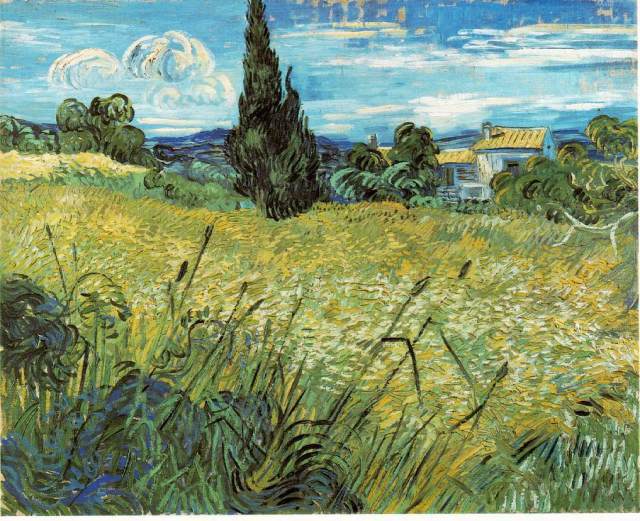
Wheatfield with Crows, by Vincent Van Gogh, 1890

One Sabbath day as Jesus was walking through some grainfields, his disciples began breaking off heads of grain to eat. But the Pharisees said to Jesus, “Look, why are they breaking the law by harvesting grain on the Sabbath?”

Jesus said to them, “Haven’t you ever read in the Scriptures what David did when he and his companions were hungry? He went into the house of God (during the days when Abiathar was high priest) and broke the law by eating the sacred loaves of bread that only the priests are allowed to eat. He also gave some to his companions.”

Then Jesus said to them, “The Sabbath was made to meet the needs of people, and not people to meet the requirements of the Sabbath. So the Son of Man is Lord, even over the Sabbath!”

Jesus went into the synagogue again and noticed a man with a deformed hand. Since it was the Sabbath, Jesus’ enemies watched him closely. If he healed the man’s hand, they planned to accuse him of working on the Sabbath.

Jesus said to the man with the deformed hand, “Come and stand in front of everyone.” Then he turned to his critics and asked, “Does the law permit good deeds on the Sabbath, or is it a day for doing evil? Is this a day to save life or to destroy it?” But they wouldn’t answer him.

He looked around at them angrily and was deeply saddened by their hard hearts. Then he said to the man, “Hold out your hand.” So the man held out his hand, and it was restored! At once the Pharisees went away and met with the supporters of Herod to plot how to kill Jesus. (New Living Translation)

Jesus Heals the Man with the Withered Hand, by Ilyas Basim Khuri Bazzi Rahib, 1684

I am continually amazed whenever good people are surprised by being embroiled in the muck of human controversy. Since we live in a profoundly fallen world, good is often going to buck up against the bad. Besides, Jesus often found himself in a controversy of some kind; and we are not above our Lord.

There are two distinct yet similar controversies in today’s lesson; and they highlight why there were some folk who were all upset about the way Jesus went about things. Such people eventually came to the dark decision that Jesus needed to go away, permanently.

Much of the controversy between Jesus and the religious leaders came down to particular views of God’s law; and, of course, whose view was going to win out over the other. It ended up becoming what almost all controversies are about: Deciding who is really in power and calls the shots.

The Politics of Hunger

It was a Sabbath day. Jesus and his disciples were walking through the fields. And they were hungry. So the disciples took some grain, broke off the heads, and ate them. To any non-Jewish person, there’s no problem here. But the Pharisees were concerned.

First, they observed the disciples walking through grain fields. The Pharisees thought they should be staying put on the Sabbath. Second, and perhaps more significantly, the religious leaders saw Christ’s disciples gleaning – which was working on the Sabbath. To them, any respectable Jew prepared their food the day before. This is a lack of holiness, of not taking the Sabbath seriously. And this was completely unacceptable to the Pharisees.

Wheat Field and Cypress by Vincent Van Gogh, 1890

Jesus, however, viewed walking through the fields differently. He did not consider the Sabbath as trivial; Jesus instead stood back and took a big picture perspective of it all. And that view included the ancient story of David, who took the consecrated bread in the tabernacle which was reserved only for Levite priests. (1 Samuel 21:1-6; Leviticus 24:8-9)

The reason David wanted the bread was because he was a fugitive, on the run from King Saul who was trying to take his life. Jesus insisted, on that day, the priest on duty did nothing wrong in giving the special bread to David. Yes, the strict letter of the law was broken; and, no, this was not wrong – because the priest was helping to save a life, and a very important one at that.

Jesus discerned there are times when particular laws come into conflict; so it’s necessary to maintain the spirit of a law in order to maintain a high value and meet a pressing human need. In a sense, Jesus gave a covenant code legal opinion on the subject.

It’s no surprise, to any reader of the New Testament Gospels, that Christ would behave this way; and that it would drive the religious leaders bananas. After all, they, the Pharisees, upheld law and rendered legal decisions – not this upstart wannabe. Jesus took an authoritative stance on what was happening, and the leaders did not at all like their own authority questioned.

This wasn’t some maverick interpretation by Jesus. He simply pointed out that the Sabbath is a gift, given to people to promote life and health – and not a burden that folks are to carry. Any decent Sabbath-keeper knew this.

It appears the leaders didn’t like being reminded of it from Jesus. What’s more, Jesus was much too close to likening himself to David. Yet another reason to despise this uppity teacher.

The Legality of Suffering

A second controversy brought the issue of who is in charge and who gets to arbitrate community values into a greater light. There is perhaps no other place for that conflict to happen than in the synagogue, the meeting place of worshipers. The juiciest things always seem to happen in a place of worship.

In the first story, the religious leaders were caught surprised over the behavior of Jesus and his disciples. They’re determined not to make that mistake again. From this point forward, it seems the Pharisees are continually waiting for a chance to put down Jesus as a lawbreaker and rabblerouser.

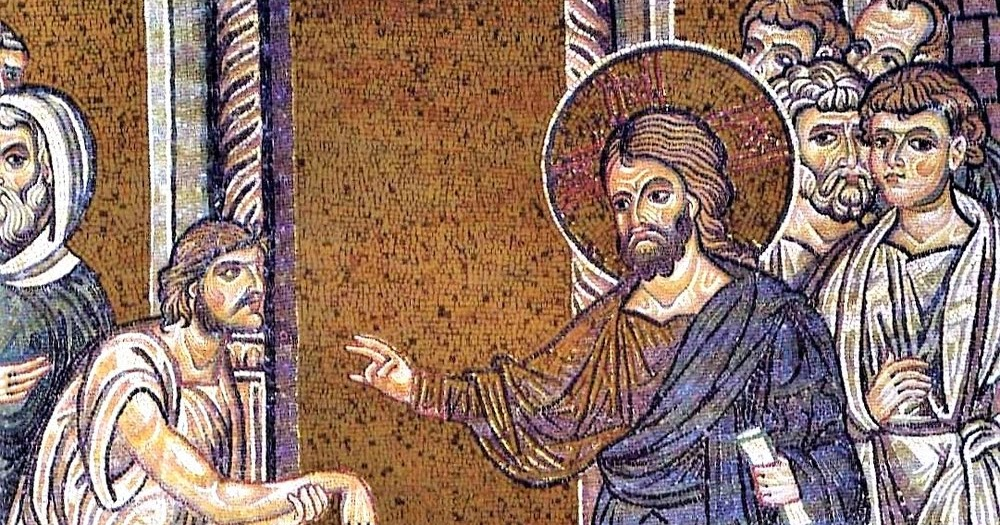
Byzantine mosaic of Christ healing the man with a withered hand, Cathedral of Monreale, Palermo, Sicily

For them, the issue wasn’t about the ability to heal, but whether it’s being done on the Sabbath. Much like the grainfield incident, healing is work, and working on the Sabbath is a direct violation of God’s immutable law. The religious leaders wanted to prove that Jesus has no regard for God’s will.

Law, for many Pharisees in Christ’s day, was meant to bring order so that chaos does not rule. Obedience to the law is a pre-condition for blessing. Without a clear demonstration of holy living, the community could be under a curse, much like their ancestors before them who were exiled for disregarding God’s law.

Yet again, Jesus cut through the anxious fear and authoritative posturing and went directly to the intended spirit of the law. The Sabbath, of all days in the week, ought to be a time for doing good, not harm; and to save life, not kill it. Jesus was not doing anything that could be considered work, anymore than his disciples were actually gleaning or harvesting grain.

There is no better day than the Sabbath for restoring a man’s withered and malformed hand, for giving him back his ability to make a living and contribute to the community. Much more was restored to the man than a physical ability; he now had the ability to better his life and his family, not to mention the local economy. It ought to be all good…

Unfortunately, the Pharisees didn’t see it that way, that the man gained his dignity back, his wholeness and his joy. They could only see a threat to their own hegemony.

The Beginning of the End

So, this marks the beginning of the end. The leaders are so upset and angry, they began plotting for Christ’s destruction. Unlikely political allies came together because of a common enemy. To view Jesus as a threat to society is, at the least, messed up. But that’s what happens when people cannot see beyond the end of their nose. They make bad choices.

Even though Jesus came to give life, others want to take his. Despite the fact that Jesus did not reject the law or demean the Sabbath, people with a short-sighted agenda and hard hearts could only see someone upsetting the status quo.

Today, these same things can quickly turn to hostility. The legal implications of one’s values and commitments can get nasty fast. Opinions can harden, resulting in oppression, persecution, and even death.

The most noble of motives can go sour; and the best of intentions, the highly educated, and the most gifted persons among us can become despotic in their leadership. Indeed, absolute power corrupts absolutely.

This is why the gracious and benevolent kingdom of God will win the day. Hard-hearted people become desperately out of touch with what is most important; they are calloused to the human need in front of their faces. I believe that the words and ways of Jesus can dispel those dark forces and impulses.

I’ll take a controversial Christ any day because that is the path to life abundant and everlasting.

Whenever unjust, oppressive, harmful, and fearful systems hold on, the ministry of Jesus exposes them for what they are, and will deliver us from evil.

Thanks be to God!

Jesus Prays For Us (John 17:6-19)

Word of Life, by Millard Sheets

“I have made your name known to those whom you gave me from the world. They were yours, and you gave them to me, and they have kept your word. Now they know that everything you have given me is from you, for the words that you gave to me I have given to them, and they have received them and know in truth that I came from you, and they have believed that you sent me.

I am asking on their behalf; I am not asking on behalf of the world but on behalf of those whom you gave me, because they are yours. All mine are yours, and yours are mine, and I have been glorified in them. And now I am no longer in the world, but they are in the world, and I am coming to you.

“Holy Father, protect them in your name that you have given me, so that they may be one, as we are one. While I was with them, I protected them in your name that you have given me. I guarded them, and not one of them was lost except the one destined to be lost, so that the scripture might be fulfilled. 

But now I am coming to you, and I speak these things in the world so that they may have my joy made complete in themselves. I have given them your word, and the world has hated them because they do not belong to the world, just as I do not belong to the world. 

“I am not asking you to take them out of the world, but I ask you to protect them from the evil one. They do not belong to the world, just as I do not belong to the world. Sanctify them in the truth; your word is truth. As you have sent me into the world, so I have sent them into the world. And for their sakes I sanctify myself, so that they also may be sanctified in truth. (New Revised Standard Version)

It seems to me only fitting that Jesus concluded his time with the disciples in the Upper Room before his betrayal, crucifixion, and death with prayer. It also seems to me that if you really want to know the heart of a person, listen to them pray.

The prayer of Jesus was thoroughly oriented toward the spiritual needs of his followers – even potential believers who will follow him in the future. And it was a prayer completely devoted toward honoring the heavenly Father through praying consistent with God’s will for this world.

Without the physical presence of Jesus – which would soon be gone – his followers would have to rely on prayer. And Christ was intent on instilling within his disciples the confidence and hope they needed for a solid life of prayer.

For post-resurrection Christians living in an ever-expanding world of oppression, greed, and indifference, we can be encouraged not to settle into despair or loneliness. Why? Because believers can have a solid hope and an abiding trust in the continuing presence of Jesus by means of the Holy Spirit.

God Gives

God gives. Jesus gives. Both the Father and the Son are givers. This is a major reason and motivation for prayer because God is not a reluctant giver. In the act of giving, the Father and the Son are fully on the same page; God is ready and willing to give. The Holy Trinity – Father, Son, and Spirit – are in complete unity, and act as One, in giving to us what we need.

“Those who drink of the water that I will give them will never be thirsty. The water that I will give will become in them a spring of water gushing up to eternal life.” (John 4:14, NRSV)

“Do not work for the food that perishes but for the food that endures for eternal life, which the Son of Man will give you.” (John 6:27, NRSV)

“I give them eternal life, and they will never perish. No one will snatch them out of my hand.” (John 10:28, NRSV)

We Belong

Through giving we are included. Believers and followers of Jesus – having been given the grace of faith – know that they belong to God. Christians are in union with Christ. The redemption which Jesus has secured is a million billion times stronger, and bonds us closer, than any sort of Gorilla glue. And, what’s more, once we belong, we are never forgotten, but always remembered by God.

“The Father knows me, and I know the Father. And I lay down my life for the sheep. I have other sheep that do not belong to this fold. I must bring them also, and they will listen to my voice. So there will be one flock, one shepherd.” (John 10:15-16, NRSV)

Christ the King, statue in Swiebodzin, Poland

The Name of Jesus

Because we belong, we know God’s name. The divine name stands for all that God is and all that God has done. It’s all focused in Christ. In the name of Jesus, through the person and work of Jesus Christ, we have everlasting life, spiritual power, and eternal security.

Now Jesus did many other signs in the presence of his disciples that are not written in this book. But these are written so that you may continue to believe that Jesus is the Messiah, the Son of God, and that through believing you may have life in his name. (John 20:30-31, NRSV)

We Have the Word

The Word became flesh and dwelt among us (John 1:14). Jesus has given to his disciples only those words which he first received from the Father. Those who accept the enfleshed Word and his words have been given power to become God’s children (John 1:12). Because believers belong to God, they know the truth and that truth has set them free.

It is the Christian’s mission to live into the words and ways of Jesus, to follow Christ in thought, word, and deed. The very glory of Jesus in his cross and resurrection is focused within the believing community, who is in union with Christ and belongs to God.

In his prayer, Jesus claimed an intimate oneness in the sharing of concern for people who are the objects of the Father’s gracious giving of love through the Son. All who belong to Christ belong to God, and vice versa. All the love that went into the cross was poured out upon us.

Those who believe in the name of Jesus Christ are the very glory of Jesus, and thus, the glory of God.

Sent Into the World

Because of the Father’s name—because of who the Father is and what the Father has given in love to the Son—we are set apart for truth; the words of God are truth.

Since we belong to God and bear the name of Christ, we don’t belong to the world’s systems of guilt, shame, injustice, and evil. And yet, we are separated from the world for precisely the reason of immersing ourselves in the world. In other words, Christianity is meant for the life of the world, and not as a religion that’s only concerned for itself.

To reach the world, we must be different from it. To reach the world, we need to have boots-on-the-ground in it. To reach the world, Christians are to be both far from the world, and near to the world.

As the Father sent the Son, so the Son sends us into the world – not to be like the world, but to embody the words and ways of Jesus to and for the world.

Just as the world rejected Jesus in his suffering and death, so the world, too, will reject his followers. Which means we will need to pray, a lot! And there is no better scriptural prayer to emulate than the very words of the Lord Jesus, who loved us and gave himself for us.

Holy Father, guard our hearts and minds in Jesus, as we pursue this Christian life which you gave as a gift through Christ, so that we can be united, just as the Father and the Son are one. Although we long for heaven, don’t take us out of the world until we have fulfilled our sacred mission to carry the words and ways of our Lord to the world. Make us holy, and give us everything we need for life in this present evil age; through Jesus Christ your Son, our Lord, who with you and the Holy Spirit are one God, now and forever. Amen.