The Message of Palm Sunday (John 12:12-16)

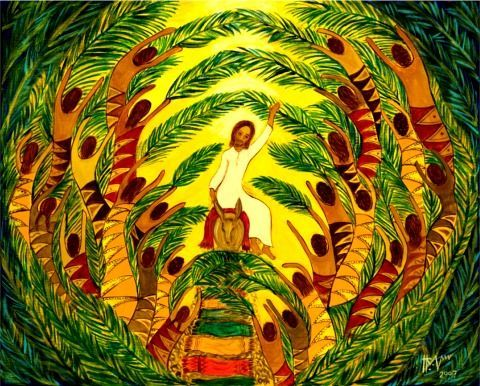
Christ enters Jerusalem, by Hanna-Cheriyan Varghese

The next day the great crowd that had come to the festival heard that Jesus was coming to Jerusalem. So they took branches of palm trees and went out to meet him, shouting,

“Hosanna!
Blessed is the one who comes in the name of the Lord—
    the King of Israel!”

Jesus found a young donkey and sat on it, as it is written:

“Do not be afraid, daughter of Zion.
Look, your king is coming,
    sitting on a donkey’s colt!”

His disciples did not understand these things at first, but when Jesus was glorified, then they remembered that these things had been written of him and had been done to him. (New Revised Standard Version)

Here are two questions to keep in mind as we consider Palm Sunday, the day we remember Jesus coming into Jerusalem during the Feast of Passover (Holy Week): 

  1. Is Jesus really enough for me, just the way he is? 
  2. Or, do I think he ought to be different than he is?

Many of the people who gathered to give Jesus praise at the beginning of the week, shouted to the Roman authorities to have him crucified at the end of the week. So, what changed? Why the big turn around? 

The change in attitude came because Jesus did not fit the crowd’s expectations of who the Messiah is, and what he should do. Jesus, just as he is, was not enough for them. They did not accept him for who he was. 

Let’s be aware and in touch with our own expectations for God, and for what we believe Jesus ought to be and to do. Because missed expectations create either hurt, anger, or both. 

How we view Jesus determines how we view the Christian life and the Christian Church. If we see Jesus like an earthly king or politician, and emphasize his war chest, while downplaying his meekness, we will then have a triumphalist view of Christianity. We’ll be disappointed when there is no practical victory taking place. 

The crowd wanted assurances that in Christ’s first 40 days in office, he would put the big hurt on the Roman authorities. The people had expectations of strong leadership, making things happen now, and accomplishing big hairy audacious goals of upending the establishment. 

But if we view Jesus as the Gentle King and the Humble Sovereign – viewing him as lowly royalty – giving due emphasis to both his authority and his humility, then we will likely worship Jesus as he truly is, and not as we want him to be. 

Most of the crowd was following Jesus with misguided expectations

Jesus did some incredible miracles, especially the one where he raised Lazarus from the dead. Over a million people came to Jerusalem every year during the week of Passover, and word had spread about a man who just might be the hope of Israel. They heard about his power and authority, and wanted to check him out.

And this is a good thing, not a bad thing. It’s important that people investigate Jesus and see for themselves who he is and what he’s all about. 

Just because there are people who do not respond immediately to Jesus, doesn’t mean they won’t in the future. After all, even the disciples who were closest to Jesus did not fully understand who he was or what he was doing. Only later, after the resurrection and ascension, did they put it all together and “get it.” So, cut others (and yourself) some slack.

Let’s give a lot of latitude to people who seek Jesus. They need the good news of forgiveness and new life in Christ. They don’t need immediate pressure to follow Jesus, or given a set of moral rules to follow, right now, as if clean living brings salvation from sin, death, and hell. 

People need room to investigate Jesus, and plenty of helpful guides along the way to point them in the right direction. So, let’s encourage honest questions and real conversations about Jesus.

However, some of the crowd checking out Jesus already had their minds made up about who they thought he should be. They had no room for a suffering servant and a humble savior, seeing only the sins of others, and not their own faults. 

Those with closed minds believed Jesus should be a political liberator from the Gentile Romans. The crowd was understandably weary of being dominated by non-Jews. But what many wanted was some serious payback and a new establishment with Messiah in charge.

This would be like, in our own day, getting completely jazzed-up about a particular presidential candidate who did some incredible things on the campaign trail and is now entering Washington D.C. to a ticker-tape parade and lots of flag-waving. 
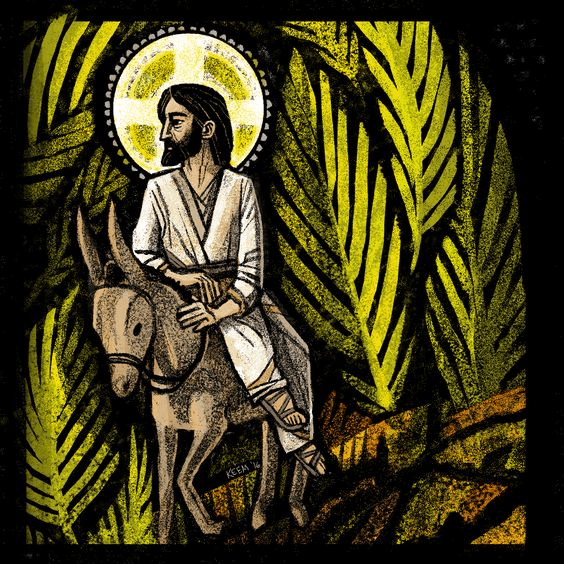
Art by Kris Miller

Palm branches were the national symbol for Israel, like our flag displays. There was no question about what the crowd of people wanted: A strong leader-king who was going to change the establishment and inaugurate a new administration of peace and prosperity that put the Romans in their place and give prominence to the Jews, like King David of old.

But Jesus made it evident he was not going to submit to what the crowd wanted. Christ had a different idea about what needed to take place.

Jesus did not ride into Jerusalem on a war horse, but on a donkey

An enthused crowd. People anticipating Jesus… and then he shows up! “What in the heck is he riding on…?  Is that a donkey!?” It was an anti-climactic moment.

Jesus purposely chose a donkey to ride into Jerusalem – serving notice to everyone that he was not going to capitulate to the crowd’s agenda for him and become the political savior they were looking for. The establishment was not going to be overturned.

Christ was giving balance to the people about who he was. Yes, he actually is a king, and the sovereign Lord of all – but a gentle King, a humble Sovereign, a meek Messiah. Those adjectives were not in most people’s vocabulary for a king. But Jesus is a king on his terms, not anybody else’s.

Because Jesus is a gentle king, we need not be afraid

Sometimes, what we think we need, and what we actually need, are two different things. Jesus uses his royal authority and power to help, not hurt. Although he might not meet all the expectations of the crowd, that doesn’t mean he will avoid giving them what they really need. 

The crowd was too hung up on their hardships and expecting deliverance from a human government. But what they received was something better: salvation from the dark powers of sin, death, and hell. 

Jesus will certainly come and right every wrong, but he will do it in God’s timing, not ours. 

In the meantime, when evil seems to be winning the day, we can be assured that God’s judgment will deal with each and every sin committed against God’s people. Jesus is attentive to his followers; his grace and power combine to give us what we truly need.

Conclusion

Ironically, Jesus ended up not being enough for his own people; they wanted something different than what they got. Here is the timeless point today’s story emphasizes:

We must adjust to who Jesus is, and not the other way around. 

In truth, Jesus came to take on the establishment – just not the Roman one. Jesus came to overturn the ruling establishment of Satan and his wicked spirits; to upend the principalities and powers of this dark world.

Jesus came to take back the people of this earth for God, and he would not do it through a political revolution, but by a spiritual one. Jesus would seize power by becoming a sacrifice for sin, making it possible for people to live a new life without the world, the flesh, and the devil dogging them at every turn.

Jesus is the rightful Ruler of both the church and the world. And he rules in humility, meekness, gentleness, and love. Jesus calls his followers to serve him by living in that same way. Just a few days after the entrance into Jerusalem with palm branches waving, Jesus told his disciples exactly what he wanted from them: 

“Now that I, your Lord and Teacher, have washed your feet, you also should wash one another’s feet. I have set you an example that you should do as I have done for you. I tell you the truth, no servant is greater than the master, nor is a messenger greater than the one who sent him (this is Jesus’ way of saying that they all must adjust to him, and not the other way around). Now that you know these things, you will be blessed if you do them.” (John 13:13-17, NIV)

Jesus went on to give them a clear command:

“Love one another.  As I have loved you, so you must love one another (this is Jesus’ way of emphasizing what is to be the priority of his subjects in the kingdom of God). By this all men will know that you are my disciples if you love one another.” (John 13:34-35, NIV)

Jesus is engaging in a revolution, but not in a worldly sense. Christ sends his followers to spread the message of forgiveness and new life for individuals, families, workplaces, neighborhoods, and nations. It is a revolution that will be ushered in through love, not hate; through the violence of a singular sacrifice, and not through the violence of wars and political coups.

Is Jesus really enough for me, just the way he is? Or, do I believe he ought to be different than he is?  

I daily strive to say, no matter the circumstance, that the grace of Jesus Christ is enough for me. If all were stripped and taken from me, if all the world were against me, if nothing went right and all was upside-down, I would still have the love of God in Jesus Christ. Amen.

The Mediator and Leader (Psalm 110:1-4)

The Lord said to my lord,
    “Sit here at my right side
    until I put your enemies under your feet.”
From Zion the Lord will extend your royal power.
    “Rule over your enemies,” he says.
On the day you fight your enemies,
    your people will volunteer.
Like the dew of early morning
    your young men will come to you on the sacred hills.

The Lord made a solemn promise and will not take it back:
    “You will be a priest forever
    in the priestly order of Melchizedek.” (Good News Translation)

This is the most quoted psalm in the New Testament (twenty-four times) with the reason being that the apostles discerned Jesus as the messianic ruler of Psalm 110. The author of Hebrews purposed to highlight the superiority of Jesus Christ over everyone and everything. So, he went to this psalm, and used it early in his letter for the beginning of his argument:

In the past God spoke to our ancestors through the prophets at many times and in various ways, but in these last days he has spoken to us by his Son, whom he appointed heir of all things, and through whom also he made the universe. The Son is the radiance of God’s glory and the exact representation of his being, sustaining all things by his powerful word. After he had provided purification for sins, he sat down at the right hand of the Majesty in heaven. So, he became as much superior to the angels as the name he has inherited is superior to theirs….

But about the Son he says,

“Your throne, O God, will last for ever and ever;
    a scepter of justice will be the scepter of your kingdom.
You have loved righteousness and hated wickedness;
    therefore God, your God, has set you above your companions
    by anointing you with the oil of joy.”

He also says,

“In the beginning, Lord, you laid the foundations of the earth,
    and the heavens are the work of your hands.
They will perish, but you remain;
    they will all wear out like a garment.
You will roll them up like a robe;
    like a garment they will be changed.
But you remain the same,
    and your years will never end.”

To which of the angels did God ever say,

“Sit at my right hand
    until I make your enemies
    a footstool for your feet”? (Hebrews 1:1-13, NIV)

In Christianity, Jesus is the ultimate Mediator between God and humanity. Neither angel nor any other human can fill such a role. The author of Hebrews wanted to make it clear that Jesus is the rightful Ruler of all creation.

Christ’s authority is far and above all others. So, Christians are never defenseless in this world. Believers have a caring mediator, and a powerful sovereign, knowing that Jesus has the authority to back up his words of love and assurance toward us.

Jesus has the unique combination of being both a king and a priest; he intercedes for us and provides us with compassionate leadership. Again, in the middle of his argument, the author of Hebrews used Psalm 110 to emphasize this:

Every high priest is selected from among the people and is appointed to represent the people in matters related to God, to offer gifts and sacrifices for sins. He can deal gently with those who are ignorant and are going astray, since he himself is subject to weakness. Therefore, he has to offer sacrifices for his own sins, as well as for the sins of the people. And no one takes this honor on himself, but he receives it when called by God, just as Aaron was.

In the same way, Christ did not take on himself the glory of becoming a high priest. But God said to him,

“You are my Son;
    today I have become your Father.”

And he says in another place,

“You are a priest forever,
    in the order of Melchizedek.”

During the days of Jesus’ life on earth, he offered up prayers and petitions with fervent cries and tears to the one who could save him from death, and he was heard because of his reverent submission. Son though he was, he learned obedience from what he suffered and once made perfect, he became the source of eternal salvation for all who obey him and was designated by God to be high priest in the order of Melchizedek. (Hebrews 5:1-10, NIV)

Christ demonstrated and proved that he is qualified to be the rightful priest and king because of his obedient suffering. Therefore, Jesus is perfectly suited and able to help us. He is neither a detached nor an aloof priestly king.

The Lord Jesus knows exactly what it’s like to be a human in this broken and fallen world. Such divine empathy translates into solid emotional and spiritual support because, as the Christian tradition holds, Jesus has taken care of the sin issue once for all through the Cross.

The Messiah’s enemies – whose eventual and final defeat is certain – are not Gentile kingdoms or human institutions. Christ’s ultimate foes are the hostile and evil principalities and powers of this dark world, including death itself. The universal reign of Jesus, the exalted Son of David, brings deliverance from guilt, shame, and injustice as the unique God-Man.

In this unabashed Christian view of Psalm 110, Jesus is our perfected high priest who is able for all time to save those who approach God, since he always lives to make intercession for us (Hebrews 7:25). The appropriate response to such a great king and priest is submissive loyalty and eternal praise.

O Lord our God: Reign in power over us, through your Son, Jesus Christ – for he is exalted over all governments and authorities, all ideologies and creeds, and all human hearts and souls. King Jesus: Be enthroned in our lives, in all people everywhere, as our mediator and atoning sacrifice. Spirit of God: Reign in power over us through Jesus Christ and give us the victory over all the enemies of our souls, within and without, for the glory of your Name. Amen.

Are You Looking for Healing? (Mark 3:7-12)

Jesus departed with his disciples to the sea, and a great multitude from Galilee followed him; hearing all that he was doing, they came to him in great numbers from Judea, Jerusalem, Idumea, beyond the Jordan, and the region around Tyre and Sidon. He told his disciples to have a boat ready for him because of the crowd, so that they would not crush him, for he had cured many, so that all who had diseases pressed upon him to touch him. Whenever the unclean spirits saw him, they fell down before him and shouted, “You are the Son of God!” But he sternly ordered them not to make him known. (New Revised Standard Version)

A man’s shriveled hand was restored in full view of all the public. From then on, throngs of people came to check out what was happening. Jesus was well into his earthly ministry and created quite a buzz amongst everyone in Palestine. The ancient paparazzi even started following him around.

There were more fans rushing to see Jesus than Swiftys at a sighting of Taylor Swift. Like having the limousine ready after a concert to get away from the huge crowds, so Jesus instructed his disciples to have a boat ready for him in order to avoid the great crush of people.

Christ’s reputation of curing the sick and infirmed had reached such a critical mass that thousands were determined to at least touch him and experience long-awaited healing. And, really, you can’t really blame them, can you?

Maybe you’ve never experienced debilitating chronic pain – day after day not being able to get away from it’s awful effects in both body and soul. Or perhaps you have no idea what it’s like to live with depression constantly dogging you, just waiting to take a bite out of your life and devour you like some piece of meat.

A lot of people know what it’s like to live with infirmities that they don’t want and didn’t ask for. And they’ve tried everything to either get rid of it, or cope with it, somehow.

In fact, there are so many such persons living on planet earth, that when they had a snowball’s chance at getting to Jesus, they dropped everything and took it – going after him and not caring one bit if they themselves got crushed from all the other people trying to get help.

That, my friend, is how many people there are with great physical, mental, emotional, and spiritual needs on this planet.

We could go the route of playing arm chair observer and criticize the great crowd of people for being nothing but a bunch of fans who wanted to see the latest fad in Jesus. But, if you get up close with boots-on-the-ground, you will see a different picture: thousands of people looking for hope, health, and wholeness, wanting to be “normal” like everyone else.

The problem? Normal is nothing more than a social construct. For the infirmed, it’s likely not going to happen. For those believing they’re normal, in truth, they have a profound lack of awareness to their own great need.

No, we’re all abnormal; all of us are disordered, or diseased, or distressed in some sort of way. It turns out that we all need Jesus; some of us just know it much more profoundly than others.

Jesus was not only about to be crushed from physical bodies pressing in on him; he was going to be crushed by the sheer weight of the world’s tremendous need for healing.

But he was pierced for our transgressions,
    he was crushed for our iniquities;
the punishment that brought us peace was on him,
    and by his wounds we are healed.
We all, like sheep, have gone astray,
    each of us has turned to our own way;
and the Lord has laid on him
    the iniquity of us all. (Isaiah 53:5-6, NIV)

At this point in Christ’s ministry, a significant shift began. Rather than entering a synagogue and speaking only to Jews, Jesus started addressing Gentiles, as well. In fact, the crowds wanting to see him came not only from exclusively Jewish locations, but also from other places.

This ministry of Christ raised the attention of the demonic realm. It was a major threat to the demons’ influence on people. Identifying him as the Son of God and calling Jesus out by that name was a way for the demons to reassert their power and try to get some leverage. Names are actually a big deal. Which is why, for example, Jesus once asked a demoniac in the cemetery what his name is.

That’s one way a name is powerful. Yet, when it comes to you and me, the fact that Jesus knows your name, and my name, is a mighty thing in a very different way. Rather than having demons making the Son of God known, Christ grants us the authority to make the name of Jesus known throughout the world.

Even though the redemptive events of Jesus happened two thousand years ago, great crowds of people still come to Jesus, clamoring for but a touch of his grace. And the forces of darkness are still hanging around, knowing that their time is short.

Yes, there is still healing and wholeness to be found in Jesus, even today. And even though there remain some forces of darkness in opposition to it, the victory has already been achieved.

O God the Father, whose will for us and for all your people is health and salvation,

Have mercy on us.

O God the Son, who came that we might have life and have it in abundance,

Have mercy on us.

O God the Holy Spirit, whose indwelling makes our bodies the temples of your presence,

Have mercy on us.

O Triune God, we pray you to hear us, and that you will grant your grace to all who stand in need of healing both of body and spirit, and lead them to look with confidence in you;

We beseech you to hear us, O Lord.

That you will grant patience and perseverance to all who are disabled by injury or illness, and increase their courage,

We beseech you to hear us, O Lord.

That you will grant peace to all who are troubled by confusion or pain, and set their minds at rest,

We beseech you to hear us, O Lord.

That you will grant relief from suffering to all sick children, and give them a sure sense of your tender love and care,

We beseech you to hear us, O Lord.

That you will grant rest to all whose increasing years bring weariness, distress, or loneliness, and give them the abiding comfort of your presence,

We beseech you to hear us, O Lord.

That you will grant confidence to all about to undergo surgery or difficult procedures, and keep them free from fear,

We beseech you to hear us, O Lord.

That you will grant purpose to the church as it seeks to carry on Christ’s ministry of healing to suffering humanity, and keep it always true to the gospel of Christ,

We beseech you to hear us, O Lord.

That you will grant skill and compassion to doctors, nurses, technicians, aides, and all who are called to  practice medical arts, and make strong their dedication to help others,

We beseech you to hear us, O Lord.

That you will grant to all people the refreshment of quiet sleep and joy of resting in your everlasting arms, that we may rejoice in your care while we are on earth, and in the world to come, have eternal life.

We beseech you to hear us, O Lord.

O God, who in Jesus Christ called us out of darkness into your marvelous light; enable us always to declare your wonderful deeds, thank you for your steadfast love, and praise your with heart, soul, mind, and strength, now and forever.

Amen, and amen.

Contending with Forces Beyond Our Control (Mark 5:1-20)

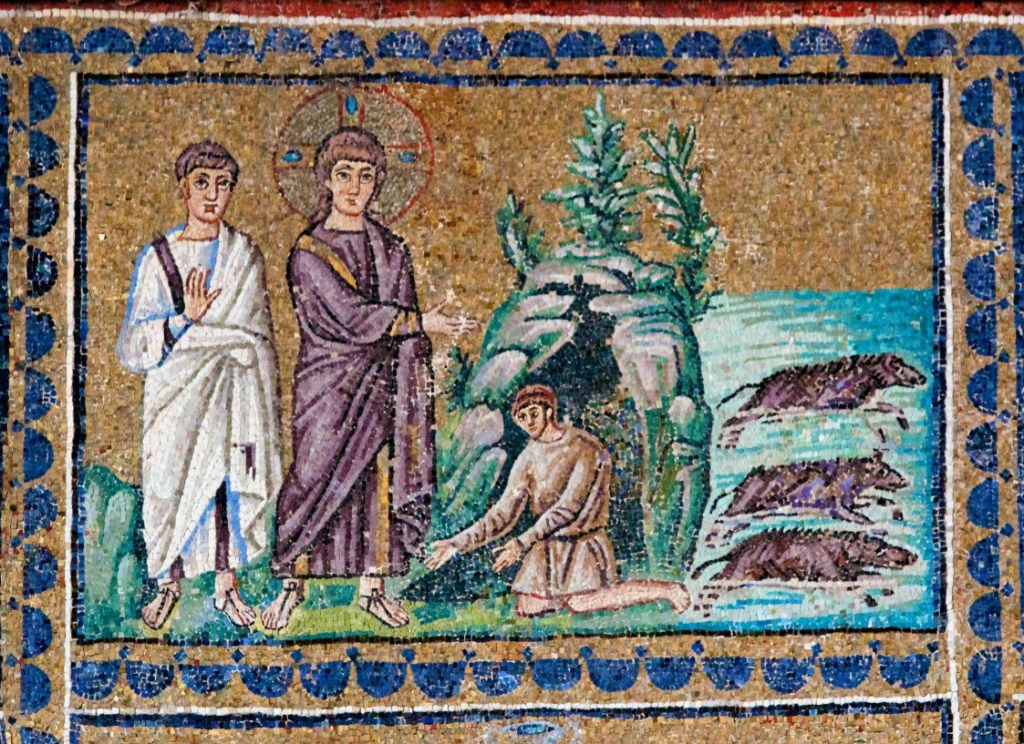
6th century mosaic of the exorcism of the Gerasene demoniac, Basilica di Sant’Apollinare Nuovo, Ravenna, Italy

They went across the lake to the region of the Gerasenes. When Jesus got out of the boat, a man with an impure spirit came from the tombs to meet him. This man lived in the tombs, and no one could bind him anymore, not even with a chain. For he had often been chained hand and foot, but he tore the chains apart and broke the irons on his feet. No one was strong enough to subdue him. Night and day among the tombs and in the hills he would cry out and cut himself with stones.

When he saw Jesus from a distance, he ran and fell on his knees in front of him. He shouted at the top of his voice, “What do you want with me, Jesus, Son of the Most High God? In God’s name don’t torture me!” For Jesus had said to him, “Come out of this man, you impure spirit!”

Then Jesus asked him, “What is your name?”

“My name is Legion,” he replied, “for we are many.” And he begged Jesus again and again not to send them out of the area.

A large herd of pigs was feeding on the nearby hillside. The demons begged Jesus, “Send us among the pigs; allow us to go into them.” He gave them permission, and the impure spirits came out and went into the pigs. The herd, about two thousand in number, rushed down the steep bank into the lake and were drowned.

Those tending the pigs ran off and reported this in the town and countryside, and the people went out to see what had happened. When they came to Jesus, they saw the man who had been possessed by the legion of demons, sitting there, dressed and in his right mind; and they were afraid. Those who had seen it told the people what had happened to the demon-possessed man—and told about the pigs as well. Then the people began to plead with Jesus to leave their region.

As Jesus was getting into the boat, the man who had been demon-possessed begged to go with him. Jesus did not let him, but said, “Go home to your own people and tell them how much the Lord has done for you, and how he has had mercy on you.” So the man went away and began to tell in the Decapolis how much Jesus had done for him. And all the people were amazed. (New International Version)

Jesus cures the Gerasene demoniac,from the Gospel Book of Otto III, Reichenau,
Germany, c.1000

The Evangelist Mark wants his readers and hearers to understand and know that Jesus is the Divine Warrior who fights against evil in the world. Many times in his earthly ministry, the Lord Jesus encountered some rather militant demons. In today’s Gospel lesson, an entire legion of them were tormenting a man who was unable to be with others and hung out in cemeteries all the time, practicing self-harm.

Much like Pharaoh’s army being drowned in the Red Sea by an act of God, so Jesus sent the legion of demons into a herd of pigs who rushed over an embankment and into the sea to drown.

The chaotic man comes to his right mind. The chaos evoked by the demonic realm is restored to order.

But, similar to an Old West movie in which the townsfolk are shortsighted to the sheriff’s heroic feat, the people in the region of the Gerasenes only see the loss of pigs, and not the loss of demons. So, the people pleaded with Jesus to leave the area.

Yet, at some point, everyone must deal with Jesus, simply because he is a force to be reckoned with. 

Eventually, we all face unseen forces that are beyond our control. It might not be today, and the sun may out, but the weather will change; everyday isn’t the same. Summer will give way to autumn, and then winter. The landscape will look very different. It’s not a question of “if” but “when.” We may console ourselves that we don’t have to deal with those forces today, but contend with them we shall.

Jesus will come. A person might not have to deal with him today, maybe not tomorrow. However, eventually, there will be a whopper of a gale force, and we will have to deal with it.

In today’s Gospel lesson, a man who was severely influenced by a strong demonic force approached Jesus. Inside of him was such a terrible inner storm that the demons shouted at Jesus.

Jesus, unfazed by the man’s inner violence and outer screams, uttered a command from a place of confidence. As fierce as the man was, Jesus had the authority to deal with the situation. As a result, the terrible force within the man subsided.

Yet, the bad weather was not over – it picked up momentum with the townsfolk. It seems they had been living their merry lives with no thought to Jesus. But he showed up. So, they had to contend with his authority right there in front of them. Unfortunately, they chose poorly. 

The Evangelist, Mark, wants us to see a connection in the story between the demons who begged Jesus, and the people of the town who begged Jesus. They did not humbly beg to follow him; they begged him to get away and leave them alone.

Jesus is an authoritative force to be reckoned with… and he is coming to your town.  Maybe not today, perhaps not tomorrow. But things will not always be the way they are right now. People will have to contend with unseen forces, and they will eventually face Jesus, one way or another.

Jesus Christ, Son of God, you are Lord over the wind, the waves, and the weather. You also command the unseen, and they obey. You are God with us. Oh, that all people would beg to follow you and not beg you to leave! I am grateful for your power and authority over all things. Amen.