Jeremiah 26:1-9, 12-15 – How to Use Our Voice

The Prophet Jeremiah by Marc Chagall (1887-1985)

Early in the reign of Jehoiakim son of Josiah king of Judah, this word came from the Lord: “This is what the Lord says: Stand in the courtyard of the Lord’s house and speak to all the people of the towns of Judah who come to worship in the house of the Lord. Tell them everything I command you; do not omit a word. Perhaps they will listen, and each will turn from their evil ways. Then I will relent and not inflict on them the disaster I was planning because of the evil they have done. Say to them, ‘This is what the Lord says: If you do not listen to me and follow my law, which I have set before you, and if you do not listen to the words of my servants the prophets, whom I have sent to you again and again (though you have not listened), then I will make this house like Shiloh and this city a curse among all the nations of the earth.’”

The priests, the prophets and all the people heard Jeremiah speak these words in the house of the Lord. But as soon as Jeremiah finished telling all the people everything the Lord had commanded him to say, the priests, the prophets and all the people seized him and said, “You must die! Why do you prophesy in the Lord’s name that this house will be like Shiloh and this city will be desolate and deserted?” And all the people crowded around Jeremiah in the house of the Lord….

Then Jeremiah said to all the officials and all the people: “The Lord sent me to prophesy against this house and this city all the things you have heard. Now reform your ways and your actions and obey the Lord your God. Then the Lord will relent and not bring the disaster he has pronounced against you. As for me, I am in your hands; do with me whatever you think is good and right. Be assured, however, that if you put me to death, you will bring the guilt of innocent blood on yourselves and on this city and on those who live in it, for in truth the Lord has sent me to you to speak all these words in your hearing.” (NIV)

Although much attention is given to Christmas Day, the Christian season of Christmas spans twelve days from December 25 through January 5. Celebrating Christmas as a season helps us immerse ourselves in Christ’s incarnation more fully than merely celebrating for one day.

Perhaps today’s Old Testament lesson is a curious choice for a Christmas season Scripture text. Yet, although we hold in one hand the joy and celebration of Christ’s birth, in the other hand we hold the deep sadness of recognizing that not everyone was or is excited about Jesus. For Christ is both the cornerstone of faith and the stone which causes people to stumble and fall. (1 Peter 2:8)

The fact of the matter is that God is not okay with cruel injustice, hollow worship, and an inattention to both the divine and human. Jesus came to make things right. But not everyone wants that. Systemic evil persists because there are always people who benefit from how power and resources are structured – and they care little about how it impacts those on the underbelly of their control.

Therefore, just as important it is to recognize the inbreaking of God into this world and celebrate the incarnation of Christ, it is equally necessary to acknowledge that the world is broken and that we must speak truth to power. This is no easy task because rarely are things simply black and white, all good or all bad.

Jeremiah by Marc Chagall, 1956

In Jeremiah’s day, it was not that his opponents were pure evil with no acknowledgment of God. Rather, the problem was that the power brokers in Judah tried to keep a strict separation of religion from everything else. In other words, they were perfectly fine with God, that is, if the Lord would stay in the temple where he belonged. But Jeremiah would have none of it. Keeping Yahweh out of matters of social justice, geopolitics, and institutional governance led to great humanitarian problems. Jeremiah became God’s voice to a generation of people who ignored the divine in everything but religious ritual.

Bifurcating worship and work disconnect daily life from divine resources. Without God infused in all of life, a lack of grace fills the empty places. What is more, the sovereign Lord of all can neither be silenced nor dismissed; God will find a way to accomplish peace and justice for the common good of everyone, and not just the few.

The heart of Jeremiah’s message was for king and people to be obedient in all of life, to recenter themselves around God’s law – not just the religious bits but the social ones, as well. Jeremiah did not proclaim something new. He was just calling the powers that be to Torah observance.

The true needs and interests of our communities can never be addressed and lifted-up in the narrow self-serving interests of persons in power who turn a blind eye to anyone unlike them. The needs and interests of our world lie in becoming who we were designed from the beginning to be: A people belonging to God, tapping into the deep reservoir of spirituality inside us.

For the Christian, we are to acknowledge the baby born as a king and follow in the way of grace and truth. There is to be no division between sacred and secular because Jesus is Lord of all. We are to continually use our voice for both praise and prophecy, for shouting celebration to God and speaking truth to power.

Holy God, Sovereign of all, we give you praise for sending your Son, our Savior, Jesus as a baby, a human just like us. Keep us grounded in humility, sensitive to sin, attentive to that which is just and right, merciful in all things, pure in worship, and peace-loving through Christ our Lord in the strength of your Spirit. Amen.

John 1:1-14 – Christmas Day

The Word was first,
the Word present to God,
    God present to the Word.
The Word was God,
    in readiness for God from day one.

Everything was created through him;
    nothing—not one thing!—
    came into being without him.
What came into existence was Life,
    and the Life was Light to live by.
The Life-Light blazed out of the darkness;
    the darkness couldn’t put it out.

There once was a man, his name John, sent by God to point out the way to the Life-Light. He came to show everyone where to look, who to believe in. John was not himself the Light; he was there to show the way to the Light.

The Life-Light was the real thing:
    Every person entering Life
    he brings into Light.
He was in the world,
    the world was there through him,
    and yet the world didn’t even notice.
He came to his own people,
    but they didn’t want him.
But whoever did want him,
    who believed he was who he claimed
    and would do what he said,
He made to be their true selves,
    their child-of-God selves.
These are the God-begotten,
    not blood-begotten,
    not flesh-begotten,
    not sex-begotten.

The Word became flesh and blood,
    and moved into the neighborhood.
We saw the glory with our own eyes,
    the one-of-a-kind glory,
    like Father, like Son,
Generous inside and out,
    true from start to finish. (MSG)

Merry Christmas! Glory to God in the highest, and on earth peace, goodwill toward humanity! Today we celebrate the mystery of the incarnation – the unfathomable miracle of God becoming human – all for us and for our salvation.

The beginning of the Apostle John’s Gospel is an astounding passage of Scripture. These are verses to slowly and worshipfully read through because it is a theologically rich, lovingly beautiful, and missionally sensitive piece of Holy Scripture. 

The high and holy God has chosen to come and reveal true divinity to us in the person of Jesus. We know God through Christ. We learn what God is like through Jesus. God graciously condescended to us, bent down to communicate in ways we can understand and discern, through the Lord Jesus. 

The God which Christians worship and serve is an over-the-top gracious and generous God. This is a God who has gone to incredible lengths in restoring lost humanity. Since God has bridged the great chasm between heaven and earth, we have hope, joy, peace, and faith. With God in the neighborhood, divine love becomes our motivation to reach out in compassionate service. People matter to God. We matter so much that God cared enough to be born.

This Tiny Baby by Madeleine L’Engle

Whoever is the baby?

Nothing but a little lamb

who says God is and that I am.

Who is this tiny baby?

Just an infant, meek and mild,

just a feeble, mortal child.

Who is this tiny baby?

The Lord strong and mighty

even the Lord mighty in battle.

The king of glory is coming,

who is the Lord of Hosts.

This is the tiny baby!

Christmas Eve – All I Want for Christmas is Faith

Luke 1:26-38 tells us what led to the observance of Christmas Eve, the holy night for Christians everywhere. Nothing is outside the power of God to accomplish the impossible. Click the videos below and we will remember and observe the coming of the Christ child…

Josh Groban – O Holy Night
Silent Night – Concordia Christmas Concerts, 2016

May the joy of the angels, the eagerness of the shepherds, the perseverance of the Magi, the obedience of Joseph and Mary, and the peace of the Christ child be yours this Christmas. And the blessing of God almighty, the Father, the Son, and the Holy Spirit, be upon you and remain with you always.  Amen.  

All I Want for Christmas Is Faith

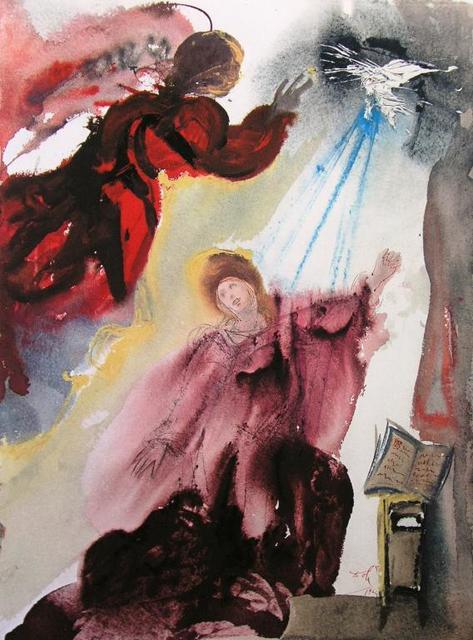
Annunciation to Mary by Salvador Dali, 1965

In the sixth month, God sent the angel Gabriel to Nazareth, a town in Galilee, to a virgin pledged to be married to a man named Joseph, a descendant of David.  The virgin’s name was Mary.  The angel went to her and said, “Greetings, you who are highly favored!  The Lord is with you.”

Mary was greatly troubled at his words and wondered what kind of greeting this might be.  But the angel said to her, “Do not be afraid, Mary, you have found favor with God.  You will be with child and give birth to a son, and you are to give him the name Jesus.  He will be great and will be called the Son of the Most High.  The Lord God will give him the throne of his father David, and he will reign over the house of Jacob forever; his kingdom will never end.”

“How will this be,” Mary asked the angel, “since I am a virgin?”

The angel answered, “The Holy Spirit will come upon you, and the power of the Most High will overshadow you.  So, the holy one to be born will be called the Son of God.  Even Elizabeth your relative is going to have a child in her old age, and she who was said to be barren is in her sixth month.  For nothing is impossible with God.”

“I am the Lord’s servant,” Mary answered.  “May it be to me as you have said.”  Then the angel left her. (Luke 1:26-38, NIV)

Most of life is lived in the mundane, even in a time of pandemic. For the most part our everyday lives involve going about our business and dealing with the daily grind. That is because we are common ordinary people. So, we can especially relate to Mary because she is quite plain. 

To put Mary’s life in our contemporary vernacular, at the time of this encounter with the angel, she is of junior high age but has never attended school. She wears mostly clothes from Goodwill, and occasionally can get some from Wal-Mart. She cannot read because girls of her day rarely did. Her parents make all the decisions that affect her life, including the one that she should be married to an older man named Joseph. We do not know if she even liked him. She lives in a small town that most people cannot point to on a map. 

One night, into the bedroom of this young girl comes the brightly beaming divine messenger Gabriel whose name means, “God has shown himself mighty.” Mary stands there in her ratty old flannel nightgown, her life very quickly moving from the ordinary to the extraordinary. The juxtaposition could not be more pronounced:  a mighty angel and a plain teen-ager; a messenger of the Most High God and a girl barely past puberty; a holy angelic light which beams in a simple candlelit bedroom; an awesome power encountering complete vulnerability.

Annunciation by Mexican painter Angel Zárraga (1886-1946)

Mary, compared to Gabriel, is defenseless, fragile, and overwhelmed. She is in way over her head. That is why we can relate to her. We can get our human arms around Mary. She is like us. She has faced life with little power to make it turn out the way she planned. Forces beyond her have rearranged her life and altered it forever. She is the Matron Saint of the Ordinary. We can totally understand why Mary responds the way she does.

Mary’s initial reaction was to be “greatly troubled.”  She was disturbed and shaking in her hand-me-down slippers. The angel confidently told Mary that she had found favor with God. In other words, Mary was literally “graced” by God. The situation was not that Mary had some extreme spirituality, but that God simply chose her to be the mother of Jesus. And Mary needed to come to grips with what was happening to her.  This was well beyond anything she could have expected.  Becoming pregnant with the Savior of the world was not even remotely on her radar. 

Mary immediately sensed the crazy disconnect between what was being told to her and who she was. After all, she was a plain ordinary girl from the hick town of Nazareth and was being told that she would raise a king.  Maybe somebody in heaven screwed up. Maybe Gabriel got the wrong girl. Maybe his Google map sent Gabriel on a wild goose chase. Relating to Mary, we can totally understand that she would question how in the world all this was going to happen.  Not only is Mary ordinary and far from royalty, but she is also very much a virgin.  Nothing about any of this made any sense.

But the angel let Mary know that God specializes in the impossible. English translators chose to phrase the original rendering of Gabriel’s words as “for nothing is impossible with God.” I rather prefer the more literal translation which is “for there is nothing outside of God’s power.” To me, that is beautiful. There is nowhere we can go, no place on earth, no situation whatsoever that is beyond God’s ability and reach to affect divine power.

We do not always get straightforward answers to our questions about God, but Mary asked a question and got a straight answer: She really can be pregnant with Jesus because the Holy Spirit will come upon her, will overshadow her with power. If the story were to end there it would be a great story. But to me the most astonishing part of the narrative is Mary’s response to what was happening to her.

Mary believed the message and submitted herself completely to God’s will. I think we would completely understand if Mary simply said in her ordinary way that she was not prepared for this. We would totally “get it” if Mary pushed back on what the angel said to her. We could relate if Mary just dismissed the angel’s presence, like Scrooge in the Christmas Carol, as if Gabriel were just “an undigested bit of beef, a blot of mustard, a crumb of cheese, a fragment of an underdone potato. There’s more of gravy than of grave about you, whatever you are!”

Yet, Mary not only believed; she also humbly submitted herself to what was happening. And this is what I believe we need to relate to most about Mary – not her being just a plain ordinary person in a non-descript village but stepping up to the calling she received. We, too, have received a calling in our lives. We, too, have been given the power of the Holy Spirit.  We, too, are ordinary people who have been given a very extraordinary task. 

Our response today can be the same as Mary: “I am the Lord’s servant; may it be to me as you have said.” The Church is pregnant with possibilities because of the Holy Spirit. We know the end of Mary’s story. She gave birth to Jesus. She raised him in her plain ordinary way. She watched him grow up. She saw him embark on his ministry to proclaim the kingdom of God has become near. Mary did not always understand what Jesus said or what he was doing. And she experienced every mother’s nightmare in seeing her beloved son killed in a terribly gruesome manner right in front of her eyes. 

Yet, just as the Holy Spirit was with the birth of Jesus, so the Spirit was with Jesus at his resurrection from the dead. Jesus lived an ordinary life in a very extraordinary way. Furthermore, today Jesus invites us to do the same. Because Christ accomplished his mission of saving people from their sins and establishing a kingdom that will never end, he has given us the same Holy Spirit to follow him forever and call other people to follow him, too. 

To trust and obey is God’s only way to live into the life of Jesus. The Christian life may often be difficult, but it is not complicated. It is rather simple, just like Mary. Mary responded to God’s revelation with faith, choosing to fully participate in what God was doing. “I am the Lord’s servant” is our confession, as well. Along with Mary we declare, “May it be to me as you have said.”