It’s About Love (1 Corinthians 8:1-13)

Now concerning meat that has been sacrificed to a false god: We know that we all have knowledge. Knowledge makes people arrogant, but love builds people up. If anyone thinks they know something, they don’t yet know as much as they should know. But if someone loves God, then they are known by God.

So concerning the actual food involved in these sacrifices to false gods, we know that a false god isn’t anything in this world, and that there is no God except for the one God. Granted, there are so-called “gods,” in heaven and on the earth, as there are many gods and many lords. However, for us believers,

There is one God the Father.
        All things come from him, and we belong to him.
And there is one Lord Jesus Christ.
        All things exist through him, and we live through him.

But not everybody knows this. Some are eating this food as though it really is food sacrificed to a real idol, because they were used to idol worship until now. Their conscience is weak because it has been damaged. Food won’t bring us close to God. We’re not missing out if we don’t eat, and we don’t have any advantage if we do eat.But watch out or else this freedom of yours might be a problem for those who are weak. 

Suppose someone sees you (the person who has knowledge) eating in an idol’s temple. Won’t the person with a weak conscience be encouraged to eat the meat sacrificed to false gods? The weak brother or sister for whom Christ died is destroyed by your knowledge. You sin against Christ if you sin against your brothers and sisters and hurt their weak consciences this way. This is why, if food causes the downfall of my brother or sister, I won’t eat meat ever again, or else I may cause my brother or sister to fall. (Common English Bible)

Consider an issue you care about… 

Likely, one of the big reasons you care is that you either see some abuse, neglect, inattention, or lack of love applied toward someone or a group of people. So, you want to see it be different. 

Now, here comes the interesting part: We are motivated by love, but we often end up addressing the problem or issue in the realm of thought and/or belief. We may rely on the political, theoretical, and intellectual to solve the problem.

Our hearts might be open and attuned, and yet we may turn to knowledge and rules to achieve the change we deeply desire.

The Apostle Paul knew that we are primarily lovers – not thinkers or believers. Thinkers and believers traffic in knowledge and belief systems. Although these are important, they are not the primary or ultimate ends for the Apostle. 

Instead of leading with the head, Paul led with the heart. He tackled the divisive issue in the Corinthian Church about whether one can eat food sourced from a pagan temple and originally sacrificed to idols by saying:

“Knowledge makes us proud of ourselves, while love makes us helpful to others.”

Paul began with love and ended with love. The issue of particular kinds of food was neither an intellectual nor a faith issue – it was a love issue. 

Paul’s answer to the problem dividing the Christian believers on food was that food is a secondary issue. Rather, to look at the food issue through the lenses of love, makes it clear what you ought to, or ought not to do. In coming at the issue from this angle, it doesn’t make our thinking and our believing somehow irrelevant; it just places it in its proper place, and supports love.

Whenever our opinions and thoughts, and our faith and beliefs are handled without love, then special interest groups begin to form. A division occurs based upon what we think and believe about certain things. But when love is supreme, knowledge is no longer the tail wagging the dog.

Love is meant to enlighten us. Love illumines not only to the problems among us, but love is also the answer to those issues we care about most. And if we will keep this in both our minds and in our hearts, then we have both added to our knowledge so that we can encourage and build-up others, without discouraging others and tearing them down. 

It really is all about love.

Love rejoices in the truth,
    but not in evil.
Love is always supportive,
loyal, hopeful,
    and trusting.
Love never fails! (1 Corinthians 13:6-8a, CEV)

Loving God, you demonstrated your own love for us through sending us your Son, the Lord Jesus, who is the perfect embodiment of love. May Christ be so manifested within me that love becomes not only the motivator to change, but also the answer to change; through the power and help of the Holy Spirit. Amen.

Christ and Culture (Revelation 2:12-17)

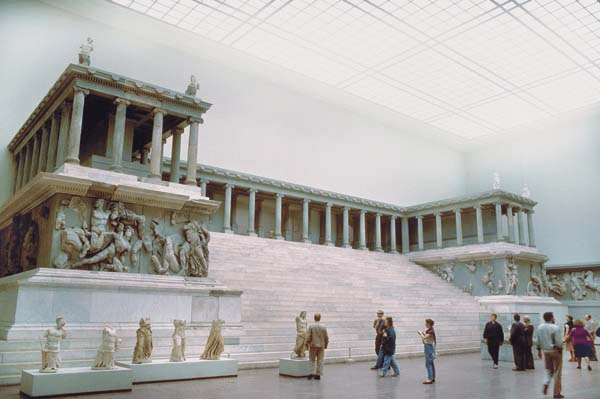
The Altar of Pergamum is considered one of the greatest surviving monuments from antiquity, now located in the Pergamum Museum, Berlin, Germany

“To the angel of the church in Pergamum write:

These are the words of him who has the sharp, double-edged sword. I know where you live—where Satan has his throne. Yet you remain true to my name. You did not renounce your faith in me, not even in the days of Antipas, my faithful witness, who was put to death in your city—where Satan lives.

Nevertheless, I have a few things against you: There are some among you who hold to the teaching of Balaam, who taught Balak to entice the Israelites to sin so that they ate food sacrificed to idols and committed sexual immorality. Likewise, you also have those who hold to the teaching of the Nicolaitans. Repent therefore! Otherwise, I will soon come to you and will fight against them with the sword of my mouth.

Whoever has ears, let them hear what the Spirit says to the churches. To the one who is victorious, I will give some of the hidden manna. I will also give that person a white stone with a new name written on it, known only to the one who receives it. (New International Version)

I’ve lived in one or two places in my life that I might have secretly described as the city where Satan lives. Jesus, however, in words to an ancient church, put it out there that they were living in such a place.

We aren’t told why Jesus described the city of Pergamum that way. Many ancient and important places typically had a prominent temple to some Greek god or goddess. In Pergamum, there existed a temple to Asclepius, the god of healing, symbolized by a snake – which isn’t exactly a positive icon in the worship of God.

The bad names didn’t stop there. Balaam is mentioned. He was a foreigner to Israel who is associated with false prophecy and leading worshipers of God astray. Balaam was blamed for the people’s idolatry and immorality before entering the Promised Land. (Numbers 31:16)

“Probably the greatest tragedy of the church throughout its long and checkered history has been its constant tendency to conform to the prevailing culture instead of developing a Christian counter-culture.”

John R.W. Stott

The name “Nicolaitans” is likely a Greek form of saying “Balaamites.” Thus, they are one in the same thing. It seems that Jesus was pointing a finger directly at particular religious practices consistent with the tradition of Balaam, namely, eating food sacrificed to idols and committing sexual immorality.

Idols and temples and eating were a hot button issue in the earliest church. All the places that churches were established, there were a significant number of Gentile converts from Greek religion to following Christ and worshiping God. And it was anything but a nice easy clean break from the old to the new.

I would surmise that the Balaamites and Nicolaitans are a group of Christian converts from paganism who were embracing a more syncretistic religion, and urging others to do the same – to maintain and engraft some of the Roman values and Greek religious practices so that the church would become more socially accepted and economically viable. Perhaps, they may have reasoned, there would be less persecution and things would generally go better for everyone.

“Some Christians want enough of Christ to be identified with him but not enough to be seriously inconvenienced.”

D.A. Carson

Whereas the Apostle Paul had a more nuanced understanding of the relationship between the church and the culture, the communication to the church at Pergamum was a definitive statement that Nicolaitans are immoral idolaters and the only thing to do in such a case is for them (not the entire congregation as a whole) to repent, stop the syncretism, and start devoting themselves completely to the worship of God alone.

Jesus himself was advocating for a firm refusal in trying to achieve respectability, to make compromises in religious practice. It certainly appears that, at least in the case of Pergamum’s converts, there was to be absolutely no connection with the old religion – not even with eating any meat or anything else that came from the pagan temple.

The Greek god Asclepius was connected with medicine and healing. So, why would this be such a problem for the fledgling church? Why would the city of Pergamum be labeled as the place where Satan lives?

Pergamum was a prominent city. It’s Greek culture, cultural and social traditions, and religious center represented the pinnacle of pagan society. This perhaps explains in part why early Christians viewed the place as a bastion of the devil.

Antipas, the Christian Bishop of Pergamum, is said to have been martyred there at the end of the first century, C.E. – which is around the time when many scholars believe the Book of Revelation was composed.

Whatever was actually going on at the time, there were most certainly significant tensions between the Christian and pagan communities which existed in the ancient city of Pergamum. Avoiding persecution, even death, may have been foremost in the minds of the Nicolaitans – who wanted accommodations with paganism that went too far, even for Jesus.

“Christ claims no man purely as a natural being, but always as one who has become human in a culture; who is not only in culture, but into whom culture has penetrated.”

H. Richard Niebuhr

It’s always been a difficult thing for Christians of every historical age to know how to deal with being in a society that is of a different culture and religion. And every generation of believers need to struggle through and reaffirm what Christian faith looks like wherever they live in this world, and in whatever cultural context they find themselves within.

In the letter to the church at ancient Pergamum, we perhaps find some guidance in Christ’s affirmation of holding onto Christian faith and keeping up a public profession of fidelity to him; and in Christ’s denunciation of diluting that Christian faith with too much accommodation to pagan culture.

Not every believer is going to agree in how to practically proceed with such matters. Yet these are issues worth having constructive conversations about, rather than simply digging into an established personal trench and, from there, lobbing unhelpful volleys of words at those who disagree.

Almighty God and Father of our Lord Jesus Christ, you are a jealous God who will not accept any attachment to other gods. I affirm you as the Most High God, and you will not give your honor or acclaim to idols. Please help us your people to avoid putting anything or anybody above or below you. Amen.

Hang In There (1 Corinthians 7:17-24)

Nevertheless, each person should live as a believer in whatever situation the Lord has assigned to them, just as God has called them. This is the rule I lay down in all the churches. Was a man already circumcised when he was called? He should not become uncircumcised. Was a man uncircumcised when he was called? He should not be circumcised. Circumcision is nothing and uncircumcision is nothing. Keeping God’s commands is what counts. Each person should remain in the situation they were in when God called them.

Were you a slave when you were called? Don’t let it trouble you—although if you can gain your freedom, do so. For the one who was a slave when called to faith in the Lord is the Lord’s freed person; similarly, the one who was free when called is Christ’s slave. You were bought at a price; do not become slaves of human beings. Brothers and sisters, each person, as responsible to God, should remain in the situation they were in when God called them. (New International Version)

Whenever a person converts to Christianity and becomes a follower of Jesus, they experience new life. They don’t, however, experience reincarnation. They’re still the same person – not a different one altogether.

If the convert was married, it doesn’t matter if their spouse is a convert, or not; they’re still married and need to hang in there and remain married, albeit with a new way of being with them.

There is no magical wiping away of situations, circumstances, jobs, family, and relationships with becoming a Christian. Hopefully, a new orientation of grace, truth, and love begins to permeate it all. But all those people and situations are still there, and need to be dealt with.

So, the Apostle Paul gave some very practical social instruction to the Corinthian converts to Christ. He was rather pointed in communicating to them in not using the occasion of conversion to go someplace else and/or be with someone else. Nor is it proper to daydream of a reincarnated life; stick with the new redeemed life you have received.

The place where you became a Christian is the place to start living the Christian life. Obey God, follow the Lord’s words and ways, live out your redemption right there. Why? Because your new identity as belonging to God – not your marital status, vocation, or anything else – defines your life and determines how you are to live. And Paul was consistent on that instruction in all of the churches he established.

For the Jew in Paul’s day, circumcision was the defining mark of religion and identity. To marry an uncircumcised non-Jewish person was unthinkable; it defiled a relationship and made it impure. But the Apostle insisted that Jewishness (or non-Jewishness) isn’t actually the point of living the Christian life. What’s really important is obeying God’s call and following Christ’s commands, period.

Therefore, the convert ought to stay where they are – no matter what their marital status or social position is. Believing in Christ and following Jesus transcends all of it. Whether one is a slave, or not, faith obliterates any and all obstacles to God. If a person comes to faith and converts to Christianity, they still might be in human bondage; but they have freedom in Christ.

Hopefully, the slave’s spiritual freedom will work itself out in actual physical freedom. The point, however, is that – whether slave or free – the person belongs to God and neither bondage nor freedom will ever hinder the individual from realizing spiritual redemption.

In many different ways, we are all both slaves and free persons. The best situation is to be a bondservant of Christ and a slave to no one else. Yet, if circumstances are not ideal, the reality is that one’s union with Christ can never be severed by any human institution or authority.

Once we convert, and enter into a life-giving free relationship with God in Christ, Paul exhorts all believers to be vigilant: Don’t slip back into old ways of spiritual bondage and capitulate to a shameful society. After all, Christ – whom the convert serves – has paid the true ultimate sacrifice of himself on the cross for the sake of all humanity.

So, hang in there, stay in the place and position where you were called by God, and reorient your life with Christ in the middle of it. In doing this, every believer can persevere through adversity, hold onto the gift of faith, and make a difference in the society to which one belongs.

Blessed and holy God, grant us the Spirit of wisdom and discernment so that we may know Christ better and love you more. Give us an understanding heart so that we may be open to hear your divine voice, and the courage to walk in the way of your commands.

Use us, your people who belong to Christ, to be your hands and feet – your voice and heart, so that we may be a channel through which you pour out your grace to help others – may we decrease and Christ increase, so that Jesus is seen in our lives, through the power of the Holy Spirit. Amen.

“Follow Me” (John 1:43-51)

The next day Jesus decided to go to Galilee. He found Philip and said to him, “Come, follow me.” Philip was from Bethsaida, Andrew and Peter’s hometown.

Philip went to look for Nathanael and told him, “We have found the very person Moses and the prophets wrote about! His name is Jesus, the son of Joseph from Nazareth.”

“Nazareth!” exclaimed Nathanael. “Can anything good come from Nazareth?”

“Come and see for yourself,” Philip replied.

As they approached, Jesus said, “Now here is a genuine son of Israel—a man of complete integrity.”

“How do you know about me?” Nathanael asked.

Jesus replied, “I could see you under the fig tree before Philip found you.”

Then Nathanael exclaimed, “Rabbi, you are the Son of God—the King of Israel!”

Jesus asked him, “Do you believe this just because I told you I had seen you under the fig tree? You will see greater things than this.” Then he said, “I tell you the truth, you will all see heaven open and the angels of God going up and down on the Son of Man, the one who is the stairway between heaven and earth.” (New Living Translation)

I describe myself as a follower of Jesus. I have been for decades. I found, and continue to find, in Jesus Christ a compelling person full of grace, truth, and love.

But my early life was not characterized with knowing Christ. I certainly learned about Jesus, that this ancient guy lived an altruistic life, got tortured and killed on a cross, and that Christians believe in his resurrection from death. However, back then it was more like some strange history lesson. The information made no difference to me.

That is, until I heard a voice – not an audible one that others could hear. Yet, it was just a real as any daily conversation with another person. I heard the call of Jesus. The Ancient of Days showed up.

I know with every epistemic fiber in my being that it wasn’t an undigested bit of beef, a blot of mustard, a crumb of cheese, a fragment of an underdone potato. I am sure beyond certainty that there was more of an empty grave than gravy about my experience of the risen Christ.

I experienced the call of Jesus to “follow me.” And that is really, at its simplest, the call which continually goes out to all humanity. It is a gracious and merciful call. It isn’t a summons to experience a cataclysmic event of total belief in one fell swoop. Rather, it’s a call to believe that is much more an unfolding awareness of the deep spirituality and connection with the divine within.

Important to that faith process is another call to “come and see.” Whereas there are some Christian traditions which focus solely on a singular one-time experience of saving faith in Christ, the Gospel of John displays a drama of faith with multiple layers which people move through.

There is no egalitarian zap in which God grants total and immediate understanding. Instead, faith is an ever-increasing process. It is appropriate and biblical to say that our salvation has happened, is happening, and will happen. We follow, we come and see, and we keep following, keep coming, keep seeing more and more.

Like a muscle, our faith grows, develops, stretches, and strengthens over time. To use another metaphor, we ascend a stairway to heaven, one step at a time, day after day, following Jesus and ascending to spiritual maturity.

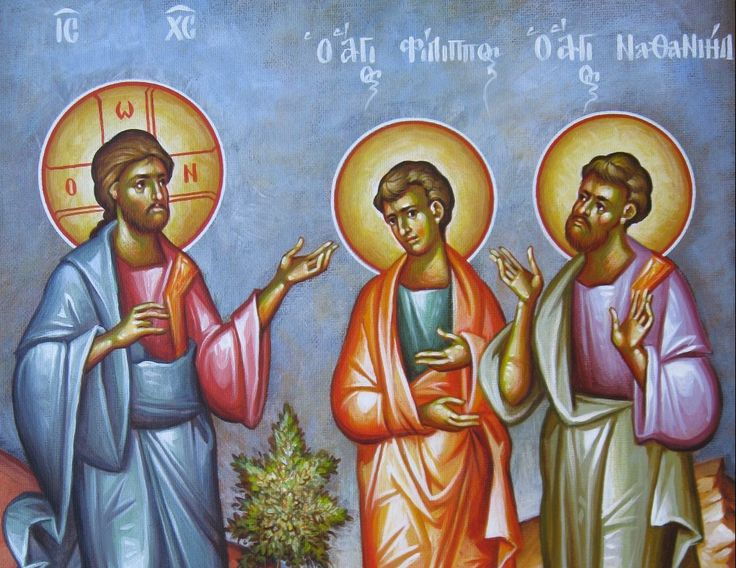
Orthodox icon of Christ calling Philip and Nathanael

Methinks this is likely part of what Jesus was getting at with Nathaniel in today’s Gospel lesson. Nathaniel would have quickly picked up on the reference Jesus was making, way back to the first book of Genesis. The Jewish patriarch, Jacob, had an experience of seeing the angels of God on some celestial stairway, ascending and descending. It was an encounter of God’s presence with Jacob, assuring him of divine intervention into the muck of humanity. (Genesis 28:10-17)

Jesus connected that ancient portrait to himself so that Nathaniel would understand, would believe, that God has again broken into this world with a special divine presence. To look at Jesus and follow him, is to see and follow God.

Christ Jesus is the ultimate example and embodiment of God with us. Throughout John’s Gospel, Jesus presents himself as:

  • Living water – connecting to Jacob’s well (John 4:5-14)
  • The Temple of God – the place where the Lord dwells in all divine fullness (John 2:18-22)
  • Bread from heaven – linking the giving of manna to the Israelites in the desert (Exodus 16:4-7; John 6:1-59)
  • The good shepherd – fulfilling divine Old Testament imperatives of caring for people (Ezekiel 34:11-16; John 10:1-30)

In all these ways, and more, Jesus intentionally connects himself as fulfilling God’s ancient promises to people.

In whichever way we need to hear the call to follow, Jesus accommodates to us. For some, Christ comes knocking on the front door. For others, he enters the side door, or slips into the backdoor of our lives.

And, if we will come and see, Jesus will also accommodate us by being the authority over us, the teacher to us, or the friend beside us. The Lord Jesus shall shepherd us and woo us to the flock for guidance and protection.

However it may be that Jesus comes to you, it most likely will be in ways you aren’t expecting. Surely, nothing good can come from Nazareth! Yet, it did. Can anything good come from Calcutta, India, or Juarez, Mexico, or Hoboken, New Jersey, or Milwaukee, Wisconsin, or even from a small rural area that doesn’t show up on a map? Yes, it can. Because with Jesus, God has entered this world, and, as it turns out, the Lord’s presence is everywhere.

Follow me. Come and see. Two of the simplest exhortations ever uttered. Yet, two of the most gracious phrases ever said, with profound implications for us beyond what we can fathom or imagine.

Guide us waking O Lord, and guard us sleeping; that awake we may watch with Christ and asleep we may rest in peace. May the shape of each day be formed by the pedantic following of my Lord; and may I come and see the wonders you have done, are doing, and will do. Almighty and merciful God – Father, Son and Holy Spirit – bless us and keep us. Amen.