There Is Hope (Psalm 89:20-37)

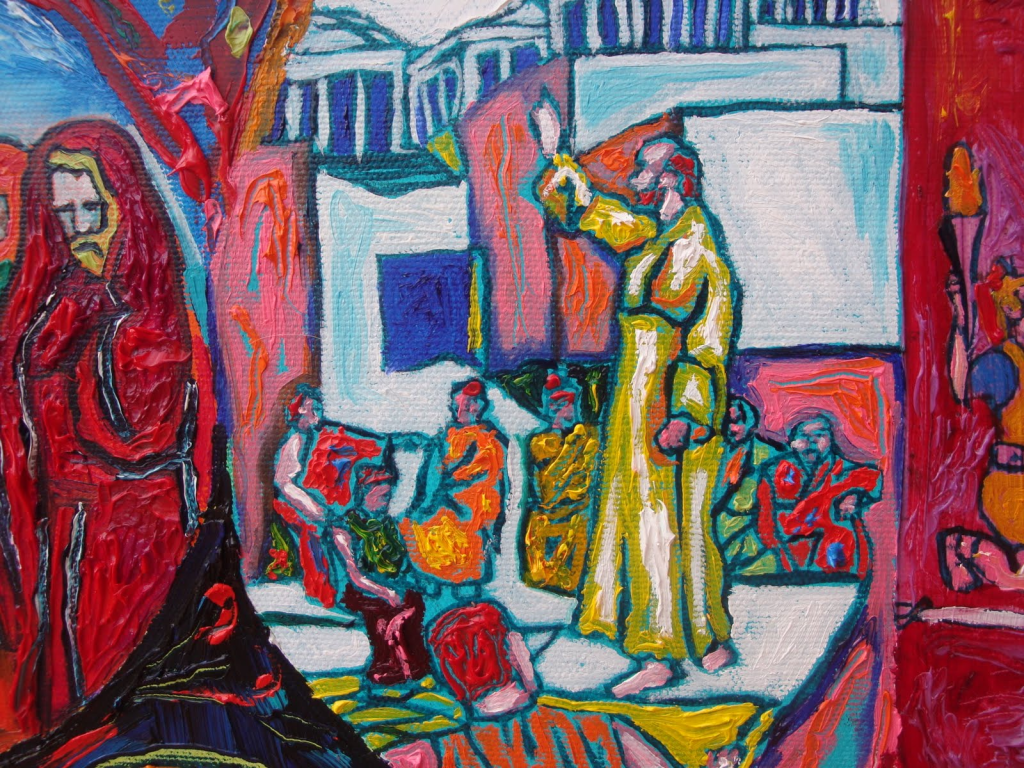
Ethiopian Orthodox depiction of Jesus

“I have found my servant David;
    with my holy oil I have anointed him;
my hand shall always remain with him;
    my arm also shall strengthen him.
The enemy shall not outwit him;
    the wicked shall not humble him.
I will crush his foes before him
    and strike down those who hate him.
My faithfulness and steadfast love shall be with him,
    and in my name his horn shall be exalted.
I will set his hand on the sea
    and his right hand on the rivers.
He shall cry to me, ‘You are my Father,
    my God, and the Rock of my salvation!’
I will make him the firstborn,
    the highest of the kings of the earth.
Forever I will keep my steadfast love for him,
    and my covenant with him will stand firm.
I will establish his line forever
    and his throne as long as the heavens endure.
If his children forsake my law
    and do not walk according to my ordinances,
if they violate my statutes
    and do not keep my commandments,
then I will punish their transgression with the rod
    and their iniquity with scourges,
but I will not remove from him my steadfast love
    or be false to my faithfulness.
I will not violate my covenant
    or alter the word that went forth from my lips.
Once and for all I have sworn by my holiness;
    I will not lie to David.
His line shall continue forever,
    and his throne endure before me like the sun.
It shall be established forever like the moon,
    an enduring witness in the skies.” (New Revised Standard Version)

Back when today’s psalm was originally crafted, there was a lot of stress for the Jews in Jerusalem. The city was in ruins, the land without their king, and the people were experiencing divine judgment from their God.

Into this situation, the psalmist brought some light from darkness; and hope for the survivors, that blessings lay in the future. The psalm is a song of prayer, speaking of the Lord’s faithfulness and steadfast love because of the promises made to the people’s ancient ancestor, King David.

The covenant between God and the people, made so many centuries ago, will never be broken. Why? Because fidelity to that covenant doesn’t depend on the people, but on the faithfulness of God and God’s timeless moral law.

The Lord God, the Almighty, did not forsake nor forget the people. The Lord’s mercies are new every morning; and God’s faithful love is forever.

Renewal and restoration are very real possibilities, despite the dire circumstances, and the people’s spiritual infidelity. Once again in history, one worthy of the throne of David will sit to judge the people with equity and grace.

The Son of David will be the custodian of God’s covenant promises. Evil shall be defeated. Authority to forgive sins, and to grant eternal life, will be established on earth. Indeed, the Lord’s enduring words and ways will be accomplished on this earth, as they are always done in God’s heaven.

The divine covenant will find its ultimate fulfillment in One whose throne is established for all eternity. The anointed one, the God-Man, will carry the burden of government on his shoulders; his rule and authority shall extend over the whole earth. (Isaiah 9:7)

Acting with the power of God, this Ruler is the visible image of the invisible God – the Mighty God, Eternal Father, Prince of Peace. For the Christian, these qualifications and descriptions are all met in the person of Jesus the Christ.

In a thoroughly and unabashed Christo-centric reading of the psalm, Jesus is the ultimate Messiah and High Priest who offered himself as the faultless, acceptable, eternal, and final sacrifice on behalf of the whole world. (Isaiah 53)

Therefore, since we are justified by faith, we have peace with God through our Lord Jesus Christ, through whom we have obtained access to this grace in which we stand, and we boast in our hope of sharing the glory of God. (Romans 5:1-2, NRSV)

Through Jesus, the New Testament perspective is that the old Mosaic Covenant became obsolete, and the New Covenant – promised by the prophets Jeremiah and Ezekiel – took its place. (Jeremiah 31:31-34; Ezekiel 36:25-27; Hebrews 8:13)

Although this High Priest died, he also was raised to life, and ascended to heaven – where he continues to intercede for God’s people.

He holds his priesthood permanently because he continues forever. Consequently, he is able for all time to save those who approach God through him, since he always lives to make intercession for them. (Hebrews 7:24-25, NRSV)

Before David was anointed king, Saul and his enemies hunted him and tried to kill him. Yet, through all of those twists and turns of harrowing circumstances, David trusted in the Lord and patiently waited for God to ensconce him as king. In time, that is precisely what happened. And David became the greatest king Israel ever had.

In much the same way, that fox King Herod tried to kill Jesus. Then later, Herod’s son, along with the religious establishment, sought to kill Jesus, as well. Behind the murderous intent, and every intent of doing away with the innocent, are the dark evil forces of this world.

The Accuser, Satan, the devil, tried to tempt the Christ and subvert the will of God, thus making the New Covenant something that would never happen. But Jesus was obedient to the Father – obedient even to death. (Philippians 2:8)

Christ Jesus offered himself willingly. His death may have been orchestrated by the existence of evil on this earth, yet it was God who allowed it all to occur, so that evil’s murderous tool, death, would become impotent.

The power of sin, death, and hell has been broken; but it will take awhile before the kingdom of God is established in all its grace and glory, and David’s fallen Tabernacle restored.

No matter how difficult, chaotic, and frustrating our current earthly situation may be, God will still establish the king; the good work begun and effected shall ultimately be thoroughly fulfilled. Jesus is coming again.

Until then, the good news is proclaimed that the kingdom of God is near. There is grace and forgiveness in the name of Jesus. Peace is no longer a pipe dream. Hope is real.

O Lord, when evil darkens our world, give us light. When despair numbs our souls, give us hope. When we stumble and fall, lift us up. When doubts assail us, give us faith. When nothing seems sure, give us trust. When ideals fade, give us vision. When we lose our way, be our guide, so that we may find serenity in Your presence, and purpose in doing Your will. Amen.

Yet Another Conflict (Acts 21:27-39)

Apostle Paul in Jerusalem, by Gustave Doré, 1878

When the seven days were nearly over, some Jews from the province of Asia saw Paul at the temple. They stirred up the whole crowd and seized him, shouting, “Fellow Israelites, help us! This is the man who teaches everyone everywhere against our people and our law and this place. And besides, he has brought Greeks into the temple and defiled this holy place.” (They had previously seen Trophimus the Ephesian in the city with Paul and assumed that Paul had brought him into the temple.)

The whole city was aroused, and the people came running from all directions. Seizing Paul, they dragged him from the temple, and immediately the gates were shut. While they were trying to kill him, news reached the commander of the Roman troops that the whole city of Jerusalem was in an uproar. He at once took some officers and soldiers and ran down to the crowd. When the rioters saw the commander and his soldiers, they stopped beating Paul.

The commander came up and arrested him and ordered him to be bound with two chains. Then he asked who he was and what he had done. Some in the crowd shouted one thing and some another, and since the commander could not get at the truth because of the uproar, he ordered that Paul be taken into the barracks. When Paul reached the steps, the violence of the mob was so great he had to be carried by the soldiers. The crowd that followed kept shouting, “Get rid of him!”

As the soldiers were about to take Paul into the barracks, he asked the commander, “May I say something to you?”

“Do you speak Greek?” he replied. “Aren’t you the Egyptian who started a revolt and led four thousand terrorists out into the wilderness some time ago?”

Paul answered, “I am a Jew, from Tarsus in Cilicia, a citizen of no ordinary city. Please let me speak to the people.” (New International Version)

The Apostle Paul arrived in Jerusalem, after a sojourn in Greece and the province of Asia. He had been gathering a collection for the believers in need. In his journey, Paul received messages, warnings, and even prophecy that he would be arrested if he went to Jerusalem.

Since the prophecy did not tell Paul to stay away, he kept going, ready not only to be arrested but to also die for his faith, if need be. (Acts 21:10-14)

Iron handcuffs (chains) from the Roman Empire, Archaeological Museum in Durrës, Albania

The first week of being Jerusalem entailed the status quo for Paul: He dealt with yet another church conflict between Jews and Gentiles. Then, the prophecy began to unfold and become reality.

Jews from Asia, who had seen Paul in the Temple and recognized him as a Christian agitator, immediately jumped to the conclusion that Paul was up to no good. It appeared to them that Paul had taken a Gentile into the Temple, thus defiling it, which in fact, he had not.

But when you have a grudge against someone, and an axe to grind, you begin making mental correlations and causations that aren’t really there.

So, the Jews from Asia got the crowd all stirred up by judging Paul as a person who teaches everyone everywhere against the people, the law, and the Temple. In other words, they accused Paul of being anti-Semitic and fomenting violence against the Jews.

Ironically, however, that is just what the Asian Jews did themselves. Without just evidence, they evoked the crowd’s emotions enough to drag Paul from the Temple. And they weren’t inviting him to tea. It seems they had every intention of doing him in, and not by throwing sugar cubes at him.

The only thing that stopped a death that day was the Roman authority getting in between Paul and the crowd. As per the prophecy, Paul was arrested and bound with chains.

The crowd had turned so riotous that the Roman commander could not ascertain Paul’s identity. The mob became violent, so Paul was whisked away by the Roman soldiers. As he left, the shouts of “Away with him!” could be heard throughout the city.

Jesus had a similar experience, but went to his death without any opportunity for a defense speech before an angry crowd.

Paul requested, however, to address the mob. And the Roman commander was aghast to learn that Paul spoke Greek – supposing that he was just another annoying religious nut on the street corner who got up into everyone’s grill a bit too much.

Yet, the commander quickly discovered that he was dealing with a citizen of the Empire who was no kooky preacher. Here we see a turn of events and a flip-flop between two groups of people.

It’s the Roman army who upheld proper justice and protected the interests of the individual; whereas the Jewish crowd became vigilante, ironically violating their own law by trying to put an innocent person to death without justification.

In a twist of history, the Roman arrest of Paul was his deliverance from a Jewish mob. Go figure.

Today’s story opens for me a set of questions that are both genuine, as well as a bit rhetorical:

  • How often do we – as both individuals and churches – accuse others of being unfaithful and/or unbiblical, when it is we ourselves who are going rogue from Holy Scripture?
  • In what ways do we handle false charges, judgmentalism, and unjustified criticism from others who misunderstand and/or misinterpret us?
  • What do we do (and not do) whenever there are differences within the church, family, community, workplace, or nation?
  • Does our manner of approaching conflict include the verbal violence of gossip and slander and/or actual physical violence through passive-aggressive behavior?
  • Am I looking too closely and/or critically under the hood of your soul? What will you do with me, let alone Jesus?

If you can receive this, I recommend taking some time and space today for answering those questions honestly through writing them in a journal and/or talking about them with a trusted friend.

May God have mercy upon our human institutions, societies, and relationships. To God be the glory. Amen.

Confronting the Evil in Front of Us (Mark 6:14-29)

St. John the Baptist rebuking Herod, by Giovanni Fattori (1825-1908)

King Herod heard of it, for Jesus’s name had become known. Some were saying, “John the baptizer has been raised from the dead, and for this reason these powers are at work in him.” But others said, “It is Elijah.” And others said, “It is a prophet, like one of the prophets of old.” But when Herod heard of it, he said, “John, whom I beheaded, has been raised.”

For Herod himself had sent men who arrested John, bound him, and put him in prison on account of Herodias, his brother Philip’s wife, because Herod had married her. For John had been telling Herod, “It is not lawful for you to have your brother’s wife.” 

And Herodias had a grudge against him and wanted to kill him. But she could not, for Herod feared John, knowing that he was a righteous and holy man, and he protected him. When he heard him, he was greatly perplexed, and yet he liked to listen to him. 

But an opportunity came when Herod on his birthday gave a banquet for his courtiers and officers and for the leaders of Galilee. When his daughter Herodias came in and danced, she pleased Herod and his guests, and the king said to the girl, “Ask me for whatever you wish, and I will give it.” And he swore to her, “Whatever you ask me, I will give you, even half of my kingdom.” 

She went out and said to her mother, “What should I ask for?” She replied, “The head of John the baptizer.” Immediately she rushed back to the king and requested, “I want you to give me at once the head of John the Baptist on a platter.” The king was deeply grieved, yet out of regard for his oaths and for the guests, he did not want to refuse her. 

Immediately the king sent a soldier of the guard with orders to bring John’s head. He went and beheaded him in the prison, brought his head on a platter, and gave it to the girl. Then the girl gave it to her mother. When his disciples heard about it, they came and took his body and laid it in a tomb. (New Revised Standard Version)

Feast of Herod with the Beheading of St John the Baptist, in the Museo del Prado, Madrid, Spain

The earthly life and mission of Jesus was connected to the social and political affairs of Judea and the Roman Empire. In truth, Christ’s impact is never only ethereal; rather, it smacks against every system and organization in this world.

John the Baptist’s death was closely connected to Christ’s mission and ministry; and it was also a result of the social and political forces John was subjected to. This would explain why Herod thought of Jesus as a resurrected John, after killing him. Both the messages of John and Jesus were met with resistance by the powers that be.

Marriages in the ancient world, especially among governmental officials, were primarily political affairs, and not love arrangements. The more authority and power a person had, the greater the political implications and impact there was. And marriage was one way of consolidating more power.

Herod’s marriage to Herodias may have been politically expedient, but was ethically repugnant, and John let him know about it. Herod was both a Jew and a Roman official, with his actual allegiance being to himself.

Herodias considered John as politically repugnant and found it unethically expedient to silence him once and for all when she had the opportunity. John the Baptist discovered first-hand that hell hath no fury like a woman’s scorn. Herodias hated him and waited for an opportune time to be rid of him once and for all.

But not only did Herodias orchestrate John’s demise, she did it in a way that sought to humiliate him. To die in battle at the hand of an enemy soldier was an honorable death; but to be executed because of a woman’s handiwork was a mark of shame.

Anyone who lives for God and speaks truth to power will nearly always suffer deep consequences. Hence, this is why a great many prophets ended up dead, often by tortuous methods – including Jesus and nearly all his original disciples.

Unfortunately, there are individuals in this world who are incapable of doing good.

Whenever such persons talk a good line, or do a good deed, it’s always in the service of a larger evil agenda. They often end up in positions of authority, simply because they have no scruples and will lie to you with a straight face.

And they will do anything to not only hold on to their power, but to acquire more so that they can be in control of everything around them. Of course, the people around such a person are miserable. They typically feel powerless to change the situation.

So, if there’s going to be transformation, there will need to be a prophet – someone like John the Baptist – who has the courage to speak truth to power and remind the world that God is the sovereign of the universe.

The Gospel writer Mark presents Herodias as a person with influence and power who only cares about her own interests. She had no scruples in using her daughter for malevolent purposes.

Whereas the young daughter of the synagogue ruler Jairus was (earlier in Mark’s account) raised to life by Jesus, in today’s story the young daughter of Herodias became the vehicle of a grisly murder. And, of all things, it’s this girl who brought the severed head of John the Baptist on a platter to her mother.

We are meant to see the impact and consequence when those in power have self-centered objectives and dark hearts. This is in direct contrast to both Jesus Christ and John the Baptist, both of whom gave their lives for that which is right, just, and good.

God’s mercy and redemption will eventually overwhelm all of creation. The cross and resurrection of Christ have won the victory over evil. Yet, until Christ returns, the dark forces of this old world know their time is short; and they are doing everything they can to throw a monkey wrench into the benevolent machine of grace, before the demonic forces themselves are thrown into the pit forever.

Christian mission and ministry was never designed to be easy nor pain-free. But it is meant to bring hope, love, redemption, peace, and satisfaction to all who believe.

Christ has connected himself to us. Let’s keep that gracious connection going by doing what is right and living a good and just life, and confronting the evil in front of us – to the glory of God. Amen.

Our Riches In Christ (Colossians 2:1-5)

I want you to know how hard I am contending for you and for those at Laodicea, and for all who have not met me personally. My goal is that they may be encouraged in heart and united in love, so that they may have the full riches of complete understanding, in order that they may know the mystery of God, namely, Christ, in whom are hidden all the treasures of wisdom and knowledge. 

I tell you this so that no one may deceive you by fine-sounding arguments. For though I am absent from you in body, I am present with you in spirit and delight to see how disciplined you are and how firm your faith in Christ is. (New International Version)

When you already have everything you need, it’s useless – and can even be damaging – to indulge in listening to fine sounding arguments about how you are missing out, lacking something, and/or falling short in some way.

For the Christian, the truth is: You now possess God’s treasure chest of wisdom and knowledge in Christ Jesus. So, why would you ever let someone deceive you through slick persuasion about having something superior to what you already have?

“Heresy” is really nothing more than making a bold claim to an alternative theological understanding than what you presently adhere to.

In some cases, an existing belief system is inferior and bogus. So, it’s a good thing when someone turns from bad religion in order to embrace a religion which is life-giving, helpful, and good.

Yet, if we already have a belief which is robustly full of righteousness and justice, and is good for the common life of everyone in the community, then it is dangerous to consider replacing it, or letting it fall into disuse.

The Apostle Paul’s consistent and overarching theme throughout his letter to the Colossian Christians is that Jesus Christ is sufficient, he is enough – more than enough – for our life and salvation.

That means the task of the Christian is to hold on to and cultivate what already has been taught to them according to apostolic tradition (that is, the Scriptures).

Another way of putting the matter: Learn to appreciate and enjoy what you already have, because it really is worth exploring, living into, and celebrating.

So, let’s put away any notions that standing firm in the faith involves defending your own personal brand of the Christian life (which is usually done obnoxiously) or for others to adhere to every jot and tittle of your own dogmatic theology.

To remain steadfast in the faith means primarily to nurture your faith – to actively pursue the spiritual life and concern oneself with the development of the soul. It is, more specifically, to keep on struggling to live into the words and ways of Jesus Christ; and to keep on learning and applying the apostolic teaching which has been passed down to us.

This is not too much to ask. It is reasonable (and biblical) to expect professing believers in Christ to put solid energy into encouraging one another in love and unity by means of sound Christian theology and doctrine.

Genuine and lasting unity depends upon both truth and love. Christians need to be of one mind and one heart, embracing the same values.

My dear wife and I recently celebrated 39 years of marriage together. Someone asked me today how we’ve made it all these years. I said that the main reason is that, although we are extreme opposites in nearly every way, we have both shared the same basic core values throughout our marriage. And that has gotten us through a lot of things.

Love for one another in the church will be maintained when we understand there is nothing being held back from us by God. The mystery of Christ has been revealed. There are no secrets. Solid and lasting relationships are built upon the foundation of truth. Nothing is held back.

We might as well lay bare everything, because it’s eventually going to happen one way or another.

Nothing in all creation is hidden from God’s sight. Everything is uncovered and laid bare before the eyes of him to whom we must give account.

Hebrews 4:13, NIV

If we begin to think the grass is greener on the other side of the fence, then we start listening to other people – perhaps even inviting other lovers into our lives. But the truth is: If I have some delicious fresh fried catfish on my plate, why in the world would I ever settle for a measly can of tuna?

The unity of the Colossian Church was at stake for the Apostle Paul. Just because someone is skilled in the art of persuasion, and can speak a good line, doesn’t necessarily mean that those words are good, right, or just.

There’s nothing wrong with persuasion. In fact, Paul himself was highly skilled in rhetoric and persuasion. At issue is losing sight of the message and focusing solely on the means of communicating the message.

Oftentimes a false teacher who peddles a different message other than apostolic teaching, has a highly believable way about them – which is why folks can be deceived. When one is being charmed, then critical analysis is rarely on their mind.

We can also be self-deceived, deluding ourselves, and talking ourselves into going down a bad path. It is most necessary to evaluate things according to the content rather than the attractiveness of the packaging.

Gifts of speaking and persuasion are good, so long as they are used for good, and controlled by sound thinking and directed by compassionate hearts.

There is no compelling witness for Christ if the church is fragmented and divided. But if we are convinced that our spiritual riches are found in Jesus Christ, then we shall find ways to remain connected and caring.

Therefore, let’s live as if we really believe this.

I always pray to the great and glorious Father, the God of our Lord Jesus Christ. I pray that he will give you the Spirit, who will let you know truths about God and help you understand them, so that you will know him better.

I pray that God will open your minds to see his truth. Then you will know the hope that he has chosen us to have. You will know that the blessings God has promised his holy people are rich and glorious. And you will know that God’s power is very great for us who believe. Amen. (Ephesians 1:17-19, ERV)