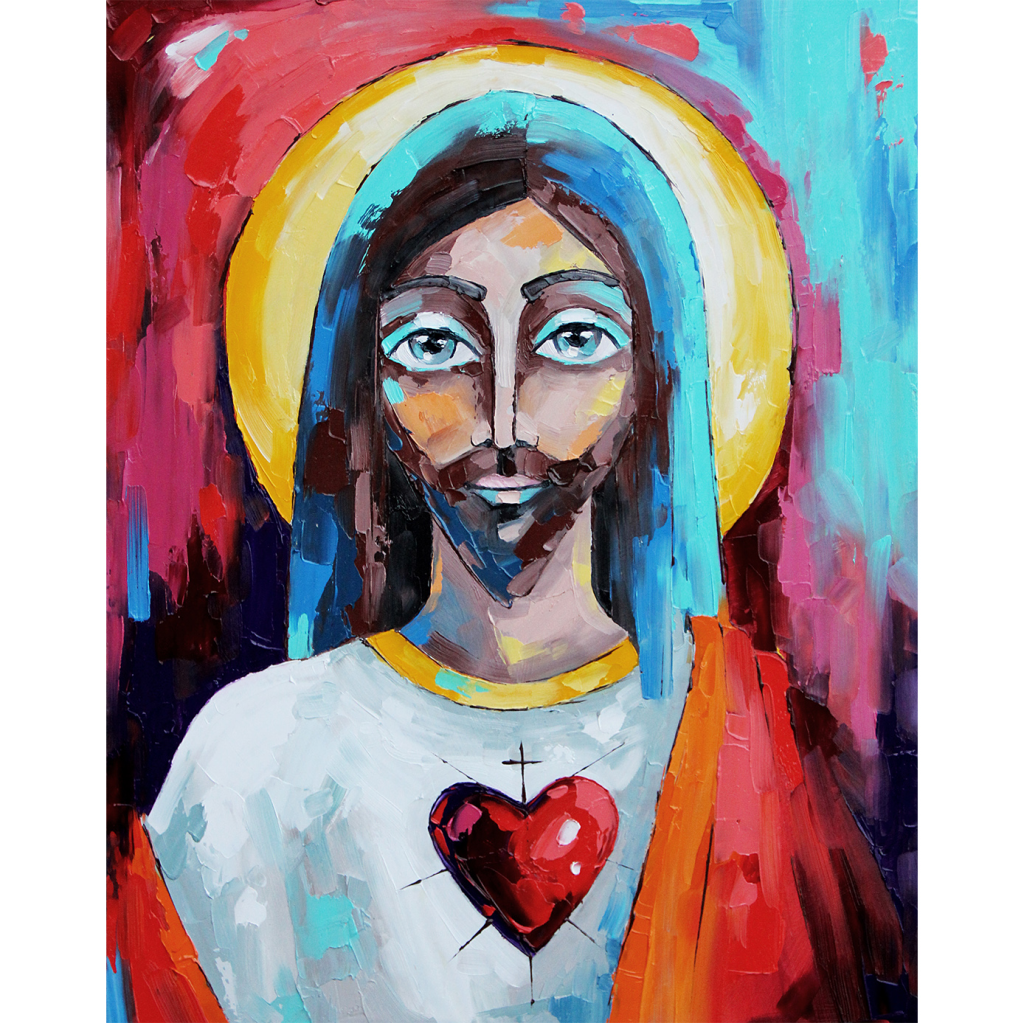
Self-Denial (Mark 8:27-38)

“Let him take up his cross and follow me.”

Jesus went on with his disciples to the villages of Caesarea Philippi, and on the way he asked his disciples, “Who do people say that I am?” And they answered him, “John the Baptist; and others, Elijah; and still others, one of the prophets.” He asked them, “But who do you say that I am?” Peter answered him, “You are the Messiah.” And he sternly ordered them not to tell anyone about him.

Then he began to teach them that the Son of Man must undergo great suffering and be rejected by the elders, the chief priests, and the scribes and be killed and after three days rise again. He said all this quite openly. And Peter took him aside and began to rebuke him. But turning and looking at his disciples, he rebuked Peter and said, “Get behind me, Satan! For you are setting your mind not on divine things but on human things.”

He called the crowd with his disciples and said to them, “If any wish to come after me, let them deny themselves and take up their cross and follow me. For those who want to save their life will lose it, and those who lose their life for my sake, and for the sake of the gospel, will save it. For what will it profit them to gain the whole world and forfeit their life? Indeed, what can they give in return for their life? Those who are ashamed of me and of my words in this adulterous and sinful generation, of them the Son of Man will also be ashamed when he comes in the glory of his Father with the holy angels.” (New Revised Standard Version)

It is quite common for English translations of Holy Scripture to smooth over some of the rough edges of the biblical text. In today’s Gospel lesson, there are three instances of a Greek word (ἐπιτιμάω, pronounced ep-ee-ti-MA-o) getting a somewhat tepid translation into English:

  1. Jesus “sternly ordered” them not to tell anyone about him (8:30)
  2. Peter took Jesus aside and began to “rebuke” him (8:32)
  3. Jesus “rebuked” Peter (8:33)

These are accurate translations; it’s just that the Greek word’s punch isn’t quite there for us as English readers. “Sternly ordered” and “rebuke” are strong English words, yet they must go further. For a more vernacular reading, I would frame the verses this way:

  1. Jesus made it very clear to the disciples to “shut up” about him. In my family growing up, “shut up” was the one word we were never to say without severe consequences. Swear words typically were fine; “shut up” was not. 
  2. Peter took Jesus aside and told him to “shut up.” Now you can see how much more forceful the word is. Imagine saying that to Jesus! 
  3. Jesus told Peter to “shut up.” Christ took up his authority and let Peter know who was really in charge, and perhaps more importantly, let Satan know that he is to “shut up” and keep his sinister mouth quiet.

The strong language is necessary because Jesus was quite strongly upsetting the apple cart and being the sort of Messiah that nobody expected, and frankly, did not want to see.

Messianic hope in the first century did not include things like being crucified, and no less, by religious leaders. Folks believed the opposite would be true. Messiah would come, affirm the religious status quo, and crucify the wretched Romans, thereby setting up Jewish rule with no more Gentile interference and persecution.

But Jesus was insistent about the way of the cross, and was not about to sidestep his ultimate mission of suffering and death. This was not just being killed; it was terrible torture and human degradation.

What’s more, to follow Jesus is to follow the way of the cross. Self-denial, ironically and paradoxically, is the true way of finding oneself and becoming awake and aware of how the universe works.

Yet another less than stellar English translation is “life.” For those who want to save their life will lose it, and those who lose their life for my sake, and for the sake of the gospel, will save it (8:35).

The typical Greek word for life was not used by the Gospel writer Mark; instead he used a word which denoted the substance of a person’s life, the essence of one’s innermost personhood: “soul” (Greek ψυχή, transliterated psyche)

It was necessary for Jesus to give himself for us. His self-denial and horrible martyrdom was the way to save our souls. Humanity is in such a dark predicament that they cannot save themselves; we need someone to deliver us, to save our innermost selves.

But, of course, that doesn’t stop so many of us humans from trying to save ourselves anyway. Knowledge and education, perfectionism and achievement, hard work and effort, money and resources, political power and control, are all the typical ways of trying to psychologically (or psyche-logically) make our souls, our inner person, feel as if there is freedom and happiness.

Yet, it doesn’t take long for those on the committed path of self-improvement to realize that they have only imposed a greater burden on themselves which keeps them in their immaterial shackles.

Instead, we must accept Christ’s authority over our lives, and over our souls. The stark reality is that we need a Savior, and that savior is not you nor me. And neither health nor wealth will get us anywhere with our soul.

It is imperative that we walk in the way of Jesus. It is the way of suffering. Yet, the suffering leads to glory; the crucifixion results in resurrection.

In giving your soul, you find it. In giving yourself to Jesus, you will discover the key to the soul’s freedom and happiness. Furthermore, in losing yourself for the sake of others, you find the soul’s real mission on this earth.

The only path to overcoming shame is by reframing it and embracing it, just as the Lord Jesus did:

Fix your eyes on Jesus, the pioneer and perfecter of faith. For the joy set before him he endured the cross, scorning its shame, and sat down at the right hand of the throne of God. (Hebrews 12:2, NIV)

Perhaps many of us need to “shut up” long enough to listen well to Jesus, and discover in him what our inner self has been searching for so long to find.

Blessed Lord, give us grace to deny ourselves, to take up our cross daily, and to follow Christ; to discipline our bodies and keep them under control. Keep us from being lovers of ourselves, and from being wise in our own eyes and leaning to our own understanding. Help us to seek, not our own good only, but also the good of our neighbor. And grant that we may not live to ourselves or die to ourselves, but whether we live or die, we may be the Lord’s, and may live and die to him. Amen.

The Power of Emptiness (Mark 7:24-37)

From there Jesus set out and went away to the region of Tyre. He entered a house and did not want anyone to know he was there. Yet he could not escape notice, but a woman whose little daughter had an unclean spirit immediately heard about him, and she came and bowed down at his feet. Now the woman was a Gentile, of Syrophoenician origin. She begged him to cast the demon out of her daughter. 

Jesus said to her, “Let the children be fed first, for it is not fair to take the children’s food and throw it to the dogs.” But she answered him, “Sir, even the dogs under the table eat the children’s crumbs.” Then he said to her, “For saying that, you may go—the demon has left your daughter.” And when she went home, she found the child lying on the bed and the demon gone.

Then Jesus returned from the region of Tyre and went by way of Sidon toward the Sea of Galilee, in the region of the Decapolis. They brought to him a deaf man who had an impediment in his speech, and they begged him to lay his hand on him. 

Jesus took him aside in private, away from the crowd, and put his fingers into his ears, and he spat and touched his tongue. Then looking up to heaven, he sighed and said to him, “Ephphatha,” that is, “Be opened.” And his ears were opened, his tongue was released, and he spoke plainly. 

Then Jesus ordered them to tell no one, but the more he ordered them, the more zealously they proclaimed it. They were astounded beyond measure, saying, “He has done everything well; he even makes the deaf to hear and the mute to speak.” (New Revised Standard Version)

Two stories. Two suffering people, because of their infirmities. A mother and a community suffering along with them, not knowing how to help them.

Lo and behold, Jesus, of all people, was the last person they expected to hear was in the area. He a Jew. They Gentiles. Yet, what if….

Maybe there is a ray of hope. After all, where there is emptiness, there is potential. And Jesus is the expert on that!

Christ had the rare ability to give the necessary gift of envisioning potential in another’s life, of seeing how the empty space could be filled with life and joy. Indeed, with Jesus there is possibility.

It is important to not only look at what is there, but also on what is not there. Because that’s where we find the quality, opportunity, and potential in another, and in ourselves.

The daughter in the narrative was vexed and incapacitated by an unclean spirit, a demon. The man in the story was deaf and mute, unable to hear and speak, lacking capacity for effective interaction in a society which relied so heavily on the ears and the mouth.

We may imagine their emptiness, feeling bereft of ever experiencing abundant life in their respective circumstances. However, they had those around them who cared, and interceded on their behalf.

Just realizing that Jesus was amongst them seemed to inspire a spark of possibility. Their thinking began to move in a slightly different direction with Christ in the neighborhood.

500 years before Christ’s encounters with these folks, the Chinese philosopher Lao Tzu crafted this poem:

A wheel may have thirty spokes,

but its usefulness lies in the empty hub.

A jar is formed from clay,

but its usefulness lies in the empty center.

A room is made from four walls,

but its usefulness lies in the space between.

Matter is necessary to give form,

but the value of reality lies in its immateriality.

Everything that lives has a physical body,

but the value of a life is measured by the soul.

The immaterial is the real substance. The material is only the form we see around it. It isn’t the material which effects the immaterial; it is the immaterial which has the power to transform the material.

Yet, change is never easy, even the necessary changes we long to see realized. It was not easy for any Gentile living in a Jewish world, and vice versa. Both Jews and Gentiles find out how hard things really can be.

Exorcising the Canaanite Woman’s Daughter, by Peter Gorban, 1990

The word got around that Jesus was in town. Nobody knew where he was. But desperate people discover ways to find the people they believe can help. The mother of the daughter with an unclean spirit found where Jesus was staying.

Furthermore, desperate persons are resilient; they rarely give up. The woman was used to tension in the room. She was unfazed by the Jew and Gentile disparity. I happen to think that the response of Jesus was probably expected by the woman. It certainly didn’t discourage her.

The woman asked for help. Jesus rebuffed her. Perhaps this seems incongruent with your understanding of Christ. It may even shock you. It was anything but Midwest nice.

One of the realities, it seems to me, that we need to understand and grapple with, is that Jesus was a real bona fide human being. He was born, grew up, had to learn things and become mature, in every sense of the word.

Christ also needed to develop and live into his own ministry. He had to learn how to establish personal boundaries, apply wisdom to particular situations, and deal with being hungry and tired with a world of human need around him.

I believe that is what we see in this interaction with the woman. And it in no way diminishes Christ’s divinity. We need to be able to hold all of Jesus – both his divinity and his humanity – at the same time, all the time.

Undeterred, the woman bent the words of Jesus to her advantage. That’s what desperate people do. So, Christ, recognizing true desperation and the faith behind her persistence, then immediately exercised his divinity by expelling the unclean spirit from the daughter and bringing her to full capacity.

I’m glad the Gospel writer Mark recorded the narrative as he did. I see a Messiah who deeply desires to do his Father’s will, and has to struggle with how to accomplish it.

I see Jesus in the story as actively growing in his understanding and ability, learning to break into the world with grace and truth; yet at the same time, not conforming to the world’s status quo.

Methinks that not much of this had anything to do with Christ’s sense of ethnicity and gender, but with everyone else’s understanding of the terms. Jesus, along with all of us who desire to follow the ways of God, must struggle with how to bring God’s kingdom values to people.

Jesus, to his credit, is a quick study. Being oriented to love, mercy, and obedience will do that for you. The woman was an outside voice. Christ was willing to listen and banter with her. He was not threatened when she spoke her truth to his power.

I will suggest to you that perhaps the reason for Christ’s willingness and ability to have effective ministry with the woman and her daughter (as well as everyone else) is that he had his own sacred emptiness.

Whenever we are full of ourselves, full of all our thoughts of how things ought to go, and full of all our settled beliefs, then there is no room to see and listen to another person.

Jesus was empty so that the woman could add to him with her own story and struggle. And when that happened, a miracle occurred.

The same sort of sacred emptiness happened with the deaf and mute man who was healed of his infirmity. Jesus was able to receive and be filled with the people who brought the man to him.

They begged Christ to help the man. Jesus saw them and heard them, because he was not so full of himself. And if anyone ever had a right to be full and tell others what to do, it is Jesus.

But he didn’t. In his empty humility, he had room for others. Since Christ emptied himself, he could empty others of all the stuff that gets in the way of living a peaceful life. (Philippians 2:5-8)

That is precisely why I am here. Because Jesus had room for me. Christ has a very large inner space, big enough to accommodate an untold amount of people. He has room for you, too. He sees you, and is able to listen to you.

So, go ahead; speak your own truth to Christ’s power.

From the Heart (Mark 7:9-23)

Art by Anna Startseva

Then he said, “You skillfully sidestep God’s law in order to hold on to your own tradition. For instance, Moses gave you this law from God: ‘Honor your father and mother,’ and ‘Anyone who speaks disrespectfully of father or mother must be put to death.’ But you say it is all right for people to say to their parents, ‘Sorry, I can’t help you. For I have vowed to give to God what I would have given to you.’ In this way, you let them disregard their needy parents. And so you cancel the word of God in order to hand down your own tradition. And this is only one example among many others.”

Then Jesus called to the crowd to come and hear. “All of you listen,” he said, “and try to understand. It’s not what goes into your body that defiles you; you are defiled by what comes from your heart.”

Then Jesus went into a house to get away from the crowd, and his disciples asked him what he meant by the parable he had just used. “Don’t you understand either?” he asked. “Can’t you see that the food you put into your body cannot defile you? Food doesn’t go into your heart, but only passes through the stomach and then goes into the sewer.” (By saying this, he declared that every kind of food is acceptable in God’s eyes.)

And then he added, “It is what comes from inside that defiles you. For from within, out of a person’s heart, come evil thoughts, sexual immorality, theft, murder, adultery, greed, wickedness, deceit, lustful desires, envy, slander, pride, and foolishness. All these vile things come from within; they are what defile you.” (New Living Translation)

There is nothing inherently wrong with tradition. Ideally, traditions are helpful ways of remembering and maintaining the values that are important to us.

Yet, what can happen over time is that the tradition itself can become equal to the value we hold to; and eventually, the tradition can become more important than the value it is supposed to remind us of.

In the worst case scenario, the tradition is kept, and the value is forgotten and lost. Whenever that happens, traditions easily become weaponized to protect our interests while harming others. And that is a phenomenon Jesus wanted nothing to do with.

So, Christ affirmed and upheld the essential purpose of the Torah (scriptural law) as the foundation of morality to live justly and righteously in the world. Keeping Torah, therefore, is a matter of inner motives, and intents of the heart, rather than external compliance to ritualized traditions.

Unfortunately, the outward form had supplanted the inward disposition of the heart. Purity then became a matter of observable rituals, and defilement a matter of failing to do the ritual properly. And the original values behind the rituals were lost – which caused souls to become lost, and other people victimized by religious traditions.

Whether one is ritually clean or unclean is not ultimately determined by material objects; it is, instead, determined by the state of the heart.

Art by Andy Perez

In other words, no outward ritual can ever really make a person clean or unclean, pure or impure, spotless or polluted. Inner transformation is what scrubs a person clean and makes them pure.

Ritual traditions, and even scriptural law itself, is unable to effect a transformative change.

Torah can require purity, cleanness, and moral uprightness; but it cannot affect a metamorphosis. We need something other than traditions, rituals, and laws to bring true and sustainable transformation of life.

I say that it is time to hear and observe Jesus. Millions of people throughout history, and up to the present time, have found in Christ (and not in Christian rituals, traditions, church codes, nor in a political Christendom) the answer and the key to what life is really all about.

Again, there is not a problem with our human traditions per se, but with traditions replacing Torah and the word of God.

Jesus gave an example of just such a contradiction between religious tradition and divine law: According to tradition, if a person makes a vow concerning their property and/or possessions as a gift to God at the temple, then those assets cannot be used to support that person’s parents in their old age.

Christ pointed out that this clearly contradicts the command to honor your father and mother. Ironically, the very tradition that was supposed to purify became the means to contamination – because the tradition forbids the person from obeying the command of God.

In a word picture that everyone could understand, Jesus explained that impurity and defilement have to do with what passes through the heart, not the bowels.

People obey or disobey the Ten Commandments due to the state of their heart, and not whether they keep every detail of traditional washing of the hands and body.

People lack virtue not because they fail to do human traditions; but because of what is in their hearts.

This is why Jesus, in his Sermon on the Mount, gets to the heart of why people break commands. For example:

  • The outward act of murder is a result of the inward anger of nurturing bitterness in the heart. (Matthew 5:21-22)
  • The physical act of adultery is the culmination of dozens of mental adulteries which originated in the heart. (Matthew 5:27-28)

Everything that harms and hurts is sourced in the heart, and not in failing to keep a tradition.

Furthermore, the Gospel writer Mark, added the very interesting parenthetical comment that in speaking this way, Jesus meant to declare that all foods are clean; there is nothing eaten that can make us impure.

That may not seem remarkable to most people, but to Jews this statement is cataclysmic and revolutionary. Levitical law details the separating of clean and unclean food, for the purpose of distinguishing the Israelites from all the other surrounding nations. (Leviticus 11:43-44; 20:24-26)

Holding to food laws, and traditional hand washings when it comes to eating, are a way of preserving religious identity and national identity. Jesus had no intention of doing away with Jewish identity, but he very much intended to do away with maintaining practices that keep strict separation from other people.

In other words, Christ was opening the way for ministry to Gentiles. He wanted to bring connection where there was deep division. He wanted the world to know God.

This gets at the “heart” of true religion. Distinctiveness as God’s people does not necessarily nor ultimately come by observing particular traditions; it comes primarily through purity of heart.

And the means of bringing purity of any kind, comes through love. Love always makes a way and finds connections. Love is the sine qua non mark of God.

Traditions infused with love, point people to God, and let them know that they belong.

But traditions for tradition’s sake, repel people, and communicate to them that they don’t belong, and should go away and not pollute the pure ones.

This approach of Jesus toward the religious leaders raises for me several probing questions:

  1. What is the true state of your heart?
  2. Are you aware of your own heart’s dark shadows?
  3. In what sort of direction is your heart inclined to speak and act?
  4. Does encouragement or criticism typically arise from your heart?
  5. Is love the compass of your heart, or does bitterness give you direction?
  6. Will you acknowledge your need of a savior? Will you ask for help?

Blessed God and Father of our Lord Jesus Christ: Make us quick to listen, and slow to speak, so that the Word implanted in our hearts may take root to nourish all of our living. And may the the Word within us overflow into speech and action which blesses the world. Amen.

The Lord of Life (John 6:56-69)

Bread of Life, by Kennedy Paizs

“Those who eat my flesh and drink my blood abide in me and I in them. Just as the living Father sent me and I live because of the Father, so whoever eats me will live because of me. This is the bread that came down from heaven, not like that which the ancestors ate, and they died. But the one who eats this bread will live forever.” Jesus said these things while he was teaching in a synagogue at Capernaum.

When many of his disciples heard it, they said, “This teaching is difficult; who can accept it?” But Jesus, being aware that his disciples were complaining about it, said to them, “Does this offend you? Then what if you were to see the Son of Man ascending to where he was before? It is the spirit that gives life; the flesh is useless. The words that I have spoken to you are spirit and life. But among you there are some who do not believe.”

For Jesus knew from the beginning who were the ones who did not believe and who was the one who would betray him. And he said, “For this reason I have told you that no one can come to me unless it is granted by the Father.”

Because of this many of his disciples turned back and no longer went about with him. So Jesus asked the twelve, “Do you also wish to go away?” Simon Peter answered him, “Lord, to whom can we go? You have the words of eternal life. We have come to believe and know that you are the Holy One of God.” (New Revised Standard Version)

This is a hard teaching – which is why a fair number of Christ’s disciples unfollowed him, literally, and not just socially and virtually.

Perhaps they believed they were following a great moral teacher, only to find Jesus prattling-on about being bread from heaven and divinely related to God.

The late great C.S. Lewis commented on Jesus, saying this:

“I am trying here to prevent anyone saying the really foolish thing that people often say about Him: I’m ready to accept Jesus as a great moral teacher, but I don’t accept his claim to be God. That is the one thing we must not say. A man who was merely a man and said the sort of things Jesus said would not be a great moral teacher. He would either be a lunatic — on the level with the man who says he is a poached egg — or else he would be the Devil of Hell. You must make your choice. Either this man was, and is, the Son of God, or else a madman or something worse. You can shut him up for a fool, you can spit at him and kill him as a demon or you can fall at his feet and call him Lord and God, but let us not come with any patronizing nonsense about his being a great human teacher. He has not left that open to us. He did not intend to.” C.S. Lewis, Mere Christianity

It seems Jesus cares little about whether we think of him as a moral teacher or some monstrosity. But he does care about moving people to a spirit-filled confession, a settled claim of faith, and a bold proclamation of his person and work.

Indeed, Jesus Christ, Son of Humanity, Son of God, leads us to hear his own confession, claim, and proclamation: “I Am.”

The crowd of people listening to Jesus were having a hard time wrapping their heads around his message. There were simply no existing categories of thought to which they could put Jesus neatly into. Everyone was rather puzzled with Christ’s words.

Jesus was in the Capernaum synagogue, a village on the Sea of Galilee, 30 miles from where he grew up in Nazareth. Any talk of eating and drinking and religion within any faith community is likely to be a charged discussion. Typically the politics of faith is not for the faint of heart.

We are to abide in Christ, to be in vital union with him. To have Jesus close, to have his words and ways within us, is akin to eating a satisfying meal that goes throughout our entire body and effects our being. Connecting and remaining with Jesus is true living and abundant life.

But the synagogue crowd wasn’t having any of this crazy talk of eating flesh and drinking blood. The lines between meat and metaphor were severely blurred for them. They did not accept the wedding of the spiritual and the material, of word and flesh, of God and Jesus together as Father and Son.

Jesus was causing the men to fold their arms in disgust, and the ladies to squirm in their pews with agitation. They looked upon this Jesus in front of them as causing a religious scandal of the first degree.

Rather than back off the scandalous words, Jesus stuck with them. Furthermore, he intensified what he was saying. At the heart of it was a claim to be the ladder between heaven and earth, the one who is manna from above, given for the life of the people.

His flesh is bread, and his blood is drink. He is life itself. He is even spirit, the one who breathes new life into people. At this point, Jesus was being as scandalous as it gets for his audience in the synagogue.

All of Christ’s talk is meant to bring people to consider him, to contemplate God, and to come to a point of response. Because nobody encountered Jesus without deciding if he is a liar, a lunatic, or the Lord who is life itself.

Many of Christ’s own disciples bailed on him. The scandal was too much. They didn’t sign up for this. To stay with Jesus means to really stay, to abide, to believe and know who he is.

Throughout the New Testament Gospels, Jesus honors people with questions and choices – and does not simply bypass human dignity and worth. He asked his closest twelve disciples if they also wanted to retreat from the scandalous message and messenger they’d been following.

Peter, of course, still had to learn this lesson of respect; he answered for the entire group. Jesus is where, and in whom, he found life, along with the rest of them. They didn’t know how all of the scandalous talk was going to shake-out specifically, although I think each of them had a pretty good idea.

But it didn’t matter. The twelve disciples were stuck on Jesus. Or, to be more accurate, the eleven disciples. Perhaps it was at this point that Judas Iscariot no longer had to wonder what was going to happen, and what exactly Jesus was up to.

Abiding in a movement that did not include a Roman takeover and a glorious wealthy kingdom was something Judas was unwilling to invest in. Maybe it was here that he began considering his exit plan.

Recognizing Jesus as Son of Humanity, Son of God, and the Word made flesh for us, requires both belief and knowledge – because you must have the one to have the other. C.S. Lewis discovered this. So did I. And may you, as well, my friend. For Jesus is the Lord of life.

Gracious God, although we once were strangers, you receive us as friends and draw us home to you. Set your living bread before us so that, feasting around your table, we may be strengthened to continue the work to which your Son commissioned us. Amen.