Welcome, friends! The world cannot stand up under judgment, criticism, and unkindness. Instead, the earth spins on the axis of mercy. Everyone needs basic human kindness, compassion, and grace. Click the videos below, and let’s explore the blessing of mercy….
Matthew 5:7, Pastor Tim Ehrhardt
We do not presume to come to you, O merciful Lord, trusting in our own righteousness, but in your abundant and great mercies. We are not worthy so much as to gather up the crumbs under your table; but you are the same Lord whose character is always to have mercy. Grant us, therefore, gracious Lord, so to receive your dear Son Jesus Christ, that our sinful bodies may be made clean by his body, and our souls washed through his most precious blood, and that we may evermore dwell in him, and he in us. Amen.
Coptic Church icon of Christ healing the blind man
As Jesus was coming near Jericho, there was a blind man sitting by the road, begging. When he heard the crowd passing by, he asked, “What is this?”
“Jesus of Nazareth is passing by,” they told him.
He cried out, “Jesus! Son of David! Have mercy on me!”
The people in front scolded him and told him to be quiet. But he shouted even more loudly, “Son of David! Have mercy on me!”
So, Jesus stopped and ordered the blind man to be brought to him. When he came near, Jesus asked him, “What do you want me to do for you?”
“Sir,” he answered, “I want to see again.”
Jesus said to him, “Then see! Your faith has made you well.”
At once he was able to see, and he followed Jesus, giving thanks to God. When the crowd saw it, they all praised God. (Good News Translation)
This is one of my very favorite stories in the entirety of Holy Scripture. And I will tell you why….
Because Jesus listens with ears of mercy.
Jesus was headed to Jerusalem and had a lot on his mind and his heart. He knew what was coming, that his passion and death awaited him. No one would fault Jesus for not hearing a blind man shouting. But Jesus was listening so that he might hear someone just like the needy blind man. Rather than being distracted and lost in his head, Jesus was just the opposite – being attentive and aware of the humble folk right in front of him.
Because Jesus speaks with words of mercy.
Once Jesus listened, he responded by asking a question. I am impressed with Jesus throughout the Gospels. Christ gave people the gift of choice. He acknowledged people and respected them by not simply and indiscriminately healing, as if he were some fix-it guy. Jesus Christ bestowed on the lowliest of people the human dignity of choice by empowering them to answer a question.
Because Jesus pays attention with divine appointments of mercy.
Our Lord took the time to heal the blind man. Jesus could have simply healed him without even stopping his journey. He could have just waved his hand and the man would be healed. What’s more, Jesus could have even started a healing factory where everyone with a need got healed: bring ‘em in, move ‘em out, and keep the line moving. Jesus was doing more than giving sight; he was giving a man the blessing of time and personal attention. The Gospel is never impersonal, which is why we ought to resist being non-relational in ministry to others. It isn’t simply about meeting a need but about blessing other people with the gift of relationship.
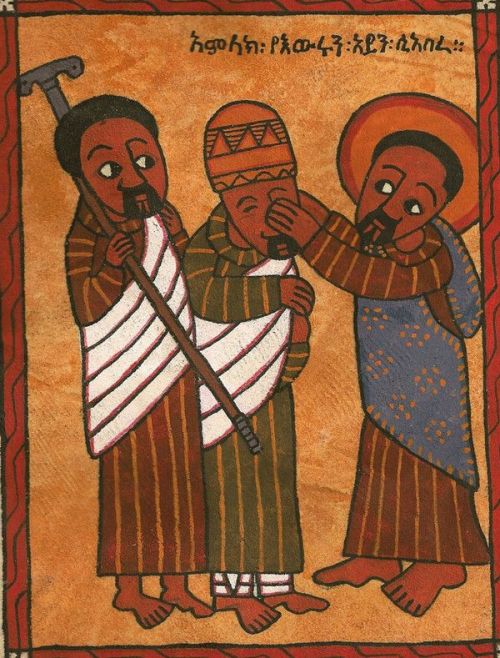
Ethiopian Orthodox Church depiction of Jesus healing the blind man
Because Jesus reaches out with the touch of mercy.
Jesus touched the man’s eyes (Matthew 20:29-34; Mark 10:46-54). He didn’t have to do that. The Lord of all most certainly could have healed without touching. In fact, it most likely may have been downright gross. A lot of people had eye diseases with runny pussy eyes in the ancient world.
Because the blind man didn’t listen to the crowd.
I really love that! Maybe it’s the rebel in me. I just believe it is such a beautiful thing whenever someone refuses to be shamed by another and embraces their need. That is exactly what the blind man did. He not only refused to give-in to peer pressure, but he also responded to them by shouting all the louder. May his tribe increase!
Because the blind man could actually see.
The man already had sight – not physical sight but spiritual eyes which could see better than anyone else in the crowd. One of the great ironies throughout the Gospels is that the sighted crowd seems to never see who Jesus really is, while blind folk see Christ clearly for who he is: the Son of David, the rightful king, the Savior of all. It matters not how much faith one possesses but in whom that faith is placed. A thimble-full of faith is enough to move mountains, while a water tower full of faith misplaced in someone else cannot even provide a single glass of refreshment.
Because the blind man followed Jesus.
Once healed by Jesus, there were plenty of persons who simply walked away and went about their lives. Yet, this man, who was given the gift of physical sight, started following Jesus and giving thanks to him. It feels a lot like my own testimony of experiencing the love of God in Christ and not ever wanting to leave it, so I’ve been following Jesus for over forty years, still having gratitude in my heart.
Because one lowly non-descript blind man made a difference.
I don’t think the man ever set out to change the world. Yet, he did. Here we are reading his testimony all these millennia later. At the time, please take note that one man becoming a disciple of Jesus and living a life of gratitude changed the entire crowd from being a group of shushing church ladies to a robust throng of worshipers. One individual makes a difference. Don’t let anyone tell you otherwise.
Lord Jesus Christ, Son of God, have mercy on me, a sinner.
Lord Jesus Christ, Son of David, heal me, a broken person.
Lord Jesus Christ, Son of Man, help me, a lost and lonely individual.
Lord have mercy, Christ have mercy, Lord have mercy on my love-starved soul. Amen.
Devote yourselves to prayer, being watchful and thankful. And pray for us, too, that God may open a door for our message, so that we may proclaim the mystery of Christ, for which I am in chains. Pray that I may proclaim it clearly, as I should. Be wise in the way you act toward outsiders; make the most of every opportunity. Let your conversation be always full of grace, seasoned with salt, so that you may know how to answer everyone.
Tychicus will tell you all the news about me. He is a dear brother, a faithful minister and fellow servant in the Lord. I am sending him to you for the express purpose that you may know about our circumstances and that he may encourage your hearts. He is coming with Onesimus, our faithful and dear brother, who is one of you. They will tell you everything that is happening here.
My fellow prisoner Aristarchus sends you his greetings, as does Mark, the cousin of Barnabas. (You have received instructions about him; if he comes to you, welcome him.) Jesus, who is called Justus, also sends greetings. These are the only Jews among my co-workers for the kingdom of God, and they have proved a comfort to me. Epaphras, who is one of you and a servant of Christ Jesus, sends greetings. He is always wrestling in prayer for you, that you may stand firm in all the will of God, mature and fully assured. I vouch for him that he is working hard for you and for those at Laodicea and Hierapolis. Our dear friend Luke, the doctor, and Demas send greetings. Give my greetings to the brothers and sisters at Laodicea, and to Nympha and the church in her house.
After this letter has been read to you, see that it is also read in the church of the Laodiceans and that you in turn read the letter from Laodicea.
Tell Archippus: “See to it that you complete the ministry you have received in the Lord.”
I, Paul, write this greeting in my own hand. Remember my chains. Grace be with you. (New International Version)
Every church has its problems. Much like individual believers, each faith community has its own character and personality – which makes their particular issues unique to them.
The Apostle Paul wrote his letter to the church in the ancient city of Colossae to address an issue which was weighing on his heart.
Broadly speaking, the problem of the church was legalism. That is, boiling down and condensing the Christian life into spiritual rules to live by. Although, on the surface, that may not sound so terrible, for Paul it was damaging to Christianity.
Whenever anyone or any group of people systematize Christianity into a list, it is a fool’s errand. Let’s face it: the worship of God, and thus the Christian life, is, for the most part, ethereal and mysterious. Throughout church history there have been legions of folks who have attempted to nail down Christianity into laws we can clearly see and hold people accountable to.
Whether it is making human contrived lists of sins to avoid and codifying them as something like the Terrible Ten or the Nasty Nine; or whether it is trying to humanly comprehend salvation in a tidy Five Spiritual Laws or Basic Principles for Life – all this predilection for list-making does nothing but discourage the Christian heart and divide one another about things that just don’t matter.
Paul wanted all his churches to be encouraged and united in the love of God in Christ through the enablement of the Holy Spirit. This requires prayer – lots of it! Because we must live by faith, trusting God for each step to take in the Christian life, rather than relying on the list to tell me what to do.
So, that’s why Paul ended his letter to the church on a note exhorting the people to never give up praying.
“Prayer enlarges the heart until it is capable of Containing God’s gift of himself.”
Mother Teresa (1910-1997)
Devoting ourselves to prayer means that we will need to quit devoting ourselves to something else – namely, the nice, neat, packaged formula of do’s and don’ts on the list. Paul didn’t just want the people to adopt a different list; he wanted all the lists tossed into hell!
Instead of always trying to control outcomes, Paul wanted perseverance in prayer without knowing what the result and outcome would be. His deep desire was that believers would rely on God and the mystery of Christ. He longed for the church to pray with all their doubts and uncertainties – not believing they always needed sure answers for everything.
The Christian life cannot be made into some geeky algorithm so that we can avoid suffering, know all the right things to say in a conversation, and always keep God happy. God is not some algebra equation to figure out. He is not a gumball machine to put a quarter in and get what you want. He is not Santa God.
Christianity requires living in the tension of not knowing everything and yet having cogent answers for others who inquire about our faith. It is a dynamic relationship in which we must continually interact in prayer to God as we largely improvise our lives, spontaneously applying what understanding we have for each situation we face.
“The whole reason why we pray is to be united into the vision and contemplation of God to whom we pray.”
Julian of Norwich (1342-c.1416)
Christians need an ongoing dialogue with the God who answers in his own good time, according to his own good will. We are to make good use of the time God has given through choosing our words with others wisely as we simultaneously carry on a silent prayer conversation with God. This is a Christianity that’s far above rules and laws and checklists. It is Christianity as it’s meant to be lived, depending on Jesus, and relaxed in the Spirit.
This takes practice, practice, practice. Failure is both inevitable and expected. And that’s okay. We’re not living by lists and human contrived rules. We’re living a new life in the power of Christ’s resurrection.
God of Mystery, the One who conceals and reveals, forgive me for my attempts at reducing faith to a few spiritual rules to keep. Help me to speak in ways which are gracious, loving, and redemptive. May the person and work of Jesus come tumbling out of my mouth while I inhale the breath of your Holy Spirit. Amen.
*Above paintings of prayer by African artist Angu Walters
See what large letters I use as I write to you with my own hand!
Those who want to impress people by means of the flesh are trying to compel you to be circumcised. The only reason they do this is to avoid being persecuted for the cross of Christ. Not even those who are circumcised keep the law, yet they want you to be circumcised that they may boast about your circumcision in the flesh. May I never boast except in the cross of our Lord Jesus Christ, through which the world has been crucified to me, and I to the world. Neither circumcision nor uncircumcision means anything; what counts is the new creation. Peace and mercy to all who follow this rule—to the Israel of God.
From now on, let no one cause me trouble, for I bear on my body the marks of Jesus.
The grace of our Lord Jesus Christ be with your spirit, brothers and sisters. Amen. (New International Version)
Motives matter. The interior life of a person is important. Life is neither a mere getting things done nor doing what is needed on the exterior. A house may be beautiful and orderly on the outside, with careful landscaping, a manicured lawn, and attractive appearance – yet on the inside it might be disorderly, full of relational discord, and completely discombobulated.
The exterior life of a person is also important. But it’s only half the person. And, unlike God who sees the heart, we aren’t always privy to what’s going on inside someone.
Folks who are enamored with outward displays of spirituality and righteousness tend to be compulsive about maintaining appearances – for both themselves, and everyone else.
Policing outward forms of righteousness through clear identifiable means is really nothing more than old fashioned judging of one another. It’s antithetical to grace. And it smacks of the snooty superiority of Star-Bellied Sneetches.
Rather than a star on the belly, in the Apostle Paul’s day it was circumcision. Those who had it were “in” and those without it were “out.” Never mind the interior life. A hard outward boundary of righteousness was established by false teachers who made the Christian life easy by simply holding to readily observable forms, like circumcision.
It wasn’t that circumcision was a bad thing. The issue was making it a necessary part of the Christian life. Not circumcised? Not a Christian, insisted the false teachers. In other words, one had to become Jewish before becoming a Christian. I can picture the Apostle Paul doing a hand to the forehead, saying, “Oy vey.”
For the Christian, one must be vigilant not to exaggerate baptism. On the one hand, I would argue far too many believers underestimate the significance and importance of baptism. Flippantly making it a personal choice, as if the individual is in complete control of one’s own salvation, is not only wrongheaded – it’s downright blasphemous.
Yet, on the other hand, a preoccupation with getting a person, especially a child, baptized, as if the world might end if it doesn’t happen, betrays the same problem as Paul faced with circumcision in the first century.
The proper approach, it seems to me, is to embrace the full spectrum of Christianity – both outward and inward – the whole person. And Paul addresses this by anticipating a question of the Galatian congregation: What, then, is of central importance?
The answer is: a new creation. To be transformed by the power of the Spirit is what really counts. The grace of God in Christ, applied to a person, brings a change to inner motives and attitudes, as well as outer behavior through loving actions.
We must always keep in mind that the sign points to the substance. It would be weird if I were traveling to Milwaukee on I-94 and pulled over on the interstate next to the sign marking the city is ahead, crawl all over it, and say, “I’m here!”
The overall thrust of Paul’s letter to the Galatians is that they were debasing the true worship of God into an outward show, honoring Christ with their lips but not holding him in their hearts.
Christianity is fundamentally not about what we do for God but what God has done for us in Jesus Christ. It is divine grace which saves people. We belong to God. Just as we neither chose our own parents nor the time when we were born, so akin to this is, before we chose God, God chose us. We don’t “born again” ourselves; God does the rebirthing.
And since it is solely the work of God in us, there is zero reason to boast about the circumstances of our new birth and becoming a new creation in Christ. We didn’t save ourselves. It would be something like getting a COVID-19 vaccine and then bragging about how we stopped the pandemic.
Instead, we are to bear the spiritual marks of Christ’s crucifixion on our inner selves. No one is saved because they deserve it but simply because they need saving.
Lord Jesus Christ, Son of God, grant us the faith to accept your saving work in the cross and to be so transformed by it that we will not be without excuse on Judgment Day. Help us not merely walk at your side, with mere words to offer. Convert us and give us new life in you so that in the end we will not be dry wood, but living branches in you, the true vine, bearing fruit for eternal life. Amen.