Hebrews 7:23-28 – Jesus Is Better

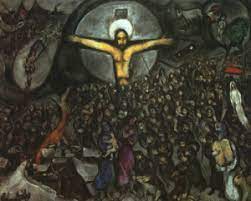
“Exodus” by Marc Chagall, 1952

Now there have been many of those priests, since death prevented them from continuing in office; but because Jesus lives forever, he has a permanent priesthood. Therefore, he is able to save completely those who come to God through him, because he always lives to intercede for them.

Such a high priest truly meets our need—one who is holy, blameless, pure, set apart from sinners, exalted above the heavens. Unlike the other high priests, he does not need to offer sacrifices day after day, first for his own sins, and then for the sins of the people. He sacrificed for their sins once for all when he offered himself. For the law appoints as high priests men in all their weakness; but the oath, which came after the law, appointed the Son, who has been made perfect forever. (New International Version)

Several years ago, I enjoyed serving communion with a retired minister in the church for which I was serving at the time. When we were in the middle of it, I leaned over to him and gave him a bit of instruction on what we were about to do. After I finished, he leaned over to me with a smile and said, “I didn’t hear a thing you just said, but I’ll figure it out!”

When it comes to the Christian life, I think we can learn something from the old Pastor. We are neither always going to hear well everything which is in the Bible, nor are we going to understand everything which is happening around us as Christians. 

The Jewish Christians, for which the book of Hebrews was originally preached, had a difficult transition from Judaism to Christianity. In Judaism, they knew what was happening. The sacrificial system was detailed and meticulously planned. The priesthood was clearly observed with men from the tribe of Levi. Worship was predictable.

However, becoming a Christian changed a lot of things. Being a Christian meant relying on the wild and unpredictable Spirit of God. There was no longer a tangible sacrificial system. Jesus is the high priest, but the believers never see him. 

There was so much living by faith, and so little understanding of what was going to happen, that the Hebrew Christians’ resolve began to break down. They became discouraged and started to lose patience with Christianity.
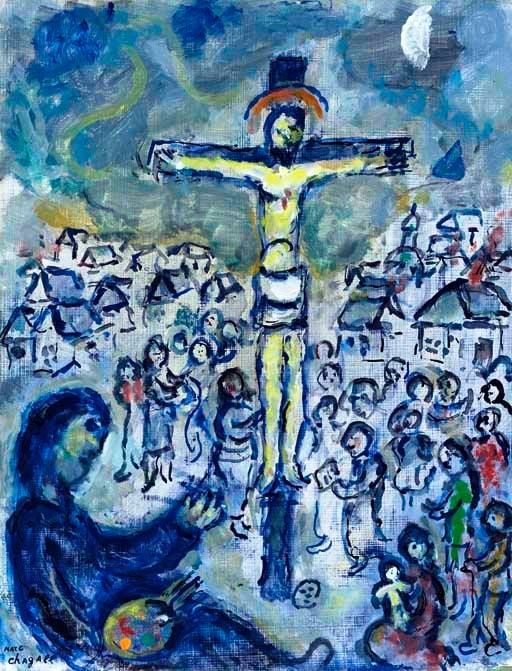
“The Painter and the Christ” by Marc Chagall, 1975

Today’s New Testament lesson is in the middle of an extended discussion by the author of Hebrews about the priesthood and sacrificial system. The Christian Jews were thinking about reneging on their commitment to Jesus and returning to their previous way of life in Judaism. 

So, central to the author’s exhortation is to demonstrate that Jesus is superior to everything in Judaism. Jesus is better than any Old Testament priest. Jesus is the once-for-all sacrifice for sins. Jesus is better because his priesthood is permanent, and his sacrifice is perfect.

In the ancient world, sacrifice was at the center of everyone’s belief system. Every pagan religion had some sort of sacrificial practice to satisfy the god(s) and ensure deliverance and/or prosperity. Jews, of course, had an elaborate sacrificial system of their own with detailed prescriptions of how to go about it.

We need to feel something of the original force of Christianity. It was a radical idea to have one sacrifice to end all sacrifices.

Everyone understood that sacrifices were temporary; you had to keep offering them over and over again. Christianity, however, asked the world to have a new understanding of sacrifice. No longer would there be any sacrifice – no grain sacrifice; no offerings of first-fruits; no animal sacrifices; no physical sacrifices whatsoever. 

In Christianity, Jesus as the once-for-all sacrifice to end all sacrifices was such a crazy notion for so many people that they mocked Christians for it. Both Jews and pagans could barely wrap their minds around such a progressive idea. It would be like saying to us today that there is no longer any need for money because some individual became the underwriter for everything everybody does.
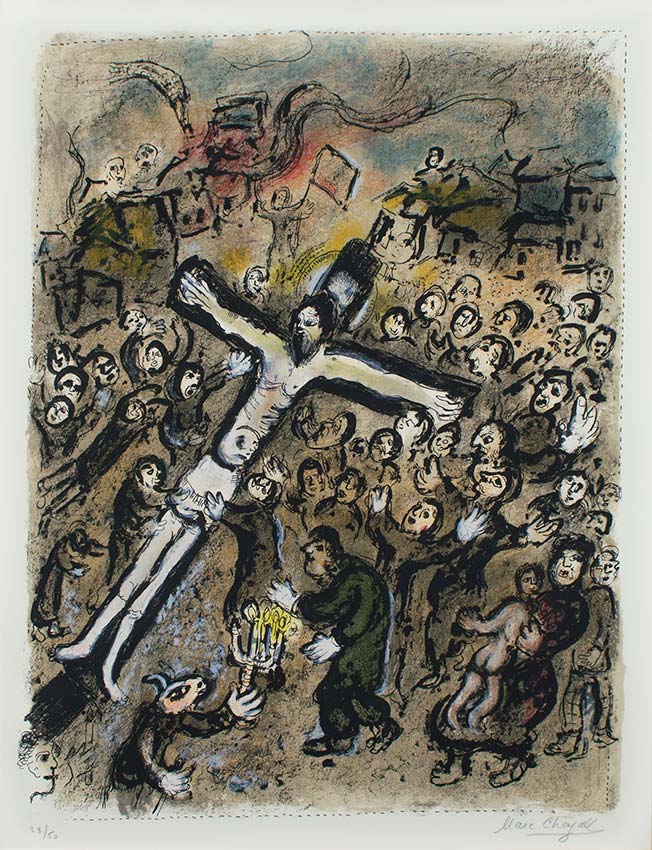
“The Martyr” by Marc Chagall, 1970

All the things the old sacrificial system did for worshipers are now completely fulfilled in the person of Jesus.  Condensed in just a few verses of Scripture, we have a very rich picture of Jesus:

  • Jesus is not a temporary priest, but a permanent priest, the one who is able to intercede continually on our behalf without us having to perform a ritual sacrifice.
  • Jesus lives forever, which enables him to never cease his intercessory work.
  • Jesus saves completely.
  • Jesus meets our need.
  • Jesus has been made perfect forever.

Yet, sometimes Christians go back to the old sacrificial system, not by physically offering animal sacrifices, but treating Christ’s once-for-all finished work as if it were just too good to be true. We reason that we need to do something to help save ourselves. Although Jesus has saved us fully, and therefore, there is no longer any need for sacrifice, yet we still try:

  • To appease God through church attendance or other works, as if the Lord needs to be soothed into not becoming angry at us.
  • To satisfy God through our giving so that the Lord will not have a furrowed brow against us.
  • To assuage our guilty conscience through Christian service, believing this will give us some leverage with God.

In all these kinds of instances, it is going back to an old sacrificial system that is obsolete.

The biblical and theological truth is that Jesus has thoroughly saved us from our sin, and, so, has cleansed us from all guilt, including a guilty conscience.

Jesus meets our need and has completely satisfied God’s wrath against sin. Jesus is our mediator and intercedes for us as we come to God’s throne of grace. That means we do not need to try and get God’s attention with some incredible sacrifice that will somehow obligate him to take notice. 

There is no longer ever a situation where we must run to some spiritual liquor store to pick up a Captain Morgan because the Captain of our souls, Jesus Christ, has already given us everything we need.

Since Jesus has been made perfect forever; is our great high priest; and is the once-for-all sacrifice to end all sacrifices, we have all the grace we need. 

We need not worry anymore about being good enough because Jesus is perfect. Christ’s work is made complete in us. The constant anxiety of feeling we don’t measure-up is not from God. The person and work of Jesus is sufficient to deliver us from guilt and shame.

“Well,” you might say, “if everybody believed that, then nobody would ever do anything.” No, it’s just the opposite. When we feel like we don’t measure up, we do less, not more. A low level discouragement sets in, and we do nothing because we intuitively know it will never be enough. We do just enough to squeak by, never quite knowing if it is doing anything. 
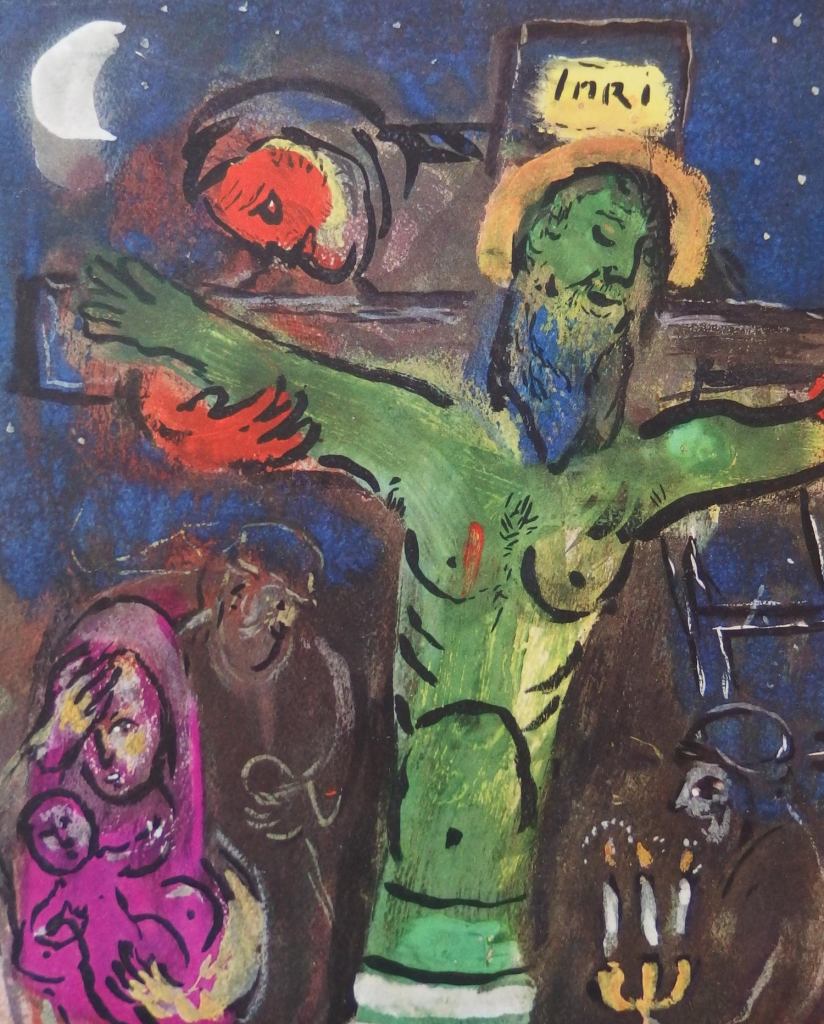
“Crucifixion” by Marc Chagall, 1961

Just like the Hebrew Christians of the first century, we consider giving up because Christianity doesn’t work for us. Yet, when we grasp Christ’s sacrifice to end all sacrifices, and are overwhelmed by grace, then everything we do in the Christian life is a simple desire to say “thank you” with our life and our lips. 

It is the grace, and not the wrath, of God that teaches us to say “no” to ungodliness and worldly passions and to live upright and godly lives (Titus 2:11-12).

The old system wasn’t bad. It served a purpose. Now, however, the old has given way to the new, and there is a better hope by which we draw near to God. The sacrificial system pointed forward to a perfect sacrifice by a permanent priest that would bring us to God forever.

Going back to the old system is like living permanently in a tent, and believing you are home.

Therefore, we must choose what is better. The options are not so much between what is bad and what is good, but between what is good and what is better than good. It is possible to do all kinds of good things and miss the better thing God is doing. 

So, how do we choose the better thing? How do we embrace the new, which is Christ, and not the old, which is the sacrificial system?

  1. Learn to say “no” to the treadmill going nowhere. Since we do not need to impress God, we have the freedom to say “no” to keeping up with the spiritual Jones’s; “no” to cajoling God’s favor, approval, or attention.
  2. Learn to say “yes” to engaging in spiritual practices which remind us of Christ. Say “yes” to the new way of the Spirit, which is by faith and not by sight. This present spiritual age is often intangible, ethereal, and unseen. It requires a new set of spiritual eyes to see.
  3. Let Christianity be about Jesus, and not about us. Resist the allure to rescue others, or have others rescue you. The work of rescue has already been done. Christ saves, we don’t.
  4. Know the better thing over the good thing. Pause before acting or re-acting. Are we expecting someone else to do what Christ has already done? Are we looking to do something we think will make God like us better? Remind yourself of Jesus and his redemption every day in small ways through Scripture reading and prayer, fellowship, and loving service.

Good people can love God, and yet, miss the opportunity to see they are already justified through Christ’s blood. We do not need to justify ourselves. We need to live into the justification we possess by grace through faith.

May it be so to the glory of God.

Mark 8:22-26 – A Ministry of Touch

“Healing” by Ivan Filichev

They [Jesus and his disciples] came to Bethsaida, and some people brought a blind man and begged Jesus to touch him. He took the blind man by the hand and led him outside the village. When he had spit on the man’s eyes and put his hands on him, Jesus asked, “Do you see anything?”

He looked up and said, “I see people; they look like trees walking around.”

Once more Jesus put his hands on the man’s eyes. Then his eyes were opened, his sight was restored, and he saw everything clearly. Jesus sent him home, saying, “Don’t even go into the village.” (New International Version)

Spirituality is, of course, a matter of the spirit. It is also a matter of the body. It may be lost on us that the way our spirituality is expressed is through our very real physical selves. A disembodied spirituality is really no spirituality, at all.

Christianity is profoundly physical. A core doctrine of the Church is the incarnation of Christ, God becoming man. Jesus has a real flesh and blood body. His physical body was the vehicle by which he did the will of God. Christ’s earthly ministry directed attention to people’s holistic needs – including the physical body.

So, perhaps it ought not surprise us when Jesus intentionally and literally touches people. From one person to another, Jesus was attentive to the power of compassionate and healing physical touch. For healing does not happen from afar; it is close enough to be personal, touching the spirit, the emotions, the mind, and the body.

In today’s Gospel lesson, some folks came to Jesus with a blind man in tow. They were evidently concerned and close enough to the man to beg Jesus to touch him. Yes, touch him. The small group of people were looking for a tangible reach from Jesus.

Just the other day, I visited a dear lady in the hospital for which I’m a Chaplain. As I began to speak with her, she reached out her hand, and I took it. I then realized that she was blind. This patient, in the dark because of her eyes, and in a strange unfamiliar place, needed more than a verbalized healing prayer from me. She needed a very real physical connection. The ability to compassionately touch another person has tremendous power.

“To touch is to give life.”

Michelangelo

Skin-to-skin contact is vital for our mental, emotional, spiritual, and physical health. Sensory deprivation is a real thing, and it’s a pervasive problem, especially during a pandemic.

We now know that whenever we feel unusual stress and pressure in our lives that the body releases the stress hormone cortisol. One of the biggest things actual physical touch can do is reduce the abnormal stress, allowing the immune system to work the way it should. What’s more, touch helps calm our heart rate and blood pressure, enabling us to have a more regulated way of life.

Jesus took the blind man by the hand and walked him outside the village. Let’s pause on that factoid for a moment. There was a man who literally walked with Jesus, hand-in-hand, for perhaps a few miles. I wonder what he experienced, just in that walk. What seems clear to me is that this event of walking was part of the man’s healing. He quite simply needed this bodily experience with Jesus.

I find it a bit humorous that some commentators struggle with the process of Christ’s healing the blind man, as if Jesus himself was struggling with trying to heal the guy. However, by taking the approach of an embodied spirituality, we can discern that this man required a great deal of touch from Jesus. The spitting, the putting the hands on the eyes, and then doing it again, was all deliberately tactile and just what the man needed for his healing of both body and soul.

Christ’s physical body was an instrument of grace. And our own bodies are meant to bless others with appropriate and compassionate touch. I realize this gets complicated with social distancing practices and concerns with health during a pandemic, yet we can still be agents of healing through simple acts of touch, including the following:

  1. Hug others. Hugs are healthy. I completely understand that some people aren’t huggers, and we ought to be guarded hugging others we don’t know very well. I usually ask before I hug someone outside of my family or church. Unfortunately, many people have had bad experiences being touched, and my heart goes out to them. Yet, the need for meaningful and positive touch still remains both for us and for others.
  2. Pet the dog. My wife’s little dog is a prima donna. He drives me nuts sometimes (maybe most of the time). Yet, because of his disposition, he is the perfect little gentleman when in a care facility or in public. He likes the attention. If you have a pet, let other folks pet them. I’m a busy guy, but when it comes to taking time for neighborhood kids to pet the dog while I’m walking him, I’m all in. It is a simple ministry that anyone can do.
  3. Hold hands or offer light touch. This can and perhaps should be a liberal activity within most families. It can also be done with others. It’s not weird to do this, even in some contexts with strangers. For example, when leading someone in the hospital to their appointed place, depending on the circumstance, I place a light hand on the back or shoulder. Hospitals aren’t exactly destination vacation spots, so folks can be nervous when in them. Simple ways of appropriate touch help calm the anxiety.
  4. Fist pumps and elbow bumps have replaced handshakes, and that’s a good thing. Fist and elbows just aren’t the same thing as a good old fashioned tight handshake, yet it is still an opportunity to touch. Some touch is better than no touch. Don’t give up on practicing ways to physically connect, even if those ways aren’t ideal.
  5. Use your eyes. There are just going to be some circumstances and places where you cannot offer an actual physical ministry of touch. So, use your eyes. Imagine in your mind offering a hug or a handshake to the person and intentionally focus that picture to your eyes. Since our physical eyes communicate a lot, the other person will pick it up.

Every day is an opportunity, for the believer, to walk with Jesus along our life’s journey. As we allow Christ to touch our lives, we, in turn, are able to touch others both spiritually and sometimes even physically through compassionate ministry.

May you know the grace of being touched by Jesus, and the blessing of touching others with the love of God.

Matthew 5:13-20 – Live as Salt and Light

“You are the salt of the earth. But if the salt loses its saltiness, how can it be made salty again? It is no longer good for anything, except to be thrown out and trampled underfoot.

“You are the light of the world. A town built on a hill cannot be hidden. Neither do people light a lamp and put it under a bowl. Instead, they put it on its stand, and it gives light to everyone in the house. In the same way, let your light shine before others, that they may see your good deeds and glorify your Father in heaven.

“Do not think that I have come to abolish the Law or the Prophets; I have not come to abolish them but to fulfill them. For truly I tell you, until heaven and earth disappear, not the smallest letter, not the least stroke of a pen, will by any means disappear from the Law until everything is accomplished. Therefore, anyone who sets aside one of the least of these commands and teaches others accordingly will be called least in the kingdom of heaven, but whoever practices and teaches these commands will be called great in the kingdom of heaven. For I tell you that unless your righteousness surpasses that of the Pharisees and the teachers of the law, you will certainly not enter the kingdom of heaven. (New International Version)

There is a world of people in our sphere of influence, who need to see that Christianity is real and that it works.

Jesus used a few metaphors to help his followers understand their role in society and their effect on the world.

Salt

Obviously, in the ancient world, there was no refrigeration. So, salt was used to preserve food, with the added result that it brought some flavor when the food was eaten. Christians are meant to be a preservative in the culture, helping to stave off worldly decay and rot.

Sometimes, believers in Jesus feel a compulsion to complain about eroding cultural mores, the sad state of public affairs, or the declining value of religion. However, Christians can play a positive role, rather than a negative stance, by being salt in the world.

Christianity is meant to be therapeutic and helpful, adding value to culture and society – and not an added burden to an already bad situation.

Jesus said if Christians lose their saltiness, and are no longer impacting society, they are useless to the culture. Nobody would miss them if they were thrown out into the garbage dump of the street to be trampled on and forgotten.

Christians were never meant to simply exist for themselves. They are on this earth to be the continuing presence of Christ in the world by means of God’s Spirit.

This is not an exhortation from Jesus to be salt, because he says we are salt. It is rather a matter of allowing the world to taste Christianity and find it compelling and flavorful. 

For example, instead of being worried or upset that a low income housing project is being built next to church property, leading to discussions of erecting a fence, a salty Christian response would be to imagine creating a sidewalk so that the neighborhood kids will wander over to the church’s grounds.

Saltiness is a fundamental way of thinking and acting which orients itself around the common good of everyone and the community needs surrounding where Christians live, work, and play.

To drive his point home even deeper, Jesus used a second metaphor to describe what Christianity’s relation to the world is to be like….

Light

In the ancient world, there were no artificial lights. At night, it was pitch black. In the dark, any light, even a small candle, makes a real difference.

An individual person may mistakenly believe their life does not make much of a difference. Yet, it does! One person exhibiting the characteristics of humility, gentleness, grace, and peacemaking is able to have significant penetration into the darkness.

Here are some ways the church has always brought light into the darkest times of history:

  • Taking-in and adopting unwanted children who would otherwise be victims of infanticide.
  • Ministering to the sick and dying during periods of plague and disease, while others fled.
  • Caring for prisoners who had no family to provide them with necessary food and clothing.
  • Giving benevolence and kindness to the poor – especially to immigrants, widows, and orphans.

Christianity is designed to take a proactive approach – and not just a passive policy of waiting for needy people to show up – by searching, identifying, and meeting the needs of people.

The reason religious people wondered about Jesus and his teaching is because Christ offered a different perspective than what they typically heard. 

Jesus was concerned to uphold basic Old Testament ethics by offering a distinct interpretation that the Law is fulfilled in himself. For example, the entire book of Leviticus (which reads something like a B-grade slasher film) is a detailed account of regulations concerning the sacrificial system – with the actual intent of all these laws to expose sinfulness, and the need for a once-for-all sacrifice that would take care of the sin issue altogether. The ceremonial law was not intended to be permanent, but to be fulfilled by the Messiah, Jesus.

Christ made it clear that all of Scripture is important; not the slightest detail is unimportant. True righteousness shows itself when Christians do the right things for the right reasons.

Christians are people of the Word. They are to learn Scripture, know it, and live it. One opportunity of doing this is based on an ancient way of reading the Bible called Lectio Divina (Latin for “spiritual reading”):

  1. Lectio (reading with a listening spirit)
  2. Meditatio (reflecting or meditating on what are hearing from God)
  3. Oratio (praying in response to what I hear from God)
  4. Contemplatio (contemplating what I will do to live out the text)

Through listening, reflecting, praying, and obeying, Christians allow Holy Scripture to spiritually shape and form them into the people of God – thus becoming salt and light in the world.

May you discover the light of God’s grace through being a person of the Word.

May you be salty, flavorful and preserving the world in which you live.

May you know and connect with Jesus.

May Christianity be seen, felt, and known as the contribution to this old world it was always meant to be. Amen.

James 3:1-12 – Taming the Tongue

Not many of you should become teachers, my fellow believers, because you know that we who teach will be judged more strictly. We all stumble in many ways. Anyone who is never at fault in what they say is perfect, able to keep their whole body in check.

When we put bits into the mouths of horses to make them obey us, we can turn the whole animal. Or take ships as an example. Although they are so large and are driven by strong winds, they are steered by a very small rudder wherever the pilot wants to go. Likewise, the tongue is a small part of the body, but it makes great boasts. Consider what a great forest is set on fire by a small spark. The tongue also is a fire, a world of evil among the parts of the body. It corrupts the whole body, sets the whole course of one’s life on fire, and is itself set on fire by hell.

All kinds of animals, birds, reptiles and sea creatures are being tamed and have been tamed by mankind, but no human being can tame the tongue. It is a restless evil, full of deadly poison.

With the tongue we praise our Lord and Father, and with it we curse human beings, who have been made in God’s likeness. Out of the same mouth come praise and cursing. My brothers and sisters, this should not be. Can both fresh water and saltwater flow from the same spring? My brothers and sisters, can a fig tree bear olives, or a grapevine bear figs? Neither can a salt spring produce fresh water. (New International Version)

Words and speech are the most powerful tools we have in the Christian life. And the tongue is the means of forming the words and using the speech God gives us.

The problem is, we may too often underestimate the importance and the great power of the tongue to effect both good and evil. We might not believe that our particular words carry much weight.

Yet, in reality, our words are very powerful.  In fact, what we say with our tongues is either the vehicle of praise to God, or the ruin of another person. We must measure our words because the tongue is a beast to control and tame. 

The tongue is so powerful that it determines the direction of a person’s life.

The horse is a strong animal, and the strength of a horse must be respected at all times. Yet, a small woman, even a young girl who knows what she is doing with a bridle and a bit, can make a horse do whatever she wants. Ships can be massive and carry thousands of people and huge amounts of cargo. Yet, it is controlled and directed by the rudder – a very small piece of the ship.  In our own day, we know the devastating power of a very small handgun trigger which can literally snuff out a life in an instant.

Likewise, the tongue is quite small among the parts of the body. Yet, it sets the course of a person’s life and has the power to determine its destiny.  A rider who does not know how to handle a horse is in trouble.  An undisciplined pilot of a ship is in danger of shipwreck.  A gun owner loose with gun safety is a danger to others. And the loose, unbridled, untrained and undisciplined tongue is on a one way course to destruction.

The tongue is so powerful that it can destroy another person.

Like fire, the tongue has an awesome potential for harm. The great Chicago fire of 1871, one of the costliest disasters of the nineteenth-century, killed three hundred people and destroyed seventeen-thousand buildings.  All the destruction was started by Mrs. O’Leary’s cow kicking over a lantern in a barn. 

The Yellowstone National Park fire of 1988 burned for several months and completely destroyed nearly 800,000 acres of the park.  At the peak of the fire there were 9,000 firefighters battling the blaze. All the devastation was caused by one quick flash of lightning.

The largest fire in American history occurred in 1871 and began in northern Wisconsin. The fire created its own wind system and turned into a tornado, moving into the Upper Peninsula of Michigan. By the time it was over, 3.7 million acres were scorched with 2,500 people left dead. All the destruction was likely caused by a small meteorite.

Whenever we underestimate the power of our speech and allow a stray word to fly off the tongue, the spark has the potential to start a huge conflagration of evil. A firestorm of destruction can be set off with just a few uncontrolled words. 

Through gossip (saying something behind somebody’s back that you would not say to their face), flattery (saying something to someone’s face that you would not say behind their back), negative criticism, sarcastic humor, boasting, and a host of evil words, the tongue has the immense power to destroy life.  It is speech fueled and spread by Hell itself.

The tongue is so powerful that it cannot be tamed.

Animals can be tamed, even crocodiles.  I once took my oldest daughter to the circus, when she was a small girl, and watched as a guy had a trained crocodile open its mouth and stuck his head inside the crazy reptile! 

Yet, no one can tame the tongue. It is like a tarantula, biting its victim with paralyzing venom so that the arachnid can eat its prey alive. The untamed and uncontrolled tongue is like a poisonous spider which spreads its verbal venom, paralyzing other people and sucking the life out of them.

The Apostle James paints a hopeless picture because he wants to drive us to the grace of God for help. We cannot tame the tongue – but God can. When we begin to see the true nature of our speech, it reveals something of ourselves.

The tongue is so powerful that it exposes the duplicity of the heart.

Whatever comes out of our mouths reveals what is on the inside of our lives. If we can grasp the truth of this, I believe it could transform the way people talk to one another. Even more metaphors to communicate the point….

Salt water and fresh water cannot both come from the same spring. A fig tree cannot bear olives, and a grapevine is not going to produce figs. And whatever comes out of the mouth reveals the source. Evil words come from an evil source; good words come from a good source. 

A pattern of negative condescending speech is drawing from a well, pumping up words from the depths of Hell. Conversely, a continuous stream of helpful words that encourage and build up others, draws its nourishment from God’s Word.

Conclusion

The following are four ways to help bring the tongue under control:

  • Train your tongue for good. Speech is a skill to be developed. When starting an exercise regimen, we are deliberately training our bodies for health. When dieting, we are saying “yes” to certain foods, and “no” to others. The tongue needs to be trained to express gratitude, good news, and grace. And one of the best ways to do it is through speaking Scripture out loud in a daily regular regimen. Consider going on a fast from talking and seek only to be silent and listen for a specified amount of time.

Do not waste time arguing over godless ideas and old wives’ tales. Instead, train yourself to be godly. “Physical training is good, but training for godliness is much better, promising benefits in this life and in the life to come.” (1 Timothy 4:7-8, NLT)

Solid food is for the mature, for those whose faculties have been trained by practice to distinguish good from evil. (Hebrews 5:14, NRSV)

  • Read a chapter of Proverbs each day for a month. There are thirty one chapters in Proverbs, one for each day of the month. Pay attention to the power of words. Notice the difference between the speech of a wise person and the words of a fool – and take to heart the consequences of both approaches. 

You will say the wrong thing
    if you talk too much—
    so be sensible and watch
    what you say. (Proverbs 10:19, CEV)

Careless words stab like a sword,
    but wise words bring healing. (Proverbs 12:18, NCV)

  • Build friendships with people who are positive and encouraging. If a negative person keeps being negative, even after you have warned them more than once about it, you likely need a new relationship. 

Warn a quarrelsome person once or twice, but then be done with him. It’s obvious that such a person is out of line, rebellious against God. By persisting in divisiveness, he cuts himself off.  (Titus 3:10-11, MSG)

  • Listen and learn before speaking. A judgmental spirit often comes from misinterpreting another person’s words and/or actions. We can too often jump to conclusions about something or someone with only partial information and without the whole story.

Love never gives up.
Love cares more for others than for self.
Love doesn’t want what it doesn’t have.
Love doesn’t strut,
Doesn’t have a swelled head,
Doesn’t force itself on others,
Isn’t always “me first,”
Doesn’t fly off the handle,
Doesn’t keep score of the sins of others,
Doesn’t revel when others grovel,
Takes pleasure in the flowering of truth,
Puts up with anything,
Trusts God always,
Always looks for the best,
Never looks back,
But keeps going to the end. (1 Corinthians 13:4-7, MSG)

Right and Just God, teach us to speak wisely. Let us avoid useless thoughts and useless conversations. Help us to speak often of you. Grant that our words may never hurt others but always bring comfort to those in sorrow, and guidance to those in need. Take our tongues and make them yours. Take our minds and make them instruments of your goodness and a channel of truth. May you help us to use both words and silence in redemptive ways, through Jesus Christ our Redeemer. Amen.