Directives For the Married and Divorced (1 Corinthians 7:10-16)

To the married I give this command—not I but the Lord—that the wife should not separate from her husband (but if she does separate, let her remain unmarried or else be reconciled to her husband) and that the husband should not divorce his wife.

To the rest I say—I and not the Lord—that if any brother has a wife who is an unbeliever and she consents to live with him, he should not divorce her. And if any woman has a husband who is an unbeliever and he consents to live with her, she should not divorce the husband. 

For the unbelieving husband is made holy through his wife, and the unbelieving wife is made holy through the brother. Otherwise, your children would be unclean, but as it is, they are holy. But if the unbelieving partner separates, let it be so; in such a case the brother or sister is not bound. It is to peace that God has called us. Wife, for all you know, you might save your husband. Husband, for all you know, you might save your wife. (New Revised Standard Version)

Having specifically addressed questions about sex; and having directly talked to the Christians in Corinth who were single; the Apostle Paul then turned to the married persons in the church. He gave directions about their concerns of divorce and how to handle a spouse who does not share the believing spouse’s Christian beliefs.

Divorce

Divorce is one of those things that no one plans on happening when they are married; and yet, it happens. The Apostle was realistic about the situation. He upheld the sanctity of marriage, while recognizing that the ideal of two people remaining together and blessing one another doesn’t always happen.

I find it interesting, as well as gracious and understanding, that Paul neither condemns nor denounces the divorced person. He assumes that both spouses have responsibility, and both can take initiative as partners in a marriage.

A Christian married to an unbelieving partner, according to Paul, ought to remain married. As long as the non-believing spouse is willing to remain in such a marriage, then it should continue.

The Apostle’s rationale is that peace, not divorce, needs to be the controlling characteristic of both the marriage and of the Christian life.

“Mixed” Marriage

Furthermore, Paul believed that Christians are not defiled by pagan spouses. This is important when it comes to the children of a Christian and non-Christian marriage. The relationship is sanctified by the presence of both the believing spouse and the Holy Spirit.

In addition, the Apostle saw that the Christian spouse is in a special position for God to work through them to the unbelieving spouse. On this point, Paul is sanguine and optimistic. Instead of worrying about impurity for the Christian, he foresaw an opportunity for purity in the non-Christian.

The Apostle Paul’s realism reminds us that if we are looking for ultimate satisfaction through marriage (or singleness and celibacy) it will never be found.

That’s because, as Christians, contentment and peace comes through giving our lives to serve the Lord Jesus in love. To love another, and offer the gift of self-sacrificial service to them, is the ultimate path to the way of Christ.

In losing our lives, we find them; in being last, we are promoted to first.

Marriage is beautiful. Divorce is ugly. Sometimes, despite a believer’s greatest efforts at being peaceful and loving, a divorce occurs. It takes two to have a marriage. There are times when the believing person must let their spouse go, that is, if that spouse wants to go.

Although divorce can be ugly and sad, full of broken dreams, and littered with missed expectations, it doesn’t need to stay that way. The divorced person, becoming single, now has the opportunity to bring something beautiful out of the brokenness.

Kintsugi

“Kintsugi” is a Japanese term for the art of repairing broken objects. The word literally means to “join with gold.” This art form uses a particular lacquer to reattach broken pieces. Then the newly attached joints are decorated with gold (or silver) powder.

The working idea behind the art of kintsugi is to embrace the flaws and the imperfections. By doing so, the artist can create a beautiful piece of art, stronger than the original.

Applying this to relationships, people no longer have to simply live with the shame of a broken marriage. We can assign value to people who are divorced, and stop trying to hide the relational damage. Through intentional efforts on healing, the scars left behind can truly become a source of beauty – instead of permanent ugliness.

Ikigai

Another Japanese concept which can be relevant for us is “ikigai.” It refers to having a reason for living, a sense of purpose and meaning to life. The idea behind ikigai is to help people find what is truly important to them, and then to live a life full of joy and purpose. Notice the concept is based on that which is internal – fulfillment, satisfaction, joy, and meaning – instead of external factors such as money, fame, power, or position.

Jesus joyfully lived his life on this earth to serve others. He came not to be served, but to serve, and to give his life as a ransom for many (Mark 10:45). If marriage was the ideal for everyone in this world, I’m quite sure Jesus would have modeled that for us by getting married. But he didn’t.

Neither marriage, nor singleness, is what really counts. Faith, expressing itself through love, is what actually counts. (Galatians 5:6)

And when Jesus was broken, the result became the salvation of the world. By his wounds, we are healed. (Isaiah 53:5)

All of this demonstrates for us where and what we are to assign meaning. And just because things don’t work out like we want, and leaves us in a state of brokenness, our lives can be transformed into a beauty beyond what we could have imagined.

This is the strength and ability of Christianity. Methinks we ought to let it have its way in our lives.

Almighty and everlasting God, the One who makes us whole in our brokenness, calls us to deeper faith, and delivers us from all things that hinder our devotion to you: Hear our prayer, Lord, and break open all we hold back from you, so that we may see a vision of your helping and healing presence in our lives and in our world, through Jesus Christ, in the power of the Holy Spirit. Amen.


Watch Out For the Millstones (Mark 9:38-50)

John said to him, “Teacher, we saw someone casting out demons in your name, and we tried to stop him because he was not following us.” But Jesus said, “Do not stop him, for no one who does a deed of power in my name will be able soon afterward to speak evil of me. Whoever is not against us is for us. For truly I tell you, whoever gives you a cup of water to drink because you bear the name of Christ will by no means lose the reward.

“If any of you cause one of these little ones who believe in me to sin, it would be better for you if a great millstone were hung around your neck and you were thrown into the sea. If your hand causes you to sin, cut it off; it is better for you to enter life maimed than to have two hands and to go to hell, to the unquenchable fire. And if your foot causes you to sin, cut it off; it is better for you to enter life lame than to have two feet and to be thrown into hell.And if your eye causes you to sin, tear it out; it is better for you to enter the kingdom of God with one eye than to have two eyes and to be thrown into hell,where their worm never dies and the fire is never quenched.

“For everyone will be salted with fire. Salt is good, but if salt has lost its saltiness, how can you season it? Have salt in yourselves, and be at peace with one another.” (New Revised Standard Version)

Weird encounters and exorcisms, hard words and sayings, and enough metaphors to creep out the visual learners among us, were all regular staples of Christ’s earthly ministry.

For me, this makes sense. Christ coming into a world of great need, filled with all sorts of disturbances and disturbing people, will create spiritual headlines. The ministry of Jesus does not involve idyllic pictures of beautiful butterflies, and bunnies without bowel movements.

The world needs real saving, which is why Jesus showed up in an incarnational invasion that nobody saw coming.

Christian discipleship is not for the faint of heart. It demands an embrace of robust moral teaching, along with a cross to carry.

Following Jesus involves lots of servitude, and only a little bit of leadership. It requires radical humility to do anything.

Furthermore, Jesus was anything but a narrow-minded exclusivist. He encouraged his disciples to have broad and open-minded attitudes and approachs toward those who do good and provide help, outside of the disciple circle.

Whether following Jesus, or not, Christ commended, and did not condemn, those who squish evil like a grape, and offer cold water to others on a hot day. Why? Doesn’t this seem antithetical to the demands of discipleship within the disciple group?

Maybe. Maybe not. Frankly, it seems paradoxical (two things that seem contradictory but nevertheless are equally true). On one hand, only the disciples bear the name of Christ; but on the other hand, everyone who does justice and mercy has Christ’s name invisibly emblazoned on their heads.

Anybody who remotely conforms to the character of Christ, upholding basic morality and human kindness, receives a divine thumbs up from Jesus.

And conversely, anyone who acts the bully and trips up a little one who believes – whether they have a label of disciple or not – are in for a world of divine retribution.

It all hinges on how scandalous we can be; or rather, what sort of scandal we stir up with our lives.

The good kind of scandal is going against the grain of injustice and doing good when no one else much cares; and the unjust ones need a big obstacle of righteousness in their way.

The bad sort of scandal is putting a stumbling block between God and those trying to come to the Lord. It’s the wicked who need to be tripped up and set straight, and not the faithful who need to run an obstacle course just to get a peek at the good life as defined by God.

Just so you know, millstones were usually the heaviest objects in a village – weighing up to a ton (2,000 lbs.) or more. We can perhaps understand Jesus talking of perpetrators getting a millstone necklace; but it’s a real tragedy whenever someone puts one on for themself.

You’re harming yourself if the choice is to be irresponsible, hateful, unloving, or unjust. I’m not talking about the inevitable mistake, white lie, or unconscious bias. I’m talking about a deliberate choice to get in another’s way of happiness; tear someone down with verbal violence; or harm a person by any means you can do it.

All of us have a responsibility to protect and promote the common good of all persons, and the social good of the community.

Nobody is helped whenever a person comes down hard with judgmental criticism on a coworker who was just trying to do their best but failed. Everyone loses whenever a relative spreads gossip throughout the family system.

And no one is built up whenever a neighborhood association leader or condo board chair creates unnecessary roadblocks to community well-being, but then railroads a pet personal project through for their own advantage.

Feet end up walking in dangerous places. Hands reach where they shouldn’t. Eyes look with a sinful gaze. There are times when it is warranted to amputate a limb in order to save the whole body; to perform a surgery in an effort to save a life; and to remove an eye before it creates serious sickness.

But I am talking metaphorically and spiritually – which is no less real than the physical and tangible. Gangrene happens not only to the flesh and blood body; it also happens to the diseased soul.

When it happens, the only the way to deal with it is by getting rid of gangrenous part. Otherwise, death is around the corner, as well as the coroner. Both body and soul suffer. And it will do no good to feign healthiness and pretend as if everything is “just fine.”

Some salt, therefore, is good. It acts as a preservative against expiration; and promotes the good taste of obedience and fidelity to God.

All your grain offerings you shall season with salt; you shall not omit from your grain offerings the salt of the covenant with your God; with all your offerings you shall offer salt. (Leviticus 2:13, NIV)

Let’s consider hard whether we want to be lame Christians who offer nothing but a tepid discipleship and spirituality to the church and world; or whether we will spiritually support one another by building bridges to provide needed supply lines, instead of walls to keep out the people we don’t like.

You already know what Jesus wants, and what Christ advocated and agitated for. So, let’s avoid a future with millstones in it.

Almighty God of redemption and mercy: Help us to be at peace with one another: not clambering for positions; not being fearful of those who we do not know in the kingdom, but honoring, loving, and serving them. Enable us to increase peace among ourselves by being aware of sin and its effects, and choosing to deal with it. May we be seasoned with salt as we live for the cause of Christ in a world of conflict. Amen.

Spiritual Sight and Power (Acts 3:1-10)

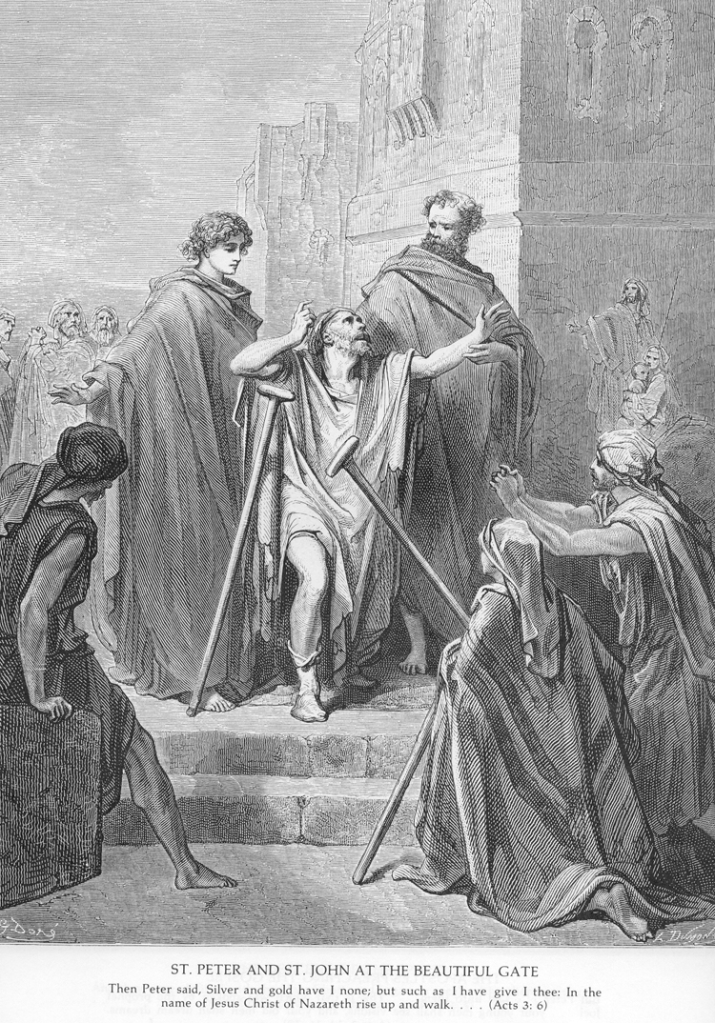
Peter and John heal the crippled man, by Gustave Doré (1832-1883)

Peter and John were going to the temple courtyard for the three o’clock prayer. At the same time, a man who had been lame from birth was being carried by some men. Every day these men would put the lame man at a gate in the temple courtyard. The gate was called Beautiful Gate. There he would beg for handouts from people going into the courtyard. When the man saw that Peter and John were about to go into the courtyard, he asked them for a handout.

Peter and John stared at him. “Look at us!” Peter said. So the man watched them closely. He expected to receive something from them. However, Peter said to him, “I don’t have any money, but I’ll give you what I do have. Through the power of Jesus Christ from Nazareth, walk!” Peter took hold of the man’s right hand and began to help him up. Immediately, the man’s feet and ankles became strong. Springing to his feet, he stood up and started to walk. He went with Peter and John into the temple courtyard. The man was walking, jumping, and praising God.

All the people saw him walking and praising God. They knew that he was the man who used to sit and beg at the temple’s Beautiful Gate. The people were amazed and stunned to see what had happened to him. (God’s Word Translation)

Peter and John at the gate of the temple, by Rembrandt

Money isn’t everything; and neither is having a lot of talent or giftedness. Yet, we often live our lives as if we cannot do much because of our lack of personal abilities and financial resources. But we can. All we need to do is give something that we all have to give.

Peter and John were disciples of Jesus. Though Jesus has ascended to heaven and the gift of the Spirit has come, they still maintained a daily rhythm of prayer three times a day at the temple.

As the two of them were about to attend afternoon prayer, they encountered a man at the gate. We are told that this particular guy was crippled. He came every day to the temple in order to beg. What is interesting to me is that this surely was not the first time Peter and John encountered the guy who begged at the gate.

Did they just ignore him? Was he one of many? Whatever the reason, they never put their eyes to him before. But on this occasion they did. In fact, they fixed their gaze on him and really took the time to stop and look at him.

I remember when my late brother-in-law had a complete turn around of his life to Jesus. At the time, he walked to work every day in the city. And every day there was a beggar on the corner. Most every day he had ignored him. One day he even spit on him.

The day after his great awakening to the Lord, he was walking to work and saw the beggar. But this time he really saw him. And when he looked into the man’s eyes, he had pity upon him. My brother-in-law – who took his lunch with him each day – surrendered it to the beggar. Eventually, he began a practice of bringing enough food for two, sitting down with the man, and talking with him as they ate together.

Perhaps for the first time, these disciples of Jesus, Peter and John, see the man who was there every day at the temple. They have not a thing with them. No money. No lunch. But they had something better: the power of grace and love.

In our contemporary Western society, we prefer things to be efficient and simple. Giving money, preferably online and dispassionately, is ideal for us. This way, we can give without any strings attached while feeling good about ourselves.

Yet, my brother-in-law and Peter and John decided to give the gift of connection. And that meeting of the eyes was the conduit for spiritual power to flow from one person to another. Doing what they saw Jesus do, the disciples gave the man who could not walk his legs back.

As a result, the guy was no longer lame nor a beggar. He became a fellow witness of God’s mercy and power. He went right up into the temple with Peter and John – walking and jumping and praising God.

It is not really money that gets things done. And it’s not our ingenuity or intelligence that really makes things happens. Throughout the book of Acts, demonstrations of God’s mighty power in the name of Jesus Christ is paramount. And those with alternative sources of power are shown to be powerless when it comes to life transformation.

In all of human history, including today, people like power; and power attracts wealth, as well as wealth attracting power. But the power of Christ’s resurrection is completely disconnected from worldly wealth. And it is never used for personal gain or popularity. And what’s more, this sort of power is available to every Christian – and not just a special class of super-Christians or clergy persons.

If we trace apostolic work in the New Testament, we shall find that the people with such spiritual power received it not because of extraordinary faith or exceptional virtue; instead, the Spirit grants us the ability to make a difference in this world by granting us the gift of sight – to truly see another as the precious image bearer of God that they are.

There are people right in front of us every day that we might not see. If we are wondering how to tap into the spiritual power of resurrection, we have no further to look than observing and gazing upon the folks within our eyesight, so that we can see them in new and redemptive ways.

Holy Lord, you gave us something more powerful and more valuable than riches; you have given us healing and hope. Please bring that healing and hope into our world and show us evidence of your presence in our lives. Amen.

Maundy Thursday (John 13:1-17, 31b-35)

Jesus Washing the Disciples’ Feet, by Leszck Forczek (1946-2019)

Now before the festival of the Passover, Jesus knew that his hour had come to depart from this world and go to the Father. Having loved his own who were in the world, he loved them to the end. The devil had already decided that Judas son of Simon Iscariot would betray Jesus. And during supper Jesus, knowing that the Father had given all things into his hands and that he had come from God and was going to God, got up from supper, took off his outer robe, and tied a towel around himself. 

Then he poured water into a basin and began to wash the disciples’ feet and to wipe them with the towel that was tied around him. He came to Simon Peter, who said to him, “Lord, are you going to wash my feet?” Jesus answered, “You do not know now what I am doing, but later you will understand.” Peter said to him, “You will never wash my feet.”

Jesus answered, “Unless I wash you, you have no share with me.” Simon Peter said to him, “Lord, not my feet only but also my hands and my head!” Jesus said to him, “One who has bathed does not need to wash, except for the feet, but is entirely clean. And you are clean, though not all of you.” For he knew who was to betray him; for this reason he said, “Not all of you are clean.”

After he had washed their feet, had put on his robe, and had reclined again, he said to them, “Do you know what I have done to you? You call me Teacher and Lord, and you are right, for that is what I am. So if I, your Lord and Teacher, have washed your feet, you also ought to wash one another’s feet. For I have set you an example, that you also should do as I have done to you. Very truly, I tell you, slaves are not greater than their master, nor are messengers greater than the one who sent them.If you know these things, you are blessed if you do them….

“Now the Son of Man has been glorified, and God has been glorified in him. If God has been glorified in him, God will also glorify him in himself and will glorify him at once. Little children, I am with you only a little longer. You will look for me, and as I said to the Jews so now I say to you, ‘Where I am going, you cannot come.’I give you a new commandment, that you love one another. Just as I have loved you, you also should love one another. By this everyone will know that you are my disciples, if you have love for one another.” (New Revised Standard Version)

Today is Maundy Thursday. It is a time in Holy Week to reflect upon the great love of Christ for humanity, as well as much of humanity’s great resistance to that divine love.

The word “Maundy” is the Latin word for “commandment.” It’s a reference to Christ’s mandate for his followers to love one another. And Jesus gave his disciples an example of this love in a way they would never forget.

The jaw-dropping illustration of love for each other is preceded by setting the stage. It is the Last Supper, the final meal of Jesus with the disciples. Christ’s imminent crucifixion is very much tied to the Jewish Passover. Just as the festival is about to happen, dominating the spiritual landscape of Jerusalem, so the cross of Christ looms heavy in the Upper Room. The hour is nearly upon them.

Washing of the Feet, by John August Swanson, 2000

And only Jesus seems to know the brevity of the moment. He knows that Judas is about to betray him. Events that were prophesied centuries earlier are about to be set in motion. Every word and action of Jesus at this Supper is formed and informed by what is about to take place in the next few days.

We are meant to understand, as observers to this Upper Room meal, that Jesus not only knows what is happening, but that he also has control over the unfolding events. Satan may believe that he knows what’s going on and can influence Judas for diabolical purposes; but Jesus is really the One in charge. Even the workings of the devil are used for the divine agenda. Every event – whether meant for good or for ill – shall be bent toward the will of God.

The example, the capstone of all Christ’s teaching, is now divulged and acted out. The disciples themselves are participants in the drama; and they are aghast at what Jesus is doing. Christ proceeds to divest himself, humble himself, and serve them all by washing their feet.

Jesus intends his actions to be followed. Whereas the disciples likely believed that, over the past three years, they were being groomed for ruling in God’s new government, Christ was informing them that they will be servants in that new rule and reign of God. Yes, they will be leaders; but it will be a servant-leadership that uses its authority to love others.

Not everyone was immediately on board with this type of leadership and service. That’s because there were those who found it extremely hard to accept such a love as this.

Peter had serious difficulties with this foot washing thing. Maybe Peter thought that the roles should be reversed; he should be serving Jesus, and not the other way around. It could be that Peter was simply clueless or confused. Or perhaps he believed this action to be socially inappropriate and foolish. Yet, no matter what was going through Peter’s mind, he blatantly resisted the love of Christ.

Jesus would have none of this resistance to his loving service. Sharing in Jesus involves being served by him, even in so lowly and intimate a form as foot washing. Bottom line: the disciples of Jesus must be washed by him.

Peter (bless his extrovert mouth and heart) totally changes from rejection to the foot washing, to wanting a complete bath. Even in this, however, Jesus brings the zealot spirit down a few notches. He brought Peter to where he needs to be, and not where Peter wants to be.

Jesus Washing the Feet of His Disciple by Japanese artist Sadao Watanabe (1913-1996)

The whole washing of feet is an act of love and service that Jesus performed for them. Judas is there, too, getting his feet washed, as well. The example Jesus set was not simply one of service to an elite group of believers. The love of disciples for one another includes even those people we might prefer to forget.

Slaves were the ones who performed the service of washing feet whenever guests arrived at the master’s house. For the Christian, since our own Master initiated this practice, we ought also to love one another through meeting even the most mundane and stinky of needs. After all, we are not above our Master.

Yet, Christ considers us friends, and not necessarily as slaves, and even grants us an inheritance with him. Meeting needs requires the utilization of love.

It seems that Peter wanted to make the symbolic practice of washing feet something it was not meant to be. He asked for a lavish display of cleanliness for his entire body. Perhaps Peter thought that if you’re going to make a mark and a statement, then really go all out and do it!

For sure, Peter didn’t really know what he was saying. Jesus told Peter as much. But later, Jesus assured Peter, and all the disciples, that they indeed would, in time, understand all that he was opening up for them.

Of utmost value to Jesus was to have his disciples be driven by what drives he himself: love. Being a Christ follower is only secondarily about what one knows, and primarily about how one loves.

Christians have been profoundly loved by God through Jesus Christ. And what we do with that received love is of great importance to Jesus. As the Apostle Paul would say later to a young Corinthian Church, “Knowledge puffs up, but love builds up.” (1 Corinthians 8:1)

On this Maundy Thursday, it is more than appropriate to contemplate the incredible love shown to the original disciples, and toward us, all these centuries later. Let this contemplation compel us to put a great deal of thought and conversation into the best ways of loving the people in front of us with actions that have real meaning for them.

O God of love,
giver of concord,
through your only Son
you have given us a new commandment
that we should love one another
even as you have loved us,
the unworthy and the wandering,
and gave your beloved Son for our life and salvation.
Lord, in our time of life on earth
give us a mind forgetful of past ill-will,
a pure conscience and sincere thoughts,
and hearts to love one another;
for the sake of your Son, Jesus Christ our Lord.
Amen. – A Prayer of St. Cyril of Alexandria, 5th century